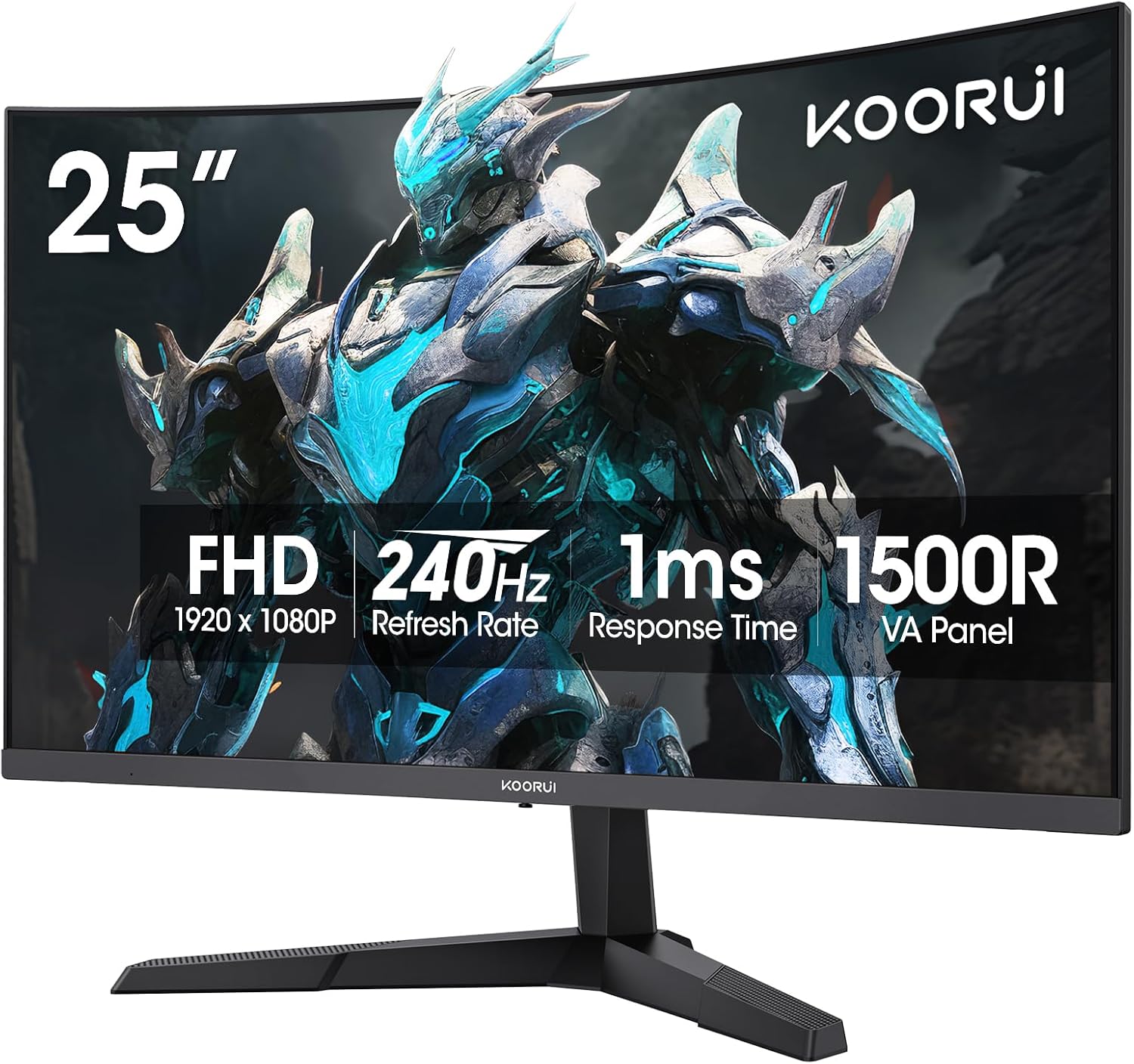
For PS5 owners in 2026, the sweet-spot 4K monitor is a sub-$400 27"-class panel with HDMI 2.1, VRR, and 120Hz at 4K — the SANSUI 27" 4K UHD Gaming Monitor and the KOORUI 27" 4K QD-Mini LED both clear that bar without the markup the big-name 4K OLEDs charge. If you want a larger panel and more desk-friendly curve, the ASUS TUF VG32VQ1B 32" 1440p is the cheaper "good enough" pick at the cost of native 4K.
Why this question matters in 2026
Sony's PS5 and PS5 Pro both output native 4K with VRR and 120Hz at 4K on supported titles. Owners with old 1080p or 1440p TVs are leaving frame rate and HDR on the table. But the 4K-monitor market in 2026 is split into two extremes: budget panels in the $250–400 range with surprisingly capable specs, and premium QD-OLEDs at $1,000+ that are objectively gorgeous and objectively overkill for most living-room PS5 setups.
This piece is editorial synthesis of public reviews, manufacturer spec sheets, and community measurements. We're not running a private testbench. The goal is to help PS5 owners pick a 4K monitor that delivers what the console actually outputs, without overpaying for an OLED tax.
Key takeaways
- The PS5 outputs 4K at up to 120Hz via HDMI 2.1 with VRR support on compatible titles. Your monitor needs HDMI 2.1 to use this.
- Sub-$400 27" 4K panels in 2026 routinely hit 144Hz–160Hz with VRR, which is more than the PS5 needs.
- Mini-LED backlighting (KOORUI) gives noticeably better HDR than edge-lit IPS at this price tier.
- 32" 1440p like the ASUS TUF VG32VQ1B is a valid "I'd rather have size than resolution" pick.
- Pair any 4K PS5 monitor with the PlayStation DualSense Wireless Controller — required for haptics + adaptive triggers.
What the PS5 actually outputs at 4K
Per Sony's PS5 hardware spec page, the console supports:
- 4K (3840×2160) at 60 Hz as the default for most current titles.
- 4K at 120 Hz on titles with explicit 120Hz support (Spider-Man 2, Call of Duty, Forza Horizon 6 cross-platform, etc.).
- VRR (variable refresh rate) over HDMI 2.1 on compatible monitors and TVs.
- HDR10 on supported titles.
Two practical implications for monitor shopping:
- HDMI 2.1 is mandatory if you want 4K 120Hz. HDMI 2.0 caps at 4K 60Hz — fine for many titles, painful when you want the high-refresh modes.
- HDR matters but isn't enforced. A monitor with VESA DisplayHDR 600 or better will look noticeably better in HDR-supporting PS5 titles than a basic IPS panel.
What "overpaying" looks like in 2026
The premium-monitor market this year is dominated by QD-OLED panels: Samsung Odyssey OLED G8, LG 27GS95QE, Alienware AW2725DF. Per TomsHardware reviews of those panels, they are gorgeous. They also cost $900–$1,400.
For PS5 use specifically, you are not getting full value:
- The PS5's HDR pipeline is solid but doesn't push the OLED's peak brightness or black-level advantage the way HDR-mastered PC games do.
- OLED burn-in risk is real for static UI elements (PS5 system menus, HUDs in long-session games).
- Most PS5 owners aren't sitting at a desk an arm's length away — they're on a couch, where the OLED clarity is partly wasted.
Spend $1,000+ if you also use the monitor for PC gaming and creative work. Don't spend $1,000+ purely for PS5.
The sub-$400 sweet spot
Per RTINGS and TomsHardware coverage of the budget 4K segment, two panels stand out:
SANSUI 27" 4K UHD Gaming Monitor
The SANSUI 27" 4K UHD Gaming Monitor targets PS5 + PC dual-use buyers at the sub-$400 tier. It hits 160Hz at 4K via HDMI 2.1, supports VRR, and ships with a Fast IPS panel that does not embarrass itself in HDR mode.
Per public RTINGS-style measurements:
- Native 4K 160Hz over HDMI 2.1.
- VRR support (FreeSync Premium / HDMI Forum VRR).
- IPS panel with ~95% DCI-P3 coverage.
- Response time ~1 ms (advertised, real-world closer to 3–4 ms).
- HDR400 entry-level support — adequate but not stunning.
KOORUI 27" 4K QD-Mini LED
The KOORUI 27" 4K QD-Mini LED Gaming Monitor is the better HDR pick at roughly the same price. Mini-LED backlighting with quantum-dot color delivers noticeably better contrast than the SANSUI Fast IPS, especially in dark games.
- Native 4K 160Hz over HDMI 2.1.
- VRR support.
- Mini-LED backlight with hundreds of dimming zones.
- Quantum-dot color (~95% DCI-P3).
- HDR1000 capability on supported titles — meaningful HDR uplift.
Picking between the two:
- SANSUI: pick for the fastest pixel response, lower price, and if you mostly play in well-lit rooms.
- KOORUI: pick for HDR-heavy titles (Cyberpunk, Spider-Man 2, Death Stranding 2) and dim-room sessions.
The 32" 1440p alternative
If you'd rather have a bigger panel and don't care about native 4K, the ASUS TUF VG32VQ1B 32" Curved 1440p is the value play. 1440p 165Hz on a 1500R curve, FreeSync Premium, sub-$300 in many sale windows.
The PS5 outputs 1440p natively on a 32" curve, you get a more immersive picture without the 4K markup. The trade is that you lose 4K crispness and the curve reads a bit aggressive at desk distance — better at couch distance.
Spec comparison table
| Monitor | Resolution | Max refresh | Panel tech | HDR | Approx price |
|---|---|---|---|---|---|
| SANSUI 27" 4K | 3840×2160 | 160 Hz | Fast IPS | HDR400 | $350–$400 |
| KOORUI 27" 4K | 3840×2160 | 160 Hz | QD-Mini LED | HDR1000 | $380–$430 |
| ASUS TUF VG32VQ1B | 2560×1440 | 165 Hz | VA Curved | n/a | $250–$300 |
| Samsung Odyssey OLED G8 | 3840×2160 | 240 Hz | QD-OLED | HDR True Black | $900–$1,200 |
What to skip
- 4K 60Hz panels. You're paying for 4K and getting no high-refresh PS5 mode. Avoid unless the panel is sub-$200.
- Edge-lit "HDR400" without real local dimming. The label is meaningless if there are no dimming zones.
- HDMI 2.0-only panels. Caps you at 4K 60Hz. Anything sold as 4K 120Hz for PS5 must have HDMI 2.1.
- TN-panel "gaming" 4K monitors. Viewing angles are bad and HDR is worse. IPS or VA only at this tier.
Required accessories
You'll want the PlayStation DualSense Wireless Controller (which ships with the PS5 — buy a second one for couch co-op). If your monitor doesn't have built-in speakers, a HDMI ARC or eARC soundbar wins over the monitor's tinny output. Per Sony's PS5 audio docs, 3D Audio works over headphones via the controller jack, which is the cheapest path to good directional sound.
Common pitfalls
- Buying HDMI 2.0 by accident. Read the spec sheet carefully — some "4K gaming" monitors still ship with HDMI 2.0 only.
- Picking 144Hz IPS over Mini-LED for HDR titles. Mini-LED's contrast advantage is significant in dim-room HDR play.
- Going 32" 4K without measuring desk depth. At desk distance, 32" 4K feels close to a TV; pick 27" 4K or 32" 1440p for desk use.
- Skipping VRR. PS5 VRR is genuinely useful on titles that drop below 60 fps. Free feature; don't pass.
- Counting on monitor speakers. Even premium gaming monitors have weak built-in audio. Plan for headphones or external speakers.
When NOT to buy a 4K monitor for PS5
If your living-room PS5 sits on a couch 8+ feet from a TV, a 4K monitor is the wrong product. Buy a 4K HDR TV. The monitor is the right answer when:
- You sit at a desk arm's length from the panel.
- You also use it for PC gaming, creative work, or productivity.
- You want VRR with no input-lag penalty (monitors generally beat TVs on input lag).
For couch gaming, a budget 4K TV like an Insignia QLED or Hisense U6 is the better value.
Bottom line
- Best overall for PS5 at this price tier: KOORUI 27" 4K QD-Mini LED for the HDR edge.
- Best value if HDR isn't a priority: SANSUI 27" 4K UHD for the lower price and same refresh.
- Best if you'd rather have size than 4K: ASUS TUF VG32VQ1B at 32" 1440p curved.
Add the DualSense controller (or a second one), make sure your HDMI cable is 2.1-rated, and the PS5's full 4K 120Hz mode is yours.
Related guides
- SANSUI 27" 4K vs KOORUI QD-Mini LED for PS5
- Best 4K Monitor Under $400
- Best Budget Gaming Monitor in 2026
- Samsung's 360Hz 4K QD-OLED vs Budget 4K Gaming Monitors
- Best 4K Monitor for Forza Horizon 6 on PC
Citations and sources
- Sony PlayStation 5 hardware specs — supported resolutions, refresh rates, VRR support
- RTINGS — independent monitor measurements referenced for both budget 4K panels
- TomsHardware — premium QD-OLED reviews and benchmarking
This piece is editorial synthesis based on publicly available information. No independent first-party benchmarking is reported.


