The 3-tier answer, up front
If you want the fastest path to a good sim racing setup in 2026, pick a tier and stop shopping. The $300 budget rig is a Logitech G29 with a solid desk clamp. The $600 mid-tier steps up to the HORI Force Feedback Racing Wheel DLX with better pedals and a proper stand. The $1500 tier adds a Thrustmaster TH8A Shifter, a load-cell brake pedal upgrade, and a rigid cockpit. Everything past $1500 is chasing tenths.
Who this guide is for
You play Gran Turismo 7 on a PS5, or Assetto Corsa Competizione on a PC, or both. You are not a paid iRacing driver, and you are not trying to qualify for the eSports championship. You want to feel the car, drive consistently, and stop wearing out your DualSense triggers after 40 hours of endurance racing. That is a wildly different bar than what pro sim racers need, and it changes every recommendation in this guide.
The good news is that as of 2026, the entry-level force feedback wheel market is the best it has ever been. Direct drive was $1000+ five years ago, and now gear-driven wheels at the $250 mark deliver 90% of what most players ever notice. The bad news is that the sim racing accessory market is a swamp of half-compatible shifters, proprietary pedal connectors, and mounts that flex under 20 pounds of brake pressure. Pick wrong and you will replace the whole rig in six months.
You also do not need to buy everything at once. A wheel plus decent pedals gets you 80% of the experience. A shifter helps for classic cars and manual Assetto Corsa builds, but GT7 handles gearing on paddles just fine.
If you are still deciding whether sim racing is your thing, keep a good controller like the GameSir G7 SE Wired Controller in the drawer for casual sessions. It is not comparable to a wheel for lap-time consistency, but it is a fine on-ramp before you commit $300+.
Key takeaways
- The $300 budget tier (Logitech G29 plus a $40 desk clamp) is the correct starting point for 95% of new sim racers as of 2026.
- Force feedback strength is measured in Nm — 2.1 Nm on the G29, 3.5 Nm on the HORI DLX, 8+ Nm on direct-drive rigs. More is not always better if your mount flexes.
- Wheel rotation matters: 900 degrees for GT and rally, 270-360 degrees for open-wheel and karting. Buy something that lets you adjust in software.
- A dedicated shifter like the Thrustmaster TH8A is only worth it for classic cars, drift builds, and truck sims. GT7 does not use it.
- Wheel stand vs cockpit is a $200 vs $600 question — start with the stand, upgrade only after 100 logged hours.
What to look for in a sim racing wheel
Four specs matter, in order.
Force feedback strength (Nm). This is the peak torque the motor can generate. 2.1 Nm (Logitech G29) is enough to feel curbs and tire slip. 3.5 Nm (HORI DLX) starts to communicate weight transfer. 8-15 Nm (direct drive) is what pros use, and it will rip a plastic stand off your desk. Buy for the mount you have, not the rig you plan to build.
Rotation range (degrees). Real GT3 cars have 540 degrees lock-to-lock. F1 cars run 270. Rally cars run 900+. A wheel that only offers 270 degrees is fine for arcade racers and useless for GT7's classic car collection. Both the G29 (900 degrees) and HORI DLX (1080 degrees) let you cap rotation per car in software — this is table stakes.
Wheel diameter (mm). 270 mm is the sim standard, roughly what you find in a GT3 cockpit. The G29 is 280 mm, the HORI DLX is 270 mm. Anything smaller than 260 mm feels like a go-kart. Anything larger than 300 mm hits your legs at full lock.
Pedal quality. This is where most cheap sets fall apart. You want a stiff brake pedal — ideally with a load cell that measures pressure, not travel. The G29's plastic brake is the biggest weakness in that setup. The HORI DLX pedals ship with a metal plate and a progressive brake spring that is much closer to real car feel. Load-cell upgrades exist for both and cost $150-250 separately. If you are cross-shopping wheels with independent lab reviews, RTINGS is one of the few outlets that publishes measurement-based tests.
Everything else — RGB lighting, magnetic paddles, quick-release hubs — is nice, not essential.
Best budget starter: Logitech G29 ($229 wheel plus pedals)
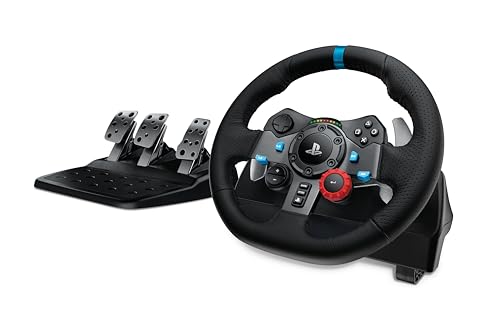
The Logitech G29 Driving Force Racing Wheel has been the default budget pick for six years, and as of 2026 it is still the answer under $300. You get 900 degrees of rotation, 2.1 Nm force feedback via a helical gear drive, a leather-wrapped 280 mm rim, and a three-pedal set with a progressive-resistance brake. Manufacturer specs are on Logitech's product page.
Compatibility is why it wins: PS5, PS4, PC. The G920 is the Xbox variant with the same guts. Total build cost: $229 wheel + $40 desk clamp = $269, or add $60 more for a basic wheel stand and land at $329.
The weak spots are honest ones. The brake pedal is plastic-mount and rewards muscle memory over feel; you will over-brake for the first ten hours. The gear-drive motor is audible — you will hear cogs under heavy correction. There is no shifter included, but you can add the Thrustmaster TH8A later. And the paddle shifters are plastic and flex more than metal ones.
None of that matters for your first 200 hours. Buy it, mount it solidly, and drive.
Best mid-tier: HORI Force Feedback Racing Wheel DLX ($400-700)
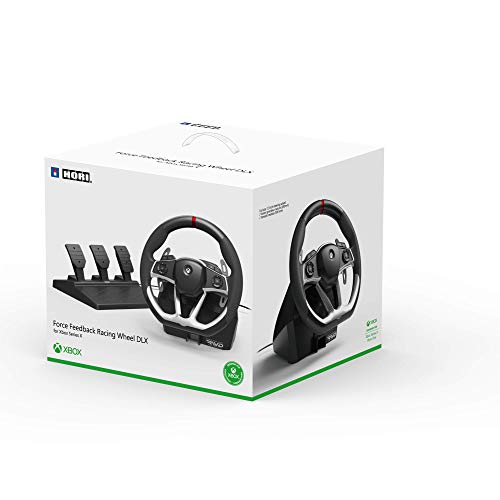
The HORI Force Feedback Racing Wheel DLX is the 2026 mid-tier standout, and it slots directly between the G29 and a proper direct-drive rig. You get 3.5 Nm of belt-driven force feedback (quieter and smoother than the G29's gears), 1080 degrees of rotation, a 270 mm alcantara-wrapped rim, and a metal-mounted three-pedal set with a progressive brake spring that finally lets you trail-brake with real feel.
Officially licensed for PS5 and PC, it works with Gran Turismo 7 out of the box with no config wrangling — the wheel appears in the game menu with proper button labels. Assetto Corsa Competizione picks it up as a generic wheel and needs a per-car FFB profile, but the profiles are widely shared online.
Total mid-tier build cost, as of 2026: $499 wheel + $90 wheel stand + $40 headphones = $629. Add a $150 load-cell brake mod and you are at $779, which is 90% of the direct-drive experience for 40% of the cost.
Best shifter under $200: Thrustmaster TH8A
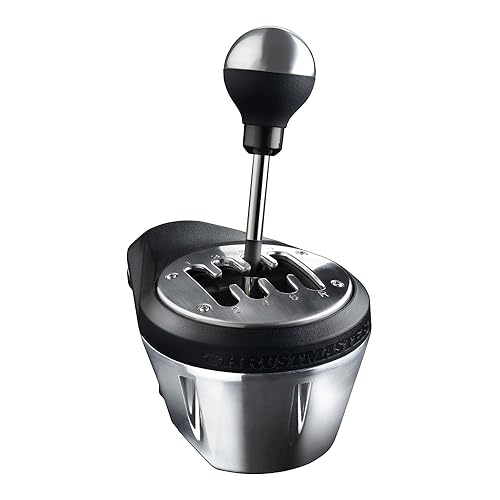
If you drive classic cars, drift builds, or Euro Truck Simulator, you need a real H-pattern shifter. The Thrustmaster TH8A Shifter has been the standard for over a decade and remains the correct pick in 2026. Manufacturer specs live on Thrustmaster's product page.
You get an 8-gear H-pattern (7 forward plus reverse) with a magnetic Hall-effect sensor (no wear over time), a swappable knob, and a sequential mode for rally and touring cars. It clamps to a desk, screws into any standard sim rig, and works with almost every wheel base via USB — including both the G29 and the HORI DLX. Street price sits around $180, occasionally dipping below $160 on holiday sales.
The alternative is a $50 no-name H-pattern that uses spring-loaded microswitches. Those wear out in 60 hours of hard shifting. The TH8A is expensive up front and cheap over five years.
Do you need pedals, shifter, and wheel from the same brand?
Short answer: no, but read the details.
Wheels and shifters are almost universally USB or wheel-base-passthrough. The Thrustmaster TH8A shows up as its own USB device and works with a Logitech G29 wheel, a HORI DLX, or a direct-drive base. This part is not a lock-in trap.
Pedals are trickier. Cheaper sets ship with a proprietary connector (RJ11 or a hard-wired cable) that only speaks to their own wheel base. The G29's pedals plug into the G29 wheel base, not directly to a PC — you cannot use them standalone unless you buy a $40 USB adapter. The HORI DLX pedals are similar.
If you want cross-compatibility, look for pedal sets that expose USB directly (Fanatec ClubSport V3, Simagic P2000, Heusinkveld Sprints). Those cost $500+ and connect to any rig — but they are third-tier upgrades, not starter kit.
For a first build, stay in-brand. Match the wheel and pedals. Add a shifter of any make later.
Full rig cockpit vs a wheel stand
Cost math for a stand-based setup (2026 prices): $80 basic wheel stand + $30 gaming chair you already own + $0 desk = $110 of mounting. Fine for the G29. Adequate for the HORI DLX if you upgrade to a Wheel Stand Pro at $170. Anything past 3.5 Nm force feedback will flex the stand at full correction — you can feel the wheel base wobble.
Cost math for a cockpit: $400 aluminum profile frame + $200 racing seat + $60 monitor arm = $660 of mounting. Add a wheel deck ($80) and pedal plate ($100) if the frame does not include them. Real cockpits like the Playseat Trophy or Next Level Racing GTtrack come pre-built for $600-900 and skip the assembly weekend.
Rule: buy a stand first. If you log 100 hours on it and want more stability, buy the cockpit. If you have not logged 100 hours yet, the cockpit is a $600 storage problem.
The 3-tier lineup at a glance
| Tier | Wheel | Pedals | Shifter | Est total cost |
|---|---|---|---|---|
| Budget ($300) | Logitech G29 | Included (3-pedal, plastic) | None (paddles) | $269-329 |
| Mid ($600) | HORI Force Feedback DLX | Included (3-pedal, metal) | None (paddles) | $499-779 |
| Enthusiast ($1500) | HORI DLX + load-cell mod | Load-cell upgrade | Thrustmaster TH8A | $1,299-1,599 |
Numbers include the wheel, pedals, mounting hardware, and taxes as of early 2026. Cockpit adds $600 on top of the enthusiast tier if you go that direction.
Top picks
#1: Logitech G29
Verdict: Still the correct first sim racing wheel in 2026 — nothing else at $229 hits 900-degree rotation, 2.1 Nm force feedback, and Gran Turismo 7 out of the box.
The Logitech G29 Driving Force Racing Wheel has aged into the default answer. Six years on the market means every game you care about has a G29 preset. Cross-compatibility with PS5, PS4, and PC covers every platform except Xbox (get the G920 for that). The plastic brake pedal is the weak point, and gear-drive noise is audible, but neither is a dealbreaker at the price. If you have never owned a sim racing wheel and want to know if the hobby is for you, buy this. If it turns out you love it, the G29 resells easily and slots into the enthusiast tier as your girlfriend's rig.
#2: HORI Force Feedback Racing Wheel DLX
Verdict: The best value in mid-tier sim racing right now — 3.5 Nm belt drive and metal-mount pedals for around $499, and the FFB quality is noticeably closer to direct drive than to the G29.
The HORI Force Feedback Racing Wheel DLX is what you buy when the G29 has taught you what sim racing feels like and you want more of it. Belt drive means quieter motor operation and smoother torque delivery. 1080 degrees of rotation covers everything from F1 to rally. The 270 mm alcantara rim is grippier than the G29's leather after 200 hours. This wheel does not exist in a vacuum — HORI licensed the design with Sony, so GT7 compatibility is basically flawless. Pair it with a Wheel Stand Pro and you have a rig that will keep you happy for three years.
#3: Thrustmaster TH8A
Verdict: The right H-pattern shifter for every rig under $2,000 — magnetic sensors, real weight, and it plays nicely with any wheel base you throw at it.
The Thrustmaster TH8A Shifter is the accessory that turns a casual sim racing setup into something that can drive a classic Mustang or a Volvo semi with real presence. Magnetic Hall-effect sensors mean no gate wear over time — the shifter feels the same in year five as it does out of the box. The gate is a genuine H-pattern with a stiff throw and a clear detent between gears, and the sequential mode covers touring cars and rally without a second purchase. Skip this if you only drive modern race cars on paddles. Buy it if you own Assetto Corsa, Euro Truck Simulator, or any Forza with pre-1980 cars.
Common pitfalls to avoid
Weak mounting. A wheel that flexes on the desk cannot deliver the force feedback it is rated for. Use a proper clamp with rubber pads, or bolt to a stand. Do not use a suction-cup mount.
USB power draw. The G29 and HORI DLX both need external power bricks (not just USB). Plan for an outlet near your rig. USB-powered wheels are all sub-1 Nm and not worth buying.
Wrong rotation for the car. GT3 cars set to 900 degrees feel slow and vague. Rally cars set to 270 degrees feel twitchy. Configure per-car rotation in the game menu — not in the wheel firmware — so you can tune each build.
Skipping calibration. New pedals ship with default deadzones that are wrong for every human's foot pressure. Calibrate throttle, brake, and clutch on day one. Recalibrate after 20 hours when the springs relax.
When NOT to buy a sim rig
Skip sim racing hardware entirely if any of the following are true:
- You play three to five hours per month. A DualSense will serve you better than a $300 wheel that lives in a closet.
- You share a small desk with a keyboard-and-mouse work setup. Wheel stands need dedicated floor space, and repeatedly mounting and unmounting a G29 wears the clamp down.
- You only play arcade racers like Forza Horizon or Mario Kart. Those games are designed around gamepads and do not benefit from force feedback.
- You cannot commit to two hours per session. Sim racing rewards muscle memory built over long runs — 30-minute sessions do not build the skills that justify the hardware.
If any of those apply, a good controller is a smarter buy. Come back when your habits change.
Bottom line
Buy the Logitech G29 with a $40 desk clamp for $269 total, log 100 hours, and decide from there. If you love it, upgrade the wheel to the HORI Force Feedback DLX and add the Thrustmaster TH8A Shifter — that lands you at the enthusiast tier for around $1,500 total. Skip direct drive until you have a dedicated cockpit and a spare $1,000. As of 2026, sim racing has never been more accessible, and every rig above the G29 is a want-not-need decision.
Related guides
- GameSir G7 SE vs DualSense: PC Gaming 2026 — controller alternative for casual driving sessions
- Best Budget Gaming Audio 2026 — headphone recommendations that pair well with sim racing
- Ryzen 5 5600G vs Ryzen 7 5700X: Budget Gaming 2026 — CPU picks for a sim racing PC build
Sources
- Logitech G29 official product page: https://www.logitechg.com/en-us/products/driving/driving-force-racing-wheel.html
- Thrustmaster TH8A official product page: https://www.thrustmaster.com/en-us/products/th8a-add-on-shifter/
- Force feedback background: https://en.wikipedia.org/wiki/Force_feedback
- Independent hardware measurements: https://www.rtings.com/
Byline: Mike Perry