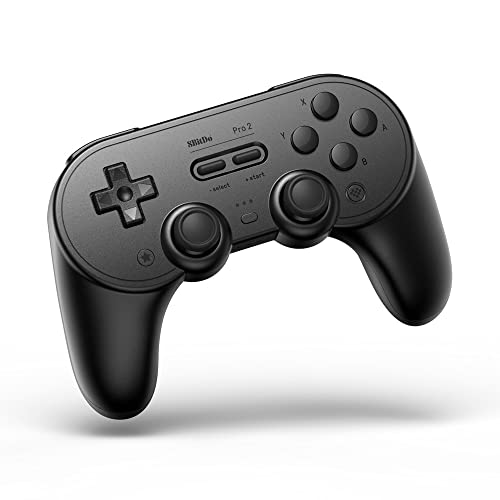
For PC sim racing on a controller in 2026, the GameSir G7 SE is the value pick thanks to stock Hall-effect sticks and triggers that resist drift, the 8BitDo Pro 2 is the most customizable, and the DualSense is the choice if you'll set up its adaptive triggers for brake modulation. None replaces a wheel for serious GT3 racing, but all three are genuinely capable for road racing up to mid-pack competitive levels.
Why a wheel isn't always the right answer
The reflex when someone asks "best sim-racing controller" is to say "buy a wheel." It's not wrong for the top end, but it skips a real question: a huge number of people race on a controller by choice — desk space, budget, noise, or simply preference — and the gap between controllers matters more than the wheel evangelists admit. In modern sims like iRacing, Assetto Corsa Competizione, and Automobilista 2, your lap time on a pad is gated by one thing above all: analog-stick precision. How finely you can hold a 3-to-5-degree steering input, and how consistently the stick returns to center, decides whether you hit your apex or wash wide.
That's why the three controllers here aren't interchangeable. The DualSense, 8BitDo Pro 2, and GameSir G7 SE each take a different approach to the stick-precision problem, and one of them — Hall-effect sensing — directly attacks the drift that ruins consistency over a stint. This synthesis weighs each on the sim-relevant criteria: stick type and deadzone, trigger feel for throttle and brake modulation, wired-vs-wireless latency, and PC setup friction. We'll also be honest about the ceiling: per community progression data, a controller takes you a long way in road racing and plateaus before the very top, where a Logitech G920 wheel and a Thrustmaster TH8A shifter become the next step.
Key takeaways
- Stick type is everything for sims. Hall-effect sticks don't develop drift the way potentiometer sticks do over hundreds of hours — decisive for holding steady steering inputs.
- GameSir G7 SE ships stock Hall-effect sticks and triggers, wired-only, at around $45 — the dollar-per-precision pick.
- 8BitDo Pro 2 is the most tunable: deep profile software, and Hall-effect retrofit options for the sticks.
- DualSense adaptive triggers model brake pressure remarkably well — but only after PC setup work via Steam Input or DSX.
- Wired beats Bluetooth for sim racing; per RTINGS' controller testing, wireless adds measurable latency.
DualSense: precision and adaptive triggers, with setup tax
Spec chips: Bluetooth/USB-C · symmetric analog sticks (potentiometer) · adaptive triggers · haptic feedback · ~$74.
The Sony DualSense has the best out-of-box stick feel of the three and a genuine party trick for sim racing: adaptive triggers. Per Steam Input's documentation and DSX's notes, the right trigger's variable resistance can model brake pressure, giving you a tactile sense of trailing off the brakes that no other controller here offers. In titles with native DualSense PC support, it works beautifully; in iRacing and ACC it requires manual profile tuning through Steam Input (free, fiddly) or DSX (paid, smoother).
The honest caveats: the sticks are traditional potentiometer units, so they're subject to the same long-term drift as any non-Hall stick, and the adaptive-trigger magic only appears after you do the PC setup work. If you'll invest that afternoon of configuration, the DualSense is the most rewarding controller here for braking finesse. If you want plug-and-play, it's the highest-friction option. Check price and full details →
8BitDo Pro 2: the customizer's controller
Spec chips: Bluetooth/USB-C/2.4GHz · profile software with macros · back paddles · Hall-effect stick retrofit available · ~$60.
The 8BitDo Pro 2 wins on tunability. Its companion software lets you remap everything, build per-game profiles, set custom stick curves and deadzones, and assign the two back paddles — genuinely useful in sims for putting shift-up/down or look-behind under your fingers. Per the 8BitDo Pro 2 product page, it's compatible with Windows, macOS, Android, Switch, and Raspberry Pi, so it doubles as an everything-pad.
For sim racing specifically, the killer feature is the ability to dial in a custom steering deadzone and response curve, which lets you tame twitchy default mappings. The stock sticks are potentiometer units, but Hall-effect retrofit modules exist if you want to eliminate drift down the line. The trade is that the Pro 2 rewards effort: out of the box it's good, but its real advantage only shows once you've spent time in the profile software. For tinkerers, that's a feature; for plug-and-play players, the GameSir is simpler. Check price and full details →
GameSir G7 SE: the dollar-per-precision pick
Spec chips: wired USB-C (9.8ft detachable) · Hall-effect joysticks · Hall-effect triggers · 3.5mm audio jack · ~$45.
The GameSir G7 SE is the value standout because it ships the thing sim racers actually need — Hall-effect joysticks and Hall-effect triggers — at around $45, stock, no retrofit required. Hall sensing uses magnetic position detection with no physical wiper to wear, so the sticks don't drift the way potentiometer sticks do after a few hundred hours of holding steady inputs. For sim racing, where consistent steering over a long stint is the whole game, that's the single most important spec, and the G7 SE delivers it for less than the competition.
It's wired-only, which for sim racing is a feature, not a limitation: per RTINGS' controller testing, Bluetooth adds several milliseconds of input latency versus wired USB, and wired connection eliminates battery anxiety mid-endurance-race. The 9.8ft detachable USB-C cable reaches a desk setup easily. It lacks the DualSense's adaptive triggers and the Pro 2's deep software, but for raw, drift-resistant precision per dollar, nothing here touches it. Note: as a value pad, stock availability on Amazon can be spotty, so the eBay channel is often the reliable buy. Check price and full details →
Comparison table
| Controller | Stick type | Trigger type | Connection | Price |
|---|---|---|---|---|
| DualSense | Potentiometer | Adaptive (variable resistance) | Bluetooth / USB-C | ~$74 |
| 8BitDo Pro 2 | Potentiometer (Hall retrofit) | Analog | BT / USB-C / 2.4GHz | ~$60 |
| GameSir G7 SE | Hall-effect | Hall-effect | Wired USB-C only | ~$45 |
Dollar figures in this article are approximate and change often; each pick's product card shows the latest tracked Amazon price or links to the live listing.
Trigger pull and throttle modulation
Throttle and brake control on a pad come down to trigger resolution. All three give you analog triggers, but they differ in feel. The DualSense's adaptive triggers are the standout: with a braking profile loaded, you feel the resistance ramp as you press, which makes trail-braking far more intuitive than a linear trigger. The GameSir's Hall-effect triggers are linear but extremely consistent and resist the dead-spot wear that plagues older analog triggers. The Pro 2 sits in between, with solid analog triggers you can re-curve in software. For drivers who live and die by brake modulation, the DualSense's tactile feedback is the genuine differentiator — provided you set it up.
PC connectivity: Steam Input, DS4Windows, DSX overhead
Plugging in is where friction lives. The GameSir G7 SE is the simplest: it presents as an Xbox-style controller over USB, so Windows and every sim recognize it instantly with no extra software. The 8BitDo Pro 2 works through its own firmware and 8BitDo's software for advanced profiles, and plays nicely with Steam Input. The DualSense is the most involved: Steam Input handles basic mapping, but adaptive triggers and haptics need DSX (paid) or DS4Windows custom profiles (free, more setup). Budget setup time accordingly — the G7 SE is minutes, the DualSense can be an afternoon.
Real-world setup: dialing in a pad for iRacing
Getting a controller fast in a sim is mostly about taming the steering response. Start by reducing the in-game steering deadzone to the smallest value where the car still tracks straight on a straight — too large and small corrections do nothing; too small and a drifting stick wanders. On a Hall-effect pad like the G7 SE you can push the deadzone very low because the stick genuinely returns to center. Next, soften the steering linearity curve so the first few degrees of stick travel produce gentle steering and the outer range stays for hairpins; most pad drivers run a mild non-linear curve to gain mid-corner finesse. Lower the steering lock to roughly what the car's real wheel uses so a full stick deflection maps sensibly. Finally, separate throttle and brake onto the two triggers (never share an axis) and run a touch of brake-side smoothing so a stab doesn't instantly lock the fronts.
Which sims play best on a pad
Not every sim is equally pad-friendly. Arcade-leaning titles — Forza Motorsport, the F1 series, Gran Turismo's controller assists — are tuned to feel great on a stick and let you run near the front on a pad. Hardcore sims reward a wheel more: iRacing and ACC are playable and even competitive on a controller for road racing, but their physics expose stick limitations sooner, especially under trail-braking. Rally and drift disciplines are the hardest on a pad because they demand large, fast counter-steer inputs that a short stick travel can't deliver quickly. Match your controller expectations to your sim diet: a pad goes furthest in circuit road racing and arcade titles, and struggles most in rally and top-split open-wheel.
Common pitfalls
- Ignoring stick type. A cheap pad with worn potentiometer sticks will drift mid-corner. Hall-effect is the durable answer for sim use.
- Racing over Bluetooth. Wireless adds latency; use a wired connection for any serious lap-time chasing.
- Skipping deadzone tuning. Default in-game deadzones are often too large; dial them down for finer steering once your sticks are drift-free.
- Expecting wheel-level precision. A controller plateaus before top-split GT3; know the ceiling before you blame the pad.
- Buying the DualSense for plug-and-play. Its best features need PC setup; if you won't configure them, a simpler pad serves better.
When to give up on controllers and buy a wheel
Be honest with yourself about the ceiling. Per community progression data, controller drivers reach respectable mid-pack levels in road racing but plateau before top-split open-wheel and GT3 competition, where braking modulation and counter-steer micro-corrections exceed what an analog stick can deliver. The practical threshold is when you're consistently within a few tenths of your personal best and the limiter is steering precision rather than racecraft — most drivers hit that around 30 to 60 hours per sim. At that point the Logitech G920 (~$300) is the entry "is sim racing for me" kit, and the Thrustmaster TH8A shifter (~$150) is the natural add-on for H-pattern cars. Until then, a good controller is the smart, affordable choice.
Verdict matrix
Get the GameSir G7 SE if: you want the best drift-resistant precision per dollar, you race wired at a desk, and you value plug-and-play simplicity. It's the value winner.
Get the 8BitDo Pro 2 if: you love tuning profiles, want back paddles, and would use one pad across PC, Switch, and mobile. It's the customizer's pick.
Get the DualSense if: you'll invest setup time to unlock adaptive-trigger brake modulation and want the best out-of-box stick feel. It's the finesse pick for dedicated configurers.
Bottom line
For most PC sim racers on a budget, the GameSir G7 SE is the controller to buy: stock Hall-effect sticks and triggers solve the drift problem that actually limits lap times, for around $45. Choose the 8BitDo Pro 2 if you're a tinkerer who wants deep customization, or the DualSense if you'll configure its adaptive triggers for braking feel. And when you've plateaued in road racing and the only thing holding you back is steering precision, that's the signal to step up to a wheel.
Related guides
- DualSense vs GameSir G7 SE for PC Sim Racing
- Best Controller for Sim Racing Beginners on PC
- Best Sim Racing Wheel for Beginners in 2026
- Best PC Gaming Controller in 2026
Citations and sources
- Steam — Steam Input documentation and news
- RTINGS — Controller testing methodology
- 8BitDo — Pro 2 product page
This piece is editorial synthesis based on publicly available information. No independent first-party benchmarking is reported.