The short answer: three pieces cover a sim-racing stream — a Logitech C922x framing your hands on the wheel, a Blue Yeti on a boom arm in cardioid to reject rig noise, and a NEEWER 18-inch ring light because a cockpit sits further from your key light than a desk does. At current catalog pricing that trio plus a Logitech G29 runs about $507, and Twitch's broadcasting guidelines cap what you need out of it at 1080p60 and 6,000 kbps.
Why a racing stream is a different production problem
Every "streamer starter kit" article assumes the same geometry: you are seated at a desk, the camera is on top of the monitor about 60cm from your face, and the microphone is on a boom arm just out of frame. That description fits an FPS streamer perfectly and describes almost nothing about a sim rig.
On a racing setup the camera is a meter or two back. Your hands are doing the interesting work, not your face. And the machine you are sitting in makes noise — a gear-driven force feedback wheel under load produces a mechanical whine that a desk streamer never has to think about, plus pedal clunk and rig frame rattle over kerbs.
That geometry change breaks the standard advice in three specific ways. The camera has to mount to the rig rather than the monitor, or it frames out the thing viewers came for. The microphone has to be closer to your mouth and more directional than a desk setup needs, because it is now competing with a noise source that is also close. And the lighting has to be brighter or nearer, because light falls off with the square of distance and your cockpit is not where your desk lamp is pointed.
Get those three right and the rest is software. Get them wrong and no amount of bitrate fixes it.
Step 0 — measure your rig geometry before you buy
Three rig types, three different answers, and the answer changes what you buy.
Desk clamp. The wheel bolts to the front edge of a normal desk and you sit in an office chair. This is the closest to a conventional streaming setup, and it is the only one where a monitor-top camera position is defensible. Your face is still roughly desk distance from the screen. The mic can go on a standard desk-mounted boom arm.
Wheel deck / stand. A dedicated wheel stand in front of a chair. The wheel is now a fixed distance from you but your seating is not, and the desk is gone — which means you have no surface for a boom-arm clamp. Budget for a floor stand or a rig-frame clamp for the mic.
Full cockpit. Seat, frame, wheel deck, pedal plate. Everything is rigid and everything moves together under force feedback. This is actually the easiest case for the camera because a rig-mounted camera never shakes relative to you, and the hardest case for lighting because you are furthest from anything already in the room.
Measure two distances before ordering anything: eye-to-wheel-centre, and eye-to-nearest-mountable-surface. Those two numbers decide your camera position and your mic mount, and no amount of gear buys you out of getting them wrong.
Key takeaways
- The wheel-hands shot is the shot. Mount the camera to the rig, not the monitor, so it stays framed under force feedback.
- Cardioid, not omnidirectional, and 15-20cm from your mouth — distance does more to reject rig noise than any other single choice.
- A cockpit needs more light than a desk because you are further from every existing source in the room.
- No capture card is needed for a single-PC setup — OBS captures the game directly and the webcam arrives over USB.
- Add an H-pattern shifter for content reasons, not for completeness. An unused shot is wasted rig space.
What you'll need beyond the three main pieces
Before the gear list, the boring inventory that trips people up on setup night:
- USB bandwidth. A webcam and a USB microphone are both isochronous devices with reserved bandwidth. Put them on separate USB controllers where you can, not on the same hub with the wheel. A 1080p webcam sharing a hub with a force feedback base is the most common cause of dropped frames in a first racing stream.
- Cable length. Rig-mounted devices are further from the PC than desk devices. A 1.5m webcam cable that was generous on a desk will not reach the wheel deck of a cockpit. Measure, then buy an active extension if you are over 5m.
- Mounts. Neither the camera nor the mic ships with a rig clamp. A camera with a standard 1/4-20 thread and a small clamp arm is the flexible answer.
The wheel: why the G29 is the streaming reference point
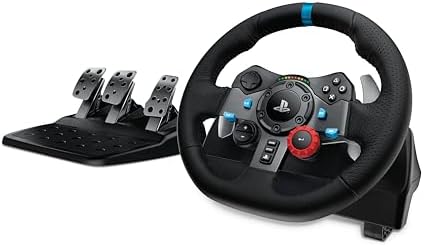
The Logitech G29 Racing Wheel and Pedals is not the best-performing wheel you can buy, and for a stream that does not matter much. What matters is what reads on camera and what your audience recognises.
Per Logitech's product page, the G29 offers 900 degrees of rotation with dual-motor force feedback and helical gearing, and ships with a three-pedal set. Nine hundred degrees is the number that matters for broadcast: hand-over-hand steering is visually legible in a way that a 270-degree gamepad-class wheel simply is not. Viewers can see you working. That is the whole shot.
The three-pedal set gives you a second camera angle worth cutting to — heel-toe footwork is genuinely interesting content in a way that a two-pedal set is not. And the install base means when you talk about settings, a large fraction of the chat has the same hardware in front of them and can follow along.
Catalog price is $199.99 as of August 2026. If you are still choosing a wheel rather than building a stream around one you own, best racing wheels and controllers for sim racing in 2026 and the G29 vs HORI Racing Wheel Overdrive head-to-head cover the tier below and beside it.
The face cam: framing a driver at cockpit distance
Per Logitech's C922 specification page, the C922x records 1080p at 30fps or 720p at 60fps, with a 78-degree diagonal field of view, autofocus, and a glass lens.
Two of those numbers decide your setup.
78 degrees diagonal is a moderately wide field. At a typical wheel-deck mounting distance of roughly 60-80cm from your face, that frames head, shoulders, and hands on the wheel rim together — which is exactly the shot you want. Mount it further back at monitor distance on a cockpit and it starts including your whole room.
1080p30 versus 720p60 is a real choice here and most racing streamers pick wrong. Hand motion on a wheel is fast and continuous. Sixty frames a second of 720p renders that motion more clearly than thirty frames of 1080p, and at typical webcam-overlay sizes — a corner box a few hundred pixels wide — the resolution difference is invisible while the frame rate difference is not. If your camera box is small, take the frame rate.
Mount it to the rig, not the monitor. A rig-mounted camera shares the rig's motion, so a hard kerb strike does not shake your face out of frame. Position it above and slightly left of the wheel centre for a three-quarter view that keeps both hands and your face in shot.
For alternatives at this price, best webcam for Twitch streaming under $100 covers the field.
The mic: keeping force feedback noise out of the broadcast
The Blue Yeti is a three-capsule USB condenser with four selectable polar patterns — cardioid, omnidirectional, bidirectional, and stereo — per Logitech's Yeti product page. For a sim rig, only one of those four is correct.
Set it to cardioid. The capsule then takes sound from the front and rejects the rear, which is where your rig is if the mic is between you and the screen. Omnidirectional — the pattern the Yeti ships in for some units — takes everything equally, which on a racing rig means it takes your wheel as enthusiastically as it takes you.
Then get it close. A boom arm putting the capsule 15-20cm from your mouth is worth more than every other noise mitigation combined, because the inverse-square relationship means halving the distance to your mouth raises your voice relative to a fixed-distance noise source substantially. Distance is the single largest variable in this entire article.
The Yeti's headphone jack with direct monitoring is genuinely useful here: you can hear what the rig sounds like in the broadcast without listening back to a VOD.
Audio: what a sim rig actually produces, and what to do about each
| Noise source | Character | Mitigation |
|---|---|---|
| Force feedback gear whine | Continuous mid-frequency, loudest under load | Cardioid pattern, mic rear-facing the wheel |
| Pedal clunk | Transient, low frequency, floor-coupled | Move mic off the rig frame onto a floor stand |
| Rig frame rattle | Intermittent, broadband | Check bolts; isolate mic mount with a shockmount |
| Wheel rim contact | Sharp transient near the camera | Reposition mic further from the wheel deck |
| Chair and seat creak | Low frequency, close to you | Mic higher, angled down toward the mouth |
The pattern in that table is one idea repeated: put physical distance and directional rejection between the capsule and the rig, and do not mount the microphone to the thing that is vibrating.
If you are choosing between mic classes rather than positions, HyperX QuadCast 2 vs Blue Yeti and headset mic vs USB mic both weigh the tradeoff.
Lighting a cockpit that is further away than a desk
This is the piece most racing streamers skip and it is the one that most visibly separates a good-looking stream from a bad one. A desk streamer is often adequately lit by their own monitors. A driver in a cockpit two metres back is not, because light intensity falls off with the square of distance — moving a light from one metre to two does not halve the illumination, it quarters it.
The NEEWER 18-inch Ring Light Kit is a 55W 5600K daylight-balanced source with a stand included, which is the right shape for this job for one specific reason: a ring is a large, soft source relative to its distance, so it does not throw the hard specular hotspot on a glossy wheel rim that a bare LED panel does.
Two placement rules. Put it high and angled down, roughly 45 degrees above your eye line, so the reflection lands below the wheel rim rather than across it. And place it off-axis rather than directly in front, because a ring light dead ahead of a driver produces a distinctive circular catchlight and a flat, shadowless face.
Catalog price is $112.99. NEEWER 18-inch vs UBeesize 22-inch compares the two sizes if you have the space for a larger source.
Kit at a glance
| Piece | Connection | Key spec | Mounting | Catalog price |
|---|---|---|---|---|
| Logitech G29 | USB | 900° rotation, dual-motor FFB | Desk clamp or rig bolt | $199.99 |
| Logitech C922x | USB | 1080p30 / 720p60, 78° FOV | 1/4-20 clamp on rig | $89.99 |
| Blue Yeti | USB | 4 polar patterns, cardioid for rigs | Boom arm or floor stand | $104.49 |
| NEEWER 18" ring light | AC | 55W, 5600K | Included floor stand | $112.99 |
| Thrustmaster TH8A | USB / base | H-pattern 7+1 and sequential | Rig side-mount | $198.95 |
Dollar figures in this article are approximate and change often; each pick's product card shows the latest tracked Amazon price or links to the live listing.
Scene layout: three OBS scenes and where each device plugs in
OBS Studio does all of this natively — no capture card is needed for a single-PC setup, because the game and the webcam are both already on the machine.
Scene 1 — Cockpit wide. Game capture full frame, webcam in a corner box sized for a three-quarter hands-and-face shot. This is your default and where you spend most of a session.
Scene 2 — Wheel hands close. Same game capture, webcam scaled up and repositioned to a larger frame. Cut to this for a technical corner, a recovery, or when explaining a setting. It is the shot that only racing content can offer.
Scene 3 — Telemetry overlay. Game capture with a telemetry or delta overlay as a browser source, webcam small or hidden. Use it for hotlap and setup segments where the numbers are the content.
Per Twitch's broadcasting guidelines, 1080p60 at around 6,000 kbps with a two-second keyframe interval is the target for a partnered-quality stream — plan your encoder around that rather than pushing resolution beyond it.
On USB: wheel base on its own controller, webcam on a second, microphone on a third if the board offers it. If you have to double up, pair the mic and the wheel and leave the camera alone, because video is the bandwidth-hungry device.
The optional fourth piece: an H-pattern shifter
The Thrustmaster TH8A supports both H-pattern (7+1) and sequential modes in a metal housing, at $198.95 in the catalog. It earns its place on a stream only when your content is truck simulation, rally, or classic touring cars — anywhere a manual gear change is a deliberate, visible action.
For modern GT and open-wheel racing, everything is paddle-shifted, and the shifter sits unused in the corner of your frame. Add it because your content calls for it, and if you do, plan a fourth OBS scene that actually cuts to it. An unused shot is worse than no shot. Best wheel and controller for truck and farm sims covers the content genres where the shifter earns its keep.
When this kit is wrong
Triple-screen racers. With three monitors there is no natural place for a face cam that does not eat game real estate, and the wheel-deck mount now has three panels behind it. Consider going face-cam-free and leaning on the wheel-hands shot alone.
VR racers. A headset covers most of the face that a face cam exists to show. A VR racing stream is better served by a rig-wide shot showing the whole body working than by a conventional webcam box, and the mic becomes disproportionately important because your voice is the only human signal viewers get.
Console racers. Everything above assumes a single PC. On console you do need a capture card, and the USB planning section becomes moot — the camera and mic go to the PC and only the game feed comes from the console.
Verdict matrix
| Your rig | Start here |
|---|---|
| Desk clamp | Camera on the monitor is fine; buy the mic and boom arm first |
| Wheel stand, no desk | Floor stand for the mic is the first purchase; camera clamps to the stand |
| Full cockpit | Rig-mounted camera and the ring light — you are furthest from existing light |
| Triple screen or VR | Skip the face cam; spend the budget on audio |
Bottom line
Buy in this order: microphone, light, camera. Audio is what makes a stream watchable, lighting is what makes it look professional, and the camera is the piece where the cheap option is genuinely close to the expensive one. A $507 four-piece kit built around a G29 covers a sim-racing broadcast completely, and the two decisions that determine whether it looks good — cardioid at 15-20cm, and a rig-mounted camera rather than a monitor-mounted one — cost nothing at all.
Related guides
- Best Racing Wheels and Controllers for Sim Racing in 2026
- Best Streaming Starter Kit for New Twitch Streamers in 2026
- Best Webcam for Twitch Streaming Under $100 in 2026
- HyperX QuadCast 2 vs Blue Yeti for Game Streaming
- Ultrawide vs 27-Inch 4K for Sim Racing on a G29 and RTX 3060
Citations and sources
- Logitech G — Driving Force G29 racing wheel — 900-degree rotation range, dual-motor force feedback, helical gearing, and the three-pedal set. Accessed 2026-08-30.
- Logitech — C922 Pro Stream Webcam — 1080p30 / 720p60 capture modes, 78-degree diagonal field of view, autofocus, glass lens. Accessed 2026-08-30.
- Logitech G — Yeti USB microphone — three-capsule array, four polar patterns, and direct headphone monitoring. Accessed 2026-08-30.
- Twitch — Broadcasting guidelines — recommended resolution, frame rate, bitrate ceiling, and keyframe interval. Accessed 2026-08-30.
- OBS Studio — scene and source model used for the three-scene layout, and native game capture without a capture card. Accessed 2026-08-30.
This piece is editorial synthesis based on publicly available information. No independent first-party benchmarking is reported.