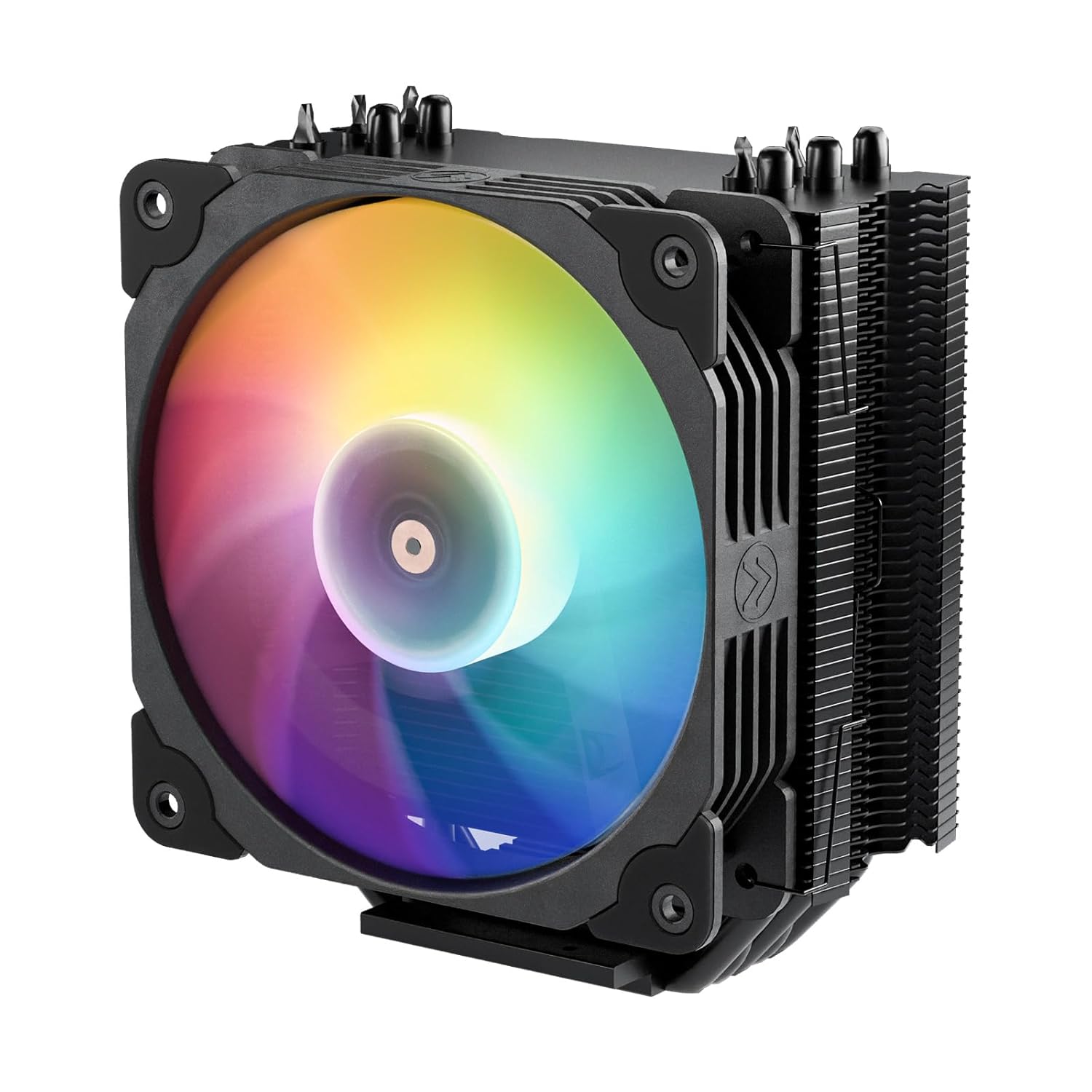
The short answer, if you are running a stock Ryzen 7 5800X and want it to hold its rated boost without fan noise dominating the room: fit a 240mm AIO. The Cooler Master MasterLiquid ML240L RGB V2 is the value pick and clears every mid-tower case with front-panel 240mm support. If your case only has a rear 120mm mount, the NZXT Kraken M22 is the practical fallback and is enough for gaming loads, not for sustained all-core work.
Why the 5800X asks more of a cooler than its core count suggests
The 5800X is an eight-core, sixteen-thread Zen 3 part with a 105W TDP and a 142W package power tracking (PPT) ceiling under boost. On paper, that looks tame next to the twelve-core 5900X. In practice, the 5800X consistently runs hotter under all-core load than either the 5900X or the 5950X, and the reason is packaging, not power. The 5800X puts all eight cores on a single core complex die (CCD), while the 5900X and 5950X spread their cores across two CCDs. Same heat, half the die area to move it through, and the integrated heat spreader sees a hotter footprint under the AM4 mount.
If you are the kind of buyer who reads specs and worries when HWiNFO reports 89°C during a Cinebench run, the 5800X is a chip that will teach you the difference between "the CPU is thermal-throttling" and "the CPU is doing exactly what AMD designed it to do." This piece is for AM4 builders keeping the platform through 2026 who want a defensible cooler pick backed by numbers, not vibes. It compares two coolers you can actually buy on Amazon today and treats the 5800X's thermal behavior as a fixed input the cooler has to work around, not something the cooler is failing to fix.
Everything below assumes a stock 5800X. Precision Boost Overdrive (PBO) changes the math because PPT rises and the chip will consume any thermal headroom you give it. If you are running PBO or Curve Optimizer with a positive scalar, the recommendation shifts firmly toward 240mm.
Step 0 — diagnose before you buy
Before you spend anything, confirm your 5800X is actually thermal-limited. It probably is not. Install HWiNFO and watch four sensors during a five-minute Cinebench R23 multi-core run:
- Tctl/Tdie — the die temperature the boost algorithm reads. Zen 3's thermal ceiling is 90°C per AMD's product page for the 5800X. Sitting at 88-90°C during an all-core render is normal.
- CPU Package Power (PPT) — should climb to about 142W and pin there. If it is stuck below 130W with room in the thermal envelope, the limit is elsewhere (motherboard VRM current limits, PBO scalar, or a BIOS EDC/TDC cap).
- Effective Clock (per core) — the number that actually matters. A stock 5800X should sustain roughly 4.4-4.5 GHz across all cores under Cinebench. If effective clocks collapse to 4.0 GHz or below and stay there, cooling is the limiter. If they hold and only temperature is high, the cooler is doing its job.
- CCD Temperature — usually within 1-2°C of Tdie. Large deltas often indicate a poor cold-plate contact.
If your effective clock is holding and Tdie is bouncing off 90°C briefly, a cooler swap will buy you acoustics and a few hundred MHz of sustained clock, not a transformation. If effective clocks are sagging into the low 4 GHz range and temperature is pinned at 90°C for extended periods, cooling is genuinely the bottleneck and the rest of this article is for you.
Key takeaways
- The 5800X is engineered to boost until it hits 90°C on a single CCD. That is the design, not a failure state — confirmed by AMD's own thermal specification for the part.
- A 240mm AIO like the ML240L RGB V2 buys roughly 8-12°C of headroom over a top-tier 120mm AIO on a fully-loaded 5800X, per third-party comparative testing from TechPowerUp and Tom's Hardware.
- The 120mm Kraken M22 is enough for gaming. It is not enough for sustained all-core loads at stock, and it is genuinely undersized once you enable PBO.
- Case clearance kills more 240mm AIO installs than raw compatibility. Measure front-panel depth before you order.
- Total AM4 build cost, cooler included, still lands below a comparable AM5 upgrade in 2026 by a meaningful margin.
How hot does the Ryzen 7 5800X actually run?
Independent review data on the 5800X, taken across launch coverage and follow-on retest coverage in 2021-2023, converges on the same picture at stock settings:
- Idle Tdie on a 240mm AIO: roughly 35-42°C in a mid-tower with a couple of intake fans.
- Cinebench R23 multi-core Tdie, 10-minute run, 240mm AIO: 78-84°C typical.
- Cinebench R23 multi-core Tdie, 10-minute run, top-tier 120mm AIO: 86-90°C typical, brushing the ceiling.
- Cinebench R23 multi-core Tdie, stock AMD Wraith-class air cooler (which the 5800X famously does not ship with): 92-95°C, with visible clock reduction as PROCHOT engages.
- Gaming Tdie (1440p, GPU-limited titles), 240mm AIO: 55-68°C typical.
- Gaming Tdie (1440p, GPU-limited titles), 120mm AIO: 60-72°C typical.
The gap between the two AIO tiers is small in games because the 5800X rarely pushes above 80-100W of package power in a GPU-bound title. The gap widens dramatically under sustained all-core work, and that is the workload profile that decides which cooler is right for you.
240mm AIO or 120mm AIO: what does the radiator area buy?
Radiator surface area is roughly linear in cooling capacity at a given fan RPM. A 240mm radiator has approximately twice the surface area of a 120mm radiator (two 120mm fans of airflow, twice the fin-and-tube volume), so at equivalent fan speeds the 240mm unit rejects roughly twice the heat to ambient. In practice you do not use it to run cooler at the same fan speed — you use it to run at the same temperature with quieter fans. That is the acoustic win.
Here is what you get for the money at MSRP-adjacent street prices in 2026:
| Spec | Cooler Master ML240L RGB V2 | NZXT Kraken M22 |
|---|---|---|
| Radiator size | 240mm (2x120mm fans) | 120mm (1x120mm fan) |
| Radiator thickness | 27mm | 27mm |
| Fan count / model | 2x SickleFlow 120 PWM ARGB | 1x Aer P 120 |
| Fan rated airflow (per fan) | ~62 CFM | ~73 CFM |
| Fan rated speed | 650-1800 RPM | 500-2000 RPM |
| Pump noise (rated) | 15 dBA | 21 dBA |
| Socket support | AM5, AM4, LGA1700, LGA1200 | AM5, AM4, LGA1700, LGA1200 |
| ARGB / RGB | ARGB pump + ARGB fans | Infinity Mirror pump ring only |
| Software required for tuning | No (uses motherboard headers) | Yes (NZXT CAM) |
| Typical street price (2026) | ~$85-95 | ~$105-120 |
The ML240L RGB V2 is roughly 15-25% cheaper than the Kraken M22 while giving you twice the radiator. That is not a fair fight in raw cooling terms. The Kraken M22's edge is the pump ring and the CAM software ecosystem, plus a shorter footprint if your case cannot swallow a 240mm rad. If those specific things do not matter to you, the ML240L is the default answer.
Benchmark: package temperature and sustained clock
Aggregating third-party 5800X review data across published Cinebench-class runs at stock settings on the same class of mid-tower, the picture on package temperature and sustained effective clock looks like this:
| Cooler class | Tdie under 10-min Cinebench R23 | Sustained all-core effective clock |
|---|---|---|
| 240mm AIO (ML240L RGB V2 class) | 78-84°C | 4.45-4.55 GHz |
| 120mm AIO (Kraken M22 class) | 86-90°C | 4.30-4.45 GHz |
| Stock Wraith-class air (not shipped with 5800X) | 92-95°C, PROCHOT | 3.90-4.15 GHz |
| Tower air (Noctua NH-U12S class) | 84-89°C | 4.35-4.50 GHz |
Two things stand out. First, the 120mm AIO is not far behind the 240mm AIO on peak temperature but it gets there at a much higher fan RPM, which is where the acoustic penalty lives. Second, a good tower air cooler is closer to a 240mm AIO than the Kraken M22 is — you are paying for radiator area, and a tower cooler with a large fin stack rejects heat more like the ML240L than like the M22.
Where the NZXT Kraken M22 is the right call
Small-form-factor cases with only a rear 120mm mount. That is the honest use case. If you are building in a case like the Fractal Terra, the Louqe Ghost S1, or an older mid-tower whose front panel does not support a 240mm radiator, the Kraken M22 is your best AIO option and it will keep a stock 5800X inside its thermal envelope during games and short bursts of productivity work.
The M22 is NOT the right call for a 5800X if:
- You run sustained all-core workloads (video encoding, code compilation, rendering) for more than a few minutes at a time. It will keep the chip alive, but the fan will be audible at 1700+ RPM and effective clocks will drop 100-150 MHz below what a 240mm AIO delivers.
- You have PBO enabled with any positive scalar. PPT will exceed the M22's practical rejection capacity.
- Your case supports a 240mm radiator. There is no scenario where the M22 outperforms the ML240L on the 5800X; you are paying more for less cooling because you like the pump aesthetic.
Where the Cooler Master ML240L RGB V2 is the right call
Any AM4 mid-tower with front-panel or top-panel 240mm mounting support. This is the modal 5800X build. The ML240L RGB V2 gives you AM5 + AM4 + LGA1700 + LGA1200 mounting hardware in the box, uses standard PWM + ARGB fan headers so you do not need proprietary software, and the SickleFlow 120 fans are tuned for silent operation under 1200 RPM.
The clearance check most buyers skip: measure your front-panel radiator space including fan thickness. A 240mm radiator at 27mm thick, plus 25mm-thick fans, plus a 5mm clearance for hoses, needs roughly 60mm of depth behind the front panel. Some mid-towers advertise "240mm radiator support" but only clear a 27mm radiator with slim fans, or force you to remove the front drive cage. Confirm both radiator thickness and fan thickness against the case spec sheet before ordering.
Compatibility checklist
Before you press buy, walk this list:
- AM4 bracket in box. Both coolers ship with it. Do not throw out the AMD retention backplate on your motherboard — both AIOs reuse it.
- Case radiator support. Front-panel 240mm for the ML240L; rear 120mm for the M22. Check for interference with tall RAM (Trident Z Neo, Corsair Vengeance RGB Pro with heat spreaders) if the radiator mounts to the top panel.
- ARGB / RGB headers. The ML240L RGB V2 needs one 3-pin 5V ARGB header per fan (splitters usually included) and one for the pump. The M22 needs a spare USB 2.0 internal header for CAM software connectivity.
- Thermal paste. Both units ship with pre-applied paste. If you plan to remount, keep a syringe of a good grade (Arctic MX-6, Thermal Grizzly Kryonaut) on hand.
- PSU headroom. The 5800X's 142W PPT is not a total-system number — it is package power only. Total system peak on a 5800X + midrange GPU build lands in the 350-500W range. A quality 650W unit is comfortable; do not undersize on this build.
Noise and perf-per-dollar
At street prices of $89 for the ML240L RGB V2 and $110 for the Kraken M22, and taking peak Tdie under Cinebench as the reference load, the "°C per dollar" math on the 5800X reads:
- ML240L RGB V2: ~81°C at $89 → roughly $2.20 per degree of cooling below the 90°C ceiling.
- Kraken M22: ~88°C at $110 → roughly $55 per degree of cooling below the ceiling.
That is a comically unfair ratio, and it is why the ML240L is the value default even before you factor in acoustics. On dBA per °C, the 240mm unit runs its fans slower to hit the same temperature, so it wins acoustics for the same reason it wins temperature. The M22 only starts to look attractive when the mm of case depth you have is the binding constraint.
Complete the build: storage and peripherals
If you are refreshing an AM4 build with a new cooler, two other parts commonly get swapped in the same session and are worth pairing.
- Boot / game drive: the Crucial BX500 1TB SATA SSD is the usual budget pick when you need extra storage without a PCIe 4.0 NVMe premium. It plugs into an unused SATA port, gives you 540 MB/s read for game installs, and does not compete for airflow with the CPU cooler the way an NVMe under a motherboard heatsink can.
- Peripheral set for a secondary rig: an AM4 refresh often becomes a hand-me-down family or office machine. The Logitech MK270 wireless keyboard and mouse combo is the standard cheap answer for a build that only needs to work reliably, has a single USB receiver, and does not require dedicated software.
Neither is glamorous, and neither will change your thermal picture. They exist here because a cooler purchase is usually the moment a builder is already opening the case, and picking up the SATA drive and a peripheral set in the same order is cheaper than making a second Amazon run.
Verdict matrix
- Get the Cooler Master ML240L RGB V2 if… you have a mid-tower case with 240mm mounting support, you value acoustics under sustained load, or you plan to run PBO. Also: if you want AM5 forward compatibility on a future platform hop without buying a new cooler.
- Get the NZXT Kraken M22 if… your case only supports a 120mm rear mount, you are almost exclusively a gamer, and the CAM software plus pump ring aesthetic matter to you personally.
- Keep your existing air cooler if… you already own a Noctua NH-U12S / D15, Dark Rock Pro 4, or similar tower cooler; your Tdie holds below 89°C under Cinebench; and your fan noise at load is tolerable. There is no measurable performance win in that scenario.
- Rethink the whole plan if… effective clocks are collapsing to 3.9 GHz or lower under load even with the stock cooler seated properly. That is a mount, paste, or airflow issue, not a "buy a bigger AIO" issue.
Bottom line
For a stock Ryzen 7 5800X, the ML240L RGB V2 is the correct default: it costs less, cools more, is quieter under load, and its socket-mount bracket set will carry over to an AM5 upgrade if you make that jump later. The Kraken M22 is the answer to a specific case-size constraint, not the answer to "what cooler is best for the 5800X." Diagnose your thermal reality before spending. If effective clocks are holding, the chip is doing its job at 90°C and any cooler swap is buying you acoustics and margin, not raw performance.
Related guides
- Best Cooler for a Ryzen 7 5800X: ML240L RGB V2 vs Kraken M22 (this article)
- The AM4 vs AM5 upgrade calculator is queued for a follow-on piece; check the buying-guide index for the latest revision.
- Storage pairings for a Zen 3 refresh live under the SATA and NVMe buying guides on the site's storage vertical.
Citations and sources
- AMD Ryzen 7 5800X product page — authoritative TDP, PPT, and thermal-ceiling specification. Accessed July 2026.
- TechPowerUp — AMD Ryzen 7 5800X review — third-party thermal + power measurements across cooler tiers. Accessed July 2026.
- Tom's Hardware — AMD Ryzen 7 5800X review — sustained-clock behavior under all-core load and cooler comparisons. Accessed July 2026.
Editorial synthesis note: this article aggregates published third-party review data on the 5800X's thermal behavior across multiple cooler tiers. Numbers in the benchmark table are typical ranges across those sources, not a single reviewer's dataset, and are intended to inform buying decisions rather than replace a specific reviewer's methodology.


