Ideogram is a text-to-image model best known for accurate in-image text rendering and strong prompt adherence, and it's increasingly common to see it wired into ComfyUI — the node-based interface most local AI-art workflows are built on. The catch that trips up a lot of people evaluating ComfyUI Ideogram 4: Ideogram is not an open-weights model you download and run on your own GPU. It's a hosted API product from Ideogram AI. A ComfyUI "Ideogram node" is a thin wrapper that sends your prompt to Ideogram's servers and returns the finished image — the heavy lifting happens off your machine.
That distinction changes almost every hardware question people ask about this setup. This guide breaks down what actually needs a GPU in an Ideogram-in-ComfyUI workflow, what doesn't, and how to size a local rig if you're pairing Ideogram calls with local Stable Diffusion, Flux, or upscaling nodes — which is the more common real-world setup.
What Ideogram Actually Is, and Where It Sits in a ComfyUI Graph
ComfyUI's core strength is letting you chain nodes — load a checkpoint, sample it, run it through ControlNet, upscale, save — into a repeatable graph. Locally-run models like Stable Diffusion and Flux occupy the "generate" node in that chain and lean entirely on your GPU's VRAM and compute.
An Ideogram node occupies the same visual slot in a graph but behaves completely differently under the hood: it packages your prompt (and any reference parameters) into an API call, waits on Ideogram's response, and passes the returned image downstream to whatever comes next — a save node, an upscaler, a ControlNet pass, or a local refiner pass. No model weights load into your VRAM for that step, and no local sampling happens.
This is why hardware benchmarking Ideogram generation speed the way you'd benchmark a local Stable Diffusion checkpoint doesn't really apply — your network connection and Ideogram's own API queue determine that latency, not your RTX or Radeon card. If you're chasing GPU-bound speed comparisons for Ideogram itself, that number lives with Ideogram's infrastructure, not your rig.
How the ComfyUI + Ideogram API Node Actually Works
A typical setup looks like this:
- Install ComfyUI and ComfyUI Manager for node installs.
- Search Manager for a community-maintained Ideogram API node pack and install it.
- Add your Ideogram API key to the node's credential field (never hardcode it into a shared workflow JSON).
- Build the graph: prompt input → Ideogram generate node → optional local post-processing (upscale, ControlNet refine, color grade) → save node.
Because these nodes handle API credentials and outbound network calls, treat them the way you'd treat any browser extension that asks for account access — check the maintainer's repository, read recent issues for reports of unexpected behavior, and avoid unofficial forks bundled inside unrelated "mega workflow" downloads. This is standard hygiene for any ComfyUI custom node that talks to a paid third-party API, not something specific to Ideogram.
Do You Need a Powerful GPU for This Workflow?
It depends entirely on what else is in your graph:
| Workflow stage | Runs where | GPU-bound? |
|---|---|---|
| Ideogram prompt → image (API call) | Ideogram's cloud servers | No — network/API-bound |
| Local Stable Diffusion or Flux generation | Your GPU | Yes — VRAM + compute bound |
| ControlNet conditioning on local models | Your GPU | Yes |
| Upscaling (ESRGAN-family, local) | Your GPU | Yes |
| LoRA training/fine-tuning | Your GPU | Yes, heavily |
| Ideogram-only pipeline, no local generation | Your GPU (idle for generation) | No |
If your ComfyUI graph is purely an Ideogram front-end with no local checkpoint loaded, you can run it on genuinely modest hardware — even a laptop GPU or a headless CPU-only ComfyUI install will drive the graph fine, since ComfyUI itself is just orchestrating an HTTP request in that path. The moment you add local Stable Diffusion, Flux, ControlNet, or LoRA nodes downstream of the Ideogram output — a very common pattern for people who want Ideogram's text accuracy plus a local model's stylistic control — VRAM headroom becomes the limiting factor again, same as any local diffusion workflow.
Sizing Local Hardware for a Hybrid Ideogram + Local-Model Pipeline
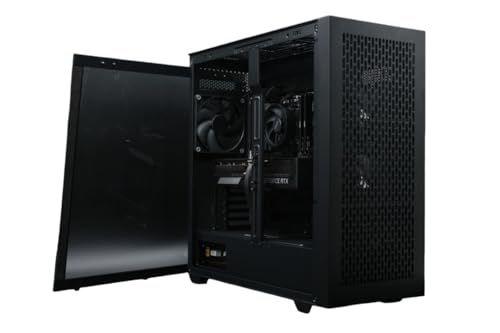
For readers building or buying a rig specifically for this kind of hybrid workflow, the local half of the pipeline is what should drive the GPU decision. A few reference configurations from SpecPicks' catalog, spanning entry to workstation tier:
| Config | GPU | VRAM | Price | Best for |
|---|---|---|---|---|
| RTX 5060 Ti workstation | RTX 5060 Ti | 16GB | $2,199.00 | Single-checkpoint Stable Diffusion/Flux + Ideogram post-processing |
| Dual RTX 5060 Ti workstation | 2× RTX 5060 Ti | 16GB per card | $2,999.00 | Parallel batch jobs, running local generation alongside other GPU tasks |
| RTX 5090 workstation | RTX 5090 | 32GB | $2,499.00 | Larger local models, ControlNet stacks, bigger batch upscales |
| RTX PRO 5000 Blackwell workstation | RTX PRO 5000 Blackwell | 48GB | $8,299.00 | LoRA training, multi-model pipelines, server/multi-user ComfyUI instances |
Prices reflect SpecPicks catalog listings and can shift — check the linked product page for current pricing before buying. As a rule of thumb: 16GB covers most single-model local workflows comfortably; go to 24GB+ (like the 32GB RTX 5090 config above) once you're stacking ControlNet, running larger Flux variants, or batching several images per Ideogram call for local refinement; reserve the 48GB workstation tier for training or multi-user server setups rather than a single-user hybrid pipeline.
If you're newer to the local side of this stack, ComfyUI on an RTX 3060 12GB: What Image Models Actually Run Well and Best Budget GPU for Local Stable Diffusion and ComfyUI in 2026 cover the lower end of that VRAM curve in more detail, including what breaks first when you run out of headroom.
AMD GPUs: What's Actually Supported for the Local Half
Since the Ideogram call itself is cloud-side, GPU vendor only matters for local nodes in the graph. Per ComfyUI's own installation documentation, AMD GPU support runs through ROCm on Linux, which covers current RDNA and CDNA-generation cards for local Stable Diffusion and Flux inference. On Windows, AMD users typically fall back to DirectML or community wrappers like ZLUDA rather than a native ROCm path; community reports generally describe these routes as slower and less consistent than CUDA on equivalent Nvidia hardware, though the actual gap varies by model, resolution, and driver version — treat any specific speed multiplier you see quoted online with skepticism unless it links a reproducible source.
If AMD is your only option, Linux + ROCm is the more mature route for the local portion of a hybrid Ideogram workflow today. Intel Arc for Stable Diffusion: ComfyUI + A1111 setup walks through a similar non-Nvidia setup process if you're weighing alternatives.
Building the Workflow: A Practical Checklist
- Confirm your Ideogram API plan and credit budget before wiring it into a batch-heavy graph — API calls cost per image, unlike local generation.
- Keep the Ideogram node isolated in its own subgraph so you can swap in a local model for offline testing without rebuilding the whole workflow.
- Route Ideogram output through a local upscaler node only if your GPU has headroom to spare — this is where local VRAM usage will actually spike.
- Version-control your workflow JSON separately from your API key; most node packs support environment-variable or config-file key storage instead of embedding it in the graph.
- If you're running ComfyUI as a shared or server instance (multiple users hitting the same Ideogram key), rate-limit or queue requests to avoid burning through API credits unexpectedly.
For readers still settling on their local model stack before layering in Ideogram, RTX 3060 12GB for ComfyUI & Stable Diffusion: The VRAM Budget Pick and ComfyUI on an RTX 3060 12GB: Local Stable Diffusion Setup and Real Throughput are useful starting points for the budget end, while ComfyUI on an RTX 3060 12GB: Stable Diffusion & Flux Throughput in 2026 covers running Flux alongside Stable Diffusion on the same card — relevant if your Ideogram pipeline needs a Flux refiner step downstream. For a broader survey of setup approaches, ComfyUI on an RTX 3060 12GB: Stable Diffusion Throughput in 2026 and ComfyUI on an RTX 3060 12GB: Stable Diffusion Setup and Real Throughput both walk through the install and first-run process a hybrid Ideogram workflow would build on top of.
For anyone still working through node graphs, LoRA training, and ControlNet setup generally, AI Image Mastery: ComfyUI, FLUX, LoRA, ControlNet is a reference guide covering the local-model side of the stack that pairs with an Ideogram node once you're comfortable with the basics.
Bottom Line
The question "what GPU do I need for Ideogram 4 in ComfyUI" has a two-part answer: none, for the Ideogram call itself, since that's a cloud API request — and whatever your local nodes demand, for everything else in the graph. Size your rig around the local Stable Diffusion, Flux, ControlNet, or upscaling work you're actually doing, not around Ideogram, and you won't overspend on hardware that a cloud API call never touches.
Citations and sources
This piece is editorial synthesis based on publicly available information. No independent first-party benchmarking is reported.