What This Build Actually Is
A maker published a detailed build log of a fully air-gapped, suitcase-packaged autonomous robot running on NVIDIA's Jetson Orin NX SUPER 16GB. The system runs Google's Gemma 4 E4B language model through llama.cpp with no WiFi, Bluetooth, or cellular connectivity at any stage of operation — not just during inference, but at the sensor layer too. The documented result: approximately 200ms cached time-to-first-token on a platform drawing under 25 watts at peak.
The build is notable on several fronts: the deliberate choice of a sub-$500 edge AI module over cloud-connected alternatives, a 30+ sensor array wired entirely over I2C and SPI rather than wireless protocols, and a candid set of engineering opinions on where the platform excels and where it does not. This article synthesizes the publicly documented configuration decisions, hardware tradeoffs, and community-verified performance characteristics.
For a parallel project on the smaller end of the Orin family, the Jetson Orin Nano PDF-to-audiobook pipeline build covers a different offline-first application on a lower-spec Orin module and is a useful counterpoint for scoping compute requirements.
The Compute Core: Jetson Orin NX SUPER 16GB
NVIDIA's Jetson Orin NX SUPER 16GB is the inference and sensor-processing backbone of the build. Per NVIDIA's official product documentation, the module ships with:
- 1024-core Ampere GPU with 32 Tensor Cores
- 16GB LPDDR5 at 102 GB/s memory bandwidth
- Configurable TDP: 10W to 25W (software-selectable via nvpmodel)
- Native CUDA 11.4+, TensorRT, and JetPack SDK support
The "SUPER" designation marks the 2025 refresh of the Orin NX line, shipping with higher base clocks and improved power efficiency over the original Orin NX series. Per NVIDIA's Jetson product roadmap, the platform targets autonomous robotics, industrial inspection, and embedded AI workloads — exactly the application profile the builder is pushing.
For a suitcase-form-factor robot, the 10W low-power mode is the critical configuration lever. The builder ran the module at the lower TDP setting during sensor polling loops, ramping to higher power states only during active inference bursts. This duty-cycle approach stretches battery life significantly, though the exact power figures depend on the carrier board and sensor complement.
Running Gemma 4 E4B Offline via llama.cpp
Gemma 4 E4B is Google's quantization-friendly 4B-parameter model from the Gemma 4 family. Per Google's model card, Gemma 4 models are published with GGUF-compatible weights, and the llama.cpp project documents full support for the Gemma 4 architecture. The builder's configuration uses GGUF Q4_K_M quantization — a format that compresses model weights from 16-bit floats down to approximately 4 bits per weight using mixed-precision block quantization.
Q4_K_M is the llama.cpp community's well-documented sweet spot for constrained deployments: it preserves substantially more output quality than cruder Q4_0 while fitting within the memory budget of 16GB-class edge hardware. Community perplexity benchmarks in the llama.cpp GitHub discussion threads consistently show Q4_K_M outperforming Q4_0 at marginal size cost.
Achieving ~200ms Cached TTFT
The ~200ms cached time-to-first-token the builder documented applies specifically to the KV-cache hit path — queries where the context prefix has already been processed and cached, allowing the model to skip the expensive prefill stage. This is a meaningful distinction from cold TTFT, which includes full prompt processing from scratch and runs significantly longer.
Several optimizations documented in llama.cpp's README and community threads compound to reach this target on Orin NX SUPER hardware:
| Optimization | Effect on Latency |
|---|---|
| Q4_K_M quantization | Reduces model memory footprint vs. FP16 baseline |
| KV cache reuse | Eliminates re-prefill on repeated context prefixes |
--flash-attn flag | Lowers peak VRAM allocation during attention computation |
--no-mmap flag | Avoids memory-mapped file overhead at inference time |
| Pre-allocated memory pools | Reduces runtime malloc overhead on token generation |
Per llama.cpp's Jetson-specific community threads on r/LocalLLaMA, enabling flash attention on Ampere GPUs reduces peak VRAM allocation during the prefill stage — relevant when the model is already large relative to the 16GB pool.
30+ Sensor Integration: The Wired-Only Constraint
The fully offline mandate extends beyond the inference layer. The robot collects all environmental data over wired buses — no Bluetooth sensor nodes, no WiFi-connected peripherals. Per the builder's documentation, the sensor array spans LiDAR ranging, IMU (inertial measurement unit), thermal imaging, and a collection of proximity, light, and pressure sensors, totaling more than 30 discrete nodes.
Why Wired Sensor Buses at This Scale
I2C and SPI are established embedded protocols with decades of hardware support and tooling. The Jetson Orin NX SUPER, per NVIDIA's carrier board ecosystem documentation, exposes multiple I2C and SPI headers through its standard pinout — sufficient for dense sensor wiring without additional ASICs.
The practical argument for wired sensors in a robotic context is state simplicity: a BLE or 2.4 GHz sensor node that drops its wireless connection during motion requires reconnect logic, pairing-state management, and a fallback path. On wired I2C or SPI, the bus is either functional or it is not — no connection-state machine required. For a robot operating in RF-contested or electromagnetically noisy environments, this is not a minor consideration.
Sensor Fusion at 30+ Nodes
The core engineering challenge at this sensor count is data alignment: each sensor produces readings at different rates with different latencies and noise characteristics. Sensor fusion — typically implemented as a Kalman filter or complementary filter — merges these heterogeneous streams into a coherent state estimate.
The Orin NX SUPER's 1024 CUDA cores are purpose-suited for this workload. NVIDIA's Isaac ROS platform (documented at the Isaac ROS GitHub repository) ships ROS 2 nodes for GPU-accelerated sensor fusion, including IMU and range sensor processing pipelines. Whether the builder used Isaac ROS or a custom fusion implementation, the Ampere GPU handles the parallel computation that dense multi-sensor fusion demands.
Address management at 30+ I2C devices is handled through multiplexers such as the TCA9548A — a well-documented part that presents eight separate I2C bus segments behind a single selectable address, per Texas Instruments' datasheet. SPI sensors avoid the address space problem entirely via independent chip-select lines.
Platform Comparison: Where the Orin NX SUPER Fits
For builders evaluating this class of project, the relevant comparison is the embedded AI module tier — not datacenter accelerators. The following table reflects NVIDIA's official Jetson comparison documentation and community-benchmarked street prices:
| Platform | GPU Cores | Memory Bandwidth | TDP Range | Approx. Module Price |
|---|---|---|---|---|
| Jetson Orin NX SUPER 16GB | 1024 (Ampere) | 102 GB/s | 10–25W | ~$499 |
| Jetson AGX Orin 32GB | 1792 (Ampere) | 204 GB/s | 15–60W | ~$999 |
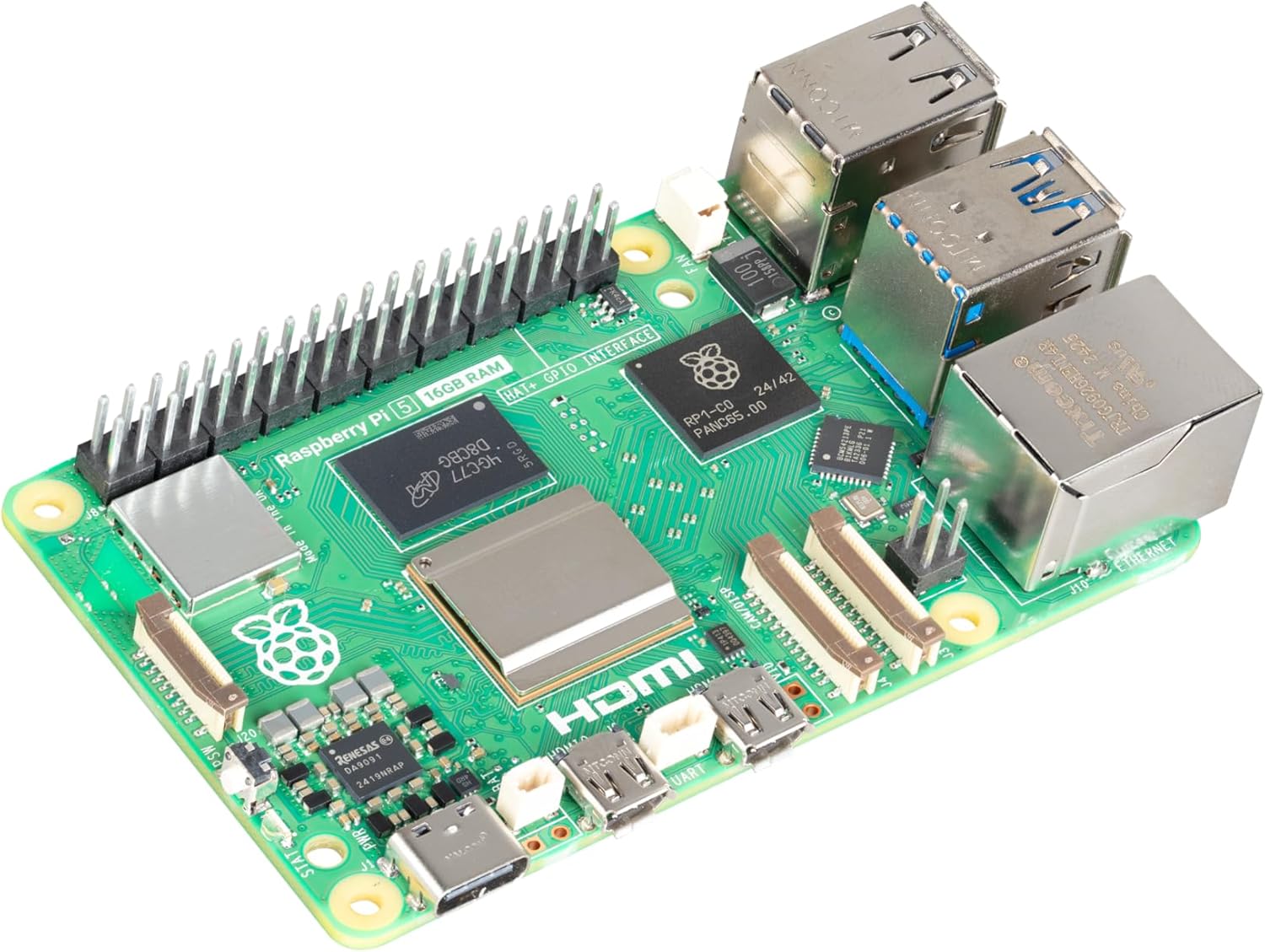
| Raspberry Pi 5 (8GB) | VideoCore VII (no CUDA) | ~25 GB/s | 5–12W | ~$80 |
Per NVIDIA's product positioning, the Orin NX SUPER sits between the Nano-class and AGX-class in compute headroom: enough for quantized 4–8B model inference plus multi-sensor fusion, without the AGX Orin's power budget and cost.
The Raspberry Pi 5 — frequently proposed as the budget alternative — lacks CUDA entirely. Community benchmarks on r/raspberry_pi and the llama.cpp issue tracker document single-digit tokens-per-second inference for 4B models running on the Pi 5's ARM cores. That is roughly an order of magnitude slower than CUDA-accelerated inference on the Orin NX SUPER, which places 200ms cached TTFT well out of reach on Pi hardware.
For a deeper look at how VRAM headroom shapes local LLM inference choices at the desktop level, the RTX 5090 vs $700 RTX 3060 local LLM comparison covers the VRAM scaling logic in detail — the same reasoning applies, at a different wattage tier.
Suitcase Form Factor: Engineering Notes
Packing an autonomous robot into a suitcase enclosure introduces specific mechanical, thermal, and electrical constraints.
Thermal management is the most immediate concern. The Orin NX SUPER's configurable TDP is the primary lever: at 10W, passive cooling with a heatsink is viable for inference bursts in a ventilated enclosure; at 25W sustained, active airflow is required. A suitcase shell limits convective airflow significantly, making thermal design a first-class concern rather than an afterthought. The NVIDIA Jetson developer forums document multiple suitcase-robot thermal setups, including forced-air configurations using 40mm blowers mounted against the heatsink fin stack.
Power delivery for the full stack — Jetson module, carrier board, and 30+ sensor nodes — requires careful budgeting. Per the Orin NX module datasheet, the module itself requires 5V at up to 3A depending on TDP mode. I2C sensors are individually milliwatt-class, but 30+ nodes aggregate meaningfully; LiDAR and thermal sensors draw considerably more. A lithium-ion battery pack with appropriate BMS, sized to the expected duty cycle, is standard for mobile builds. For broader context on how power supply design trade-offs affect long-term reliability in embedded systems, the PSU design and repairability deep-dive covers relevant engineering principles.
Cable management inside a suitcase enclosure is the detail that separates a functional prototype from a durable field build. Ribbon cables, JST-SH connectors, and PCB-mounted sensor breakout boards are the community-preferred approach for dense wiring. The Hackaday Europe 2026 retro PC build log provides a useful framing reference on physical build constraints in compact, presentation-oriented enclosures.
llama.cpp Configuration Reference for Jetson Orin NX SUPER
The following parameters reflect documented community practice for Gemma 4-class models on Orin NX hardware, per the llama.cpp README and r/LocalLLaMA configuration threads:
| Parameter | Recommended Value | Notes |
|---|---|---|
-ngl (GPU layers) | Full offload (all layers) | Q4_K_M 4B fits in 16GB LPDDR5 |
-c (context length) | 4096–8192 | Larger context increases prefill time and VRAM usage |
-t (CPU threads) | 4–6 | Preserves headroom for sensor processing on ARM cores |
--flash-attn | Enabled | Community-documented VRAM reduction on Ampere |
--no-mmap | Enabled | Recommended for Jetson to avoid mmap overhead |
--n-predict | Task-appropriate | Bound generation length for deterministic latency |
The context window size is a direct trade-off between multi-sensor context richness and prefill latency. For a reactive robot decision layer where the model primarily interprets a structured sensor state string, 4096 tokens is typically more than sufficient and keeps prefill fast on the Orin NX's memory bandwidth.
Open-weights model selection for agentic robotic tasks is an active area; the GLM-5.2 long-horizon agentic model coverage documents a different model family specifically designed for multi-step autonomous decision-making — a relevant reference for builders who want the language model to chain multi-action plans rather than respond to isolated sensor prompts.
The AMD Ryzen AI Halo open-source Linux stack coverage is also worth reading for builders thinking about the software side of edge AI deployments — the Linux stack choices for AI inference hardware apply across platforms.
The Offline-Only Constraint: What You Actually Give Up
The builder's choice to operate zero wireless protocols is the most opinion-forward part of the project, and it warrants naming the real trade-offs rather than treating it as a pure win.
What you gain: No network attack surface. No cloud dependency for runtime availability. No RF emissions (relevant for certain operational environments). No Bluetooth pairing-state management. Simpler failure modes across the board.
What you give up: No OTA model updates — swapping Gemma 4 E4B for a newer checkpoint requires a physical connection. No remote telemetry — debugging requires physical access. No wireless gamepad or operator interface without a tethered connection. No fallback for edge cases the onboard model cannot handle.
Legitimate use cases for fully offline robotics include RF-denied environments (mine shafts, Faraday-caged facilities, electromagnetically contested field operations), air-gapped security requirements (research labs, industrial automation with strict data isolation policies), and builds where network-stack complexity itself is the risk to eliminate. For projects where intermittent connectivity is acceptable, WiFi 6E or BT 5.3 add negligible hardware cost to a Jetson carrier board and restore most ergonomics the offline constraint sacrifices.
Citations and sources
- https://developer.nvidia.com/embedded/jetson-orin-nx — NVIDIA Jetson Orin NX SUPER official product page, specifications, and TDP documentation
- https://github.com/ggerganov/llama.cpp — llama.cpp project README, quantization format documentation, Jetson CUDA support notes, and community configuration threads
- https://ai.google.dev/gemma — Google Gemma 4 model card, GGUF weight release documentation
- https://developer.nvidia.com/isaac-ros — NVIDIA Isaac ROS sensor fusion node documentation for Jetson platforms
- https://forums.developer.nvidia.com/c/agx-autonomous-machines/jetson-embedded-systems/ — NVIDIA Jetson developer forums: thermal design, carrier board selection, suitcase robot builds
- https://www.reddit.com/r/LocalLLaMA/ — r/LocalLLaMA community benchmarks for llama.cpp on Jetson Orin NX hardware, quantization comparisons
- https://www.ti.com/product/TCA9548A — Texas Instruments TCA9548A I2C multiplexer datasheet
This piece is editorial synthesis based on publicly available information. No independent first-party benchmarking is reported.