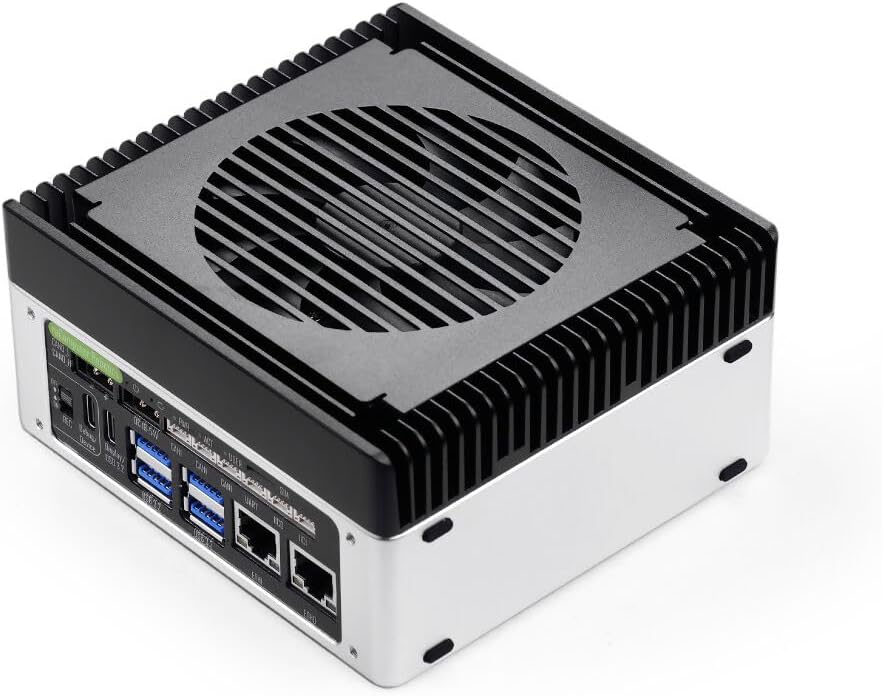
The Raspberry Pi AI HAT+ 26 TOPS is the higher-tier of Raspberry Pi's two official AI accelerator HATs, built around Hailo's Hailo-8 neural processing chip. It bolts onto a Raspberry Pi 5 over the board's PCIe connector and adds dedicated inference hardware for computer-vision workloads — object detection, pose estimation, image classification — without touching the Pi's own CPU budget. This synthesis walks through what the official specs say, how it's meant to be set up, and where it fits against other Pi-ecosystem accelerator options.
What Is the Raspberry Pi AI HAT+ 26 TOPS?
Per Raspberry Pi's official product page, the AI HAT+ line ships in two variants that share a form factor but differ in silicon:
| Spec | AI HAT+ (13 TOPS) | AI HAT+ (26 TOPS) |
|---|---|---|
| AI chip | Hailo-8L | Hailo-8 |
| Peak throughput | 13 TOPS (INT8) | 26 TOPS (INT8) |
| Host interface | PCIe Gen 3 x1 | PCIe Gen 3 x1 |
| Compatible boards | Raspberry Pi 5 only | Raspberry Pi 5 only |
| Form factor | Standard HAT+ with 40-pin GPIO passthrough | Standard HAT+ with 40-pin GPIO passthrough |
| Cooling | Included heatsink | Included heatsink |
Both boards mount to the Pi 5's PCIe FFC connector rather than the GPIO header itself, which is why they're Pi 5-exclusive — the Pi 4 and earlier boards don't expose that PCIe lane. Community coverage from Jeff Geerling, who has documented multiple PCIe-attached Pi accelerators, confirms the same mounting approach as other Pi 5 HAT+ boards like NVMe adapters — see SpecPicks' guide to adding NVMe boot and active cooling to a Raspberry Pi 5 for how the same PCIe connector gets used for storage instead of AI acceleration.
At launch, Raspberry Pi's official pricing listed the 13 TOPS HAT+ under the 26 TOPS model, positioning the Hailo-8 board as the step-up option for teams that need more throughput headroom — check the official product page for current pricing, since retail prices shift over time and vary by region.
Hailo-8 vs Hailo-8L: Why the 26 TOPS Variant Matters
The practical difference between the two chips shows up when a project moves past simple detection into something with more layers or higher input resolution — think multi-class object tracking across a busy scene, or running detection and a secondary classification pass in the same pipeline. According to Hailo's own product documentation, the Hailo-8 was originally designed as a full edge-AI accelerator for automotive and smart-city deployments before Raspberry Pi adopted it for the HAT+ form factor, which is why it carries more headroom than the Hailo-8L variant found in cheaper edge modules.
For builders unsure which tier they need, the general guidance in public write-ups is straightforward: single-model, single-camera detection workloads run comfortably on the 13 TOPS board, while multi-stream or multi-model pipelines are where the 26 TOPS Hailo-8 earns its price premium. If neither fits the project's power or cost envelope, SpecPicks' roundup of Raspberry Pi alternatives for AI covers boards with different accelerator trade-offs, including options built around other NPU vendors.
Setting Up AI Workloads on the AI HAT+
Raspberry Pi's official accessory documentation lays out the setup path at a high level:
- Enable PCIe on Raspberry Pi OS. The HAT+ communicates over the PCIe FFC connector, which needs to be enabled in
raspi-configbefore the board is recognized. - Install the Hailo software stack. This pulls in HailoRT (the runtime) and the Hailo Dataflow Compiler tooling used to convert trained models into the
.hefformat the chip expects. - Quantize the model. Public tutorials consistently quantize to 8-bit integer precision before compiling — this is the precision the 26 TOPS figure is rated against, and it's what keeps inference latency low on the Hailo-8.
- Pair with a Camera Module for vision pipelines. Real-time object detection and pose-estimation demos documented by Raspberry Pi and by community reviewers pipe a Camera Module feed through
rpicam-appsinto the Hailo post-processing stack for on-screen bounding boxes with minimal added latency.
Builders coming from a general Pi homelab background — see SpecPicks' Raspberry Pi 4 8GB homelab guide for the non-AI baseline — will find the setup process closer to installing a specialized driver package than a from-scratch ML environment. Storage matters too: model files and datasets add up quickly, so pairing the HAT+ with a fast boot drive is worth planning for; SpecPicks' best SSDs for a Raspberry Pi homelab guide covers options that work well alongside a Pi 5's PCIe lane allocation.
For projects that also need more physical I/O — extra USB ports for peripherals, storage, or a wired network dongle alongside the AI HAT+ — a compact hub like the SABRENT USB-C 5-in-1 Hub ($24.95 at time of publication; price may vary) is a common accessory pairing in Pi build threads, since the HAT+ itself occupies the PCIe connector rather than any USB ports.
Use Cases for the 26 TOPS AI HAT+
The use cases that show up most consistently in official Raspberry Pi materials and community projects cluster around a few categories:
- Smart-home and security vision. Real-time object and person detection on a live camera feed, running entirely on-device without sending video to the cloud.
- Robotics and maker projects. Low-latency inference for navigation, gesture recognition, or sorting tasks where round-tripping to a cloud API would add unacceptable delay.
- Industrial and DIY monitoring. Vision-based inspection or anomaly detection at the edge, where a full desktop GPU would be overkill on both cost and power.
For builders already running a broader Pi-based automation stack, SpecPicks' list of Raspberry Pi projects on GitHub is a useful starting point for open-source pipelines that plug into a Hailo-accelerated camera feed. And for anyone tracking the Pi 5's evolving PCIe and kernel support more broadly, the recent Raspberry Pi 5 IOMMU driver landing in the mainline Linux kernel is directly relevant to how PCIe-attached accessories like the AI HAT+ get supported going forward.
How It Compares to Other Edge AI Options
The honest comparison point for the AI HAT+ isn't a desktop GPU — it's other edge-class accelerators in the same power and price bracket, like Google's Coral TPU modules or Pi 5-compatible NPU HATs from third parties. The Hailo-8's advantage in public materials is software maturity: the Dataflow Compiler and HailoRT stack are actively maintained and directly targeted at the HAT+ hardware, which lowers the friction of getting a custom model running compared to piecing together a less-supported accelerator. Where it won't compete is against a discrete GPU on raw throughput or against a full desktop system on model flexibility — the HAT+ is purpose-built for INT8 vision inference at a few watts, not general-purpose deep learning. Builders evaluating other single-board options for AI-adjacent workloads, including 3D-printer control boards with different acceleration needs, may also want to check SpecPicks' best Raspberry Pi alternative for Klipper guide, since that use case prioritizes different specs entirely.
Is the Raspberry Pi AI HAT+ 26 TOPS Worth It?
For anyone already committed to the Raspberry Pi 5 ecosystem and building a vision-based project — a smart camera, a robotics rig, an inspection tool — the 26 TOPS AI HAT+ is the straightforward upgrade path over the 13 TOPS variant whenever the workload involves more than one model or a higher-resolution feed. It's not a general AI accelerator and won't replace a GPU for training or for non-vision workloads, but for on-device inference at low power, it's purpose-built hardware backed by an actively maintained software stack. Builders on a tighter budget or with lighter single-model workloads should start with the 13 TOPS Hailo-8L board instead and upgrade only if they hit a throughput ceiling.
Citations and sources
- Raspberry Pi AI HAT+ official product page
- Raspberry Pi AI HAT+ official documentation
- Hailo-8 chip product specifications
- Jeff Geerling — Raspberry Pi hardware coverage
This piece is editorial synthesis based on publicly available information. No independent first-party benchmarking is reported.


