

waveshare
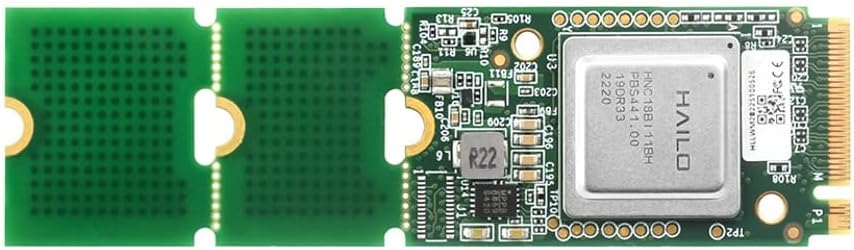
waveshare Hailo-8 M.2 AI Accelerator Module
Bottom line: The waveshare Hailo-8 M.2 AI Accelerator Module is a specs-and-price decision rather than a crowd-consensus one in the single-board computers category, priced around $219.99 on Amazon as of 2026-10-22 10:13 UTC. Check the specification table below against one or two close alternatives — on price and spec fit, not on star ratings.
As an Amazon Associate, SpecPicks earns from qualifying purchases. Full disclosure →
*Price sourced from Amazon.com. Last updated 2026-10-22. Price and availability subject to change.
Pros & Cons
Pros
- ✓ ✅Scalable, enabling simultaneous processing of multi-streams & multi-models
- ✓ Backed by waveshare's warranty and support channels
Cons
- ✗ Check the listed dimensions, connectors and platform compatibility against your setup before ordering
- ✗ Price, stock, shipping and returns are set by the retailer and may have changed since this page was last updated
Manufacturer description
About this item ✅Powered by 26 Tera-Operations Per Second (TOPS) Hailo-8 AI Processor. 2.5W typical power consumption ✅Scalable, enabling simultaneous processing of multi-streams & multi-models ✅Enabling real-time, low latency and high-efficiency AI inferencing on the edge devices ✅Supports TensorFlow, TensorFlow Lite, ONNX, Keras, Pytorch frameworks ✅Supports Linux and Windows. Supports the temperature range of -40°C to 85°C ❤️Rich WiKi Resources❤️ We provide official Wiki resources, please contact us for more information. › See more product details
SpecPicks Verdict
SpecPicks scored waveshare Hailo-8 M.2 AI Accelerator Module using a rating × review-volume × price-fit model applied to published specs and reviews across the single-board computers category. waveshare's single-board computers lineup sits within the broader category mid-tier; price and specs are the deciding factors over brand loyalty here. Judge it on the specification table and the price rather than on sentiment: check the figures that decide your use case, then put it side-by-side with two or three close alternatives in the Compare tool before clicking through.
Common buyer scenarios for single-board computers of this kind: matching it to an existing build, replacing a failing part, or upgrading from a previous-generation equivalent. Check the spec table below against your current setup — particularly socket / form-factor / power-rating fields — and confirm compatibility on the retailer's listing before purchase. Prices and stock are set by the retailer and may have moved since this page was last updated.
Key Features
- ✅Powered by 26 Tera-Operations Per Second (TOPS) Hailo-8 AI Processor. 2.5W typical power consumption
- ✅Scalable, enabling simultaneous processing of multi-streams & multi-models
- ✅Enabling real-time, low latency and high-efficiency AI inferencing on the edge devices
- ✅Supports TensorFlow, TensorFlow Lite, ONNX, Keras, Pytorch frameworks
- ✅Supports Linux and Windows. Supports the temperature range of -40°C to 85°C
- ❤️Rich WiKi Resources❤️ We provide official Wiki resources, please contact us for more information.
Full Specifications
| ASIN | B0D928WG5L |
|---|---|
| Brand | waveshare |
| Model Name | Hailo-8 |
| Unit Count | 1.0 Count |
| Manufacturer | Waveshare |
| Model Number | Hailo-8 |
| Built-In Media | Hailo-8 AI M.2 Module ×1 |
| Mfr Part Number | Hailo-8 |
| Processor Brand | HAILO |
| Compatible Devices | Raspberry Pi 5 |
| Included Components | Hailo-8 AI M.2 Module ×1 |
| Warranty Description | 1 year |
| RAM Memory Technology | LPDDR4 |
| Connectivity Technology | PCIe |
| Full listing title | waveshare Hailo-8 M.2 AI Accelerator Module, Compatible with Raspberry Pi 5, Supports Linux/Windows Systems, Based On The 26TOPS Hailo-8 AI Processor, Module Only |
Ready to buy?
waveshare Hailo-8 M.2 AI Accelerator Module, Compatible with Raspberry Pi 5, Supports Linux/Windows Systems, Based On The 26TOPS Hailo-8 AI Processor, Module Only is listed on Amazon. Price, availability, shipping and returns are set by Amazon and its sellers — check the listing for current terms. SpecPicks earns a small commission on qualifying purchases — thank you for supporting independent review work.
*Price sourced from Amazon.com. Last updated 2026-10-22. Price and availability subject to change.
Read our analysis
SpecPicks coverage that features this Single-Board Computer.
Related Single-Board Computers



waveshare Hailo-8 M.2 AI Accelerator Module head-to-head
Side-by-side specs, prices, and a pick for each matchup — no tab-switching.
More guides & deep dives from the SpecPicks archive
Browse all articles & guides →- Best Retro Handhelds in 2026 — From $35 to $500
- Best 1440p Gaming GPUs in 2026
- The Complete Voodoo5 5500 AGP Driver Guide (2026 Edition)
- How to Build a Windows 98 Retro PC in 2026
- RTX 4070 Super vs RX 7800 XT — Which to Buy in 2026
- Emulation Hardware in 2026: FPGA, Software, and Cart-Reader Ecosystems
- Best Budget Gaming PC Build 2026 — ~$1,000 Parts List
More reviews from the SpecPicks archive
Browse all reviews →- Best Gaming Monitor for Console and PC Crossover (2026)
- Why Nvidia Killed 3dfx — and How Voodoo Still Shapes Every GPU Launch
- Raspberry Pi 4 8GB vs Pi 5 vs Mini-PC for Local LLMs
- Four Frontier Models in Eight Days: What a 12GB RTX 3060 Can Actually Run
- How Secure Is My Homelab Compared to Big Companies?
- Best Streaming Starter Kit for New Twitch Streamers in 2026
- Grok 4.5 at $0.31 a Task: When Cheap Cloud Beats a Local Build
- Best Retro PC Storage Adapters in 2026: IDE, SATA & CompactFlash Picks
- Best 24GB GPU for Local LLM Inference in 2026
- Best SATA SSD to Upgrade Your PS4 Pro Storage in 2026
- Build a Low-Power Pi Home Server with NVMe in 2026
- OpenAI Codex Now Drives Windows Autonomously: What It Means for Local AI Rigs
- Sound Blaster G6 on a Modern Retro Build: When a USB DAC Beats an AWE32
- KOORUI 4K QD-Mini LED vs Samsung Odyssey 4K: Best 27-Inch Gaming Monitor?
- Intel Nova Lake-S 22-Core vs AMD Ryzen 7 5800X: Is the Cache Chip Worth Upgrading?
- 16% of Freelance Jobs Are Now AI-Doable: The Local Agent Rig That Runs Them
- Upgrading From an RTX 3080 in 2026: What to Buy
- Strix Halo Gaming Benchmarks: What AMD's APU Can Really Do
- Best GPU for Stable Diffusion Under $400: Why the RTX 3060 12GB Still Wins
- Best GPU for Running 27B-32B Local LLMs in 2026
- Half an MI350X in a PCIe Slot: Inside AMD’s 144GB MI350P, the First Air-Cooled CDNA 4 Card
- Best Streaming Gear for Game Streamers in 2026: 5 Picks
- Best Streaming Gear for New Streamers in 2026: 5 Picks to Start On-Air
- Period-Correct Storage for a Windows XP Gaming Rig: SSD, CompactFlash, or IDE?
Earliest SpecPicks reviews
Browse full archive →- Best GPU for Llama 3.1 8B (2026)
- Best GPU for Qwen 3 14B (2026)
- Best GPU for Qwen 3 32B (2026)
- Best GPU for Llama 3.1 70B (2026)
- Best GPU for DeepSeek-R1 32B (2026)
- Best GPU for Llama 3.1 405B (2026)
- How to run Llama 3.1 8B on NVIDIA GeForce RTX 5090
- How to run Qwen 3 14B on NVIDIA GeForce RTX 5090
- How to run Qwen 3 32B on NVIDIA GeForce RTX 5090
- How to run Llama 3.1 70B on NVIDIA GeForce RTX 5090
- How to run DeepSeek-R1 32B on NVIDIA GeForce RTX 5090
- How to run Llama 3.1 8B on NVIDIA GeForce RTX 4090