Raspberry Pi's GitHub ecosystem remains one of the largest open-source hardware communities in the world, and 2025 has only expanded the pool of actively maintained, Pi 5-ready projects. This guide synthesizes what's actually documented and shipping on GitHub right now — home automation, AI vision, clustering, and beginner builds — plus how to tell an actively maintained repo from an abandoned one before committing a weekend to it.
Top Raspberry Pi GitHub Projects Worth Running in 2025
| Project | What it does | Best-fit Pi | Source |
|---|---|---|---|
| Home Assistant | Local-first home automation hub | Pi 4/5, 4GB+ | github.com/home-assistant/core |
| Pi-hole | Network-wide ad and tracker blocking | Zero 2 W and up | github.com/pi-hole/pi-hole |
| RetroPie | Retro console emulation front-end | Pi 4/5 | github.com/RetroPie/RetroPie-Setup |
| MagicMirror² | Modular smart-mirror dashboard | Pi 3/4 | github.com/MichMich/MagicMirror |
| OctoPrint | Web-based 3D printer control | Pi 3/4/Zero 2 W | github.com/OctoPrint/OctoPrint |
| Frigate | AI object-detection NVR (TensorFlow Lite / Coral) | Pi 5 + Coral TPU | github.com/blakeblackshear/frigate |
| DietPi | Minimal, script-driven Debian image | Any Pi | github.com/MichaIng/DietPi |
| PiVPN | One-line WireGuard/OpenVPN server | Zero 2 W and up | github.com/pivpn/pivpn |
| k3s | Lightweight Kubernetes for Pi clusters | Pi 4/5 cluster | github.com/k3s-io/k3s |
Home Assistant remains the reference project for anyone who wants a smart home running on hardware they own rather than a vendor cloud; per its repository, it supports Python-based integrations for thousands of device types and runs comfortably on a Pi 4 or 5 with 4GB of RAM or more. Pi-hole is the smallest, most beginner-friendly entry on this list — a Zero 2 W with Ethernet or a stable Wi-Fi connection is enough to filter DNS for an entire household.
For the 'AI vision' angle, Frigate is the project actually shipping that today: it pairs TensorFlow Lite object detection with an optional Coral USB or M.2 Edge TPU accelerator to run always-on camera detection without sending video to the cloud. Google's own Coral benchmarks show sub-10ms per-inference latency for lightweight vision models like MobileNet SSD on the Edge TPU, which is why Frigate recommends the accelerator over CPU-only inference on a Pi.
If 'cluster computing' is the goal, k3s — Rancher's stripped-down Kubernetes distribution — is the project most Pi-cluster tutorials actually build on, since it's light enough to run its control plane on a single Pi 4 or 5 node.
How to Evaluate Raspberry Pi Project Quality on GitHub
Star count is a popularity signal, not a maintenance signal. Before building around a project, check:
- Commit cadence. Look for activity in the repository's last 30-60 days, not just total commit count.
- Issue and PR responsiveness. A maintainer replying to issues within days, not months, is a strong signal the project will still work after the next Pi OS update.
- Hardware compatibility in the README. Well-maintained projects explicitly list which Pi models — Zero 2 W, 3, 4, 5 — and which Pi OS architecture they support. Anything silent on Pi 5 compatibility should be tested cautiously.
- Prebuilt images or Docker support. Projects that ship a ready-made image or docker-compose file (Home Assistant, Frigate, PiVPN) cut setup time from hours to minutes versus build-from-source instructions.
- Community discussion volume. GitHub Discussions or a linked Discord/subreddit with recent activity is a better real-world reliability signal than star count alone.
Beginner-Friendly Raspberry Pi Projects With Setup Guides
Weather station. The Raspberry Pi Foundation's own project library documents sensor-based weather station builds using the Sense HAT or basic I2C sensors, with setup times measured in a single sitting rather than a weekend.
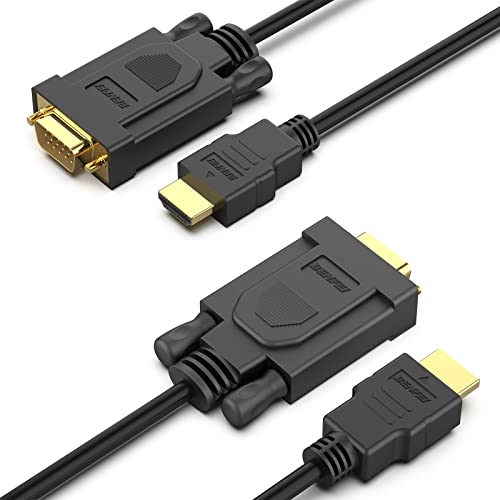
Retro gaming emulator. RetroPie is still the default answer here — its setup script handles emulator installation, ROM organization, and controller mapping from a single menu. If the display side of that build involves an older VGA-only monitor or projector, a HDMI-to-VGA adapter or 10-foot cable version is the cheapest way to bridge a Pi's HDMI output to legacy hardware — a common ask for retro-gaming case builds that reuse an old CRT or LCD.
IoT sensor network. A Pi Zero W (or the newer Zero 2 W) is enough to run a single-purpose sensor node reporting over MQTT or HTTP to a central Home Assistant or Node-RED instance. The same low-power board family underpins accessory projects like the driverless Pico W USB Wi-Fi adapter, worth a look if the sensor network needs a cheaper, headless radio node instead of a full Linux Pi.
Advanced Projects and What the Hardware Actually Delivers
The Pi 5 is the meaningful jump for anything CPU- or GPU-bound. Per Raspberry Pi's own product page, the Pi 5 pairs a 2.4GHz quad-core Cortex-A76 CPU with a VideoCore VII GPU and adds a PCIe 2.0 x1 lane — none of which the Pi 4's 1.8GHz Cortex-A72 / VideoCore VI combination offers. That PCIe lane is also why NVMe boot has become a realistic option on Pi 5 builds; see our NVMe boot and active cooling guide for the practical setup, and the mainline kernel IOMMU driver coverage for what's still landing upstream around that PCIe controller.
| Metric | Pi 4 | Pi 5 |
|---|---|---|
| CPU | 1.8GHz quad-core Cortex-A72 | 2.4GHz quad-core Cortex-A76 |
| GPU | VideoCore VI | VideoCore VII |
| Expansion | No native PCIe | PCIe 2.0 x1 |
| Best fit | Lightweight services, RetroPie | Frigate/AI inference, NVMe workloads, clustering |
Source: raspberrypi.com/products/raspberry-pi-5.
For multi-board clustering, published k3s and community cluster build logs commonly range from a handful of boards up to a dozen or more, used for distributed CI runners, learning Kubernetes, or home-lab redundancy rather than raw throughput — a Pi cluster is not a substitute for a single higher-power server for compute-bound work.
When a Raspberry Pi Isn't the Right Board
Not every project outline fits Pi hardware well. Two common exceptions:
- Heavier AI inference. If a project needs local LLM inference or larger vision models rather than lightweight object detection, our Raspberry Pi AI alternatives guide covers boards with more memory bandwidth and NPU throughput.
- 3D-printer motion control (Klipper). Klipper's timing-sensitive stepper control benefits from boards with better real-time performance than a stock Pi; see the Klipper alternative board guide (and the 2025 edition for the prior generation's picks) before committing OctoPrint or Klipper to a Pi Zero.
2025 Hardware Requirements Cheat Sheet
| Project type | Recommended board | RAM | Storage |
|---|---|---|---|
| Home automation (Home Assistant) | Pi 4 or 5 | 4GB+ | 32GB+ microSD or SSD |
| Ad-blocking / VPN (Pi-hole, PiVPN) | Zero 2 W or Pi 4 | 1-2GB | 8GB+ microSD |
| Retro emulation (RetroPie) | Pi 4 or 5 | 2-4GB | 32GB+ microSD |
| AI vision (Frigate + Coral) | Pi 5 | 4-8GB | NVMe recommended for clip storage |
| Kubernetes cluster (k3s) | Pi 4/5, multiple nodes | 4GB+ per node | microSD or NVMe per node |
Cases and mounting matter more than the table above suggests once a board is running 24/7: see the wall-mount case guide for always-on installs and the minimal Pi 5 case build for anything living on a desk near ventilation.
FAQs
What is the most popular Raspberry Pi project on GitHub? Home Assistant and Pi-hole are consistently among the most widely deployed community projects, per their own repositories' documentation, though 'most popular' varies depending on whether the metric is stars, forks, or active installs.
Do I need a Raspberry Pi 5 for AI projects? Not strictly, but projects like Frigate that pair TensorFlow Lite with a Coral Edge TPU accelerator benefit from the Pi 5's faster CPU and PCIe lane for handling multiple camera streams; a Pi 4 can run a single stream more modestly.
Can I run these projects on a Raspberry Pi Zero W? Lightweight, single-purpose projects — Pi-hole, PiVPN, a single IoT sensor node — run fine on a Zero W or Zero 2 W. Multi-service platforms like Home Assistant or Frigate need a Pi 4 or 5.
How do I know if a Raspberry Pi GitHub project still works on Pi OS Bookworm? Check the README for explicit OS version support and look at recent issues for reports of Bookworm-specific breakage — actively maintained projects usually pin or document a tested Pi OS release.
What's the easiest first Raspberry Pi project from GitHub? Pi-hole is widely recommended as a first project: the installer is a single script, the payoff (network-wide ad blocking) is immediate, and the hardware requirements are minimal.
Is a Raspberry Pi cluster actually useful, or just a novelty? It depends on the goal — a k3s cluster is genuinely useful for learning Kubernetes or running redundant home-lab services, but for raw compute throughput a single more powerful machine is usually more cost-effective than several Pi boards.
Citations and sources
- https://github.com/home-assistant/core
- https://github.com/pi-hole/pi-hole
- https://github.com/RetroPie/RetroPie-Setup
- https://github.com/MichMich/MagicMirror
- https://github.com/OctoPrint/OctoPrint
- https://github.com/blakeblackshear/frigate
- https://github.com/MichaIng/DietPi
- https://github.com/pivpn/pivpn
- https://github.com/k3s-io/k3s
- https://www.raspberrypi.com/products/raspberry-pi-5/
- https://coral.ai/docs/edgetpu/benchmarks/
- https://www.raspberrypi.com/documentation/
This piece is editorial synthesis based on publicly available information. No independent first-party benchmarking is reported.