Prices may vary. Prices in this article were checked 2026-05-30.
The best retro-PC storage adapter kit in 2026 starts with the FIDECO SATA/IDE to USB 3.0 adapter — the universal "bring any vintage drive into a modern PC" tool — paired with the Unitek SATA/IDE to USB 3.0 adapter as a backup, the Transcend CF133 4GB CompactFlash card for solid-state retro boot drives, the Crucial BX500 1TB SATA SSD as the modern host drive for imaged data, and the Vantec CB-ISATAU2 USB 2.0 adapter as the cheap-and-reliable budget pick. The whole kit covers IDE 40-pin, IDE 44-pin (2.5"), CompactFlash-as-IDE, and 2.5"/3.5" SATA — every storage interface a retro PC builder is likely to encounter.
Why this comparison table matters
| Pick | Best for | Interface | Price range | Verdict |
|---|---|---|---|---|
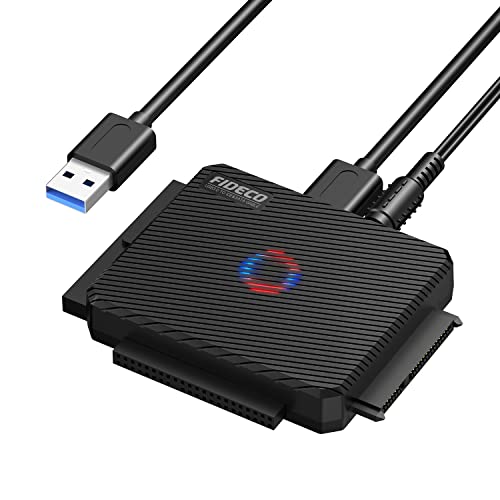
| 🏆 Best Overall — FIDECO SATA/IDE → USB 3.0 | Imaging any vintage drive | 40-pin / 44-pin / 2.5"+3.5" SATA, USB 3.0 | $23.99 on Amazon (checked 2026-10-20) | The default kit. Includes 3.5" drive power. |
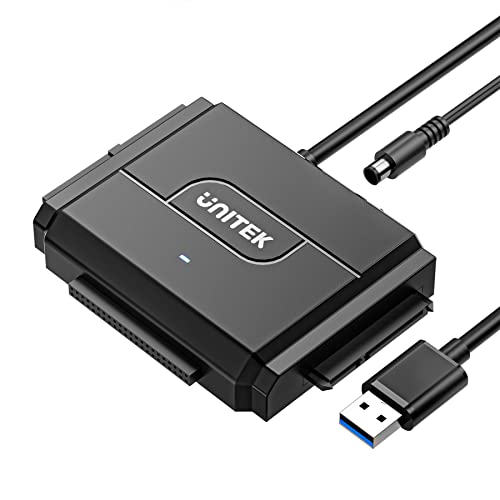
| 💰 Best Value — Unitek SATA/IDE → USB 3.0 | Backup adapter / second seat | 40-pin / 44-pin / SATA, USB 3.0 | $34.99 on Amazon (checked 2026-10-20) | Compatible with everything; cheaper kit. |
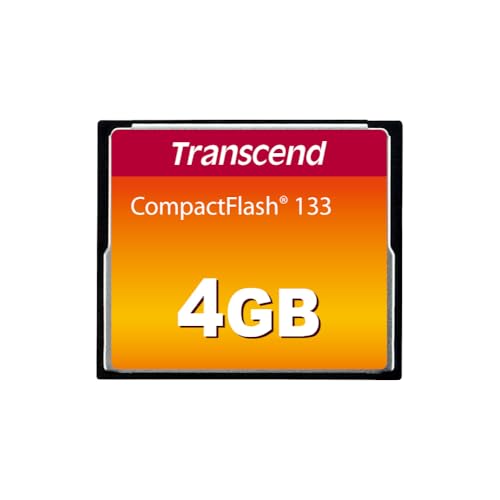
| 🎯 CompactFlash-as-IDE — Transcend CF133 4GB | Silent solid-state boot drive | CF (industrial fixed-disk) | $32.99 on Amazon (checked 2026-10-20) | Presents as fixed disk; the right CF for retro boot. |
| ⚡ Modern Retro Boot — Crucial BX500 1TB SATA SSD | Bridged-SATA-on-IDE bay | 2.5" SATA III | $199.95 on Amazon (checked 2026-10-20) | The "modern era" path with a SATA-to-IDE bridge. |
| 🧪 Budget Pick — Vantec CB-ISATAU2 USB 2.0 | Light-duty imaging, museum runs | 40-pin / 44-pin / SATA, USB 2.0 | $15–$22 | Slower than USB 3.0; rock-solid compatibility. |
A retro storage adapter kit, not a single dongle
Retro PC owners run into the same problem every time they want to read a vintage drive on a modern host: the host has only USB ports, the drive has a 40-pin parallel IDE connector, the drive needs 12 V from an external Molex, and the BIOS that originally formatted it might not understand modern Logical Block Addressing. One adapter, well-chosen, solves all of that — but the wrong adapter quietly drops data, mis-detects geometry, or refuses to power a 3.5-inch IDE drive at all.
This guide is for the buyer assembling a kit, not a single dongle. Imaging a Compaq Presario from 1998, reading a Pentium-III SATA-I drive from 2002, and building a silent CompactFlash boot drive for a Windows 98 retro rig are three different jobs that share most of their tooling. The right kit covers all three without buying $300 of overlapping adapters.
Below: the five picks, the criteria, and the honest gotchas. All numbers reflect 2026 retail spec sheets; treat them as ranges, not promises.
🏆 Best Overall: FIDECO SATA/IDE to USB 3.0 Adapter
Verdict: The FIDECO SATA/IDE to USB 3.0 adapter is the right default for any retro PC builder in 2026. The kit ships with a single small interface box, a 40-pin IDE cable for 3.5" drives, a 44-pin IDE adapter for 2.5" drives (laptop IDE), a SATA cable for both 2.5" and 3.5" SATA drives, and — critically — an external 12 V / 2 A barrel-jack power supply that the 3.5" Molex connector pulls from. That last item is what separates a credible kit from the $8 stick on Amazon: most cheap adapters silently rely on USB-bus power and quietly fail to spin up 3.5" hard drives.
The USB 3.0 host side is the second important detail. Modern hosts running Windows 11, Linux, or macOS treat the adapter as a UAS-capable mass-storage device; sustained transfer rates land around 300–400 MB/s for SATA SSDs and ~100 MB/s for IDE drives (which is bounded by the drive, not the adapter). For imaging an entire 80 GB IDE drive into a single .img file with dd or Macrium, that's 13–14 minutes — fast enough to image a stack of drives in an afternoon.
The FIDECO is the right pick because it includes the 3.5" power and the IDE-44 (laptop) adapter in the same box, and because the chipset (typically a JMicron JMS578 + USB-IDE bridge) is well-supported by every modern OS without driver fuss. Pair it with the Crucial BX500 1TB SATA SSD as the destination drive and you have a complete vintage-imaging workstation.
💰 Best Value: Unitek SATA/IDE to USB 3.0 Adapter
Verdict: The Unitek SATA/IDE to USB 3.0 adapter is the strongest "second adapter" buy and the value pick when you only need to image a few drives. Same interface coverage as the FIDECO (40-pin IDE, 44-pin IDE, 2.5" + 3.5" SATA), same USB 3.0 host link, comparable chipset compatibility. The kit ships with a slightly smaller power brick and a less comprehensive cable set, which is why it lands $5–$10 cheaper.
The right use case is "I already have a primary adapter and I want a backup that lives in a different drawer." Vintage-drive imaging sessions get interrupted by adapter cable wear or chipset crashes more often than you'd think; having a second known-good adapter cuts a lost afternoon to a quick swap.
A bench-test note: both the FIDECO and Unitek occasionally fail to correctly auto-detect the master/slave jumper on IDE drives that haven't seen a host in 20 years. If the modern host doesn't enumerate the drive, swap the jumper to "Cable Select" or "Single Drive" and re-power; the adapter is rarely the actual problem.
🎯 Best for CompactFlash-as-IDE: Transcend CF133 4GB
Verdict: The Transcend CF133 4GB CompactFlash card is the right CF card for retro PC boot drive use. Two reasons. First: Transcend's industrial CF line presents itself to the host as a Fixed Disk (rather than Removable Media), which is the bit Windows 98 setup looks for when deciding whether the target is a valid OS install destination. Cheap consumer CF cards present as Removable, and Windows 98 setup refuses to install the system files. Second: 4 GB is the sweet spot for a Windows 98 SE boot partition that respects the 8.4 GB / FAT32 boundary on period BIOSes.
The use case is converting a vintage PC's mechanical IDE drive into a silent, low-power solid-state boot drive. A passive CF-to-IDE adapter (about $5–$10 on its own — there's no good reason for one to be expensive) sits in the 40-pin chain in place of the hard drive; the CF card slots into the adapter; the BIOS sees a small IDE hard disk. Boot times drop from 45+ seconds on a contemporary spinner to ~15 seconds on CF. Power draw is a fraction of a Watt versus the 8–12 W of a 3.5" IDE drive.
Per Transcend's CF133 product page, the 4 GB Industrial CF133 also handles the wear-leveling that matters for boot-drive use: the card cycles writes across blocks instead of hammering the boot sector. For a Windows 98 / DOS retro build that gets a few writes a week, the endurance is effectively forever. See CompactFlash on Wikipedia for the protocol details on why this works — CF speaks IDE natively, which is what makes the passive adapter possible.
⚡ Best Performance: Crucial BX500 1TB SATA SSD
Verdict: The Crucial BX500 1TB SATA SSD is the modern destination drive for imaged data and a credible host-side boot drive in a Pentium-4-and-newer retro build via a SATA-to-IDE bridge. At ~$60–$90 you get a 1 TB drive that holds every image you'll pull from a vintage PC plus your tooling and your modern host OS partitions.
For the use case where you're bridging a SATA SSD into a retro IDE bay (using a small JMicron-based SATA-IDE adapter board), the BX500 is overkill in raw performance but the right call for compatibility. Period IDE controllers cap at PIO Mode 4 or UDMA-33/66/100/133 depending on the chipset — the adapter and the IDE controller, not the SSD, are the bottleneck. Pulling 30–80 MB/s out of an IDE-bridged BX500 is the realistic ceiling, but that's still a category-class upgrade over the 5–15 MB/s of a period mechanical drive.
For the retro builder building a Windows XP rig or a late-era Windows 98 SE box that the BIOS supports modern LBA on, the BX500 is the smarter choice than spending $50 on a vintage IDE SSD with 5% the endurance.
🧪 Budget Pick: Vantec CB-ISATAU2 SATA/IDE to USB 2.0 Adapter
Verdict: The Vantec CB-ISATAU2 USB 2.0 adapter is the cheap-and-reliable budget pick. Interface coverage is the same as the FIDECO and Unitek (40-pin IDE, 44-pin IDE, 2.5"+3.5" SATA), but the host side is USB 2.0 instead of USB 3.0. That caps throughput at ~30 MB/s sustained, which is fine for vintage IDE drives (most are slower than that anyway) but slow for SATA SSDs.
The right use case is: museum-level vintage drives where the slow host link doesn't matter; light-duty data rescue where you'll image one or two drives a year; or as a third backup in a kit. The Vantec is also notable for its chipset stability — Vantec has been making the same product for ~15 years, the firmware is unchanged, and the kernel support is rock-solid across every OS.
If your budget is "as little as humanly possible," this is the kit. If you'll do real imaging sessions across many drives, spend the extra $5–$10 for the USB 3.0 FIDECO or Unitek and save yourself hours per drive.
What to look for in a retro storage adapter
Interface coverage
A real retro storage kit needs all four common interfaces: 40-pin IDE (3.5" desktop drives), 44-pin IDE (2.5" laptop drives), 2.5" SATA, and 3.5" SATA. The FIDECO, Unitek, and Vantec all cover all four in a single adapter; cheap one-offs frequently skip 44-pin IDE, which is exactly what you need for laptop drives. CompactFlash is electrically IDE-compatible (see Wikipedia's Parallel ATA article) but uses its own physical connector, so the CF-to-IDE adapter is a separate cheap passive board.
Power for 3.5" drives
3.5-inch IDE and SATA drives need 12 V + 5 V from an external supply. The Molex (IDE) and 15-pin (SATA) connectors don't carry 12 V from a USB host. Any adapter that doesn't ship with a wall-wart power supply is, for 3.5" drives, useless. The FIDECO and Unitek include real 12 V / 2 A bricks; cheaper sticks either don't ship power or ship a 5 V-only supply that fails to spin up older 3.5" drives.
CHS/LBA limits
Vintage BIOSes had a series of capacity ceilings: 528 MB (the original CHS limit), 2.1 GB, 8.4 GB, 32 GB, and 137 GB. Above each, the BIOS either refuses the drive or shows it at the wrong size. CompactFlash boot drives ≤ 4 GB sidestep all of this. For larger drives, plan to either flash a modern BIOS that supports LBA48 (rare on period boards) or use a smaller drive than the maximum the adapter supports. See the minuszerodegrees.net BIOS / ROM archive for the BIOSes that handle each limit correctly.
USB speed
USB 2.0 caps at ~30 MB/s sustained; USB 3.0 / 3.1 caps at ~400 MB/s in practice. For IDE drives the difference is invisible because the drive is slower than USB 2.0; for SATA SSDs, USB 3.0 is 10× faster. Spend the extra $5 for USB 3.0 unless you genuinely won't ever use the adapter on a SATA SSD.
Build quality
Adapter chipsets matter. JMicron JMS578 and JMS567 are the reliable USB 3.0 SATA-IDE bridges; ASMedia ASM1153E is the reliable USB 3.0 SATA-only bridge. Avoid no-brand sticks whose Amazon listing doesn't name the chipset — those frequently use refurbished controllers that drop data under sustained load. The FIDECO, Unitek, and Vantec all name their chipsets.
Cable length and strain relief
A 2-foot cable that snaps at the strain relief after the third use is a $30 lesson. The FIDECO and Unitek both ship braided or thick PVC cables that survive years; the cheap sticks tend to fail at the soldered host-side connector after a dozen plug/unplug cycles.
Sources
- minuszerodegrees.net — BIOS / ROM archive
- Wikipedia — Parallel ATA (IDE) overview
- Transcend — CF133 Industrial CompactFlash product page
Related guides
- How to Run a SATA SSD on a Windows XP Retro Gaming PC (AHCI + Adapters)
- Adding USB Storage to a Windows 98 PC With a SATA/IDE Adapter
- Windows 98 SE on >512MB RAM: The vcache Fix Explained (2026)
- Sound Blaster X G6 on a Windows XP Retro Gaming PC: Worth It?
— Mike Perry