
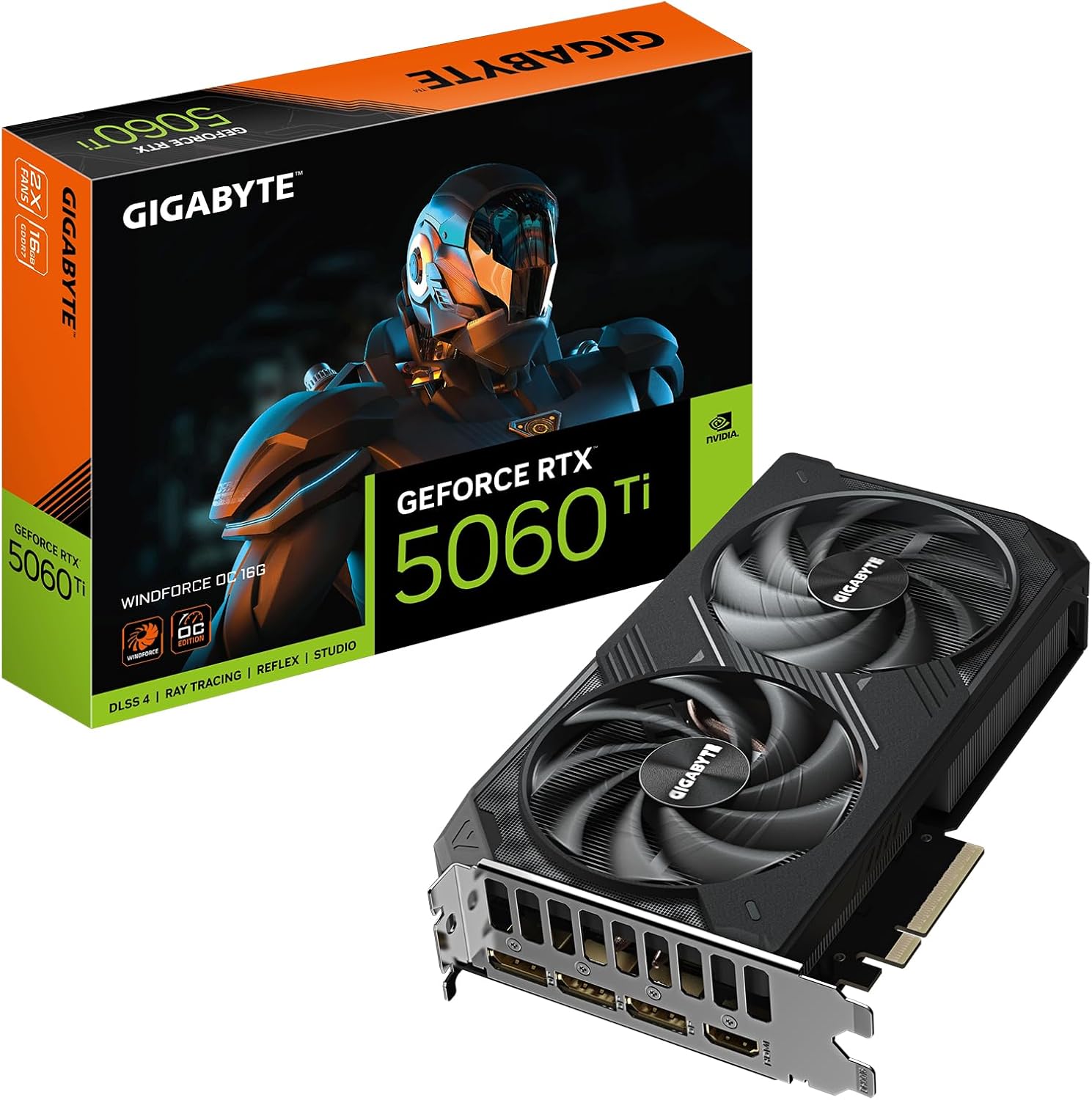
Gigabyte GeForce RTX 5060 Ti WINDFORCE OC 16G Graphics Card (GV-N506TWF2OC-16GD)
Bottom line: The Gigabyte GeForce RTX 5060 Ti WINDFORCE OC 16G Graphics Card ($1155.78 on Amazon as of 2026-10-06): 16GB GDDR7 VRAM handles high-res textures and mid-size local AI models; main trade-off: 128-bit memory bus is narrow for a 16GB card.
As an Amazon Associate, SpecPicks earns from qualifying purchases. Full disclosure →
*Price sourced from Amazon.com. Last updated 2026-10-06. Price and availability subject to change.
Pros & Cons
Pros
- ✓ 16GB GDDR7 VRAM handles high-res textures and mid-size local AI models
- ✓ NVIDIA Blackwell architecture with DLSS 4 support
- ✓ Factory OC with a 2587MHz core frequency
- ✓ PCI-E 5.0 interface for current-gen motherboards
- ✓ 3x DisplayPort + 1x HDMI for multi-monitor setups
Cons
- ✗ 128-bit memory bus is narrow for a 16GB card
- ✗ DLSS 4 gains depend on per-game support
- ✗ Only one HDMI port, a limit for TV plus AV receiver setups
- ✗ Card length and power draw not in listing; check your case and PSU
Manufacturer description
Unlock amazing gaming skills with GIGABYTE's NVIDIA graphics cards. Designed for high performance and visual excellence, our GPUs redefine gaming standards. With advanced cooling solutions and cutting-edge technologies, GIGABYTE's NVIDIA graphics cards deliver stunning visuals and seamless gaming experiences, allowing gamers to dominate every virtual battlefield with confidence and precision.
SpecPicks Verdict
SpecPicks scored Gigabyte GeForce RTX 5060 Ti WINDFORCE OC 16G Graphics Card using a rating × review-volume × price-fit model applied to our editorial and benchmark analysis across the graphics cards category. Compare with similarly-priced alternatives in the graphics cards category before committing. Judge it on the specification table and the price rather than on sentiment: check the figures that decide your use case, then put it side-by-side with two or three close alternatives in the Compare tool before clicking through.
Common buyer scenarios for graphics cards of this kind: matching it to an existing build, replacing a failing part, or upgrading from a previous-generation equivalent. Check the spec table below against your current setup — particularly socket / form-factor / power-rating fields — and confirm compatibility on the retailer's listing before purchase. Prices and stock are set by the retailer and may have moved since this page was last updated.
Key Features
- Powered by NVIDIA Blackwell architecture and DLSS 4
- Powered by GeForce RTX 5060 Ti
- Integrated with 16GB GDDR7 128bit memory interface
- WINDFORCE Cooling System
- Reinforced construction
Full Specifications
| Brand | GIGABYTE |
|---|---|
| Weight | 16g |
| GPU Series | NVIDIA RTX 50 Series |
| Model Name | GV-N506TWF2OC-16GD |
| Unit Count | 1 Count |
| Model Number | GV-N506TWF2OC-16GD |
| Built-In Media | NVIDIA |
| Number of Fans | 2 |
| Mfr Part Number | GV-N506TWF2OC-16GD |
| Number of Items | 1 |
| Number of Packs | 1 |
| Video Processor | Gigabyte |
| Antenna Location | Gaming and Content Creation |
| Graphics Card Ram | 16 GB |
| Graphics Ram Size | 16 GB |
| Graphics Ram Type | GDDR7 |
| Compatible Devices | Desktop |
| Memory Clock Speed | 28000 MHz |
| Graphics Coprocessor | GeForce RTX 5060 Ti |
| Graphics Description | 16GB GDDR7 |
| Full listing title | Gigabyte GeForce RTX 5060 Ti WINDFORCE OC 16G Graphics Card - 16GB GDDR7, 128 Bit, PCI-E 5.0, 2587MHz Core Frequency, 3 x DisplayPort, 1 x HDMI, GV-N506TWF2OC-16GD |
Performance Data
View gaming FPS, AI inference throughput, and synthetic scores for the NVIDIA GeForce RTX 5060 Ti — the core hardware component in this product. Benchmarks sourced from TechPowerUp, PassMark, and the r/LocalLLaMA community.
Related benchmarks: GeForce RTX 5060 Ti 16GB benchmarks
Which local LLMs fit in 16 GB?
16 GB holds a 20–27B model at Q4 with a modest context window; 30B-class weights need 24 GB.
- ✅ 7–9B models (Llama 3.1 8B, Qwen 3 8B) — fits at Q4
- ✅ 12–14B models (Qwen 3 14B, Phi-4) — fits at Q4
- ❌ 20–27B models (Gemma 3 27B, Mistral Small) — needs 20 GB+
- ❌ 30–35B models (Qwen 3 32B, QwQ 32B) — needs 24 GB+
- ❌ 70B models (Llama 3.3 70B, Qwen 2.5 72B) — needs 48 GB+
Across 20 community runs from 12 sources, the NVIDIA GeForce RTX 5060 Ti generates a median 65.1 tok/s on 7–9B models at Q4 (per RunAIHome).
Ready to buy?
Gigabyte GeForce RTX 5060 Ti WINDFORCE OC 16G Graphics Card - 16GB GDDR7, 128 Bit, PCI-E 5.0, 2587MHz Core Frequency, 3 x DisplayPort, 1 x HDMI, GV-N506TWF2OC-16GD is listed on Amazon. Price, availability, shipping and returns are set by Amazon and its sellers — check the listing for current terms. SpecPicks earns a small commission on qualifying purchases — thank you for supporting independent review work.
*Price sourced from Amazon.com. Last updated 2026-10-06. Price and availability subject to change.
Related Graphics Cards



More guides & deep dives from the SpecPicks archive
Browse all articles & guides →- Best Budget Gaming PC Build 2026 — ~$1,000 ($800 on Sale)
- Best Retro Handhelds in 2026 — From $35 to $500
- Best 1440p Gaming GPUs in 2026
- RTX 4070 Super vs RX 7800 XT — Which to Buy in 2026
- Emulation Hardware in 2026: FPGA, Software, and Cart-Reader Ecosystems
- How to Build a Windows 98 Retro PC in 2026
- The Complete Voodoo5 5500 AGP Driver Guide (2026 Edition)
More reviews from the SpecPicks archive
Browse all reviews →- Is the KOORUI 27-Inch 4K QD-Mini LED a Good Match for an RTX 3060?
- Best Raspberry Pi Alternative for AI Inference in 2026: When to Step Up
- Self-Hosting Jellyfin on a Raspberry Pi 4 8GB: Real Performance
- Best Mac for running local LLMs in 2026
- PebbleOS Comes to the Raspberry Pi RP2350: What the Port Means for Tinkerers
- ComfyUI on an RTX 3060 12GB: Stable Diffusion Throughput and VRAM Limits in 2026
- New Raspberry Pi 5 Active-Cooler + NVMe VESA Case Lands (3D-Printable)
- Cerebras Running GPT-5.4 and 5.5 Internally: What it Means for Local LLM Builders
- llama.cpp Vulkan vs CUDA on a 12GB RTX 3060: Which Backend Wins?
- Minecraft on Raspberry Pi via Vulkan: 2026 Setup Guide
- Best Racing Wheel Under $300: Logitech G29 vs HORI Force Feedback
- Can You Run Local TTS on an RTX 3060 12GB in 2026?
- Build a RetroPie Handheld with the Raspberry Pi Zero W in 2026: Full BOM + Setup
- Booting Windows 98 From CompactFlash: The Silent Solid-State Retro Drive
- Best Storage for a Raspberry Pi 4 Home Server: microSD vs SATA SSD vs NVMe
- FIDECO vs Unitek vs Vantec: The Best IDE-to-USB Adapter for Rescuing Retro Drives in 2026
- Best Gaming Monitor for 1440p Under $400 (2026)
- Ryzen AI Developer Platform: AMD's Debian Linux for AI Devs
- Best CPU Cooler for the Ryzen 7 5700X: Noctua vs DeepCool vs CoolerMaster
- SATA vs NVMe for a Ryzen 5800X Gaming Build: Does It Matter?
- Best GPU for 4K Gaming in 2026: Five Cards Ranked by FPS-per-Dollar
- Best Buy Cuts $900 Off an Asus 64GB Gaming Laptop — Is a Desktop Smarter?
- Best SSD for the PS4 Pro in 2026: SATA Upgrade Guide
- Raspberry Pi 5 16GB Ships — Is the Pi 4 8GB Still Worth It?
Earliest SpecPicks reviews
Browse full archive →- Best GPU for Llama 3.1 8B (2026)
- Best GPU for Qwen 3 14B (2026)
- Best GPU for Qwen 3 32B (2026)
- Best GPU for Llama 3.1 70B (2026)
- Best GPU for DeepSeek-R1 32B (2026)
- Best GPU for Llama 3.1 405B (2026)
- How to run Llama 3.1 8B on NVIDIA GeForce RTX 5090
- How to run Qwen 3 14B on NVIDIA GeForce RTX 5090
- How to run Qwen 3 32B on NVIDIA GeForce RTX 5090
- How to run Llama 3.1 70B on NVIDIA GeForce RTX 5090
- How to run DeepSeek-R1 32B on NVIDIA GeForce RTX 5090
- How to run Llama 3.1 8B on NVIDIA GeForce RTX 4090