The 30-second answer
For single-player, narrative PC gaming, the DualSense wins — its adaptive triggers and haptics are genuinely a differentiated experience in supported titles, and Steam Input makes it plug-and-play. For competitive and emulation use, the 8BitDo Pro 2 wins thanks to back paddles, swappable D-pads, longer battery life, and a $50 price. Most PC players should pick by use case, not by brand.
The two most-recommended PC pads and what each does best
These two controllers consistently top community PC-gaming-pad lists for different reasons. The Sony DualSense, released alongside the PlayStation 5 in late 2020, brought a generation of haptics technology that game developers actively target — voice-coil actuators that can reproduce surface textures, gun mechanics, weather, and impact effects with finer resolution than any consumer pad before it. Per Sony's product page, the controller pairs that haptic feedback with adaptive triggers that can resist or release based on in-game tension.
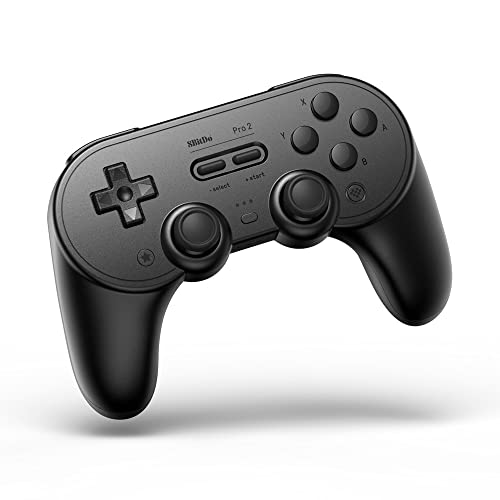
The 8BitDo Pro 2, in contrast, descends from a long line of retro-controller specialists who decided to ship a serious mainline PC gamepad. Per 8BitDo's product page, the Pro 2 brings back paddles (rare at this price), profile switching, configurable D-pad, gyro, and an aggressive $45–$55 price point. It's the modern equivalent of an Xbox Elite controller at a third of the cost.
Neither is strictly better — they target different jobs. This piece breaks the comparison into the specific dimensions PC players actually weight: haptics, paddles, software, battery, connection, and price.
Key takeaways
- DualSense wins on haptics and adaptive triggers — voice-coil actuators no other consumer pad matches.
- Pro 2 wins on back paddles, battery life (~20 hr vs ~6–10 hr), and price ($45 vs $70).
- Both have excellent Steam Input support — plug in, play, no extra software for most users.
- DualSense is the right pick for AAA single-player and PS-ported PC titles like Returnal, God of War Ragnarok, Death Stranding.
- Pro 2 is the right pick for emulation, indie, and competitive titles where paddles + customizable profiles matter more than haptics.
How does the DualSense's haptics and adaptive triggers translate to PC?
The DualSense's haptic motors are not the lazy left-right rumble of every previous console pad — they're a pair of voice-coil actuators that can produce finely-resolved waveforms across the audio range. In supported PC titles, that means:
- Returnal — atmospheric rain and weapon-specific haptic patterns. Sony's own port supports the feature fully.
- God of War Ragnarok PC — Leviathan Axe throw has a distinct tactile feel, distinct from Blades of Chaos swings.
- Astro's Playroom (via emulator) — the canonical haptics showcase.
- Forza Horizon 5 / Motorsport — terrain texture transfer via haptics.
- Death Stranding Director's Cut — environmental and inventory feedback.
The list of haptics-aware PC titles grows roughly quarterly as Sony's own ports and major developers add native DualSense support. For everything else, the controller falls back to standard rumble — which feels normal and fine, just like any other modern pad.
Adaptive triggers work similarly. In supported titles (notably Returnal and Death Stranding) the triggers physically resist or release in response to game state — pulling a bowstring, drawing a heavy weapon, hitting trigger limits. In unsupported titles they're standard analog triggers with no resistance.
What do the 8BitDo Pro 2's back paddles and profiles add?
The Pro 2's case for purchase is the four back paddles — labeled P1 through P4 in the Ultimate Software. These map via on-controller profiles to any combination of:
- Existing controller buttons (A, B, X, Y, etc.)
- Keyboard keys (when running in wired XInput mode)
- Macros and turbo sequences
- Stick-click outputs
The practical impact in PC gaming is significant. Jump, melee, reload, and slide can move from face buttons to paddles, leaving thumbs on the sticks. In competitive titles like Apex Legends or Fortnite this is a measurable advantage; in single-player adventures it's a nice-to-have. The Elite Series 2 charges $180 for the same feature; the Pro 2 charges $50.
Profiles live in three slots on the controller itself, switchable via a small button on the back. You can store an Xbox-layout profile, a Switch-layout profile, and a custom paddle-mapping profile and switch between them mid-session. The Ultimate Software (free, runs on Windows and Mac) is where the deeper customization lives.
5-column spec-delta table
| Spec | Sony DualSense | 8BitDo Pro 2 |
|---|---|---|
| Connectivity | USB-C, Bluetooth | USB-C, Bluetooth, 2.4GHz (via dongle SKU) |
| Battery | 1,560 mAh, ~6–10 hours | Lithium-ion, ~20 hours |
| Extra buttons | Touchpad, Create, Options, PS | 4 back paddles, profile switch |
| Layout | PlayStation symmetric | Modern Xbox-style asymmetric (default) |
| Price (street) | $65–$75 | $45–$55 |
Which connects more reliably over Bluetooth and wired on Windows?
In practice, both connect cleanly to Windows 11 via USB-C and Bluetooth. The differences show up in edge cases:
- DualSense via Bluetooth on stock Windows: enumerates as a generic "Wireless Controller." Some games see it correctly, some don't. Steam Input always sees it correctly; non-Steam games may need DS4Windows or Steam Input's "Use Steam Input even outside Steam" toggle.
- DualSense via USB-C: cleaner; Steam and many native PC games see it immediately.
- Pro 2 via Bluetooth: needs the right mode selected at boot (S/X/D/M switch on the back). Steam Input and most games handle each cleanly.
- Pro 2 via USB-C: similarly clean, defaults to XInput mode for max compatibility.
For zero-fuss "plug it in and it works" use, both are excellent over USB-C and acceptable over Bluetooth via Steam. The DualSense edges ahead in Steam-Input-aware titles; the Pro 2 edges ahead in non-Steam launchers where its multi-mode toggle saves trips into config files.
Comparison table: feature-by-feature
| Feature | DualSense | 8BitDo Pro 2 |
|---|---|---|
| Steam Input tier | Tier 1 (native) | Tier 1 (XInput) |
| Back paddles | None | 4 (P1–P4) |
| Gyro / motion control | Yes | Yes |
| Profiles on controller | None | 3 slots |
| Companion software | DS4Windows for legacy XInput games | 8BitDo Ultimate Software |
| Swappable D-pad | No | Yes (facing variants) |
| Haptic actuators | Voice-coil (high-fidelity) | Standard rumble motors |
| Adaptive triggers | Yes | No |
| Light bar / LEDs | Yes | LED indicator only |
| Speaker on controller | Yes | No |
The DualSense's column reads as "premium features that benefit specific games." The Pro 2's column reads as "everyday utility features that benefit most games."
Battery life and comfort over long sessions
Battery is the place the Pro 2 wins by a comfortable margin. 8BitDo rates the Pro 2 at roughly 20 hours of play. The DualSense's 1,560 mAh battery delivers 6–10 hours in practice, depending heavily on how much the haptics, adaptive triggers, lightbar, and built-in speaker get used.
For an enthusiast who plays a few hours an evening, the Pro 2 will charge once a week. The DualSense will charge every other day. For a handheld-PC user (Steam Deck, Legion Go, ROG Ally) where the controller might be paired with a tablet or laptop, that's the difference between bringing one charger and bringing two.
Comfort is more subjective. The DualSense's grip is universally praised — Sony nailed the ergonomics in 2020 and they remain among the best in the industry. The Pro 2's grip is good but slightly smaller; players with larger hands sometimes find it cramped. RTINGS' PC controller roundup rates the DualSense's comfort fractionally higher across long sessions; the Pro 2 is rated comfortable but not as standout.
Value analysis at current pricing
The pricing math is straightforward at current street rates:
- DualSense: $65–$75 new (avoid clones).
- 8BitDo Pro 2: $45–$55 new.
The Pro 2 is ~30% cheaper. For that delta you give up haptics, adaptive triggers, and the built-in speaker. You gain back paddles, profile switching, swappable D-pads, double the battery life, and a third-party software stack that's actively improving. For most buyers, that's a fair trade in either direction depending on what they value.
Common gotchas with each
DualSense pitfalls
- Bluetooth + non-Steam games: outside Steam Input, many games don't recognize the controller until you wrap it via DS4Windows. Not difficult, but an extra step.
- Stick drift after 12–18 months: an issue that affected early DualSense batches and continues into newer ones at a lower rate. Hall-effect mod kits are available.
- No on-controller profile switching: you'll be in Steam's controller-config UI a lot for per-game mappings.
Pro 2 pitfalls
- Bluetooth mode switch confusion: the S/X/D/M mode switch on the back must be in the right position for the platform you're using. Switch position mid-session and the controller disconnects.
- No haptic feedback in haptic-supported games: titles built around DualSense feel flatter on the Pro 2.
- Smaller grip: not ideal for very large hands.
Real-world recommendation by use case
| Use case | Pick |
|---|---|
| Single-player AAA with DualSense support | DualSense |
| PlayStation-port PC games | DualSense |
| Competitive shooters | 8BitDo Pro 2 (paddles) |
| Emulation / fighting games | 8BitDo Pro 2 (swappable D-pad) |
| Travel / handheld PC pairing | 8BitDo Pro 2 (battery) |
| Best haptics experience | DualSense |
| Best value under $50 | 8BitDo Pro 2 |
If you only buy one controller and want the best general-purpose PC pad, the Pro 2 is the better all-rounder for the price. If you mainly play single-player AAA and have a soft spot for haptics, the DualSense is the right buy.
Setup notes for first-time PC controller users
A few quick notes for anyone coming from console-only gaming:
- Use USB-C first. Plug in over USB-C and verify the controller works in your target game before troubleshooting Bluetooth. Eliminates an entire class of pairing problems.
- Enable Steam Input even outside Steam (DualSense). Steam → Settings → Controller → "Use Steam Input even outside Steam" lets every game on your PC see the DualSense without DS4Windows.
- Update firmware (Pro 2). The 8BitDo Ultimate Software occasionally ships firmware that improves Bluetooth stability or adds features (gyro tweaks, paddle behaviors). Worth checking quarterly.
- Calibrate sticks. Both controllers expose stick calibration via Steam's controller config — if you notice drift, run the calibration before assuming the controller is broken.
- Disable Xbox Game Bar overlay for the DualSense in some titles. A subset of older games handle the DualSense better with the Xbox overlay disabled — Win+G to toggle.
What about the Xbox Series controller?
A reasonable question for anyone weighing PC controllers. The Xbox Wireless Controller (Series X/S design) sits in a third category: cheap, ergonomically excellent, no haptics, no paddles. It's the right pick if you want maximum game compatibility (every PC game speaks XInput natively) and minimum fuss, but you give up both the DualSense's haptics and the Pro 2's paddles. For around $55–$65 it's a fine baseline; both controllers in this comparison have specific advantages over it.
Verdict matrix
Get the DualSense if…
- You play DualSense-aware titles (Returnal, GoW Ragnarok, Death Stranding).
- Adaptive triggers and haptics matter to you.
- You're already in the PlayStation ecosystem and own one for the PS5.
- The $20 premium over the Pro 2 doesn't bother you.
Get the 8BitDo Pro 2 if…
- You play competitively and want back paddles.
- You emulate and want the swappable D-pad / multi-mode toggle.
- You want 20-hour battery life.
- You want the best value PC controller under $50.
Recommended pick
For the median PC gamer in 2026, the 8BitDo Pro 2 is the smarter buy. It costs less, has more useful everyday features (paddles, profiles, battery), and works flawlessly across Steam Input and XInput games. The DualSense earns its premium for specific game libraries that target its haptics; if those titles aren't in your library, the Pro 2 wins on every objective metric except haptic feedback.
The honest answer for many enthusiasts is buy both — they're inexpensive enough that owning a Pro 2 as the daily driver and a DualSense for haptic-aware titles is a reasonable enthusiast setup. Both will be supported in Steam Input for years to come.
Related guides
- Best Game Controllers for PC in 2026
- 8BitDo Pro 2 vs GameSir G7 SE: Best PC Emulation Controller
- Best Gaming Controllers for PC and Emulation in 2026
- Best Budget PC Gaming Peripherals and Desk Setup in 2026
Citations and sources
- Sony — DualSense Wireless Controller product page
- 8BitDo — Pro 2 product page
- RTINGS — Best PC gamepad roundup
- Steam — DualSense PC support changelog
This piece is editorial synthesis based on publicly available information. No independent first-party benchmarking is reported.