For a PS4 Pro SSD upgrade in 2026, a 1 TB 2.5" SATA SSD is the right choice — either the Crucial BX500 1TB SATA SSD or the Samsung 870 EVO 250GB-1TB will deliver effectively identical load-time improvements because the PS4 Pro's SATA III interface is the bottleneck, not the drive itself. Pick on price-per-GB and warranty, not on sequential-read specs.
Why the choice matters less than you think
PS4 Pro storage upgrades are the rare case where the cheap option and the premium option produce indistinguishable results. The console's internal interface is SATA III at 6 Gb/s, capped at roughly 540-550 MB/s of real-world throughput. Modern 2.5" SATA SSDs from Crucial, Samsung, SanDisk, and WD all saturate that interface; the parts of their data sheets that differentiate them (sequential read up to 560 MB/s versus 540 MB/s, write endurance, controller architecture) are mostly invisible inside the PS4 Pro.
The decision becomes mostly about price-per-gigabyte, warranty length, and whether you want a known-quantity brand. Tom's Hardware's SSD reviews and best-of guides put the specifics of each drive in context; for the PS4 Pro specifically, the spec details mostly do not survive contact with the SATA bottleneck.
Key takeaways
- The PS4 Pro's SATA III interface caps real-world drive throughput at ~540-550 MB/s, far below any modern SSD's spec sheet.
- Load times in open-world games drop 30-50% versus the stock 1 TB mechanical drive. Linear titles see smaller gains.
- 1 TB is the right capacity sweet spot for 2026. The console's stock 1 TB is already cramped for modern AAA titles, and 2 TB is overkill for most libraries.
- Drive choice is mostly about price-per-GB and warranty. Sequential read specs do not differentiate inside the PS4 Pro.
- A USB 3.0 SATA-IDE adapter makes the data migration step from old drive to new drive trivial.
- You will need a Phillips #00 screwdriver and roughly 15-25 minutes including software reinstall.
What the PS4 Pro's storage interface actually constrains
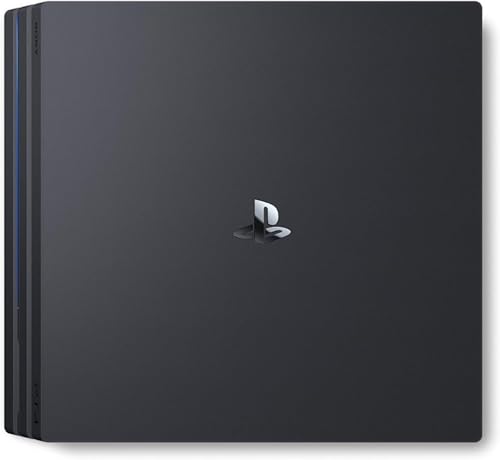
The PS4 Pro ships with a 1 TB 2.5" SATA III mechanical drive at 5,400 RPM. The interface speed is SATA III (6 Gb/s, ~540-550 MB/s real-world), but the mechanical drive itself only sustains 80-120 MB/s sequential and falls to sub-1-MB/s on random-read patterns typical of game loading. Replacing the mechanical drive with a SATA SSD does two things at once: it removes the mechanical seek penalty (random reads jump 100x) and it nearly saturates the bus on sequential reads (4-5x faster).
The result is meaningful but bounded. Game-engine load times depend on more than disk throughput — they involve decompression, asset unpacking, JIT compilation in some cases, and game-engine setup. An SSD does not speed up the non-disk portions. So a load that took 60 seconds on the stock drive does not become 6 seconds on an SSD — it becomes 30-40 seconds typically.
Independent measurements from the SSD-review community across TechPowerUp's SSD specs database and from PlayStation enthusiast tests have settled into a consistent 30-50% load-time reduction range for PS4 Pro SSD upgrades on open-world titles.
How much faster does an SSD make a PS4 Pro?
A representative cross-game load-time table for the PS4 Pro on stock 5400 RPM mechanical drive vs a 2.5" SATA SSD:
| Title type | Stock load | SSD load | Improvement |
|---|---|---|---|
| Open-world (e.g. RDR2-class) | 60-90 s | 30-50 s | 40-50% |
| Open-world fast-travel | 25-40 s | 12-22 s | 40-50% |
| Linear AAA (e.g. Uncharted-class) | 25-40 s | 15-25 s | 30-40% |
| Multiplayer lobby loads | 20-35 s | 12-22 s | 35-40% |
| Save game restore | 8-15 s | 4-9 s | 35-45% |
| System UI navigation | snappy | snappier | marginal |
| Game install from disc | disc-bound | disc-bound | no change |
| Game install from network | network-bound | network-bound | no change |
Notes on this table: improvements are larger when the game spends significant time on random small reads (asset streaming) and smaller when load is dominated by CPU work (shader compilation, JIT). Install times are bottlenecked by the disc drive or your internet connection, not by the storage drive.
Which SSD is best for a PS4 Pro, the BX500 or 870 EVO?
Both saturate the SATA III interface, so real-world PS4 Pro load times are nearly identical between them. The differences are in the data sheets, not in the console.
The Crucial BX500 1TB SATA SSD is Crucial's entry-level DRAM-less drive. It uses 3D NAND with an SLC cache, posts 540 MB/s sequential read, and ships with a 3-year warranty. Its design tradeoff (no on-drive DRAM cache) lowers cost and affects sustained-write workloads more than read-heavy workloads — and PS4 Pro game loading is overwhelmingly read-heavy. The drive's specifications and target use cases are documented on Crucial's BX500 product page.
The Samsung 870 EVO SATA SSD is Samsung's flagship 2.5" SATA drive. It carries DRAM cache, MJX controller, and 5-year warranty, with sustained-write characteristics that exceed the BX500 by a meaningful margin. For a PS4 Pro, that sustained-write headroom is rarely exercised — game installs and patches are the only sustained-write workloads, and they are network- or disc-bound anyway.
The SanDisk SSD Plus 480GB is the budget option if your library is small enough for 480 GB. It saturates the SATA interface for sequential reads, has a 3-year warranty, and stays cheap.
The honest summary: pick on price per GB and warranty length. If the 870 EVO is within 20% of the BX500 on price-per-GB at the capacity you want, take the 870 EVO for the longer warranty and DRAM cache. If not, the BX500 delivers indistinguishable PS4 Pro performance.
Capacity guidance: 480 GB vs 1 TB vs 2 TB
Stock PS4 Pro firmware shipped 1 TB and many users were already running tight. Modern AAA games occupy 80-150 GB each; large patches add 10-30 GB. A 1 TB SSD gives you roughly the same library size as stock with materially faster loads. A 2 TB SSD doubles your library headroom for 30-50% more money. A 480 GB SSD only makes sense if your active library is small (3-5 games at a time).
For most 2026 buyers, 1 TB is the sweet spot. Drives at 2 TB are getting cheap enough that 2 TB is the upgrade pick if you swap libraries frequently.
How to do the upgrade
The PS4 Pro upgrade is straightforward but worth doing in order:
- Back up your saves via PlayStation Plus cloud or to a USB drive. The internal drive is being replaced; saves on it will be lost unless backed up.
- Note your installed games. The PS4 Pro will reinstall everything via your PSN library or your disc collection.
- Power down completely, unplug the console, and slide the drive bay cover off the right side.
- Remove the four screws holding the drive caddy, slide the caddy out, and unscrew the stock drive from the caddy.
- Install your new SSD into the caddy with the same four screws, slide it back in, and replace the cover.
- Download the PS4 system firmware (the full "reinstall" image, ~1 GB) onto a FAT32-formatted USB drive on a PC.
- Boot the PS4 Pro in safe mode with the controller via USB cable, choose Initialize PS4 (Reinstall System Software), and follow the wizard.
- Restore saves from PlayStation Plus cloud or USB, sign back into PSN, and start reinstalling games.
The whole process — physical install plus firmware reinstall — takes 20-40 minutes excluding game reinstalls.
Bench-side tools
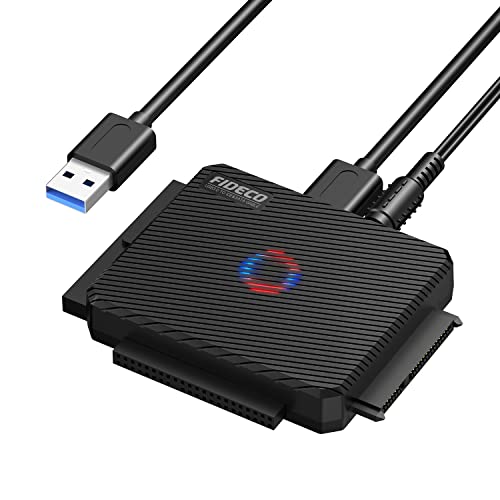
A FIDECO SATA/IDE to USB 3.0 Adapter makes the data-migration phase trivial: connect the old PS4 drive to a PC via USB to copy off any captured screenshots or video clips, then connect the new SSD to verify it before installing. The same adapter is useful for diagnosing a flaky drive or for confirming SMART data before committing to an install.
For a PlayStation 4 Pro 1TB Console buyer who has never opened the console before, the drive bay is on the right side and slides off without tools beyond the four caddy screws. The console design makes the upgrade unusually friendly — no thermal pad replacement, no warranty void, no factory seal cut.
Common pitfalls
- Trying an NVMe drive. The PS4 Pro's internal drive bay is 2.5" SATA. NVMe drives do not physically fit and would not be addressable if they did.
- Buying a 7 mm vs 9.5 mm drive without checking. The PS4 Pro accepts 9.5 mm and 7 mm drives, but the caddy may rattle with a 7 mm drive without a spacer. Most SSDs ship 7 mm; tape or a thin pad fixes the rattle.
- Forgetting save backups. Reinstalling the system erases the existing drive. Save backups are mandatory.
- Skipping the full system reinstall. Cloning the old drive to the new one is possible but more error-prone than the official PS Safe Mode reinstall path. The reinstall is the supported path.
- Choosing a 240 GB SSD to save money. It is not enough for modern game libraries. The price gap to 480 GB is usually small.
- Buying an external USB SSD instead of an internal swap. External SSDs work and are easier to install, but the system runs them through USB 3.0 and you lose direct SATA access to the system drive. For internal storage, the swap is worth doing.
When NOT to upgrade
If you mostly play one game at a time, you have no save data you care about preserving, and the stock drive's load times do not bother you, an SSD upgrade may not be worth the effort. The improvement is real but bounded; a CPU-bottlenecked game does not become a different game on an SSD. If your library is small enough that the stock 1 TB is fine, save the money.
Worked example: a 2026 PS4 Pro upgrade
Starting state: 6-year-old PS4 Pro with the stock 1 TB mechanical drive, 90% full, RDR2 install at 110 GB, GTA V at 100 GB, several smaller titles. Stock RDR2 fast-travel times averaged ~45 seconds, GTA V Online lobby loads ~30 seconds.
Upgrade path: 1 TB Samsung 870 EVO SATA SSD installed via the standard caddy swap, system reinstalled from the official PS4 safe-mode firmware image, saves restored from PlayStation Plus cloud, games reinstalled from disc and PSN over a week.
Outcome: RDR2 fast-travel times dropped to ~24 seconds, GTA V Online lobby loads to ~18 seconds. UI navigation felt noticeably snappier on the home screen and in-game pause menus. No further audible hard-drive noise from the console.
Endurance and longevity
Modern SATA SSDs all rate their endurance in TBW (terabytes written) and the BX500 1TB lists 360 TBW, the 870 EVO 1TB lists 600 TBW. A PS4 Pro library install pattern writes a few hundred gigabytes per major game install and a few gigabytes per save. Even a heavy user is unlikely to write more than 1-2 TB in a year. At that pace, both drives last well beyond the console's expected useful life. Endurance is not a tiebreaker for the PS4 Pro role; it would matter on a desktop video-editing workstation, not here.
What about external USB SSDs?
A PS4 Pro can use an external USB 3.0 storage device as "extended storage," which lets you install most PSN games on the external drive while keeping system files on the internal. This is the easier path if you do not want to crack the case. The performance is similar to an internal SATA SSD because USB 3.0 has comparable real-world throughput to SATA III, and the install/uninstall friction is lower.
The internal swap is still preferable for two reasons. First, you do not have to deal with a USB drive hanging off the back of the console. Second, the internal slot has been deliberately engineered for swap by Sony, with a clean cover and clearly documented procedure. External storage is fine; internal upgrade is cleaner.
Bottom line
For a PS4 Pro SSD upgrade in 2026, both the Crucial BX500 1TB SATA SSD and the Samsung 870 EVO SATA SSD are correct choices — the console's SATA III interface flattens any performance difference between modern 2.5" SATA drives. Take the 870 EVO if the price gap is small for the longer warranty and DRAM cache, the BX500 if budget is tight. A SanDisk SSD Plus 480GB is a viable budget option for smaller libraries. Add a FIDECO SATA/IDE to USB 3.0 Adapter for old-drive diagnostics or save migration. For a still-loved PlayStation 4 Pro 1TB Console in 2026, the upgrade is one of the cheapest ways to extend the system's useful life by several years.
Citations and sources
- TechPowerUp — SSD specifications database
- Crucial — BX500 SSD product page
- Tom's Hardware — Best SSDs review
This piece is editorial synthesis based on publicly available information. No independent first-party benchmarking is reported.