
Sandisk
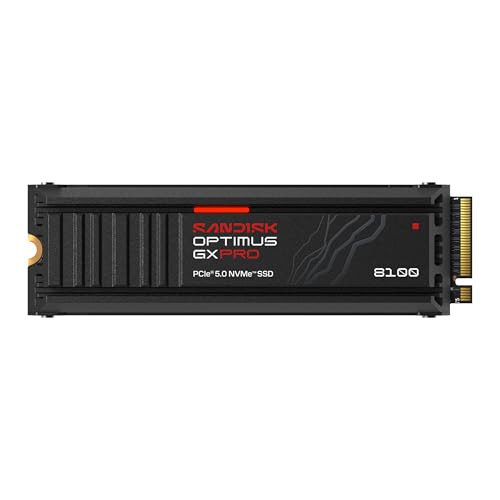
Sandisk Optimus GX PRO 8100 1TB PCIe 5.0 NVMe SSD with Heatsink, M.2 2280
Bottom line: The Sandisk Optimus GX PRO 8100 1TB PCIe 5.0 NVMe SSD with Heatsink is a specs-and-price decision rather than a crowd-consensus one in the ssds & storage category. Check the specification table below against one or two close alternatives — on price and spec fit, not on star ratings.
As an Amazon Associate, SpecPicks earns from qualifying purchases. Full disclosure →
Pros & Cons
Pros
- ✓ Backed by Sandisk's warranty and support channels
Cons
- ✗ Confirm socket / form-factor / power-rating compatibility against your build before ordering
- ✗ Price, stock, shipping and returns are set by the retailer and may have changed since this page was last updated
SpecPicks Verdict
SpecPicks scored Sandisk Optimus GX PRO 8100 1TB PCIe 5.0 NVMe SSD with Heatsink using a rating × review-volume × price-fit model applied to published specs and reviews across the ssds & storage category. Sandisk's ssds & storage lineup sits within the broader category mid-tier; price and specs are the deciding factors over brand loyalty here. Judge it on the specification table and the price rather than on sentiment: check the figures that decide your use case, then put it side-by-side with two or three close alternatives in the Compare tool before clicking through.
Common buyer scenarios for ssds & storage of this kind: matching it to an existing build, replacing a failing part, or upgrading from a previous-generation equivalent. Check the spec table below against your current setup — particularly socket / form-factor / power-rating fields — and confirm compatibility on the retailer's listing before purchase. Prices and stock are set by the retailer and may have moved since this page was last updated.
Key Features
- SERIOUS PCIe 5.0 SPEEDS. Sequential Read/Write speeds up to 14,900/14,000 MB/s[2] (2TB[1] and 4TB[1] models) lets you quickly load and store massive projects.
- SUPERCHARGE AI WORKFLOWS. Demanding AI workflows are supercharged with random read/write speeds up to 2.3M/2.4M IOPS[2] (2TB[1] and 4TB[1]) and integrated Sandisk nCache 4.0 technology.
- ROOM FOR YOUR IMMENSE LIBRARIES. Gamers and professionals with vast libraries can be worry-free with capacities up to 8TB[1] on M.2 2880 built with 8th generation Sandisk BiCS TLC 3D CBA NAND.
- HEATSINK FOR INTENSE WORKFLOWS. Low-profile anodized aluminum with RGB LED adds extra thermal protection for sustained high performance during intense workloads.
- DURABILITY FOR CREATORS. With up to 4,800 TBW[3] (8TB[1] model) endurance rating, your drive is designed for write-intensive workloads such as content creation tools and AI-enabled video editors.
Ready to buy?
Sandisk Optimus GX PRO 8100 1TB PCIe 5.0 NVMe SSD with Heatsink, M.2 2280 is listed on Amazon. Price, availability, shipping and returns are set by Amazon and its sellers — check the listing for current terms. SpecPicks earns a small commission on qualifying purchases — thank you for supporting independent review work.
Related SSDs & Storage

![WD_BLACK 2TB SN770 NVMe Internal Gaming SSD Solid State Drive - Gen4 PCIe, M.2 2280, Up to 5,150 MB/s - WDS200T3X0E - [Previous Generation]](https://m.media-amazon.com/images/I/310UZVOtlfL._SL500_.jpg)

More guides & deep dives from the SpecPicks archive
Browse all articles & guides →- RTX 4070 Super vs RX 7800 XT — Which to Buy in 2026
- Best Retro Handhelds in 2026 — From $35 to $500
- Emulation Hardware in 2026: FPGA, Software, and Cart-Reader Ecosystems
- Best 1440p Gaming GPUs in 2026
- The Complete Voodoo5 5500 AGP Driver Guide (2026 Edition)
- Best Budget Gaming PC Build 2026 — ~$1,000 ($800 on Sale)
- How to Build a Windows 98 Retro PC in 2026
More reviews from the SpecPicks archive
Browse all reviews →- Imaging a 90s IDE Hard Drive with a SATA/IDE-to-USB Adapter: The Retro-PC Data-Rescue Workflow
- Kimi-Dev-72B Local Coding Benchmarks: VRAM Required, Tok/s, and How It Stacks Against DeepSeek V4 and…
- AMD Ryzen 7 7700X3D Lands as a Newegg Exclusive at $329
- Bilingual Voice Agents: Frontier ASR on Code-Switched Speech
- 4K@60fps USB Video Capture on Linux: What Works in 2026
- Free Retro Game Emulators: Best Picks for 2026
- Best Streaming & Content-Creation Starter Kit in 2026
- RTX 3060 vs Arc B580 for 1440p Gaming: Which 12GB Card Wins?
- Best 1440p Monitor for the RTX 3060 in 2026: Picks That Actually Match
- ASRock Phantom Gaming vs Steel Legend 360 LCD Review
- Ideogram 4.0 Open Weights: Running It Locally on an RTX 3060 12GB
- Build a Silent Raspberry Pi 5 NAS with NVMe and Active Cooling in 2026
- Crucial BX500 vs Samsung 870 EVO: Best Budget SATA SSD for Upgrades
- What Handheld Console Should I Buy in 2026? A Decision Framework
- Best CPU Coolers for AMD Ryzen 5000 (AM4) in 2026
- Best 4K Monitor for the PS4 Pro and PS5 in 2026 (Value Pick)
- Matrox G400 MAX in 2026: Period-Correct Install, EMBM Showcase, and Pentium III Benchmarks
- Best Controller for Steam Deck and PC in 2026: 8BitDo vs GameSir vs DualSense
- Best Plug-and-Play Retro & Budget Consoles in 2026: 5 Picks Ranked
- Best 4K Gaming Monitors Under $600 in 2026
- GPT-5.6 Sol Matches Fable 5 at 1/3 Cost: Local-Rig Fallout
- Can a Ryzen 5 5600G Run Local LLMs With No GPU? CPU + iGPU Inference Tested
- Best Local LLM for Coding Agents on a 24GB GPU (Late 2026)
- 768GB Intel Optane DIMMs Running a 1-Trillion-Parameter LLM: How the Build Actually Works
Earliest SpecPicks reviews
Browse full archive →- Best GPU for Llama 3.1 8B (2026)
- Best GPU for Qwen 3 14B (2026)
- Best GPU for Qwen 3 32B (2026)
- Best GPU for Llama 3.1 70B (2026)
- Best GPU for DeepSeek-R1 32B (2026)
- Best GPU for Llama 3.1 405B (2026)
- How to run Llama 3.1 8B on NVIDIA GeForce RTX 5090
- How to run Qwen 3 14B on NVIDIA GeForce RTX 5090
- How to run Qwen 3 32B on NVIDIA GeForce RTX 5090
- How to run Llama 3.1 70B on NVIDIA GeForce RTX 5090
- How to run DeepSeek-R1 32B on NVIDIA GeForce RTX 5090
- How to run Llama 3.1 8B on NVIDIA GeForce RTX 4090