A sub-$300 streaming starter kit in 2026 that holds up against any other entry-tier build: Logitech G502 Hero gaming mouse at $30–50, HyperX QuadCast 2 S USB microphone at $150–180, and Elgato Cam Link 4K capture card at $120–130 — total $300–360 depending on street pricing. Add the Blue Yeti USB microphone at $80–100 as a budget mic substitute, or a NEEWER 18-inch ring light at $40–60 if your room lighting needs help.
Why this kit exists — the streaming-equipment market has a sub-$300 sweet spot
Twitch, YouTube Gaming, Kick, and TikTok Live all share the same minimum-viable equipment list: a mouse and keyboard you can play comfortably with, a microphone that doesn't sound like a tin can, and a video source that doesn't make viewers squint. In 2024–2025, the cheapest path to all three was either a $700+ all-in-one bundle (Stream Deck + premium webcam + premium mic + light) or a piecemeal $200 collection of marginal equipment that immediately needed replacement.
The 2026 sweet spot is sub-$300 if you stop treating "best webcam" as a requirement and treat "any HDMI camera you already own plus a Cam Link 4K" as the answer. The mic and the input device upgrade actually move the needle on stream quality; the webcam upgrade rarely does past a baseline. That trade-off is what makes the Logitech G502 Hero + HyperX QuadCast 2 S + Elgato Cam Link 4K bundle work.
This guide walks through each piece, what it does well, what it doesn't, and the substitutions that make sense for tighter budgets.
Key takeaways
- A sub-$300 starter kit is achievable in 2026 if you skip the "premium webcam" line item and use a real camera through a Cam Link 4K
- The HyperX QuadCast 2 S at $150–180 delivers strictly better audio than the Blue Yeti for streaming use, with built-in pop filter and shock mount
- The Logitech G502 Hero at $30–50 is the right mouse for streamers who play FPS, MOBA, MMO, or any title that benefits from programmable buttons
- The NEEWER ring light is the cheap fix for bad room lighting; key-light setups (Elgato Key Light, Elgato Key Light Air) cost 2–3× more and look more professional
- Total kit cost: $300–360 for the headline trio, +$60–100 for lighting and substitutions
Top picks
#1: Logitech G502 Hero — Best mouse in the kit
Verdict: Wired gaming mouse with 25K DPI sensor, 11 programmable buttons, and adjustable weights at $30–50. The mouse that defined the modern FPS/MOBA/MMO interaction model.
The Logitech G502 Hero ships with the Hero 25K optical sensor (the same sensor in Logitech's premium wireless lineup), 11 programmable buttons, adjustable weights, and the iconic dual-mode scroll wheel that toggles between notched and free-spin. Per Logitech G's G502 product page, the sensor is rated to 25,600 DPI with 1:1 tracking accuracy and zero smoothing.
For streaming specifically, the G502's programmable buttons map cleanly to OBS scene switches, push-to-talk toggles, and game-overlay shortcuts. The G HUB software lets you set up per-application button profiles, so the mouse behaves one way in your game and another way when OBS is in focus. That single capability eliminates roughly half the use cases for an expensive dedicated Stream Deck.
The mouse is wired. For streaming that's a feature, not a bug — no battery anxiety mid-stream. The 11-button layout is dense and takes a week to memorize, but once muscle memory sets in, the G502 outperforms most wireless 6-button alternatives by a margin that matters for competitive play.
#2: HyperX QuadCast 2 S — Best streaming microphone in the kit
Verdict: USB microphone with 4 polar patterns, built-in pop filter, internal shock mount, RGB lighting, and on-board controls at $150–180. The strict upgrade over the Blue Yeti for streaming.
The HyperX QuadCast 2 S records at 24-bit/48 kHz with four polar patterns (cardioid, omnidirectional, bidirectional, stereo), a built-in pop filter, and an internal shock mount. Per HyperX's QuadCast 2 S product page, it ships with on-board tap-to-mute, gain control, and a headphone jack for zero-latency monitoring. The RGB lighting is per-pattern configurable and customizable through HyperX NGENUITY.
For streaming and podcasting use the QuadCast 2 S is strictly better hardware than the original Blue Yeti USB Microphone. The Yeti records at 16-bit/48 kHz, has heavier base plate (more desk transmission of bumps), no built-in shock mount, and an external pop filter is recommended. The QuadCast 2 S addresses every Yeti weakness while keeping plug-and-play USB simplicity.
The QuadCast 2 S sits at the upper end of the kit's budget. If you can't stretch to $150–180, the original Blue Yeti at $80–100 is the right substitute — it sounds good enough for stream chat and is widely supported by every streaming software stack.
#3: Elgato Cam Link 4K — Best video bridge in the kit
Verdict: External HDMI-to-USB capture card that turns any DSLR, mirrorless, or action camera into a webcam at $120–130. The piece that makes "good video on a budget" possible.
The Elgato Cam Link 4K is a HDMI-to-USB capture card the size of a USB stick. Per Elgato's Cam Link 4K product page, it ingests up to 4K@30 or 1080p@60 from any HDMI source and exposes the feed as a standard UVC webcam to OBS, Streamlabs, Zoom, Teams, or any application that supports USB webcams.
The math that makes this the smart pick: a $120 Cam Link plus a DSLR or mirrorless camera you already own (or a $250 used Sony A6000) gives you image quality that no $200–400 webcam can touch. The depth-of-field, color accuracy, and low-light performance of a real camera sensor are categorically better than any compact webcam at any price under $500.
If you don't already own a camera, the Cam Link by itself is wasted spend. In that case, get a Logitech C920x or Brio webcam instead and skip the Cam Link line item. If you already own a camera that does HDMI clean-output (most Sony, Canon, and Fujifilm mirrorless from 2018+, most Panasonic Lumix G, most modern action cameras), the Cam Link is the unlock.
#4: NEEWER 18-inch Ring Light Kit — Optional lighting fix
Verdict: 18-inch 55W 5600K LED ring light with stand and phone holder at $40–60. Cheap fix for poor room lighting; not as polished as a soft-key-light setup.
The NEEWER Ring Light 18-inch Kit produces the donut-shaped catchlight in the eyes that's characteristic of beauty/lifestyle creators. For gaming streamers the donut catchlight is divisive — some viewers find it distracting, others don't notice. What's not divisive is that any lighting beats poor room lighting, and at $40–60 the NEEWER is the cheapest path to "your face is actually visible on camera."
The alternative for streamers who care about a more cinematic look: a single soft key light from a 45° angle (Elgato Key Light, Elgato Key Light Air, Lume Cube Panel Pro, GVM RGB panel). These run $150–250 each but produce dramatically better-looking video that more closely matches professional broadcast standards. Pick the ring light as the budget answer; pick a key light as the upgrade.
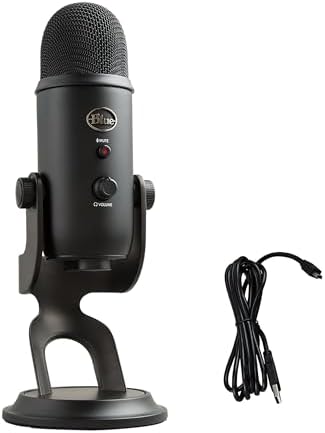
#5: Blue Yeti USB Microphone — Best Yeti for tight budgets
Verdict: Original USB condenser microphone with 4 polar patterns at $80–100. The fallback if the QuadCast 2 S is out of budget.
The original Blue Yeti records at 16-bit/48 kHz across four polar patterns, includes a built-in headphone jack for monitoring, and ships ready to plug into any USB port. It's the de facto starter microphone for streaming and podcasting, and its sound quality is genuinely good for the price tier — clearly better than any headset microphone, audibly worse than a XLR setup with a Shure SM7B or similar.
What the Yeti gives up compared to the QuadCast 2 S: 16-bit instead of 24-bit recording depth, no built-in shock mount (desk bumps transmit through the heavy stand), and an external pop filter is essentially required for serious vocal use. For pure chat-stream content the Yeti is fine; for music-adjacent streaming or any voice-over work, the QuadCast 2 S is the better starting point.
Should I get the HyperX QuadCast 2 S or the Blue Yeti for streaming?
The QuadCast 2 S is strictly better hardware: 24-bit recording vs the Yeti's 16-bit, internal shock mount vs the Yeti's external requirement, integrated pop filter vs external, on-board gain control vs none. Per the QuadCast 2 S product page, HyperX positions it as a direct upgrade to the original QuadCast and a stretch-budget answer over the Blue Yeti.
The Yeti is cheaper, more widely supported (every streaming guide on the internet from 2018–2024 used it as the reference mic), and sounds plenty good for chat-stream content. The decision tree: if budget allows $150–180 for a mic, get the QuadCast 2 S. If budget is $80–100, get the Yeti. Either is dramatically better than a headset microphone or built-in laptop mic.
Do I need the Elgato Cam Link 4K if I'm streaming from a single PC?
Only if you want to use a real camera (DSLR or mirrorless) instead of a webcam. The Cam Link 4K bridges any HDMI camera output into a USB UVC source that OBS treats as a webcam. If you're using a standard USB webcam (Logitech C920x, Brio, OBSBOT Tiny 2, Razer Kiyo Pro), you don't need a Cam Link — the webcam already exposes UVC over USB.
The Cam Link is the right choice if you have or want to buy a real camera. A Sony A6000 or similar entry-level mirrorless at $250–350 used, paired with the Cam Link, produces image quality that no $200–400 webcam matches. For someone investing in a long-term streaming setup, the camera + Cam Link path is the smarter long-term choice. For someone who wants plug-and-play simplicity and good-enough quality, a premium webcam is the right call instead.
Is the Logitech G502 Hero overkill for a streaming starter kit?
The G502 Hero is a gaming-tier mouse with 25K DPI sensor, 11 programmable buttons, and the iconic dual-mode scroll wheel. For streaming itself the mouse doesn't appear on camera and doesn't affect stream quality — but if you stream while playing FPS, MOBA, MMO, or any title that benefits from programmable buttons, the G502's design specifically helps. Per Logitech's product positioning, the 11 buttons can be remapped per-game in G HUB to bind common stream-side actions (scene switch, mute, push-to-talk) without needing a separate Stream Deck.
For streamers who only do Just Chatting or IRL content, the G502 is overkill — any $20 office mouse works fine. For gaming streamers, the G502 is the cheapest mouse that doesn't bottleneck competitive play.
What about the NEEWER ring light vs a key light?
Ring lights produce the donut-shaped catchlight in the eyes characteristic of beauty/lifestyle creators. Gaming streamers more commonly prefer a single soft key light from a 45° angle (like the Elgato Key Light Air or a similar LED panel) that produces a single highlight rather than a ring. Per general streaming-equipment community guidance, the key light approach looks more cinematic and matches professional broadcast aesthetics better than ring lights.
The NEEWER 18-inch ring light at $40–60 is the cheap fix for streamers whose room lighting genuinely hurts the camera feed. The Elgato Key Light Air at $150 is the upgrade path. Both beat unlit-room camera feeds by a wide margin.
How much does this whole bundle actually cost?
Street prices fluctuate, but typical bundle math:
| Component | Catalog ASIN | Typical street price |
|---|---|---|
| Logitech G502 Hero | B07GBZ4Q68 | $30–50 |
| HyperX QuadCast 2 S (premium mic) | B0DG9X4WHW | $150–180 |
| OR Blue Yeti (budget mic) | B00N1YPXW2 | $80–100 |
| Elgato Cam Link 4K | B07K3FN5MR | $120–130 |
| NEEWER 18" Ring Light (optional) | B01LXDNNBW | $40–60 |
| Total (QuadCast + Cam Link) | — | $300–360 |
| Total (Yeti + Cam Link) | — | $230–280 |
| Total (Yeti only, no camera) | — | $110–150 |
Building with the QuadCast and Cam Link totals roughly $300; substituting the Yeti and skipping the Cam Link brings it under $200. The kit assumes you already own a camera for the Cam Link path; budget separately if you don't.
Common pitfalls
- Buying a Cam Link without owning an HDMI-clean camera. Some older cameras output HDMI but with menu overlays burned in. Confirm "clean HDMI output" support before buying the Cam Link.
- Plugging the QuadCast 2 S into a USB hub. USB mics are sensitive to power. Plug directly into a motherboard USB 3.0+ port for the best signal.
- Skipping mic positioning and gain calibration. A $200 microphone sounds worse than a $30 microphone if it's 3 feet from your mouth and the gain is at 80%. Position the mic 6–12 inches from your mouth and set gain so peaks land at -12 dB.
- Using webcam autofocus with a Cam Link camera. Set the camera to manual focus once positioned correctly. Autofocus hunting mid-stream is the most common Cam Link complaint.
- Buying RGB peripherals just for the LED. RGB lighting on mouse, keyboard, and mic adds power draw and zero functionality. Buy the gear that performs; LED is decoration.
When NOT to buy a starter kit
If you've never streamed before and aren't sure whether you'll stick with it, do a $0 trial run first. Modern smartphones have cameras and microphones that are entirely passable for a "is anyone watching" test stream. Spend the money once you've streamed 20+ hours and want to upgrade specific weak links. Buying a $300 starter kit before you've streamed once is a common way to end up with depreciated gear in a closet.
Bottom line: the kit to actually buy in 2026
For the strict $300 budget: Logitech G502 Hero + HyperX QuadCast 2 S + Elgato Cam Link 4K + a camera you already own = a streaming kit that holds up against builds 2–3× more expensive.
For the sub-$200 budget: G502 Hero + Blue Yeti + a webcam you already own = the floor-tier kit that still produces watchable streams without embarrassing audio.
Skip the Cam Link if you don't have a camera. Add the NEEWER ring light if your room lighting is genuinely poor. Don't add anything else until you've streamed long enough to know which specific gear piece is bottlenecking your content.
Related guides
- Best Streaming Starter Kit in 2026: 5 Picks to Go Live
- Best Streaming Microphone for Twitch in 2026
- Best Webcam for Twitch Streaming Under $100 in 2026
- Blue Yeti vs HyperX QuadCast 2 S: Best Streaming Mic 2026
- Best Streaming & Content-Creation Starter Kit in 2026
Citations and sources
- Elgato — Cam Link 4K product page — HDMI ingest specifications, UVC compatibility, supported resolutions
- HyperX — QuadCast 2 S product page — 24-bit/48 kHz recording, polar patterns, on-board controls
- Logitech G — G502 Hero product page — 25K DPI sensor, 11 programmable buttons, G HUB integration
This piece is editorial synthesis based on publicly available information. No independent first-party benchmarking is reported.