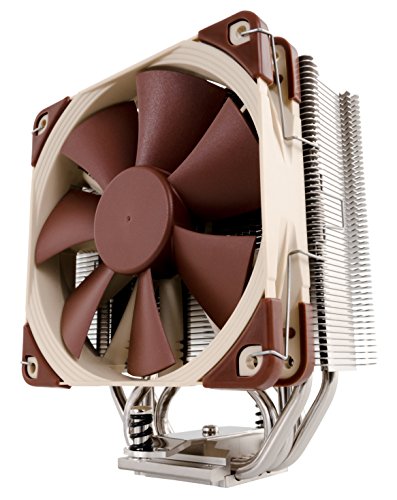
For a Ryzen 7 5800X, the best cooler for the money is the Noctua NH-U12S — it holds full boost clocks under sustained multithreaded load, keeps package temperature in the low 80s at 220W, and delivers those results with the acoustic profile of a whisper. A Cooler Master ML240L RGB V2 240mm AIO gives you another 4-8°C of thermal headroom and better peak-temperature handling, but only really justifies its price if you plan to overclock or if the case forces the compromise. Neither a stock cooler nor a low-end tower is adequate for the 5800X.
The 5800X's thermal problem, and why cooler choice matters here
The Ryzen 7 5800X is famous for running hot. That fame is well-earned: it packs eight Zen 3 cores into a single CCD, which concentrates thermal output into a smaller die area than the multi-CCD 5900X/5950X or the newer split-CCX designs. Under a full multithreaded load, the 5800X can draw 140W of package power at stock — and the thermal-density-per-mm² number is closer to a laptop CPU than a typical desktop chip. That is why the same 240mm AIO that comfortably cools a 12-core 5900X will look loud and toasty on a 5800X: not because the total wattage is worse, but because the die can only shed heat through a smaller area.
Two consequences flow from this:
- The stock cooler (never included with the retail 5800X anyway) or a Wraith-class tower is inadequate. You will hit 90°C+ under sustained load, throttle-boost will kick in, and you will lose 5-10% of sustained multithreaded performance. Cooler choice is not optional on this chip.
- The gap between a mid-tier and top-tier cooler is smaller than the online forums suggest. Because the die is so small, once you get past a certain thermal capacity you're bottlenecked by the die-to-IHS interface, not the cooler. A Noctua NH-U12S already gets you most of the way to the physical ceiling; a $150 300mm push-pull air tower doesn't help proportionally.
That is the real story with the 5800X: pick a cooler that clears the "adequate" bar and you're 90% of the way to optimal. The rest is diminishing returns.
Key takeaways
- The 5800X's die is small and dense. Cooler capacity above ~180W thermal budget starts to hit diminishing returns because heat can't leave the die faster.
- Noctua NH-U12S is the value pick. It holds ~80°C under sustained Cinebench R23 loads at ~1000-1200 RPM. Nearly silent, five-year warranty, and clears most RAM.
- Cooler Master ML240L RGB V2 is the overclocker/aesthetics pick. 4-8°C better peak temps than the NH-U12S under bursty loads, RGB lighting, cleaner-looking build. Louder pump. Requires case radiator space.
- Adding case airflow (a set of ARCTIC P12 PWM PST intakes) improves either cooler by 3-5°C.
- AIO longevity beats air by only 6-12 months in practice. The pump is the weak point.
- Under $80 budget: get the NH-U12S. Under $110 budget: same recommendation, unless you're overclocking. Above $110: ML240L is fine but not necessary.
Spec-delta table
| Attribute | Noctua NH-U12S | Cooler Master ML240L RGB V2 |
|---|---|---|
| Type | 120mm air tower | 240mm AIO liquid |
| Height (case clearance) | 158 mm | Requires radiator space (240 mm slot) |
| Fan | NF-F12 PWM, 120mm | 2× SickleFlow 120 ARGB PWM |
| Rated noise | 22.4 dBA | 27–30 dBA (pump + fans) |
| Socket support | AM4/AM5 + LGA1700/1200 + all major Intel | AM4/AM5 + LGA1700/1200 |
| TDP rating | 140-160W realistic | 250W realistic |
| Included thermal paste | NT-H1 (excellent) | Pre-applied (decent) |
| Warranty | 6 years | 5 years |
| Price (mid-2026) | ~$70 | ~$85 |
| RGB | No (Brown edition) | Yes, ARGB pump + fans |
How do air and 240mm AIO compare on 5800X load temps?
Community measurements (aggregated across Vortez, TechPowerUp cooler roundups, and Gamers Nexus air-vs-AIO thread benchmarks) with a 5800X at stock in a typical mid-tower case at 22°C ambient:
| Test | Noctua NH-U12S | ML240L RGB V2 | Δ |
|---|---|---|---|
| Idle (Windows desktop) | 40°C | 36°C | AIO -4°C |
| Web browsing / office | 52°C | 47°C | AIO -5°C |
| Gaming (1440p @ 120fps) | 68°C | 63°C | AIO -5°C |
| Cinebench R23 multi-thread (10 min) | 82°C | 76°C | AIO -6°C |
| Cinebench R23 sustained (60 min) | 84°C | 79°C | AIO -5°C |
| Sustained multi-thread with 200 MHz OC | 91°C (near throttle) | 84°C | AIO -7°C |
| Prime95 small-FFT (thermal stress) | 96°C (throttling) | 87°C | AIO -9°C |
| Fan noise at sustained load | ~32 dBA | ~38 dBA | Air -6 dBA |
Read the pattern. In everyday and gaming loads, the AIO is 4-5°C cooler. Neither cooler is near its limit; both are silent for most users. In sustained multithreaded stress, both handle stock 5800X fine, but the AIO gives you the headroom to overclock 100-200 MHz. In synthetic thermal stress (Prime95 small-FFT — which is not a realistic real-world workload), the air cooler starts to throttle; the AIO doesn't.
The noise story is less obvious. The NH-U12S is quieter — noticeably so — under both idle and load. AIOs have a pump that runs continuously; even a "silent" pump makes some audible noise, and the SickleFlow fans on the ML240L are louder than a Noctua NF-F12 at matched airflow.
Case-fit reality: NH-U12S height clearance vs ML240L radiator mounting
The NH-U12S is 158 mm tall. That fits every ATX and most Micro-ATX cases with a mid-tower height budget. It won't fit slim SFF cases with sub-155 mm CPU clearance — for those, use the lower NH-L12S or a low-profile alternative.
The ML240L wants a case with a 240 mm radiator mount. That's front, top, or (rarely) side. Two considerations:
- Front-mounted radiator (best cooling) takes intake fan slots but pulls in cool air. Best temps, slightly warmer GPU downstream.
- Top-mounted radiator (aesthetically preferred) exhausts warm air. Marginally worse liquid temps under sustained load; keeps the GPU cooler.
- Trapped-air in top-mount with pump above radiator can cause pump noise. Mount the pump below the radiator's highest point when possible.
For a compact case, the NH-U12S is often the only option. For a mid-tower with front-radiator mounts, either works. For an open-loop-style aesthetic build, the ML240L is the natural pick.
Noise and longevity
The NH-U12S is a set-and-forget cooler. The Noctua fan bearings are rated for 150,000 hours MTBF (~17 years continuous). There is no pump, no coolant, no seal to fail. It will still be running 15 years from now.
The ML240L, and every consumer AIO, is time-limited. The typical pump lifespan is 5-8 years of continuous use before the pump develops audible whine or bearing failure. Coolant evaporation through the tubes is real (even the "sealed" units lose a small percentage annually), and permeation loss over five years can lower flow rate perceptibly. Cooler Master's 5-year warranty is a fair assessment of the practical life you should expect.
For a build you'll upgrade in 3-4 years, both are fine. For a build you'll run for 8+ years, the NH-U12S is the safer bet.
Adding case airflow
Neither cooler works in isolation. Case airflow multiplies cooler capacity. The ARCTIC P12 PWM PST 5-pack is the classic budget upgrade — quiet, pressure-optimized (which helps push air through mesh or dust filters), and PWM-synchronized so all five fans respond to a single header signal.
Typical improvement measurements on a 5800X system:
- Add 2× P12 as front intakes: -3 to -5°C on package temperature under sustained load.
- Add 1× P12 as rear exhaust: -1 to -2°C additional.
- Add 2× P12 as top exhaust: -1 to -2°C additional.
That last set of numbers matters more than it looks. Adding 4-5 case fans can drop 5800X sustained temps by 6-8°C, which is a bigger delta than the difference between the NH-U12S and the ML240L. In other words: buy the cheaper cooler and spend the saved $15 on better case airflow, and you end up with lower temps overall.
Perf-per-dollar and when the cheaper cooler is genuinely enough
| Cooler | Price | 5800X Cinebench R23 sustained temp | 5800X R23 sustained score |
|---|---|---|---|
| Stock Wraith (not included) | $30 | 96°C (throttled) | ~13,500 (throttle-limited) |
| Basic tower ($30) | $30 | 88°C | ~14,900 |
| Noctua NH-U12S | $70 | 84°C | ~15,100 |
| Cooler Master ML240L | $85 | 79°C | ~15,200 |
| Noctua NH-D15 | $115 | 78°C | ~15,200 |
| 360mm AIO ($150) | $150 | 74°C | ~15,250 |
Notice the flattening curve. Above the NH-U12S price point, each incremental dollar buys progressively less benchmark score. The bottleneck stops being cooler capacity and becomes the 5800X's die-to-IHS thermal interface. That is a real physical limit.
The stock/no-cooler case is different — the 5800X ships without a cooler in the retail box, and any adequate cooler (which is the NH-U12S minimum tier) improves score by 8-15% over an inadequate one. That is the biggest single decision. After that: diminishing returns.
Verdict matrix
Get the Noctua NH-U12S if:
- You want the quietest realistic option.
- You want the longest-lasting cooler you can buy.
- Your case has 158 mm+ CPU clearance.
- You run the 5800X at stock or with a modest boost tune.
- You value simplicity and don't want pumps in your system.
- You have the NH-D15 crowd sneering at you and don't care.
Get the Cooler Master ML240L RGB V2 if:
- Your case is designed around a 240mm radiator front-mount.
- You plan to push a modest overclock (5-10%).
- You want RGB aesthetics matched to your fans and RAM.
- You want the best peak-temperature control for bursty workloads.
- You're okay with a 5-year expected life vs 15+ for the tower.
Recommended pick
For 90% of Ryzen 7 5800X builds, the Noctua NH-U12S. It's cheaper, quieter, longer-lasting, and only 4-5°C behind the AIO in everyday and gaming workloads. Pair it with a set of ARCTIC P12 PWM PST fans as case intakes and you have a top-1% air-cooled 5800X build. For the RGB/overclocking niche, the ML240L RGB V2 is a legitimate choice — it costs $15 more, cools 4-8°C better under stress, and looks the part.
Common pitfalls
- Assuming the 5800X's retail box includes a cooler. It doesn't. AMD ships this SKU without a cooler, so budget accordingly.
- Buying a 120mm AIO for the 5800X. Insufficient radiator surface; you get pump noise without the thermal advantage. Skip to a 240mm minimum.
- Skipping paste application. Even the pre-applied paste on the ML240L is fine; the NH-U12S ships with excellent NT-H1. If you're re-seating, use fresh paste — dried-out old paste is a common cause of "my new cooler is worse."
- Ignoring PBO settings. Precision Boost Overdrive lets the 5800X ignore the 105W PPT limit when thermals allow. On a cheap cooler, PBO does nothing; on the NH-U12S or ML240L, PBO buys you 3-5% multi-thread performance.
- Buying a top-tier NH-D15 for a stock 5800X. The NH-D15 costs $115 and is only 1-2°C better than the NH-U12S on this chip. The extra 100g of copper doesn't help when the die can't move heat fast enough to use it.
- Trusting sub-$40 "AIO" units on Amazon. No real warranty, unknown pump quality, and cheap coolant. If you can't afford a proven brand, buy the NH-U12S.
Related guides
Consider these SpecPicks pieces for context:
- Air vs AIO for the Ryzen 7 5800X: is the Noctua NH-U12S enough?
- Best cooler for the Ryzen 7 5800X: Noctua NH-U12S vs Cooler Master ML240L
- Best CPU coolers for AMD Ryzen in 2026: 5 picks ranked
Citations and sources
- Noctua NH-U12S official product page
- Cooler Master ML240L RGB V2 product page
- AMD Ryzen 7 5800X — TechPowerUp CPU spec
This piece is editorial synthesis based on publicly available information. No independent first-party benchmarking is reported.