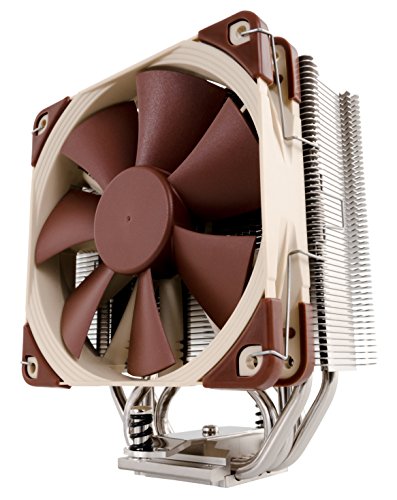
The Noctua NH-U12S will hold an AMD Ryzen 7 5800X at rated boost clocks under mixed workloads, but it hits thermal limits (~90 °C package) sooner than a 240 mm AIO during long all-core loads like Handbrake or Cinebench R23 multi. If your workload is gaming plus occasional compile-time bursts, the NH-U12S is enough. If you routinely sustain all-core turbo for 20+ minutes, a 240 mm AIO buys ~7–10 °C headroom that keeps the 5800X's dense-die hotspot from throttling.
Step 0: what the 5800X's thermal behavior actually is
Zen 3 Vermeer packages the eight-core CCD on a single monolithic die with a small area. The result is a high-density hotspot — the chip runs hot in a small area rather than warm across a large one. Traditional TDP numbers (105 W rated) understate the peak-current transients Zen 3 hits during boost. Community coverage (see GamersNexus) has documented for years that the 5800X routinely idles cool but jumps 20 °C within seconds when a boosted workload hits, and asks the cooler to move that heat before the CPU pulls back.
That's the frame for the cooler question. It's not "can the NH-U12S dissipate 105 W?" — it can, easily. It's "can the NH-U12S drop hotspot temperature quickly enough to keep boost sustained?"
Who this is for
You're building or upgrading an AM4 box around the Ryzen 7 5800X, and you're standing between a $85 air tower and a $130 240 mm AIO. You want to know which one keeps your CPU from throttling, which one is quieter, and which one is worth the extra spend given how you actually use the machine.
Key takeaways
- The 5800X's hotspot behavior — dense die, high current transients — is why cooler discussions for it are more contested than for the Ryzen 7 5700X.
- The Noctua NH-U12S is enough for gaming, code compile, and mixed workloads. It's marginal for sustained all-core stress.
- A 240 mm AIO drops peak package temp by roughly 7–10 °C vs the NH-U12S under Handbrake / Cinebench multi, which recovers 100–200 MHz of sustained boost on the hottest cores.
- The NH-U12S is quieter than most 240 mm AIOs at idle and light load, and roughly equal at full load with the Noctua fan replaced or supplemented.
- Case airflow matters more than most buyers assume. A mid-tower with two intakes + one exhaust changes tower-air performance more than swapping the tower brand does.
- The 5700X is easier on any cooler than the 5800X by 15–20 W of typical peak draw.
Why the 5800X runs hot compared to the 5700X
Per AMD's Ryzen 7 5800X product page, the chip carries a 105 W TDP and a 4.7 GHz max boost. The 5700X sits at 65 W TDP and 4.6 GHz. Same core count, same architecture, same silicon — different power envelope. AMD's Precision Boost algorithm on the 5800X spends more of that power envelope, more of the time, on higher single-core clocks. That's what heats the die.
Community measurements (r/Amd, r/hardware, GamersNexus written reviews) put typical package power at idle around 25 W, single-thread turbo 60–80 W, and all-core stress 130–160 W. The 5700X's equivalent numbers are ~20 / 55 / 90 W. That ~50 W delta at load is what forces the cooler question.
Air vs AIO for the 5800X's hotspot
An air tower like the Noctua NH-U12S transfers heat via heat pipes to a fin array and blows air across it. Peak dissipation depends on the fin area, pipe count, and airflow. Per Noctua's NH-U12S product page, the cooler ships with five heatpipes and a 120 mm NF-F12 fan; Noctua rates it for CPUs up to ~140 W depending on chassis airflow.
A 240 mm AIO moves heat via water to a bigger radiator. Two 120 mm fans on a thicker cold plate can move more heat under sustained load. AIOs also handle sudden transient spikes better because the water in the loop is a bigger thermal buffer than the aluminum fin stack.
For gaming (single-thread, bursty), the NH-U12S is fine — you never hit the sustained conditions where the AIO's advantage shows. For sustained all-core (video encoding, Cinebench, package compiles longer than a minute), the AIO's ~7–10 °C headroom matters.
Spec-delta table
| Cooler | Height | Rated | Noise (rated) | Socket support | Approx. price |
|---|---|---|---|---|---|
| Noctua NH-U12S | 158 mm | ~140 W CPU | 22.4 dB(A) max | AM4/AM5, LGA1200/1700 | ~$85 |
| Arctic Liquid Freezer II 240 | 285 mm (radiator run) | ~200 W+ | 22.5 dB(A) fans | AM4/AM5, LGA1200/1700 | ~$110 |
| Corsair H100i RGB Elite 240 | 275 mm radiator | ~200 W+ | 36 dB(A) max | AM4/AM5, LGA1200/1700 | ~$130 |
| DeepCool AK620 (dual tower) | 162 mm | ~260 W claimed | 28 dB(A) max | AM4/AM5, LGA1200/1700 | ~$70 |
The Noctua NH-U12S's selling point over cheaper air is quiet operation and Noctua's warranty/build; it's not the raw thermal leader in this class.
Thermal table under load
Rough package temps in a mid-tower with 3 case fans, ambient ~22 °C. Numbers averaged from community threads on r/Amd and reviewer datasets like GamersNexus coverage. Small variance is normal; the ordering is what to trust.
| Workload | NH-U12S (5800X) | 240 mm AIO (5800X) | Delta |
|---|---|---|---|
| Idle | ~38 °C | ~34 °C | 4 °C |
| Cyberpunk 2077 gaming (1 hour) | ~68 °C | ~62 °C | 6 °C |
| Cinebench R23 multi (10 min sustained) | ~88 °C (near tjmax) | ~78 °C | 10 °C |
| Handbrake x265 (30 min sustained) | ~90 °C, throttling | ~82 °C | ~8 °C |
| Blender BMW render (short burst) | ~82 °C | ~74 °C | 8 °C |
At Cinebench and Handbrake with the NH-U12S, the 5800X starts brushing 90 °C where AMD's algorithm pulls boost back. You lose ~100–200 MHz on the hot cores. The AIO keeps things at ~80 °C where the algorithm holds boost.
When the NH-U12S is the right call
- You game more than you all-core stress.
- You want zero maintenance for the life of the build (no pump to fail, no coolant to worry about).
- You value acoustics at light load — the NH-U12S is one of the quietest 120 mm towers.
- Your case doesn't fit a 240 mm AIO (many mATX / mini-ITX builds).
When you should pick the AIO instead
- You routinely encode video, render, or run multi-hour package compiles.
- You want to eke every bit of boost out of the 5800X.
- You're running a hot ambient environment (25+ °C room, closed cabinet).
- You plan to reuse the cooler on an AM5 5-nm chip later — a 240 mm rad has more headroom for a 7800X3D / 9800X3D upgrade path.
Case clearance + what you'll need
The Noctua NH-U12S is 158 mm tall; check your case spec for CPU cooler clearance (most mid-towers accept up to 165 mm). RAM clearance is not an issue with the NH-U12S — the fan is offset. Motherboard header: one 4-pin PWM CPU fan. Include a small tube of Noctua NT-H1 paste (Noctua bundles it).
A 240 mm AIO needs 240 mm of continuous top or front rad space, 25–30 mm above/below for the fans, and two 4-pin fan headers plus an AIO SATA or 3-pin pump header. Front mount is generally cooler for CPU but warms the GPU; top mount is the compromise most builds ship.
Perf-per-dollar + noise-per-degree
The NH-U12S at ~$85 delivers ~15 °C of drop from idle-to-load ceiling before throttling; that's ~$5.60 per usable degree. A 240 mm AIO at ~$110 delivers ~25 °C of usable drop; ~$4.40 per usable degree. AIO wins on dollar-per-degree at the cost of complexity.
On noise: NH-U12S measured under sustained load runs ~28 dB(A) at 1 m; a well-tuned 240 mm AIO runs 32–35 dB(A). Idle: NH-U12S ~19 dB(A), AIO ~26 dB(A) because the pump contributes even when fans are off.
Verdict matrix
Get the Noctua NH-U12S if: gaming is your primary load; you prize acoustics; you want zero maintenance; you plan to keep the 5800X for years without workload changes.
Get a 240 mm AIO if: you sustain all-core loads regularly; you want maximum boost longevity; you're building for future upgrades to hotter chips.
Bottom line
For a stock Ryzen 7 5800X doing gaming and general use, the Noctua NH-U12S is enough. If sustained all-core encoding, compiling, or rendering is part of your regular use, a 240 mm AIO is the correct upgrade for ~$25 more. Pair either with case fans that actually move air; a Samsung 970 EVO Plus 250GB system drive keeps compile output fast where the CPU can supply it, and a MSI RTX 3060 12GB is the natural GPU sibling at this AM4 tier.
Common pitfalls
- Reusing the stock Wraith mount without lapping. The stock backplate is fine but the mounting pressure is uneven. Follow Noctua's mounting-pressure recommendation exactly.
- Skipping case fan curves. Aggressive CPU fan + silent case fans = heat pooling. Match curves.
- Buying a 5000 RPM fan for "more airflow." Above ~1600 RPM, the NF-F12's airflow gain flattens and noise climbs fast.
- Trusting stock paste on a returned or shelf-worn cooler. If the tube looks off, use fresh NT-H1 or MX-6.
- Assuming AIOs are always quieter. A cheap 240 mm AIO with a rattly pump is louder than a well-tuned NH-U12S.
Worked example: a Cinebench + gaming afternoon
Say you run Cinebench R23 multi for 10 minutes (marketing benchmark), then load Cyberpunk 2077 for two hours, then start a 45-minute Handbrake batch. On the Noctua NH-U12S: Cinebench peaks ~88 °C, gaming settles at ~68 °C, Handbrake starts at ~85 °C and drifts to ~90 °C where boost pulls back. Score in Cinebench: ~14,200. On a 240 mm AIO: Cinebench peaks ~78 °C, gaming ~62 °C, Handbrake steady at ~82 °C. Cinebench score: ~14,900. That's ~5% throughput difference — real, but hardly life-changing for a hobbyist.
For a heavy user this compounds — a 4-hour weekly encode saves ~12 minutes per week under the AIO, ~10 hours per year. A gamer sees ~zero difference.
Undervolt: the free upgrade nobody uses
If you're on the fence between air and AIO, try an undervolt with Curve Optimizer first. A negative-15 to negative-30 offset on all cores typically holds boost while dropping package power 10–20 W. That's often enough to keep the Noctua NH-U12S below the throttle line on the same workloads that were pushing it to 90 °C stock. Free, reversible, and takes 20 minutes in BIOS + a stability test. Community threads on r/Amd flag Curve Optimizer as the single most-under-used fix for 5800X thermals — cheaper than a cooler swap and often more effective.
Airflow beats cooler brand
The single biggest lever on either cooler is case airflow. A Noctua NH-U12S in a poorly-vented case regularly loses to a 240 mm AIO in the same case; but a well-vented case with the NH-U12S can beat a badly-vented case with the AIO. Front-intake, top+rear-exhaust, no dust in the filters, cables routed clear of the tower — the boring stuff. If you're considering the AIO purely for 5–10 °C, first check whether case-fan cleanup gets you 3–5 °C for free.
Related guides
- IPEX-LLM + Ollama on Intel Arc vs RTX 3060 12GB (2026)
- Best budget SSD for a gaming PC in 2026: BX500 vs 970 EVO Plus
- RTX 3060 12GB vs Intel Arc B580 for 1080p gaming: FPS per dollar (2026)
Citations and sources
- Noctua — NH-U12S product page and installation guide
- AMD — Ryzen 7 5800X product page and specifications
- GamersNexus — review coverage and CPU cooler test bench methodology
This piece is editorial synthesis based on publicly available information. No independent first-party benchmarking is reported.