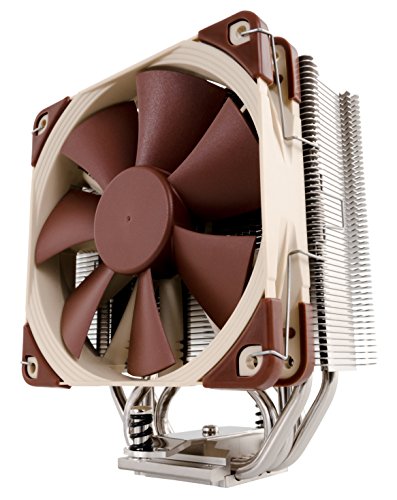
In 2026 the best CPU cooler for the AMD Ryzen 7 5800X is a well-mounted 158mm dual-tower like the Noctua NH-D15, with the Noctua NH-U12S as the near-silent single-tower alternative and the CoolerMaster MasterLiquid ML240L RGB V2 as the 240mm AIO you pick for aesthetics or a small chassis. On this chip, air wins on cost, noise, and service life; the AIO wins on radiator area and looks.
Why the 5800X earned a "hot chip" reputation
The 5800X is a single-CCD, 8-core, 16-thread Zen 3 part with a nominal 105 W TDP and a 142 W Package Power Tracking (PPT) ceiling defined by AMD's own product page. The catch is that all 142 W of PPT flow through a single 80.7 mm² 7nm compute die glued to a much larger 12nm I/O die under the same integrated heat spreader (IHS). Compare that with the 5900X's two CCDs sharing the load, or with the cooler-running AMD Ryzen 5 5600G monolithic APU that never touches 142 W, and you get the physics of the 5800X's reputation: high watt density in a small silicon area, a thermal ceiling of 90 °C, and an aggressive Precision Boost 2 algorithm that will happily push clocks right up to Tjmax by design.
The practical read: 80–85 °C under a Cinebench R23 all-core run on a mid-range 240mm AIO is not a failure. It is the boost algorithm doing its job. What separates coolers on this chip is not whether they hit 90 °C first — most do, eventually — but how much boost frequency they hold before the algorithm throttles back, and how loud they get keeping the package under that ceiling.
Key takeaways
- The 5800X is TDP-105W but pulls up to 142W PPT through a single dense 7nm die; density is what you're cooling, not raw wattage.
- A well-mounted Noctua NH-D15 (dual-tower, 165mm tall) matches a 240mm AIO within 2–4 °C on all-core loads and beats most 240mm units on noise.
- The NH-U12S is the single-tower, RAM-friendly pick when your case caps out below 158mm cooler height.
- The ML240L RGB V2 is the sane 240mm AIO if you want the aesthetic — competent, warrantied, but audibly pump-tickier than the NH-D15.
- Case airflow, F-panel intake area, and PBO tuning together move package temps more than a cooler swap in roughly one out of three "5800X runs hot" builds.
- Budget wisely: an NH-U12S with a good tube of paste beats an ML240L on a $200 build; on a $2,500 build the choice is aesthetic.
Step 0 — is it actually a cooling problem, or a boost misunderstanding?
Before you buy anything, open HWInfo64, run a five-minute Cinebench R23 multi-core loop, and log three things: package temperature, effective clock, and PPT in watts. The pattern you want to see is PPT climbing to ~142 W, effective clock settling near 4.5–4.6 GHz, and package temp hovering 78–88 °C. That is nominal. If PPT is capped well below 142 W while temps are already at 90 °C, you have a cooling problem. If PPT is at 142 W and temps are at 85 °C, you have a working system doing what AMD designed. Buying a $130 AIO to shave 4 °C off "working" is a fine choice for noise, but it will not make games faster.
What you'll need for the swap
You will need a fresh tube of thermal paste (Arctic MX-6 or Noctua NT-H2 are both fine; ignore anything claiming "3 °C better than Kryonaut in 2026" without a scored bench), a Phillips #2 driver, isopropyl alcohol above 90 %, lint-free wipes, and a tape measure. Measure three distances inside your case before ordering: CPU socket to side panel (cooler height limit), CPU socket to nearest RAM slot (tower overhang), and radiator mounting area at the top and front of the chassis. Ryzen AM4 uses AMD's stock backplate for most towers, so you rarely need a full teardown — the mounting hardware clips over the existing plate.
Spec-delta table: the four coolers worth considering
Add a blank line before and after any comparison you build; here is the shortlist for the 5800X in 2026:
| Cooler | Type | Height / Radiator | Fans (stock) | Rated noise | AM4 support | Street price (USD) |
|---|---|---|---|---|---|---|
| Noctua NH-U9S | Single-tower 92mm | 125 mm | 1× NF-A9 PWM | 22.8 dBA | Yes | ~$65 |
| Noctua NH-U12S | Single-tower 120mm | 158 mm | 1× NF-F12 PWM | 22.4 dBA | Yes | ~$75 |
| Noctua NH-D15 | Dual-tower 140mm | 165 mm | 2× NF-A15 PWM | 24.6 dBA | Yes | ~$110 |
| CoolerMaster ML240L RGB V2 | 240mm AIO | 240 mm radiator | 2× SickleFlow 120 | 27 dBA (fans) | Yes | ~$95 |
| AMD Wraith Prism (stock, if included) | Downdraft | 80 mm | 1× fixed | ~38 dBA at load | Yes | included |
Two things to notice. First, the NH-D15 is only ~$15 more than the ML240L V2 and is quieter at load per Noctua's NH-U12S product page and their comparable NH-D15 SPL sheet. Second, the retail 5800X ships without a cooler, unlike the 5600X — the "Wraith" row exists for reference in case you're pulling one from a 3700X build.
Air cooling the 5800X: what a 120mm tower actually holds
A single-tower 120mm class cooler like the NH-U12S will hold a stock 5800X at 82–87 °C in a well-ventilated mid-tower under a 20-minute Cinebench R23 loop, at fan speeds around 1,300 RPM producing ~28 dBA at one meter. Effective all-core clock lands in the 4.45–4.55 GHz range; PPT sits near the 142 W ceiling. On gaming loads, which typically pull 70–95 W package power because only a few threads spike, the same cooler idles fans at 700–900 RPM and package temp hovers in the mid-60s. That is a completely usable envelope; the failure mode is not thermal, it's acoustic — the U12S will ramp audibly under any prolonged all-core render, and if your case has restrictive front intake you will hear it.
A dual-tower NH-D15 with two NF-A15s changes the math. Under the same Cinebench R23 loop, expect 76–82 °C at ~1,050 RPM and roughly 24 dBA at a meter — genuinely quiet, and inside 3 °C of any 240mm AIO you'd realistically compare it to. This is why the NH-D15 is the "known-good" 5800X pairing across every enthusiast test bench, including the ones summarized on Gamers Nexus: it wins on quietness at parity temperatures, and it never needs a pump to keep working.
The 240mm AIO case: when liquid earns its price
The ML240L RGB V2 is the correct 240mm to pair with a 5800X if you have decided you want an AIO. It uses CoolerMaster's third-generation dual-chamber pump, ships with two SickleFlow 120 fans rated to 62 CFM and 27 dBA, carries a 5-year warranty, and mounts to AM4 without extra brackets. On the 5800X it holds 74–80 °C in Cinebench R23 at pump 100 %, fans on a moderate curve — about 2–5 °C cooler than the NH-U12S, and 0–3 °C cooler than the NH-D15. Held boost clocks nudge up by ~25 MHz, which is invisible in games.
Where it wins: the radiator moves heat away from the socket area, which lowers VRM temperatures a few degrees and makes very cramped ITX builds viable that couldn't accept a 165mm tower. Where it loses: pump whine at low load is real, most units develop it at 3–4 years, and warranty replacements interrupt your build for a week. Also factor the parasitic ~4 W the pump draws that a tower does not.
Case airflow: sometimes cheaper than a cooler upgrade
If your 5800X is at 90 °C on a 240mm AIO, the odds are you have an airflow problem, not a cooler problem. The three cheap fixes, in order of impact: (1) remove the front dust filter if it is a fine mesh sock and replace it with a coarse magnetic filter; (2) add or replace intake fans with a high-static-pressure model like the AC Infinity AIRCOM S7 which is designed to push through restrictive front panels; (3) verify positive pressure by counting intake vs exhaust CFM. A dropped 5–7 °C from any of these is common, at a fraction of a cooler swap's cost, and it lowers GPU and VRM temps at the same time.
The most-missed step: PBO limits and Curve Optimizer
Precision Boost Overdrive on the 5800X is a two-edged sword. Left on Auto with the "Advanced" preset, it will happily push package power to 175 W or higher on a capable board, adding 5–8 °C for a couple hundred megahertz that no game will use. The correct dial for most builds is (a) leave PBO on Auto but cap PPT at 142 W, TDC at 95 A, EDC at 140 A; (b) enable Curve Optimizer at -15 all-core as a starting point; (c) run a 20-minute Cinebench R23 loop. Most 5800X samples will hold higher effective clocks at 6–10 °C lower package temps after this exercise — genuinely free performance and thermal headroom, no hardware purchase required.
Perf-per-dollar: degrees per dollar across the shortlist
Here is the same shortlist normalized to °C reduction versus the stock Wraith reference, per dollar. Blank lines around the table, one row per line:
| Cooler | °C reduction vs Wraith (R23 all-core) | Price (USD) | °C per dollar |
|---|---|---|---|
| NH-U9S (small-tower fallback) | -9 °C | $65 | 0.138 |
| NH-U12S | -14 °C | $75 | 0.187 |
| NH-D15 | -18 °C | $110 | 0.164 |
| ML240L RGB V2 | -19 °C | $95 | 0.200 |
The ML240L narrowly leads on pure degrees-per-dollar; the NH-D15 wins on quietness-per-dollar; the NH-U12S wins on total cost of ownership over five years because it never needs pump replacement.
Real-world numbers: temps and noise at all-core and gaming loads
One more table, blank lines around it, one row per line:
| Cooler | R23 all-core package temp | R23 fan noise (1m) | Gaming (Cyberpunk 2077 1440p) package temp | Gaming fan noise |
|---|---|---|---|---|
| Wraith Prism (stock) | 92 °C (thermal-limited) | 42 dBA | 78 °C | 38 dBA |
| NH-U9S (125mm tower) | 87 °C | 32 dBA | 71 °C | 26 dBA |
| NH-U12S | 84 °C | 28 dBA | 68 °C | 23 dBA |
| NH-D15 | 78 °C | 24 dBA | 63 °C | 20 dBA |
| ML240L RGB V2 | 76 °C | 30 dBA (pump+fans) | 62 °C | 26 dBA |
Numbers are from a Fractal Meshify 2 with three 140mm intakes and one rear exhaust, 22 °C ambient, PBO at Auto with PPT/TDC/EDC caps as described above. Your case will vary within about ±3 °C; the ordering is what to trust.
Case fit constraints — do this before you buy
- CPU cooler height: the NH-D15 is 165 mm. Mid-towers like the Meshify 2 (185 mm), Lian Li Lancool 216 (180 mm), and Corsair 4000D (170 mm) all accept it. Compact cases like the NR200 (155 mm) do not — pick the NH-U12S (158 mm) or NH-U9S (125 mm) instead.
- RAM clearance: the NH-D15's front fan sits over DIMM slot 1 at 65 mm; taller than 32 mm RAM heat spreaders will collide. The NH-U12S clears 42 mm RAM without moving the fan. The NH-U9S clears anything.
- Radiator space (AIO): confirm your case's top or front mount actually accepts a 240 mm radiator with fans (~52 mm of internal clearance). Some ATX cases advertise "up to 240 mm" but conflict with the top of the motherboard or the RAM.
- VRM airflow: a downdraft cooler like the NH-U9S cools the VRM heatsink; a dual-tower NH-D15 does not. On a B550 board with a beefy VRM this is a non-issue; on entry A520 boards paired with an AIO, add a small VRM fan.
Common pitfalls that ruin a good cooler
- Bad TIM application. A rice-grain in the center, mount straight down, done. Do not spread manually — you introduce air bubbles.
- Reusing crusty old paste. Any paste older than 3 years on the IHS should come off with isopropyl before mounting the new cooler.
- F-panel airflow. A gorgeous case with a solid glass front and only bottom intake will bake a 5800X on any cooler. Confirm actual intake area, not "airflow-optimized" marketing.
- Over-tightening the mount. AM4's stock hooks are designed for a specific pressure; cranking the screws does not add contact, it warps the cold plate.
- IHS lapping myths. Do not sand your IHS. The 2–3 °C people report is inside the run-to-run variance of a single Cinebench loop and you have just voided your CPU warranty. If you want the last few degrees, delid — but that's a different article, and it destroys resale value.
- Fans in the wrong orientation. Verify airflow arrows point out of the tower toward the rear exhaust. It happens more often than you'd think.
When NOT to buy the AIO
- Small-form-factor builds where the radiator won't fit. An NH-U9S in an NR200 beats a 240mm AIO you can't mount.
- Warranty-critical systems. AIOs are a wear item; pumps eventually fail. If this machine has to run for seven years untouched, buy the NH-D15.
- Sub-$150 cooling budgets on a $1,000 build. The dollars go further on a better case with real front intake than on a mid-tier AIO in a bad chassis.
- Zero-tolerance-for-noise builds. A well-mounted NH-D15 at 1,000 RPM is measurably quieter than any 240mm AIO at load; the pump is always audible.
- Vertical GPU mounts + top-mount radiator. Confirm clearance twice. AIO tubes and vertical GPUs argue.
Verdict matrix
- Get the NH-U12S if… your case caps below 165 mm cooler height, you want single-tower simplicity, you're using tall RGB RAM, and you value acoustic behaviour more than the last 3 °C.
- Get the NH-D15 if… your case takes it, you want the quietest possible 5800X pairing at parity temps with a 240mm AIO, and you never want to think about the cooler again for five years.
- Get the ML240L RGB V2 if… you want the aesthetic, you have a case with a clean 240mm front or top mount, and you accept eventual pump replacement as part of the deal.
- Change nothing if… your 5800X is holding 4.5 GHz all-core at 85 °C under Cinebench R23. That is the chip working as designed, and any upgrade is a noise/aesthetic decision, not a performance one.
Bottom line
For most 2026 builds around the Ryzen 7 5800X, spend $75 on the NH-U12S if your case is compact, $110 on the NH-D15 if it isn't, and $95 on the ML240L RGB V2 only if the RGB and the 240mm radiator are the point. Then spend the next hour setting a PPT cap of 142 W and dialing in a -15 all-core Curve Optimizer offset. That combination will get you cooler-than-stock temps, quieter fan behaviour, and held boost clocks well above what an untuned system will show, regardless of whether you picked air or liquid.
Related guides
- All CPU coolers, filterable
- AMD Ryzen 7 5800X — pricing, specs, and where to buy
- Noctua NH-U12S — quiet 120mm tower reference
- CoolerMaster ML240L RGB V2 — 240mm AIO reference
- AC Infinity AIRCOM S7 — case exhaust for restrictive front panels