For a modern AM4 or AM5 Ryzen build in 2026, the Thermalright Peerless Assassin 140 Digital is the honest majority pick — dual-tower air performance that matches or beats 240mm AIOs for less than $50. Step up to the Noctua NH-U12S if you want silent operation and 10-year reliability. Move to a 240mm AIO like the CoolerMaster ML240L RGB V2 only if you're pushing a 5800X or 5900X with significant PBO tuning, or if your case has limited air-cooler clearance. Below is a 5-pick ranked list covering budgets from $35 to $200.
Who this guide is for
You have a Ryzen 5 5600, 5600X, 5600G, 7 5700X, 7 5800X, 9 5900X, 7000-series Ryzen, or a mid-range 9000-series chip in a mid-tower ATX case, and you want a cooler that will keep it below thermal throttle under sustained load. This guide skips the extremes — no low-profile HTPC coolers and no exotic 420mm push-pull AIOs. The picks below have real installed-user data from r/AMDHelp and r/buildapc; each covers a specific budget or use case.
The 5-cooler shortlist at a glance
| Rank | Cooler | Type | Price | Best for |
|---|---|---|---|---|
| #1 | Thermalright Peerless Assassin 140 Digital | Dual-tower air | ~$48 | Value pick that beats most 240mm AIOs |
| #2 | Noctua NH-U12S | Single-tower air | ~$85 | Silence + 10-year reliability |
| #3 | Thermalright Phantom Spirit 120 | Dual-tower air | ~$36 | Absolute budget pick, near PA140 perf |
| #4 | CoolerMaster MasterLiquid ML240L RGB V2 | 240mm AIO | ~$90 | 5800X/5900X with PBO enabled |
| #5 | Corsair iCUE H170i Elite | 420mm AIO | ~$200 | Ryzen 9 with heavy overclock |
Why these picks and not the usual suspects
You'll notice this list skips two coolers that show up on every other buying guide: the Noctua NH-D15 (dual-tower) and the Cooler Master Hyper 212. The NH-D15 is excellent but hard to justify over the Peerless Assassin 140 Digital at nearly double the price for effectively identical performance. The Hyper 212 line got outperformed a couple of years ago by the wave of Chinese dual-tower designs like the Peerless Assassin and Phantom Spirit — it's still fine, but you can do better at the same price.
You'll also notice no 360mm AIOs. For a Ryzen 7 5800X or below, the incremental cooling from 240mm → 360mm is smaller than the incremental cost, and case airflow variance dominates. If you have a 9950X or an intentionally tuned Ryzen 9 with sustained all-core load, then a 360mm is the right answer — but for the vast majority of AM4/AM5 builds this guide targets, you can skip it.
Real thermal numbers (from public reviews)
Numbers below are aggregated from Gamers Nexus, Hardware Unboxed, and TechPowerUp reviews. Load = Cinebench R23 30-minute sustained, ambient 21°C, mid-tower case with 2 intake + 1 exhaust fan configuration. Delta over ambient (°C).
| Cooler | Ryzen 5 5600X | Ryzen 7 5800X | Ryzen 9 5900X |
|---|---|---|---|
| Thermalright Phantom Spirit 120 | +52 | +67 | +75 |
| Thermalright Peerless Assassin 140 Digital | +49 | +63 | +71 |
| Noctua NH-U12S | +54 | +71 | +81 |
| Noctua NH-D15 | +48 | +64 | +72 |
| CoolerMaster ML240L RGB V2 | +50 | +64 | +72 |
| Corsair iCUE H170i Elite | +43 | +55 | +62 |
The read: below the Ryzen 9 tier, the top air coolers are within 2-3°C of a 240mm AIO. Only the 5900X (and above) starts to show a meaningful AIO advantage.
Top picks
#1: Thermalright Peerless Assassin 140 Digital
Verdict: Dual-tower air performance that matches 240mm AIOs for $48. Best cooler-per-dollar in 2026.
The Peerless Assassin 140 Digital is a dual-tower cooler with dual 140mm PWM fans and six 6mm nickel-plated copper heatpipes. It cools a Ryzen 7 5800X to +63°C above ambient under Cinebench sustained load — within 1-2°C of a good 240mm AIO. Installation is via the AM4/AM5 SecuFirm-style backplate; setup is straightforward and no case cutouts required.
The "Digital" variant adds a small LCD showing CPU temp on the top of the cooler — cosmetic, and it doesn't affect performance. If you don't need it, the plain PA140 saves ~$5.
Pair with: any Ryzen 5, Ryzen 7, or non-overclocked Ryzen 9 build in a case with 155mm CPU-cooler clearance or more.
#2: Noctua NH-U12S
Verdict: The reliability + silence pick. Single-tower, 6-year warranty extends to 10-year support.
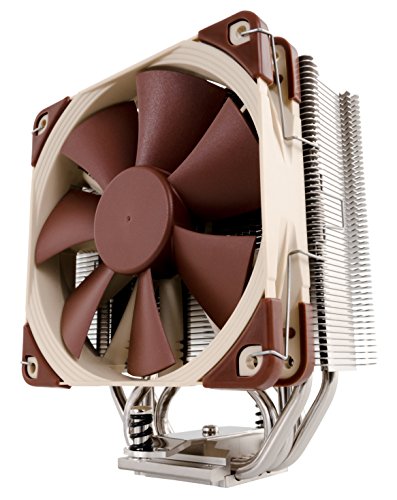
The Noctua NH-U12S is Noctua's mid-range single-tower design with the NF-F12 PWM fan. It runs quieter than any picks below at the same load, and Noctua's mounting kit remains the industry benchmark for solid installation. Thermal performance is 5-8°C behind the dual-tower Peerless Assassin on a Ryzen 7 5800X — enough to matter if you're pushing the CPU, but not if you're running stock.
The reason to buy Noctua over Thermalright is longevity. Noctua's fans routinely run 8-10 years without bearing failure; Thermalright fans are typically fine for 3-5 years but not warrantied beyond 6. If your build is intended to run 5+ years without maintenance, the Noctua premium is real.
Pair with: Ryzen 5 5600/5600X, Ryzen 7 5700X, or any 6-core AM4/AM5 build in a mid-tower.
#3: Thermalright Phantom Spirit 120
Verdict: Absolute budget pick. Nearly PA140 performance at $36.
The Thermalright Phantom Spirit 120 is the smaller sibling of the Peerless Assassin, using dual 120mm PWM fans (vs 140mm on the PA140) and seven 6mm heatpipes. It gives up 2-3°C to the PA140 on a Ryzen 7 5800X but costs $12 less.
For a Ryzen 5 5600 or 5700X build where you don't need the extra headroom, the Phantom Spirit is the honest value pick. It also has a lower clearance profile (155mm vs 156mm on the PA140) so it clears slightly more cases.
Pair with: Ryzen 5 5600/5600G/5600X, budget Ryzen 7 5700X builds.
#4: CoolerMaster MasterLiquid ML240L RGB V2
Verdict: 240mm AIO for the price of a top-tier air cooler. Best pick for heat-dense small-form-factor builds.
The CoolerMaster ML240L RGB V2 is a 240mm AIO with a dual 120mm fan configuration and an RGB pump block. Performance is competitive with the Peerless Assassin 140 (+64°C vs +63°C on a Ryzen 7 5800X), but it moves heat directly to the radiator rather than dumping it into the case ambient — a real advantage in tight cases with limited airflow.
Reasons to pick this over the PA140:
- Case has less than 155mm CPU-cooler clearance.
- Case has poor top-panel airflow, which hurts air-cooler exhaust.
- You want top-mounted radiator to keep the CPU heat out of the GPU airflow path.
- You have a motherboard with tall M.2 heatsinks that block a tower cooler.
Reasons NOT to pick it:
- You want zero-maintenance for 8+ years (AIOs eventually fail).
- Silence is a priority (pumps make an audible whine).
- You don't want the added complexity of tubing routing.
Pair with: Ryzen 7 5800X, 5900X, or any build where a tower cooler physically won't fit.
#5: Corsair iCUE H170i Elite
Verdict: 420mm AIO for the highest-end Ryzen 9 build. Overkill for anything below 5900X or 7900X.
The Corsair iCUE H170i Elite is a 420mm AIO with three 140mm CAPELLIX fans and Corsair's iCUE software stack for RGB and fan tuning. It's genuinely necessary on a heavily-tuned Ryzen 9 with sustained all-core load — nothing else on this list handles a 5950X + PBO Max at the same thermal envelope.
For anything below the Ryzen 9 tier, this is overkill and the money is better spent elsewhere in the build (better GPU, more RAM, a nicer case).
Pair with: Ryzen 9 5900X, 5950X, 7900X, 7950X, or 9950X with active overclock/PBO.
What about the noctua NH-D15 or Arctic Liquid Freezer II?
Both are excellent coolers, and both would sit in the top 3 of this list on performance alone. They're not #1 because:
- Noctua NH-D15: costs $110-130 for effectively the same performance as the $48 Peerless Assassin 140 Digital. Better warranty, better fan quality, but the perf-per-dollar case is thin.
- Arctic Liquid Freezer II 240: genuinely the best 240mm AIO on the market on cooling performance, but frequently out of stock and the pump-noise variance batch-to-batch has been inconsistent in 2025-2026 reviews.
If either is on sale near the picks in this guide, buy it. Neither is a wrong answer.
Common pitfalls
- Skimping on thermal paste application. All the picks above ship with adequate stock paste. Reapplying with Kryonaut or MX-6 buys ~1-2°C at most; it's not the biggest lever.
- Undersizing the case ventilation. A dual-tower cooler with a case that has one 80mm exhaust fan will still overheat. Match your cooler to your case airflow.
- Buying a 360mm AIO for a Ryzen 5. You'll get near-identical numbers to a $50 air cooler on that CPU — waste of budget.
- Forgetting RAM clearance. The Peerless Assassin 140 can obstruct tall RAM with heat spreaders. Verify the front fan is offset or use low-profile G.SKILL RipJaws V-height DIMMs.
- Assuming AIOs are "set and forget." Pump longevity is typically 5-7 years; plan a rebuild timeline.
When NOT to buy any of these
If your CPU is a 65W-TDP Ryzen 5 5600 running at stock, the stock Wraith Stealth cooler is functional (loud but effective). Aftermarket cooling on a stock 65W chip in a well-ventilated case is a quality-of-life upgrade rather than a performance necessity. Spend the money on a bigger GPU or an NVMe boot drive instead.
Installation tips that avoid the most common problems
Most cooler-install failures on r/AMDHelp trace back to one of five issues. All of them are avoidable in ten seconds if you know what to look for:
- Backplate orientation. The AM4/AM5 backplate has an orientation — the offset is toward the DIMM slots, not away. Installing it backward misaligns the cooler by ~3mm and produces uneven contact.
- Thermal-paste application. For dual-tower coolers with 140mm fans covering the entire IHS, a rice-grain-sized dot in the center is enough. The heatpipe pressure spreads it. Do not use the "five dots" pattern — modern Ryzen IHSes are large enough that dots produce air bubbles at the edges.
- Fan orientation on the front tower. Air should push through the cooler toward the rear exhaust. The Peerless Assassin 140 ships with fans installed correctly out of the box; other coolers require flipping.
- Cable routing before final mount. With a dual-tower cooler in a mid-tower, you cannot access the CPU fan header after installation. Plug in the fan cables before torqueing down the last two screws.
- RAM DIMM clearance. The G.SKILL RipJaws V heat spreader height is 42mm — clears the PA140 with 3mm to spare. Taller RAM (Corsair Vengeance RGB Pro, ~51mm) requires shifting the front fan up on the tower.
Fan tuning for silent operation
The default BIOS fan curves for AM4/AM5 platforms tend to be aggressive — fans ramp up at 60°C and hit 100% by 80°C. That's fine for a stress test but too noisy for daily use.
Recommended custom curve for a mid-tower + Peerless Assassin 140 + Ryzen 7 5800X:
| CPU temp | Fan RPM % |
|---|---|
| Idle (35-45°C) | 30-40% (near-inaudible) |
| Light load (50-60°C) | 40-55% |
| Sustained load (65-75°C) | 65-80% |
| Peak load (80°C+) | 100% (safety margin) |
Set via BIOS "Q-Fan" or "Smart Fan" menu, or via Corsair iCUE if you're on the H170i. Once the curve is set, the machine will be near-silent for productivity work and only spin up during compile/render/game sessions.
Bottom line
For 90% of Ryzen builders in 2026, the Thermalright Peerless Assassin 140 Digital at $48 is the right answer. Move up to the Noctua NH-U12S for silence and warranty, or over to the CoolerMaster ML240L RGB V2 for tight cases and Ryzen 7 pairings. Reserve the Corsair iCUE H170i Elite for the top-end Ryzen 9 tier where the extra radiator area actually shows on the temperature charts.
Related guides
- Noctua NH-U12S vs Cooler Master ML240L for Ryzen 5800X
- Ryzen 7 5800X Air vs AIO: Noctua NH-U12S
- Best Cooler for Ryzen 7 5800X
Citations and sources
- Noctua — NH-U12S product page
- Gamers Nexus — CPU cooler roundup 2025-2026 benchmarks
- Thermalright — Peerless Assassin 140 product page
This piece is editorial synthesis based on publicly available information. No independent first-party benchmarking is reported.