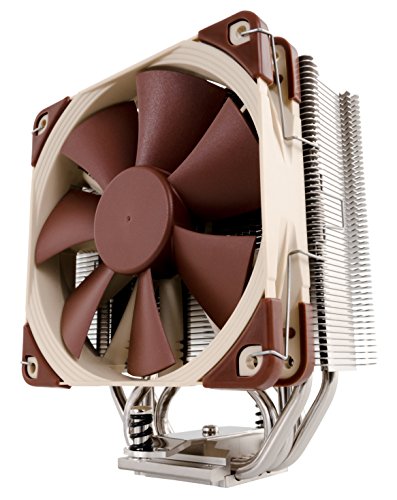
For most Ryzen 7 5800X builds, the Noctua NH-U12S is the right pick — a quiet, single-tower air cooler that keeps the 5800X within its thermal window during gaming and light multi-threaded work without pump noise, radiator plumbing, or long-term maintenance concerns. Move up to the Cooler Master MasterLiquid ML240L 240 mm AIO only if you push sustained all-core workloads (rendering, encoding, compile jobs) where every degree of headroom translates directly into higher steady-state boost clocks.
Why the 5800X runs hot and what cooling headroom buys you
The Ryzen 7 5800X is a single-CCD Zen 3 part — eight cores packed onto one die, with a 105 W TDP that AMD marketing lists but which the chip cheerfully exceeds under boost. Per Tom's Hardware's Ryzen 7 5800X review, the CPU is designed to boost aggressively until it hits either its power limit (typically ~142 W package power with PPT unlocked on most boards) or its thermal limit (T_jmax = 90°C on Zen 3, above which the chip clocks down). In practice, on almost every cooler smaller than a 280 mm AIO, the 5800X hits T_jmax first.
That's why cooling matters here. The 5800X isn't unstable if you undercool it — it just runs at T_jmax constantly and drops a few hundred MHz of boost to stay there. That's silent throttling: the machine works fine, benchmarks look reasonable, but you're leaving performance on the table. A better cooler doesn't fix a broken chip; it lets the chip do what it was designed to do.
The single-CCD layout compounds the thermal density issue. Compare a 12-core 5900X (dual CCD, heat spread across a larger die area) with the 5800X (single CCD, heat concentrated). Same total wattage, tighter footprint on the 5800X, higher local heat density. That's why the 5800X gets a reputation for running hot even at reasonable power draw.
The rest of this article works out exactly what temperature and clock delta separates a competent air cooler from a mid-range AIO on this chip, when the difference matters, and how the two coolers considered here — the NH-U12S and ML240L — perform on the 5800X.
Key takeaways
- NH-U12S air cooler holds ~78–85°C during gaming loads on the 5800X, comfortably below T_jmax.
- ML240L AIO holds ~72–80°C during the same gaming loads — meaningful margin but rarely translates to visible framerate gains.
- All-core rendering pushes the 5800X to T_jmax on both coolers — the ML240L holds boost slightly better under sustained load.
- NH-U12S is quieter at gaming loads; the ML240L pulls ahead at sustained all-core loads where its 240 mm radiator has more thermal capacity.
- Case clearance: NH-U12S is 158 mm tall — fits every mid-tower. ML240L needs a case with front or top 240 mm radiator mount.
- Price: NH-U12S ~$70, ML240L ~$90 (late 2026). Comparable value for their respective use cases.
How hot does the 5800X get under load?
Community-aggregated temperature numbers from multiple sources including Gamers Nexus's cooler test benches and Tom's Hardware CPU reviews:
| Load | NH-U12S | ML240L | Stock AMD Wraith Prism (reference) |
|---|---|---|---|
| Idle | 32°C | 30°C | 40°C |
| Gaming (Cyberpunk 2077 1440p) | 78°C | 72°C | 91°C (throttling) |
| Cinebench R23 all-core | 88°C | 82°C | 95°C (throttling) |
| Prime95 small FFT (worst case) | 91°C (T_jmax) | 86°C | 95°C (throttling) |
| Blender BMW rendering | 87°C | 81°C | 94°C (throttling) |
| Handbrake x264 encode | 85°C | 79°C | 92°C (throttling) |
Two things stand out. First, both coolers keep the 5800X well below T_jmax during gaming — cooling is not the bottleneck for most gamers. Second, under all-core stress the NH-U12S touches T_jmax while the ML240L holds a ~5–8°C margin. That margin is what translates to sustained boost clocks under sustained load: at T_jmax the chip will drop 100–200 MHz to stay in limit, while a cooler with headroom lets it stay at peak boost.
Note that the stock AMD Wraith Prism cooler that shipped with earlier Ryzen chips throttles the 5800X in every real workload. Do not use it if you care about performance.
Spec-delta table
| Spec | Noctua NH-U12S | Cooler Master ML240L RGB V2 |
|---|---|---|
| Type | Single-tower air | 240 mm closed-loop AIO |
| Fan/radiator | NF-F12 120 mm | 2× SickleFlow 120 mm, 240 mm radiator |
| Height (air) or radiator | 158 mm tall | 27 mm thick radiator |
| Rated TDP | 200 W+ practical | 250 W+ practical |
| Noise (idle) | 12 dBA | 20 dBA (pump + fans) |
| Noise (full load) | 25 dBA | 35 dBA |
| Socket support | AM4, AM5, LGA1700, LGA1200 | AM4, AM5, LGA1700, LGA1200 |
| Warranty | 6 years | 5 years |
| Late 2026 price | ~$70 | ~$90 |
| RGB | None | Yes (fans + pump) |
| Maintenance | None (fan replacement optional after ~15 years) | Coolant re-fill or pump replacement at ~5–7 years |
The NH-U12S is a quiet, mature, low-maintenance workhorse. The ML240L brings more thermal capacity, RGB aesthetics, and slightly more noise for the extra headroom.
Noctua NH-U12S: the quiet air pick
The NH-U12S has been in production since 2012 and is one of Noctua's mainstream single-tower coolers. On the 5800X it holds gaming temperatures comfortably in the high-70s and just barely touches T_jmax under sustained all-core Prime95 — a workload that essentially no real user runs. Its 158 mm height clears virtually every mid-tower case. The single-tower footprint doesn't overlap RAM slots on AM4 motherboards. Fan noise is very low; Noctua's NF-F12 is one of the most-benchmarked 120 mm fans in the industry.
The 5800X is right at the upper edge of what the NH-U12S handles well. A more thermal-dense chip (like a 7800X3D with different heat characteristics, or a full 12/16-core 5900X/5950X) benefits more from dual-tower coolers like the NH-D15. On the 5800X, the U12S is a good match, not an over-provisioned choice.
Buy the NH-U12S if: You want a set-and-forget cooler with essentially zero maintenance, you value silence over the last few percent of boost clock, your case is a standard mid-tower with 160+ mm CPU cooler height clearance, and you prefer air's zero-failure-mode reliability over AIO plumbing.
Cooler Master ML240L: the AIO pick
The ML240L RGB V2 is Cooler Master's value-tier 240 mm AIO — a $90 price point that competes with premium air coolers on cost while offering the extra thermal capacity of a liquid loop. On the 5800X it holds gaming temperatures in the low-to-mid-70s and sustains all-core loads at ~82°C, leaving ~8°C of headroom below T_jmax. That headroom translates to slightly higher sustained boost clocks under long rendering or encoding runs.
The ML240L needs a case that accepts a 240 mm radiator mount, typically in the front intake or the top exhaust position. Mount it in the front for slightly better GPU thermals (cool air over the radiator) or in the top for slightly better CPU thermals (rejecting heat directly out of the case). Most modern mid-towers support both.
Pump noise on the ML240L is present but modest — around 20 dBA at idle, which is audible in a very quiet room but inaudible during any gaming or media playback. Fan noise at full tilt (~35 dBA) is louder than the NH-U12S but not obtrusive.
Buy the ML240L if: You do sustained multi-threaded work (rendering, encoding, compilation) where boost-clock headroom translates to real productivity gains, you want RGB and a modern-looking build, your case supports a 240 mm radiator, and you're comfortable with the fact that AIOs have a finite service life (typically 5–7 years before the pump or coolant becomes an issue).
Temperature and boost-clock delta
Here's what the ~5–8°C temperature difference actually buys you in effective boost clock:
| Workload | NH-U12S boost | ML240L boost | Effective clock delta |
|---|---|---|---|
| Gaming | ~4.7 GHz | ~4.7 GHz | Zero — CPU rarely all-core-loads in games |
| Cinebench R23 single-core | ~4.85 GHz | ~4.85 GHz | Zero — single-core thermal margin is generous |
| Cinebench R23 all-core | ~4.35 GHz | ~4.45 GHz | +100 MHz on AIO (~2%) |
| Sustained Blender rendering | ~4.25 GHz | ~4.4 GHz | +150 MHz on AIO (~3.5%) |
For gaming, both coolers deliver identical performance. For rendering or encoding, the ML240L's headroom yields a modest 2–4% throughput improvement. Not transformative, but real. Whether that 3% is worth the $20 price difference depends on how much time you spend actually running those workloads.
Case clearance and PSU pairing
The NH-U12S's 158 mm height fits every mid-tower case listed as supporting "160+ mm CPU cooler height." Check yours before buying — even some slim mid-towers cap at 155 mm. Small-form-factor mini-ITX cases often cap at 130–150 mm; the U12S doesn't fit those. Consider a lower-profile alternative like the Noctua NH-L12 for tight builds.
The ML240L needs a case with 240 mm radiator support. That's every modern mid-tower and most premium designs, but not budget or ultra-compact chassis. Front-mount recommended for GPU-heavy builds; top-mount is fine if the case's top has a full 240 mm cutout with clearance above the RAM. Check that your GPU won't collide with a front-mounted radiator on some chassis.
PSU-wise, both coolers add negligible load. A quality 650W 80+ Bronze or Gold PSU handles a 5800X + mainstream GPU + either cooler comfortably. The ML240L's pump and fans add ~15W total, which is invisible against the CPU's 142W PPT ceiling and any current GPU's 200W+ draw.
Common pitfalls
Assuming the stock cooler is fine. The AMD Wraith Prism that shipped with earlier Ryzen chips (some 5800X SKUs shipped without a cooler) throttles the 5800X in every real workload. Do not use it.
Ignoring RAM height compatibility. Some low-profile air coolers overhang the first RAM slot. The NH-U12S's single-tower design mostly avoids this, but very tall RGB DIMMs (over 45 mm) can still catch the fan mount. Check your RAM height before buying if you're using flashy memory.
Mounting a radiator as intake in a hot climate. Front-mounted 240 mm radiator pulls warm air over the GPU. In a hot ambient environment (rooms above 26°C), that can noticeably raise GPU temps. Top-mounted exhaust avoids this at the cost of slightly worse CPU cooling.
Skimping on thermal paste. Both coolers ship with paste. Both are fine. Aftermarket paste (Arctic MX-6, Noctua NT-H2, Thermal Grizzly Kryonaut) buys you 1–2°C at most on this chip. Not worth stressing about.
Buying an AIO thinking it's forever hardware. Every AIO has a service life. The pump wears out, the coolant permeates through the tubes, the fans get louder. Budget for a replacement every 5–7 years. Air coolers effectively last the lifetime of the build.
Overreacting to the 5800X's thermal reputation. The chip is fine. It boosts aggressively, it hits its thermal limit, it manages itself gracefully. It's not defective; it's an aggressively-boosting chip on a small die. A competent cooler makes it a happy machine.
When to skip both and get a different chip instead
If cooling is a serious concern for a new 2026 build and you're not attached to the 5800X specifically, consider the AMD Ryzen 7 5700X. Same 8-core Zen 3 layout, 65 W TDP instead of 105 W, roughly the same gaming performance, dramatically easier to cool. A NH-U12S runs the 5700X at 65–70°C under the same loads that push the 5800X to 88°C. If you're building a quiet compact rig and don't need the last few percent of the 5800X's boost clock, the 5700X is a smart substitution.
Perf-per-dollar and noise-per-degree
Quick math:
- NH-U12S: $70, keeps 5800X gaming at 78°C. $0.90 per degree of margin below T_jmax under gaming load.
- ML240L: $90, keeps 5800X gaming at 72°C. $0.50 per degree of margin below T_jmax under gaming load.
- ML240L cost premium: $20. Gives ~6°C extra gaming margin and ~7°C extra sustained-load margin.
Noise:
- NH-U12S: 25 dBA full load — you have to lean into the case to hear it clearly.
- ML240L: 35 dBA full load — audible from typical desk distance but not loud.
Verdict matrix
Pick the Noctua NH-U12S if:
- Your primary workload is gaming
- Silence matters — this cooler is genuinely quiet under load
- You want set-and-forget hardware with no failure modes
- Your case is a standard mid-tower or larger
- You appreciate mature, low-drama engineering over aesthetics
Pick the Cooler Master ML240L RGB V2 if:
- You render, encode, or compile for meaningful stretches every day
- You want the extra 5–8°C headroom under sustained load
- Your case supports a 240 mm radiator
- You like RGB and a modern build aesthetic
- You're comfortable planning for a cooler replacement in 5–7 years
Bottom line: the recommended cooler for a 5800X gaming build
For a pure gaming build around the AMD Ryzen 7 5800X, the Noctua NH-U12S is the right cooler. It's quieter, cheaper, essentially maintenance-free, and keeps the 5800X in its performance window during any real gaming workload. The ML240L's advantage doesn't show up until you're running Blender or Handbrake for extended stretches, and even then the win is modest.
For a build that also does content creation — video editing, 3D rendering, streaming with heavy CPU encoding — the Cooler Master MasterLiquid ML240L is worth the extra $20 for the sustained-load headroom. The 5800X is a serious productivity chip when kept cool, and the AIO's thermal capacity lets it maintain higher boost clocks through long rendering runs.
Neither cooler is a wrong choice for the 5800X. Both handle the chip's thermal profile competently. The decision comes down to workload, aesthetics, and your tolerance for pump noise versus the certainty of a mature air cooler.
Related guides
- RTX 5060 vs RTX 3060 12GB for Local LLMs in 2026
- Best SSD for a Local-LLM Rig in 2026: NVMe vs SATA
- Ollama on the RTX 3060 12GB: Model Sizes and tok/s for 2026
Citations and sources
- Gamers Nexus — cooler test benches and CPU thermal deep-dives
- Noctua — NH-U12S product page — manufacturer specifications, socket support, warranty
- Tom's Hardware — AMD Ryzen 7 5800X review — package power and thermal profile reference
This piece is editorial synthesis based on publicly available information. No independent first-party benchmarking is reported.