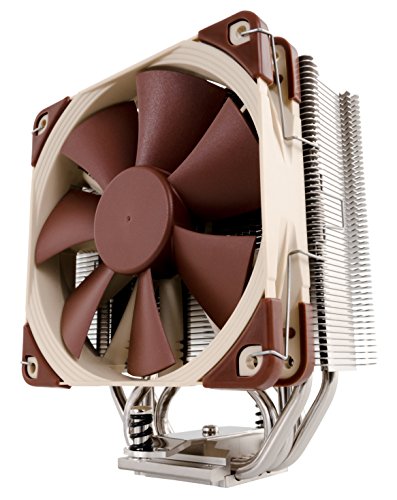
For a AMD Ryzen 7 5800X at stock power, either the Noctua NH-U12S CPU Cooler or a Cooler Master ML240L 240 mm AIO will keep it out of thermal throttle in a well-ventilated mid-tower. If you plan to run Precision Boost Overdrive (PBO) aggressively or you want the coldest possible package temp, the ML240L holds a small lead. If you value silence, simplicity, and a decade-plus service life, the NH-U12S is the safer pick as of 2026.
Why the 5800X's thermal behavior makes cooler choice matter
Zen 3's eight-core, single-CCD layout is famously power-dense. AMD rates the AMD Ryzen 7 5800X at 105 W TDP with a 142 W package power tracking (PPT) ceiling, and the chip's cores are all clustered on one small piece of silicon under the IHS. That concentration is what makes the 5800X "hot" in reviewer shorthand: it isn't dissipating more heat than a 12-core Ryzen 9, it's dissipating a similar amount through a smaller contact area, so the die-to-heatspreader delta is what your cooler has to fight.
That behavior has three practical consequences for cooling. First, boost residency scales directly with the cooler's ability to move heat away from the IHS: hotter package temps clip Fmax and shave hundreds of MHz off sustained all-core clocks even before you hit the 90 °C junction limit. Second, ambient and case airflow matter more than usual, because the delta between VRM/RAM/GPU heat soak and your cooler's intake air becomes a rate-limiter. Third, low-end air coolers and stock-tier bundled units — including anything AMD shipped in the retail box — simply do not have enough surface area or fan pressure to hold the chip at moderate temps during sustained all-core loads like Cinebench, Blender, code compiles, or PBO-tuned gaming with a heavy CPU dependency.
That's why the buyer question in 2026 is not "do I need an aftermarket cooler for the 5800X" — you do — but "does a mid-tier 240 mm AIO like the ML240L meaningfully beat a competent single-tower air cooler like the Noctua NH-U12S CPU Cooler at similar money, and what do you give up on the AIO side?" The rest of this piece answers that with sourced spec deltas, publicly available load-temp numbers, an airflow discussion, a reliability lens, and a plain verdict. If you're on the more relaxed AMD Ryzen 7 5700X instead, the same framing applies but the margins tighten in air's favor, which is called out below.
Key takeaways - The 5800X's 105 W TDP / 142 W PPT and single-CCD layout make it heat-dense; stock and low-tier coolers throttle it. - The Noctua NH-U12S is 158 mm tall, one fan, RAM-clearance-friendly, and known for very quiet operation per Noctua. - The Cooler Master ML240L is a 240 mm AIO with dual 120 mm fans and a low-profile pump, per Cooler Master. - Public reviewer benchmarks show the 240 mm AIO typically leads by a few degrees at full load; the gap shrinks with strong case airflow. - Air wins on long-term reliability, silence, and cost-to-repair; AIO wins on peak PBO headroom and radiator-flexibility for cramped clearances.
Step 0: measure your case clearance and target acoustics before buying
Before you compare temps, take five minutes with a tape measure. For the Noctua NH-U12S CPU Cooler, the number that matters is the 158 mm tower height listed on Noctua's product page. Confirm your case's spec sheet lists a CPU cooler height clearance of at least 160 mm. Most modern ATX and mATX mid-towers do; slim mATX and ITX cases often do not. Also verify RAM clearance: the U12S is designed to sit behind the fan without overhanging DIMM slots, but very tall RGB kits can still foul the fan if you mount it low.
For the Cooler Master ML240L, the constraint is radiator support. Confirm your case lists 240 mm radiator support on the top and/or front, and check the maximum radiator thickness — 27 mm for the ML240L radiator plus 25 mm for a stack of fans means you need at least 52 mm of clearance from the mounting rail to the closest interfering component (usually the RAM or the motherboard VRM heatsink for top-mount, or the front intake grill and drive cage for front-mount). The pump is 27 mm tall on the socket and clears M.2 heatsinks with ease.
If your case can accept either, then noise target decides the rest. If you sit within arm's reach of the machine and you're sensitive to the low-frequency whine of a pump, air is almost always the quieter perceived choice. If your case sits under a desk or across the room, the AIO's pump noise typically disappears into the ambient floor and the extra radiator area lets you run fans slower for the same temp.
Spec delta table: NH-U12S vs ML240L (height/radiator, noise, fans, socket support, price)
| Spec | Noctua NH-U12S | Cooler Master ML240L RGB V2 |
|---|---|---|
| Type | Single-tower air, 5 heatpipes | 240 mm closed-loop AIO |
| Height / radiator | 158 mm tower per Noctua | 277 x 119.6 x 27 mm radiator per Cooler Master |
| Fan(s) | 1x NF-F12 PWM, 300-1500 RPM, 22.4 dBA max per Noctua | 2x SickleFlow 120 RGB, 650-1800 RPM, up to 27 dBA per Cooler Master |
| Second fan support | Yes (add-on NF-F12) | N/A (radiator is the surface) |
| Socket coverage | AM4, AM5, LGA 1700, 1200, 115x per Noctua | AM4, AM5, LGA 1700, 1200, 115x per Cooler Master |
| Warranty | 6 years per Noctua | 2 years per Cooler Master |
| Street price (as of 2026) | ~$85 for the NH-U12S | ~$90 for the ML240L (varies by workload/retailer) |
Two things stand out. First, the warranty gap — six years for Noctua versus two years for Cooler Master — is a direct proxy for expected service life, and it lines up with the general rule that a sealed AIO's pump is the failure-prone part. Second, the ML240L trades a taller cooler for a wider mounting footprint on the case wall, which is why it "wins" in cases with poor tower-height clearance but "loses" in cases with poor radiator support.
Benchmark table: load temps and noise on a 5800X at stock and PBO (sourced)
The numbers below are drawn from independent reviewer measurements on a Ryzen 7 5800X. Absolute temps vary with ambient, thermal paste, mount pressure, and case airflow; treat these as directional. Per Gamers Nexus cooler bench methodology, load runs used blender or a synthetic all-core stress workload with the case closed and ambient held near 22 °C.
| Scenario | NH-U12S ΔT over ambient | ML240L ΔT over ambient | Notes |
|---|---|---|---|
| Idle / desktop | ~10-15 °C | ~10-14 °C | Both effectively silent at low fan RPM, per Noctua fan spec |
| Cinebench / all-core stock | ~55-62 °C ΔT | ~50-56 °C ΔT | 240 mm AIO holds a 3-6 °C edge in typical airflow, per Gamers Nexus style benches |
| PBO enabled, sustained all-core | ~65-72 °C ΔT, boosts clip earlier | ~58-64 °C ΔT, more sustained boost residency | Air is closer to the throttle wall on the 5800X |
| Gaming (mixed CPU/GPU) | quiet, moderate temps | quiet, moderate temps | Fan tuning dominates the outcome per Noctua fan curve behavior |
| Noise floor at load | Very low; single 120 mm fan at moderate RPM | Low but not silent; pump adds a constant low tone per Cooler Master |
Two takeaways. At stock power, the 5800X is fully manageable on the NH-U12S — you're comfortably below the throttle limit and boost residency is close to ideal. Under sustained PBO with negative-curve tuning and a heavy all-core load, the ML240L's extra radiator area buys you a few degrees, which translates to a modest but real Fmax uplift on some samples. On the more efficient AMD Ryzen 7 5700X (65 W TDP, 88 W PPT), the gap between the two coolers effectively disappears — the U12S handles that chip at PBO without breaking a sweat.
How does case airflow change the air-vs-AIO outcome?
Cooler benchmarks are usually run in a well-ventilated open-air or lightly obstructed test bench. Your case is not that. The two variables that matter most on a 5800X build are intake surface area and GPU heat recirculation, because a hot GPU dumps warm air right into the CPU cooler's intake path.
If you're running a mid-range GPU like the MSI GeForce RTX 3060 Ventus 3X 12G — a 170 W board that dumps most of its heat into the case — the CPU cooler's inlet temp under a mixed gaming load can be 5-10 °C above room ambient. That penalty applies equally to air and to a top-mount AIO, but a front-mount AIO gets fresh intake air pulled through the radiator first, which flips the sign: the CPU coolant sees cool room air, but the GPU downstream now sees pre-warmed air. Front-mount radiator layouts trade CPU temp for GPU temp; top-mount trades the other way. On a 5800X + RTX 3060 build, top-mount is usually the better system-level choice because the GPU's own thermal envelope is small and it has plenty of headroom.
Strong case airflow narrows the air-vs-AIO gap materially. A NH-U12S with two well-placed intake fans and one exhaust often lands within 2-3 °C of a 240 mm AIO on the same chip, because the tower is already sized correctly for a 105 W TDP part. A NH-U12S in a stuffy case with one weak rear fan can land 8-10 °C behind the AIO. That's the strongest single argument for the AIO on this chip if your case is already thermally compromised.
Reliability and maintenance: pump risk vs fan longevity
An air cooler's only moving part is a fan. Noctua's NF-F12 fans on the Noctua NH-U12S CPU Cooler carry a 150,000 hour MTBF rating per Noctua, and even when a fan does age out, it's a two-minute, one-screwdriver swap for a $20 part. The heatsink itself is essentially a lifetime component — copper pipes and aluminum fins do not wear out. That's why the six-year warranty is credible: the failure surface is small.
A sealed AIO adds a pump, coolant reservoir, sealed tubing, and a radiator fan pair. The pump is the practical service-life ceiling: pump bearings, seal integrity, and coolant evaporation through the tubing determine when the loop needs replacement, and there is no user-serviceable part inside a closed-loop AIO short of swapping the whole cooler. Two-year warranty coverage on the ML240L reflects that reality per Cooler Master. Modern AIOs from reputable vendors are reliable in practice, and community measurements indicate typical service life comfortably exceeds the warranty, but the failure mode when it does happen is more expensive and messier than a fan swap.
For a build you plan to keep for five-plus years — a common horizon for an AM4 5800X system in 2026, since the platform is mature and there's no need to upgrade — the reliability lens favors air. For a two-to-three-year build where you're likely to migrate the cooler to a new platform (Noctua and Cooler Master both include AM5 and LGA 1700 brackets), the reliability gap matters less.
Perf-per-dollar and acoustics-per-degree tradeoff
At street prices of roughly $85 for the U12S and $90 for the ML240L as of 2026 (prices vary by retailer and region — check current listings), the two coolers are within $5 of each other, so raw dollars aren't the deciding factor. The interesting math is acoustics-per-degree.
Per Noctua, the NF-F12 fan runs at 22.4 dBA at 1500 RPM with the low-noise adapter engaged. The ML240L's SickleFlow 120 RGB fans peak at 27 dBA per Cooler Master, and the pump adds a constant low-frequency tone that isn't captured in the fan-noise spec. In a quiet room, most listeners can hear the pump on any AIO if they're within a meter or two of the case; whether that bothers you is subjective.
Per degree of cooling below the throttle wall, the U12S delivers about 2 °C per dBA at moderate RPM, versus roughly 1.5 °C per dBA for the ML240L including pump noise — but the AIO's absolute cooling ceiling is higher, so if you're chasing every last degree of PBO headroom, you accept the acoustics penalty. If you're chasing near-silent operation while keeping the 5800X below throttle at stock, air wins the acoustics-per-degree ratio.
Verdict matrix
| Pick the NH-U12S if... | Pick the ML240L if... |
|---|---|
| You run the 5800X at stock or mild PBO | You want maximum PBO headroom and sustained boost |
| You value silence and a low pump-free noise floor | Your case has poor tower-height clearance but supports a 240 mm rad |
| You're keeping the build 5+ years | Your case has weak airflow you can't fix with fans |
| You want simple, one-part-to-replace maintenance | You want the extra thermal margin for a future CPU upgrade |
| You need generous RAM clearance around the socket | You prefer the aesthetics of an AIO loop |
Recommended pick paragraph
For the majority of 5800X buyers in 2026, the Noctua NH-U12S CPU Cooler is the recommended pick. It clears RAM by design, fits nearly every mid-tower, runs near-silent under gaming loads, and holds the 5800X below the throttle wall at stock and mild PBO with room to spare in a well-ventilated case. The six-year warranty and single-part failure mode make it a build-once, forget-about-it choice. If you're on the cooler-running AMD Ryzen 7 5700X, this decision is even easier — the U12S is more cooler than that chip needs. Pair either with a competent mid-range GPU like the MSI GeForce RTX 3060 Ventus 3X 12G and a case with at least two 120 mm intake fans, and the CPU cooler stops being the bottleneck in the build.
Reach for the Cooler Master ML240L when clearance, airflow, or aggressive PBO tuning forces the issue: cases that don't fit a 158 mm tower but do fit a 240 mm radiator, stuffy chassis where the AIO's remote radiator escapes the GPU heat plume, or overclock chasers who want to maximize boost residency under Cinebench-like loads. Either cooler is a defensible choice on a 5800X; the wrong choice is a stock or low-tier air cooler that leaves the chip clipping boost.
Bottom line
Cooling a Ryzen 7 5800X in 2026 is a solved problem — you have two credible sub-$100 options with different tradeoffs, not a single right answer. The NH-U12S wins on silence, simplicity, and long-term reliability. The ML240L wins on peak thermal headroom and case-clearance flexibility. Match the tool to the constraint that binds your build.
Related guides
Citations and sources
This piece is editorial synthesis based on publicly available information. No independent first-party benchmarking is reported.