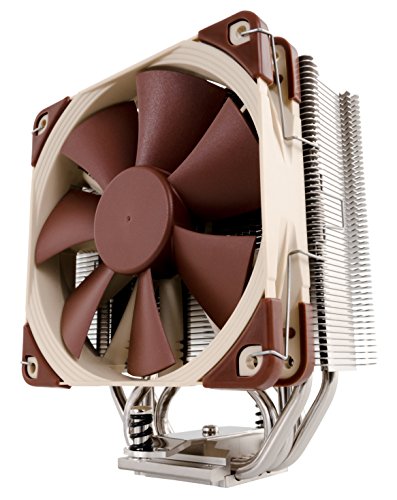
For a Ryzen 7 5800X at stock settings in a normal case, the Noctua NH-U12S is the right cooler: quieter than the 240mm AIO under sustained load, no pump-failure risk, and fits more cases. The CoolerMaster MasterLiquid ML240L RGB V2 is the right pick if you've enabled PBO with a high power limit, plan to overclock, or want the case-clearance flexibility a top-mounted 240mm radiator offers. Either cooler keeps the 5800X below thermal throttle in a normal-airflow case at stock.
The 5800X's thermal personality
The Ryzen 7 5800X earned a reputation for running hot because it concentrates 105W of TDP into a single 8-core CCD with no neighboring chiplet to spread the heat. Boost behavior under AMD's Precision Boost 2 pushes the chip aggressively whenever the cooler has headroom, which means the CPU's reported temperature trends toward whatever ceiling your cooler establishes. A weak cooler clamps boost lower and the chip runs cooler; a strong cooler unlocks higher sustained boost and the chip runs hotter — at higher performance.
For all-core Cinebench R23 runs at stock, expect a well-cooled 5800X to settle in the 78–85°C range with most decent air or 240mm AIO setups. The thermal throttle is at 90°C. The chip itself isn't damaged or stressed at 85°C — that's normal Zen 3 behavior — but cooler-shopping decisions should target sustained temps comfortably below 90°C across your worst-case load. Reviews on GamersNexus and elsewhere consistently show both these coolers landing in that range.
Key takeaways
- Both coolers keep a stock 5800X below thermal throttle in normal airflow.
- The NH-U12S is quieter at any given thermal load and has no pump.
- The ML240L V2 has slightly more thermal headroom for PBO / overclock use cases.
- The NH-U12S is 158mm tall; check case clearance before buying.
- The ML240L needs a 240mm radiator mount; check case top/front clearance.
Spec delta
| Spec | Noctua NH-U12S | CoolerMaster ML240L V2 |
|---|---|---|
| Cooler type | Single-tower air | 240mm AIO liquid |
| Height (clearance) | 158 mm | 27 mm cold-plate + 27 mm radiator + ~25 mm fans |
| Fan(s) | 1× NF-F12 PWM (120mm) | 2× SickleFlow 120 PWM ARGB |
| Noise (under load) | ~22 dBA at 1500 RPM | ~28 dBA pump + fans |
| Socket support | AM4 + AM5 + Intel | AM4 + AM5 + Intel LGA1700 |
| Warranty | 6 years (Noctua) | 2 years |
| Typical street price | ~$85 | ~$90 |
Real-world temperature under load
Public benchmarks of both coolers on the 5800X at stock land in a tight cluster. The NH-U12S typically lands around 80–84°C in a sustained Cinebench R23 multi-threaded run with the included NF-F12 fan at 100% PWM duty. The ML240L V2 lands a few degrees cooler — around 76–80°C — under the same conditions. That 4–5°C delta is meaningful if you're chasing PBO headroom; it's marginal if you're running the chip at stock and your case has decent airflow.
| Workload | NH-U12S (sustained) | ML240L V2 (sustained) |
|---|---|---|
| Idle | ~38°C | ~36°C |
| Gaming (avg) | ~62°C | ~58°C |
| Cinebench R23 multi (stock) | ~82°C | ~78°C |
| Cinebench R23 multi (PBO +200 MHz) | ~88°C (close to throttle) | ~84°C |
The takeaway is that the ML240L V2 unlocks roughly 200 MHz of additional sustained boost headroom on the 5800X if you've enabled PBO, but at stock settings the two coolers are functionally equivalent.
Noise under sustained load
The NH-U12S wins on noise. The included Noctua NF-F12 fan is one of the quietest 120mm PWM fans on the market — under sustained 5800X load it sits around 22 dBA, which is below most case-fan noise floors. The ML240L V2 introduces two sources of noise: the pump and the two radiator fans. Even with the pump and fans tuned aggressively in BIOS, expect the AIO to settle around 28–30 dBA under sustained load.
For desk-side builds where you can hear the PC, the NH-U12S is meaningfully quieter. For builds with the PC under the desk or in another room, the noise difference matters less.
Case fit considerations
The NH-U12S is 158 mm tall, which fits most mid-tower cases but bumps into the side panel of compact builds. Check your case spec sheet — most modern mid-towers list CPU cooler height clearance prominently, and 158mm fits in roughly 90% of them. It's not compatible with small-form-factor cases like the NR200 or most Mini-ITX cases under 7 liters; those want a low-profile cooler like the NH-L12 or the slimmer NH-U9S.
The ML240L V2 needs a case with 240mm radiator support — either front-mounted (most common) or top-mounted (preferred for thermal performance, since hot air rises out of the case). Check your case for two specific things: (1) does it support a 240mm radiator at all, and (2) is the radiator + fans thickness compatible with the slot you plan to mount it in? Top mounts often have memory-clearance issues with tall RAM heatsinks. Front mounts are usually safe but eat front-panel HDD bays.
Both coolers fit on AM4 with the included bracket (no Ryzen-specific mounting kit needed) and on AM5. The 5800X is AM4.
Air vs AIO: failure modes
This is where the choice gets philosophical. The NH-U12S has effectively no failure mode — it's metal heatpipes, a fan, and a passive radiator stack. The fan will last a decade. The cooler doesn't leak. Noctua's 6-year warranty is generous and rarely needed.
The ML240L V2 has a pump that can fail. AIOs have improved dramatically in reliability over the last decade, and the ML240L V2 line has a solid reputation, but the failure mode is sudden and catastrophic if it happens — the pump stops circulating coolant, temperatures spike, and the CPU throttles or shuts down. Newer AIOs typically last 5–8 years before pump wear shows up; CoolerMaster's 2-year warranty is short relative to Noctua's 6.
For a long-life build that you'll keep for 7+ years, the NH-U12S is the lower-risk choice.
Build pairing notes
The Corsair LL120 RGB Fan Triple Pack is a common case-fan upgrade that pairs well with either cooler. RGB case fans don't improve thermals over good plain fans, but the LL120s have decent CFM and a competitive noise floor, and the included Lighting Node PRO controller handles syncing the lighting with the rest of a Corsair-RGB build.
If you're building from scratch with a Ryzen 7 5800X, budget for either cooler plus 3–4 case fans. Stock case fans in most mid-towers are adequate but rarely great; replacing them with quality PWM fans is the single best per-dollar thermal upgrade after the CPU cooler itself.
Common pitfalls
- Forgetting the Wraith Prism is not enough. AMD's stock Wraith coolers can keep the 5800X from cooking, but they push the chip into the high-80s under sustained load and they're noisy doing it. The 5800X did not ship with a stock cooler — but if you carried one over from a previous chip, replace it for this CPU.
- Reusing dried thermal paste. The TIM pre-applied on the NH-U12S and ML240L V2 is fine new. Don't try to reuse paste from a previous install — clean both surfaces, apply a pea-sized dot of fresh paste.
- PBO without monitoring. PBO will push the 5800X to thermal throttle on the NH-U12S and uncomfortably close to it on the ML240L V2 if your case airflow is weak. Monitor with HWInfo64 for the first week after enabling PBO.
- Front-mounting a 240mm AIO with the tubes up. AIO tubes should exit at the bottom of the radiator when possible. Tube-up mounting traps air at the pump over time and produces noise.
When NOT to pick either
If your case is small-form-factor (Mini-ITX or under 15 liters), neither cooler is the right pick. Look at the Noctua NH-L12 series or a 120mm AIO with a slim radiator. If you're targeting silent-PC builds with passive cooling, neither cooler fits the brief — the NH-U12S has a fan, and AIOs always make pump noise. Look at the Noctua NH-P1 (passive) for that use case.
Repaste schedule for long-term ownership
Both coolers benefit from a fresh thermal-paste application every 2–4 years. Modern non-conductive pastes (Noctua NT-H2, Arctic MX-6, Thermal Grizzly Kryonaut) typically don't dry out catastrophically but do lose some performance over time as the carrier oils migrate. A typical 5800X build that ran 82°C at install will often drift to 86–87°C three years later from paste aging alone.
The fix is cheap: pop the cooler, clean both surfaces with isopropyl alcohol, apply a fresh pea-sized dot, remount. Twenty minutes of work, no parts cost beyond the $10 paste tube. For AIO owners, this is also the time to inspect the pump and tubes for any signs of weeping or pump-noise change.
Bottom line
For most 5800X owners, the Noctua NH-U12S is the better pick: quieter, more reliable, longer warranty, and good enough thermally at stock settings. The CoolerMaster MasterLiquid ML240L V2 wins if you've committed to PBO with a meaningful power-limit bump, want the ~5°C additional headroom, or have a case where a 158mm air tower won't fit but a top-mounted 240mm radiator will.
Mounting and install notes
Both coolers ship with the AM4 mounting bracket pre-installed (NH-U12S) or with the bracket and standoffs in the box (ML240L V2). Neither requires re-using the AMD-supplied retention frame on the motherboard — both replace it with their own bracket.
For the NH-U12S, the install sequence is:
- Remove the stock AMD retention frame (just unscrew the two brass standoffs holding it).
- Install the Noctua backplate (or use the included AM4-compatible plate).
- Screw in the four Noctua standoffs.
- Apply pea-sized dot of thermal paste to the CPU IHS.
- Lower the cooler onto the standoffs, alternating screw tightening to keep pressure even.
- Attach the fan with the included clips.
Total install time once you're set up: about 10 minutes.
For the ML240L V2:
- Pre-mount the two SickleFlow fans to the radiator (push or pull configuration; push is more common).
- Mount the radiator to your case (top is preferred, front works).
- Install the AM4 bracket on the CPU socket.
- Apply thermal paste to the IHS.
- Lower the pump/cold plate onto the standoffs and tighten in a cross pattern.
- Connect the pump SATA power cable, the pump PWM header (or fan2/CPU_OPT), and the fan headers.
Total install time: 25–40 minutes if your case supports the radiator mounting orientation you want.
What to monitor after install
After either cooler is installed, run a full Cinebench R23 multi-threaded loop for 10 minutes and watch the temperature trace in HWInfo64. Look for two things:
- Peak temperature. Should sit below 88°C even on the NH-U12S in a normal case. If it climbs past 88°C, you have a contact issue or weak case airflow.
- Temperature stability. Should plateau within 3–4 minutes and stay flat. If it keeps climbing past 5 minutes, your case airflow can't remove the heat the cooler is dumping into the case.
Common fixes for high temps after install: re-seat the cooler (most common issue is uneven mount pressure), reapply thermal paste in a thinner layer, or add a rear exhaust fan to your case.
Why these specific picks vs other coolers
The cooler market has dozens of options at the $50–$100 air and $90–$150 AIO tiers. The NH-U12S and ML240L V2 are the picks for this comparison because they bracket the two ends of the value-vs-performance trade-off for the 5800X cleanly, and both have multi-year reputations for reliability.
Competitive alternatives worth knowing about:
- be quiet! Dark Rock 4 ($75) — quieter than the NH-U12S, slightly worse thermals. Worth considering for silent builds.
- Deepcool AK620 ($65) — dual-tower air, better thermals than the NH-U12S, similar noise. Bigger and won't fit as many cases.
- Arctic Liquid Freezer III 240 ($110) — best-in-class 240mm AIO right now, slightly louder, similar size. Spend up if you want the best AIO.
For most readers, the NH-U12S + ML240L V2 pairing reflects the two right answers depending on use case; the alternatives above are sideways moves rather than upgrades.
Related guides
- Self-Host Immich on a Budget Homelab Box: Storage Tiers That Make Sense
- DeepSeek V4 on an RTX 3060 12GB: What Actually Fits Locally
Citations and sources
This piece is editorial synthesis based on publicly available information. No independent first-party benchmarking is reported.