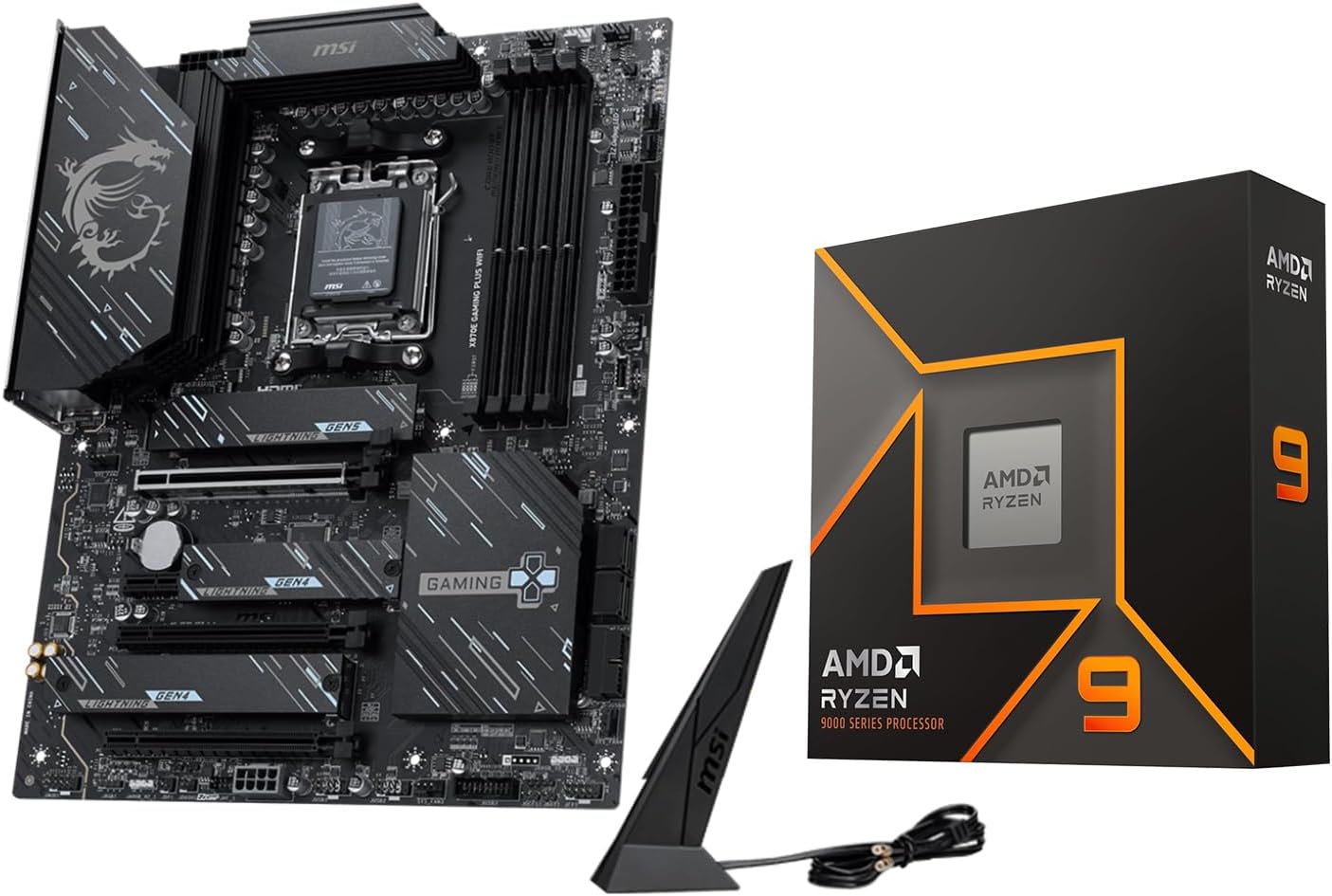
The AMD Ryzen 9 9950X is one of the fastest 16-core consumer desktop processors available, but its thermal behavior under simultaneous gaming-and-streaming workloads has become a recurring discussion topic across r/Ryzen and r/buildapc. Junction temperatures of 95–98°C during combined sessions are widely reported. Here is what AMD's official specifications and independent published reviews say about whether that is acceptable — and what the practical fixes are.
Is 98°C Normal for the Ryzen 9 9950X While Streaming?
No. Per AMD's official product specifications, the Ryzen 9 9950X carries a maximum junction temperature (Tjmax) of 95°C. Sustained operation at 98°C means the processor has exceeded its rated thermal ceiling, and AMD's built-in thermal protection firmware reduces boost clock speeds to bring temperatures back within specification. The real-world result is measurable performance loss during exactly the sessions where full throughput is most needed.
The reading is not an immediate hardware-failure emergency — AMD designs thermal headroom above the throttle point — but sustained above-Tjmax operation accelerates long-term electromigration in the silicon and prevents the processor from sustaining its advertised boost clocks. Per Tom's Hardware's extended Ryzen 9000 series coverage, the 9950X's Precision Boost algorithm is deliberately aggressive about chasing maximum frequency, and no entry-level or mid-range cooler is rated to sustain that behavior under all-core streaming loads.
Why Streaming Is the Thermal Worst Case
A standard gaming session engages many CPU threads but leaves others idle between frames and system calls. Software streaming video encoding — using x264 or x265 presets in OBS Studio or Streamlabs — recruits all 16 cores of the 9950X simultaneously, which is the all-core worst case for sustained power draw.
Per AMD's published TDP documentation, the 9950X has a 170W base TDP, but AMD's PPT (Package Power Tracking) limit allows the processor to draw considerably more during boost under blended loads. OBS Project's CPU overload documentation notes that software encoding at quality presets such as x264 medium or slow saturates every available thread. Stack a game process, audio pipeline, and OS scheduling overhead on top of that, and the thermal margin on any inadequate cooler collapses.
Streaming resolution compounds the pressure. Even if the outgoing stream stays at 1080p60, running a 1440p or 4K game render simultaneously increases frame-timing demands on the CPU significantly. Community threads in r/buildapc consistently attribute the highest temperatures to exactly this configuration — 4K gaming display driving a 1440p stream on a single CPU.
For context on how platform choice affects these thermal workloads, SpecPicks' analysis of Linux vs. Windows 11 on the Ryzen 9 9950X3D documents how OS-level CPU scheduling differences influence sustained performance — relevant to any streaming-optimized build.
Understanding AMD's Thermal Boost Behavior
One source of confusion in forum discussions is that AMD's Precision Boost 2 intentionally targets Tjmax during single- and multi-core workloads to extract maximum performance. Temperatures of 85–90°C are by design under high load — the algorithm runs the chip as fast as possible until it approaches the thermal ceiling.
The problem with 98°C is that it sits above the ceiling, not near it. The distinction:
| Temperature Range | What It Means |
|---|---|
| 70–85°C | Normal under moderate all-core load with adequate cooling |
| 85–94°C | Precision Boost operating near its thermal target; expected |
| 95°C (Tjmax) | Protection threshold — clocks begin reducing |
| 96–98°C+ | Active thermal throttling; rated performance not achieved |
The goal of any cooling intervention is to give Precision Boost room to operate below 95°C under streaming load — not merely to prevent hardware damage.
For users also considering whether the 9950X platform is competitive at this tier, the Ryzen 9 9950X3D vs. Core Ultra 9 285K comparison at SpecPicks provides context on thermal and performance trade-offs between these platforms.
Cooling Solutions: What Independent Reviews Document
Step 1: Thermal Paste Replacement (~$20, No New Hardware Required)
Before purchasing any new cooler, replacing degraded thermal interface material is the highest-return first step for any system more than six months old. Factory TIM applied at assembly degrades over time, and air pockets or pump-out effects — where paste migrates away from the IHS center under repeated thermal cycling — reduce conductivity.
Thermal Grizzly Kryonaut Extreme (~$21.99) carries a rated thermal conductivity of 14.2 W/m·K and is consistently cited in cooler reviews by GamersNexus and Tom's Hardware as a top-performing consumer compound. A paste refresh on a cooler mounted for a year or more has produced temperature reductions of 5–8°C on high-TDP processors per community documentation on Overclock.net's AMD CPU forums. This step costs less than any cooler purchase and should be completed first regardless of what comes next.
Step 2: High-Performance Air Cooling
The budget coolers bundled in many pre-built AM5 systems are not rated for sustained 170W+ PPT workloads. A premium dual-tower air cooler — the Noctua NH-D15 is the reference-class product in published reviews from GamersNexus and Tom's Hardware — provides substantially more heatsink surface area, higher-static-pressure fan airflow, and thermal mass to absorb load spikes.
Independent reviews of the NH-D15 on Zen 5 processors document it holding all-core temperatures well below Tjmax under sustained multi-core workloads, in double-digit-degree improvements over entry-level options. The trade-off is physical size: the NH-D15 requires case compatibility verification before purchase, particularly around RAM clearance in some configurations.
Step 3: All-In-One Liquid Cooling (Recommended for Daily Streaming Builds)
A 280mm or 360mm closed-loop AIO moves thermal dissipation to a radiator at a case exhaust point, decoupling CPU heat output from the immediate case airflow envelope. Published reviews from GamersNexus and Tom's Hardware consistently document 360mm AIO coolers keeping the 9950X and its architectural siblings in the low-to-mid 80s°C under sustained all-core workloads — well below the 95°C Tjmax, giving Precision Boost meaningful headroom.
Entry-level 240mm AIOs start around $70–100; 360mm options from established brands run $120–180. For a system running daily streaming sessions, the thermal margin justifies the cost.
Optimizing Without Spending Money First
AMD Curve Optimizer (Free, BIOS-Level)
AMD's Curve Optimizer is available in the BIOS of all 600-series and 800-series AM5 motherboards. It applies negative voltage offsets on a per-core basis, reducing the voltage the processor requests during boost without directly reducing the target clock speed. Lower voltage at the same frequency generates less heat, allowing Precision Boost 2 to sustain higher clocks for longer before approaching Tjmax.
Community documentation across r/Ryzen and Overclock.net reports that conservative all-core offsets in the –5 to –20 range (with per-core refinement for the two fastest cores) can reduce sustained streaming temperatures by several degrees Celsius while preserving virtually all real-world performance. The 9950X's silicon quality varies unit to unit, so optimal offsets require individual testing — start conservative and test for stability.
For users exploring platform differences that interact with thermal and scheduling behavior, the SpecPicks analysis of AMD Ryzen 9 9950X3D2 running faster on Linux than Windows 11 and the companion Phoronix findings piece document how OS scheduler differences affect sustained workloads on this architecture.
Switch to Hardware Encoding in OBS
If a discrete GPU is present in the system, enabling AMD VCE (Radeon) or NVENC (NVIDIA) hardware encoding in OBS Studio settings shifts the encoding workload from the CPU to a dedicated fixed-function encoder on the GPU. Per OBS Project documentation, HEVC hardware encoding produces comparable stream quality to x264 medium with a fraction of the CPU thread consumption. For a 9950X system where the CPU is the thermal bottleneck, this single setting change can meaningfully reduce all-core load and junction temperatures without any hardware purchase.
Case Airflow Audit
Hidden airflow restrictions are a frequently overlooked contributor to elevated CPU temperatures. Common causes: cables routed across front-panel intake fans, dust filters with significant buildup, inadequate exhaust fan count relative to intake, or a case with inherently poor front-panel airflow in a positive-pressure configuration. Clearing front-panel intake paths and adding a rear or top exhaust fan is a low-cost improvement before committing to a cooler purchase.
Decision Framework: When to Upgrade
| Scenario | Recommended Action |
|---|---|
| 90–94°C, no throttle events in HWiNFO64 | Paste refresh + Curve Optimizer first |
| 95–98°C, throttle events confirmed | Premium air cooler (NH-D15 class) or 240mm+ AIO |
| 98°C+ despite good case airflow | 280mm or 360mm AIO; audit case ventilation |
| Daily 1440p/4K gaming + simultaneous encoding | 360mm AIO as baseline |
| Hardware encoding available on dGPU | Enable OBS hardware encoding before any purchase |
For users also weighing whether a CPU upgrade makes more sense than a cooling upgrade, the Ryzen 9 9950X3D2 vs. Ryzen 7 5800X analysis puts generational streaming performance gains in context. And for the full platform picture across operating systems, the AMD Ryzen 9 9950X3D2 Linux vs. Windows 11 benchmark deep-dive is worth reading before committing to a build configuration.
For builders evaluating whether the step up to the 3D V-Cache variant is warranted — relevant since the Ryzen 9 9950X3D shares the same socket and thermal profile — the SpecPicks streaming CPU comparison pages cover where the additional cache meaningfully moves gaming-while-streaming frame rates versus the standard 9950X.
Also relevant for users still on AM4 comparing platform entry costs: SpecPicks' best AM4 CPU for streaming while gaming covers the 5600G, 5700X, and 5800X at substantially lower price points for builders not yet committed to AM5.
Citations and sources
- https://www.amd.com/en/products/processors/desktops/ryzen/9000-series/amd-ryzen-9-9950x.html — AMD Ryzen 9 9950X official product specifications including 95°C Tjmax
- https://www.tomshardware.com/reviews/amd-ryzen-9-9950x-review — Tom's Hardware Ryzen 9 9950X review covering thermal behavior under sustained workloads
- https://www.gamersnexus.net — GamersNexus CPU cooler and thermal testing coverage for AM5 processors
- https://obsproject.com/wiki/CPU-Overload-Issues — OBS Project documentation on CPU encoding load and hardware encoder alternatives
- https://www.overclock.net/forums/328-amd-cpus/ — Community Curve Optimizer testing and per-core undervolting results for Zen 5
This piece is editorial synthesis based on publicly available information. No independent first-party benchmarking is reported.

