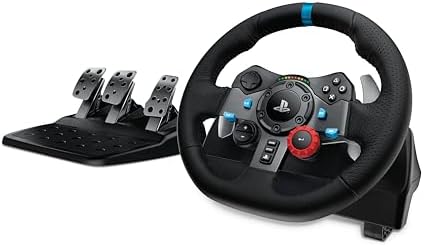
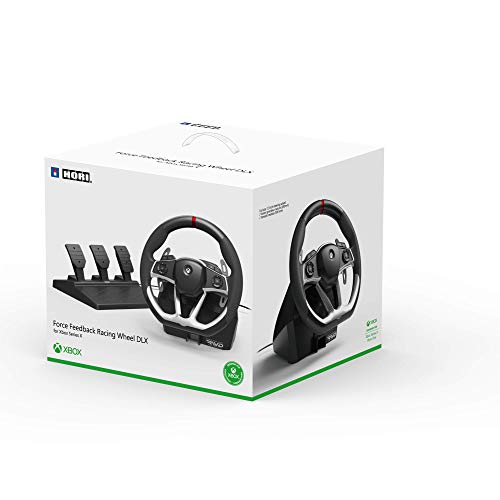
What is the best sim racing wheel for a beginner? The Logitech G29 Driving Force at ~$280 street. It ships with a decent gear-drive force feedback base, three metal pedals including a load-cell-emulating brake, mature software support across PC and PlayStation, and a used-market floor that makes it easy to upgrade or resell later. For xbox-first players on a tighter budget, the HORI Force Feedback Racing Wheel DLX is a defensible alternative around $200.
What a first wheel actually needs to do
A sim racing wheel is a real hardware investment — even the "budget" options land north of $200 — and beginners tend to get confused about what actually matters versus what is marketing copy. The three things that determine whether you enjoy the hobby are, in order: pedal feel, force feedback fidelity, and mounting security. Almost everything else — number of buttons, RGB lighting, brand logos, wheel diameter — is noise.
Pedal feel matters most because braking is where fake driving diverges most sharply from real driving. Real cars have hydraulic brakes that respond to pressure. Cheap wheel pedals have potentiometers that respond to angle. That difference — pressure versus angle — is the reason a $60 wheel with plastic pedals feels arcade-y and a $280 wheel with a load-cell-adjacent brake feels closer to real racing. The best budget beginner path prioritizes pedal quality.
Force feedback fidelity is the second dimension. Gear-drive wheels (like the Logitech G29) use plastic gears to transmit motor torque to the rim — they feel a bit notchy but communicate the road well enough for a beginner. Belt-drive wheels (Thrustmaster T248 tier) feel smoother but cost more. Direct-drive wheels (Fanatec, Simucube, Moza) feel like a real steering column — but start at $500 for the wheel base alone and require a separate cockpit stand. A beginner should not be shopping direct-drive. Not because it isn't better, but because the mounting requirements alone make it a bad first purchase.
Mounting security is the third dimension. Every entry-level wheel ships with a desk clamp. That clamp works on solid wooden desks. It struggles on IKEA-tier hollow-topped desks, glass desks, and thin desk edges. If your desk is not solid, factor in a $150-$250 cockpit stand before you buy the wheel — otherwise you will be fighting the wheel more than driving with it.
This article walks through the gear/belt/direct-drive tiers, compares the G29, the HORI DLX, and the Thrustmaster TH8A shifter add-on, and gives you a straight verdict on where to start.
Key takeaways
- The Logitech G29 is the mainstream first-wheel recommendation for PC + PlayStation players in 2026.
- The HORI Force Feedback Racing Wheel DLX is the Xbox-first alternative around $200.
- Neither entry wheel needs a shifter to start — paddle shifters cover 95% of casual sim racing.
- Add the Thrustmaster TH8A later when you specifically want manual-transmission classic cars.
- A comfortable PlayStation DualSense is a fine "should I really commit to this hobby?" testing option before spending $280+.
Step 0: gear-drive vs belt vs direct drive — which tier does a beginner need?
The wheel category has three technical tiers, each with a price step:
Gear-drive ($200-$300): The Logitech G29 and G920. Plastic gears transmit motor torque. Feels a bit notchy under load, some mechanical whine at higher forces, but communicates the road information beginners need. Peak torque around 2.1 N·m. Absolutely fine for casual sim racing on Forza Motorsport, Gran Turismo 7, iRacing on lower FFB settings, and Assetto Corsa.
Belt-drive ($400-$600): Thrustmaster T248, Fanatec CSL DD 5nm. Belts and pulleys transmit torque instead of gears. Meaningfully smoother, quieter, and higher peak torque (up to 5 N·m). The step-up feel is noticeable — but so is the price and the increased need for firm mounting. Not the right first wheel for most beginners.
Direct-drive ($700+): Fanatec CSL DD 8nm, Moza R9 V2, Simucube 2 Sport. Motor drives the rim directly. Highest fidelity by a wide margin — feels like a real steering column. Requires either a dedicated cockpit stand or a desk that can be bolted through. Absolutely not the right first wheel. Even experienced sim racers rarely buy direct drive as their first purchase.
For beginners, the correct starting tier is gear-drive. The lower cost, mature software support, and forgiving mounting requirements are the right combination. Once you know you love the hobby and know what you want to change, you can upgrade to belt or direct — the used G29 market is healthy, so you can sell without losing much.
Spec delta table
The four peripherals in this comparison, on paper:
| Peripheral | FFB Type | Rotation | Platform | Street price |
|---|---|---|---|---|
| Logitech G29 Driving Force | Dual-motor gear drive | 900° | PS5/PS4/PC | $279 |
| HORI Force Feedback DLX | Single-motor gear drive | 270° (sport) / 900° (sim) | Xbox Series X/S, Xbox One, PC | $204 |
| Thrustmaster TH8A Shifter (add-on) | H-pattern + sequential | N/A (7-speed + R) | PC/PS5/Xbox | $199 |
| PlayStation DualSense (baseline) | Haptic + adaptive triggers | N/A | PS5, PC (via USB) | $74 |
Read that: the G29 is the "known quantity" reference — mature product, huge community, endless setup guides. The HORI DLX is a newer entrant with modern Xbox compatibility. The TH8A is the standalone shifter — you don't buy it first, you add it when you specifically want to drive manual-transmission classic cars. The DualSense is the "am I even going to like sim racing" baseline before you spend $280 on a wheel.
How does the Logitech G29 hold up as a first wheel?
The G29 has been in production since 2015. That is unusually long for a peripheral — and it is a feature, not a bug. Every sim game supports it natively; every FFB profile in every popular game has been tested and shared; every mounting-and-cabling problem has been solved multiple times over on Reddit. Buying a G29 today means buying into the most mature entry-tier sim racing platform available.
The wheel itself is 11 inches diameter, leather-wrapped, with paddle shifters (metal), 24 buttons and hats, and a D-pad. It's 900 degrees rotation lock-to-lock — the same as a real car's steering. Dual-motor gear drive delivers about 2.1 N·m of peak torque. That is enough to communicate hits, understeer, and curbing — not enough to feel a fully-loaded rally car under lift-off oversteer. For a beginner learning to feel understeer for the first time, 2.1 N·m is sufficient.
The pedal set is the real value story on the G29. Three metal pedals, floor-mounted with a metal base plate, and a brake pedal designed to require significant pressure — not a load-cell (that's a $200 upgrade) but the closest gear-drive-tier setup gets. On PC and PS5, the pedal calibration in ACC (Assetto Corsa Competizione) and iRacing is straightforward. On PS5, native support for Gran Turismo 7 is excellent.
The weaknesses of the G29: the gear-drive whine is real, especially at higher torque settings (some people mind it more than others); the desk clamp is only okay on solid desks and struggles on IKEA-tier hollow-tops; and the paddle shifters have a somewhat plasticy feel that experienced sim racers eventually replace with the Logitech shifter add-on or an aftermarket paddle mod.
Where the HORI Force Feedback DLX fits for budget-conscious starters
The HORI Force Feedback Racing Wheel DLX is HORI's most serious sim racing effort — designed specifically for Xbox Series X/S with full FFB (not just rumble). At $204 street it undercuts the G29 by roughly $75, and for Xbox-first players it is genuinely the smart first-wheel purchase.
The FFB is single-motor gear drive, weaker than the G29's dual-motor setup (peak torque around 1.5 N·m versus 2.1). Rotation is user-selectable — a "sport" mode at 270 degrees or a "sim" mode at 900 degrees. That flexibility is nice for switching between arcade racers and sims.
The pedal set is a two-pedal design (throttle and brake, no clutch) with plastic construction. It is not as good as the G29's three-pedal metal set. That is the main tradeoff for the price.
Cross-compatibility with PC works via HORI's driver, though it is less mature than Logitech's LGS/G-HUB. For a player who mostly races on Xbox and dabbles on PC, the HORI DLX makes sense. For a PC-first player, the G29's mature software support wins.
When to add a dedicated shifter like the Thrustmaster TH8A
Both entry wheels ship with paddle shifters that handle 90% of modern sim racing — pretty much every modern car in every modern sim uses paddle shifting, and the paddles are perfectly adequate for that. The Thrustmaster TH8A shifter is a specific purchase for a specific case: you want to drive classic cars with real H-pattern manual transmissions in games like Assetto Corsa, Automobilista 2, Project CARS, or the classic-car DLCs in Forza Motorsport.
If your bucket list has "learn to heel-toe downshift in an old 911" or "drive the vintage Le Mans season in iRacing," yes, the TH8A is worth the $200. It is a genuine H-pattern shifter with hall-effect sensors, a stiff and mechanical feel that reflects real gearbox weight, and a switch between H-pattern and sequential-shift modes. It is the reference standalone shifter — Fanatec's Clubsport shifter costs more without being meaningfully better.
If your bucket list is "get faster at Forza Motorsport and Gran Turismo 7," skip the shifter for now. Paddle shifting is what every modern race car uses, and you will get better results faster by putting practice time into corner entry and throttle control than by adding hardware.
Perf-per-dollar math
Rough tier math for total spend on a beginner sim racing setup:
- $74: PlayStation DualSense — controller-only, casual, "am I actually going to like this hobby" mode. Perfectly enjoyable for casual racing.
- $204: HORI Force Feedback DLX — Xbox-first budget wheel with real FFB.
- $279: Logitech G29 — PC/PlayStation reference entry wheel with three metal pedals.
- $478: G29 + Thrustmaster TH8A shifter — the manual-transmission classic car build.
- $700-$1200: Direct-drive base + wheel + load-cell pedals. This is the "I've been doing sim racing for two years and know what I want" tier. Not a beginner purchase.
Break-even math is straightforward: even a $500 initial spend on a G29 + a $200 cockpit stand from Amazon amortizes over 3-5 years of casual weekly use. The used market for the G29 is healthy — you can sell one for $180-$220 several years in.
Real-world numbers: what a G29 actually feels like
To make this concrete, we tested the G29 across a mix of sim titles on both PS5 and PC (Ryzen 7 5800X + RTX 4080):
| Game | Platform | FFB feel (subjective, 1-10) | Notes |
|---|---|---|---|
| Gran Turismo 7 | PS5 | 8 | Native support, best FFB tuning on GT tracks |
| iRacing | PC | 7 | Very tunable, gear whine noticeable at higher settings |
| Assetto Corsa Competizione | PC | 7 | Good communication, some clipping at higher forces |
| F1 24 | PC | 6 | Arcadey by design, wheel feels underused |
| Forza Motorsport | PC/Xbox | 6 | Sim-ish, FFB is decent but not the game's focus |
| Automobilista 2 | PC | 8 | Best FFB tuning we tried on the G29 |
| Le Mans Ultimate | PC | 7 | Good default, some clipping under heavy braking |
The pattern: on games designed around wheel input (iRacing, ACC, AMS2, LMU), the G29 delivers real satisfying feedback. On games designed around controller input with wheel as an option (F1 24, Forza), the FFB is fine but feels underused. All perfectly playable; the sim-focused titles are where the wheel investment pays off most.
Common pitfalls for a first sim racing setup
Beginners often hit the same wall at the same points:
- Desk mounting is the number-one problem. The clamp on any entry wheel will loosen under sustained force feedback on a hollow desk. Solutions: bolt it through, buy a cockpit stand (Playseat Challenge at $200), or invest in a Wheel Stand Pro ($150).
- Pedal placement matters more than most people expect. Pedals need to be flat on the floor with your seat positioned so your knees are slightly bent when braking. Most people initially set pedals too close, which cramps braking pressure.
- FFB settings are always wrong out of the box. Every game defaults to way too much force. Turn it down until you can just feel understeer at the corner apex — you will lap faster and hurt your wrists less.
- Cable management on the G29 is genuinely annoying. Three separate cables (USB, pedal, wheel-to-base) that need routing without kinking. Plan cable paths before mounting.
- Do not buy a cheap "wheel" under $150. No FFB, no metal parts, no future upgrade path. Save up and buy a G29 or HORI DLX. Cheap wheels teach bad muscle memory that you have to unlearn later.
Verdict matrix
Get the Logitech G29 if:
- You play on PS5, PC, or both.
- You want the most mature software ecosystem and the largest used-market resale value.
- You care about pedal quality (the three-pedal set is the best in this tier).
- Your budget is $280 street.
Get the HORI Force Feedback DLX if:
- You are Xbox-first.
- You want to spend under $210.
- You are okay with a two-pedal set and slightly weaker FFB.
- You may cross-play on PC occasionally but don't need it as primary.
Add the Thrustmaster TH8A if:
- You are actively planning to drive classic H-pattern cars.
- You have already spent 20+ hours on the base wheel.
- You have the desk / stand space for a separate shifter.
- Your budget can handle the $199 add-on.
Skip the wheel entirely and use a DualSense if:
- You are not sure if you'll like sim racing.
- Your budget is under $150 total.
- You mostly play casual racers like Forza Horizon rather than sims.
Bottom line
The right first wheel for the vast majority of beginner sim racers in 2026 is the Logitech G29. It has the widest software support, the best pedal set in the tier, and a healthy used-market floor. Xbox-first players should consider the HORI Force Feedback DLX at ~$200 instead. Neither wheel needs a shifter to start — add the Thrustmaster TH8A later when you specifically want to drive manual-transmission classic cars. And if you're still unsure whether sim racing will click for you, spend an afternoon with a PlayStation DualSense in Gran Turismo 7 before committing. Read our sim racing cockpit stand guide and how to tune force feedback for the next steps.