

Pixio
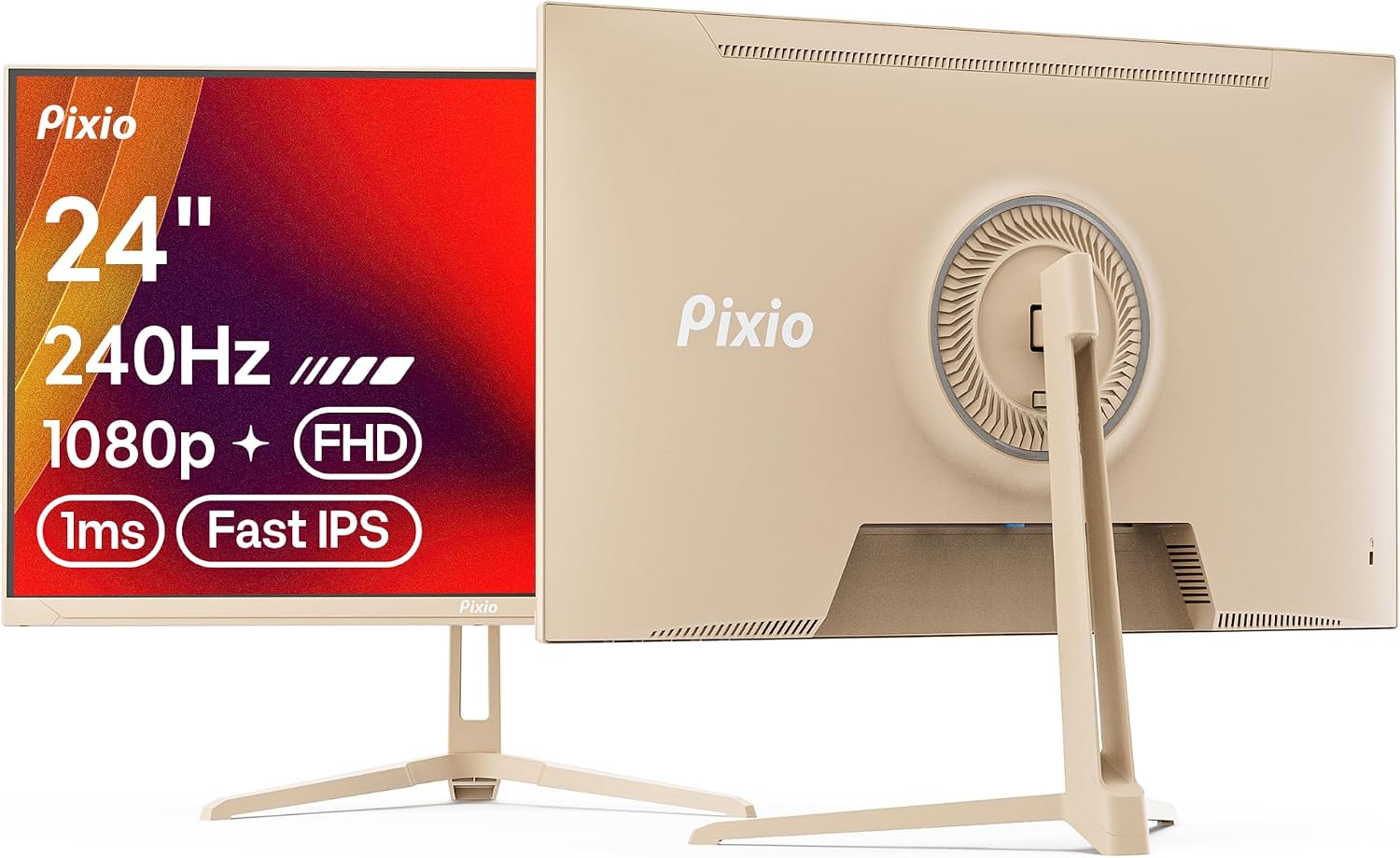
Pixio PX246 Wave Beige 24 inch 120Hz Refresh Rate FHD 1080p Resolution IPS Panel 4ms GTG Response Time Gaming Monitor with Adaptive Sync
Status: Pixio PX246 Wave Beige 24 inch 120Hz Refresh… (24 inch 1080p monitor): Unavailable on Amazon as of . Closest in-stock match (same 24" 1080p monitor): Pixio PX246 Wave White 24 inch 120Hz Refresh…, $119.99 on Amazon as of 2026-10-06 10:12 UTC (price may vary). eBay sellers may still list this model new or used.
Bottom line: The Pixio PX246 Wave Beige 24 inch 120Hz Refresh Rate FHD 1080p: Full 120Hz at 1080p over HDMI 2.0 for smoother motion than 60Hz displays; main trade-off: only one HDMI port; no DisplayPort input listed.
As an Amazon Associate, SpecPicks earns from qualifying purchases. Full disclosure →
Currently unavailable on Amazon. Not the same product — 3 in-stock alternatives with matching specs:
Same 24" 1080p monitor: Pixio PX246 Wave White 24 inch 120Hz Refresh… — $119.99 on Amazon as of 2026-10-06 10:12 UTC (price may vary).
Same 24" 1080p monitor: Pixio PX246 Wave Mint Green 24 inch 120Hz… — $119.99 on Amazon as of 2026-10-06 16:24 UTC (price may vary).
Same 24" 1080p monitor: Pixio PX249 Wave Beige 24 inch 240Hz Refresh… — $209.99 on Amazon as of 2026-10-06 04:16 UTC (price may vary).
Pros & Cons
Pros
- ✓ Full 120Hz at 1080p over HDMI 2.0 for smoother motion than 60Hz displays
- ✓ IPS panel with wider viewing angles than typical budget TN monitors
- ✓ Adaptive Sync cuts tearing and stutter when frame rates fluctuate
- ✓ VGA input keeps older and legacy PCs usable at 1080p 60Hz
Cons
- ✗ Only one HDMI port; no DisplayPort input listed
- ✗ VGA input tops out at 60Hz, so legacy sources miss the 120Hz mode
- ✗ 120Hz trails the 144-180Hz refresh rates common on esports monitors
- ✗ 1080p at 24 inches renders text softer than a 1440p panel
Manufacturer description
The Pixio PX246 Wave is a 24-inch gaming monitor that pairs a Full HD 1080p IPS panel with a 120Hz refresh rate and 4ms GTG response time. It suits a first gaming setup or a second screen for a secondary PC. At 120Hz you get twice the frame updates of a standard 60Hz office display, so fast camera pans and competitive shooters look noticeably smoother. Adaptive Sync matches the refresh rate to your GPU's frame output, which removes the tearing and stutter you see when frame rates dip below the panel's maximum. The IPS panel gives you wider viewing angles and more consistent color than…
SpecPicks Verdict
SpecPicks scored Pixio PX246 Wave Beige 24 inch 120Hz Refresh Rate FHD 1080p… using a rating × review-volume × price-fit model applied to published specs and reviews across the gaming monitors category. Pixio's gaming monitors lineup sits within the broader category mid-tier; price and specs are the deciding factors over brand loyalty here. Judge it on the specification table and the price rather than on sentiment: check the figures that decide your use case, then put it side-by-side with two or three close alternatives in the Compare tool before clicking through.
Common buyer scenarios for gaming monitors of this kind: matching it to an existing build, replacing a failing part, or upgrading from a previous-generation equivalent. Check the spec table below against your current setup — particularly socket / form-factor / power-rating fields — and confirm compatibility on the retailer's listing before purchase. Prices and stock are set by the retailer and may have moved since this page was last updated.
Frequently Asked Questions
Can the Pixio PX246 Wave actually run at 120Hz?
Yes, over HDMI. The HDMI 2.0 port supports 1920x1080 at 120Hz. The VGA port is limited to 1920x1080 at 60Hz, so connect over HDMI to get the full refresh rate.
Does the PX246 Wave work with FreeSync or G-Sync?
The listing says the monitor supports Adaptive Sync, which matches the refresh rate to your GPU's frame rate to reduce tearing and stutter. It doesn't name specific FreeSync or G-Sync certification, so check Pixio's product listing for GPU compatibility details.
Will it work with an older PC that only has VGA output?
Yes. The PX246 Wave has a VGA port that runs 1920x1080 at 60Hz, so older machines without HDMI can still drive the monitor at full resolution. The 120Hz mode needs the HDMI 2.0 port.
Does the Pixio PX246 Wave have a DisplayPort input?
The listing names only two inputs: one HDMI 2.0 port and one VGA port. If your graphics card has only DisplayPort outputs, you'll need a DisplayPort-to-HDMI adapter to connect to the HDMI port.
What panel type and response time does the PX246 Wave use?
It uses a 24-inch IPS panel at Full HD 1080p with a 4ms GTG response time. IPS gives wider viewing angles and more vivid color than TN panels. For stand adjustment, VESA mounting, and warranty terms, check the product listing.
Key Features
- 120Hz Refresh Rate for Smooth Gaming - Experience ultra-smooth visuals with a 120Hz refresh rate, ensuring fluid motion and reduced motion blur during fast-paced action.
- Vibrant Full HD 1080p IPS Display - Immerse yourself in stunning Full HD 1080p resolution with an IPS panel, providing vivid colors, sharp details, and wide viewing angles for an enhanced visual experience.
- Adaptive Sync - Matches the refresh rate of the monitor to the frame rate of the GPU, eliminating screen tearing and stuttering for a smooth and seamless gaming experience.
- Supports HDMI and VGA - There is one HDMI 2.0 port that supports 1920x1080@120Hz and a VGA port that supports 1920x1080@60Hz. The PX246 Wave has compatibility for newer machines and older as well
- Sleek and Stylish Design- The 24-inch Pixio PX246 Wave combines performance and aesthetics with a slim profile and modern design, making it the perfect addition to any gaming setup or workspace.
Full Specifications
| Brand | Pixio |
|---|---|
| Color | Beige |
| Voltage | 12 volts |
| Model Name | PX246 |
| Resolution | FHD 1080p |
| Screen Size | 24 inches |
| Aspect Ratio | 16:9 |
| Display Type | LED-sidelit |
| Model Number | PX246WAVEBE |
| Refresh Rate | 120 hertz |
| Adaptive Sync | FreeSync |
| Mounting Type | Desk Mount |
| Response Time | 4 milliseconds |
| Screen Finish | Matte |
| Viewing Angle | 178 degrees |
| Contrast Ratio | 1000:1 |
| Native Resolution | 1920x1080 |
| Display Technology | LED |
| Additional Features | Adaptive Sync, Anti Glare Screen, Blue Light Filter, Built-In Speakers, Tilt Adjustment |
| Hardware Connectivity | HDMI, VGA |
Ready to buy?
Pixio PX246 Wave Beige 24 inch 120Hz Refresh Rate FHD 1080p Resolution IPS Panel 4ms GTG Response Time Gaming Monitor with Adaptive Sync is listed on Amazon. Price, availability, shipping and returns are set by Amazon and its sellers — check the listing for current terms. SpecPicks earns a small commission on qualifying purchases — thank you for supporting independent review work.
Related Gaming Monitors


More guides & deep dives from the SpecPicks archive
Browse all articles & guides →- RTX 4070 Super vs RX 7800 XT — Which to Buy in 2026
- The Complete Voodoo5 5500 AGP Driver Guide (2026 Edition)
- Best Budget Gaming PC Build 2026 — ~$1,000 ($800 on Sale)
- Best Retro Handhelds in 2026 — From $35 to $500
- How to Build a Windows 98 Retro PC in 2026
- Emulation Hardware in 2026: FPGA, Software, and Cart-Reader Ecosystems
- Best 1440p Gaming GPUs in 2026
More reviews from the SpecPicks archive
Browse all reviews →- AI coding assistants ranked — Claude Code, Cursor, GitHub Copilot, Aider
- Best SATA SSD for Retro PC Upgrades in 2026
- Ryzen AI Max 400 'Gorgon Halo' 192GB vs RTX 3060 12GB for Local LLMs
- Strix Halo Clustering for Local LLMs: What the LocalLLaMA Reports Show
- Sega Genesis Mini vs SNES Classic Edition: Which Mini Console Wins in 2026?
- Logitech G Pro X2 Superstrike: The $125.99 Deal Has Expired
- Acti Brings AI Agents Into Your Smartphone Keyboard
- Beijing's $295B AI Buildout Wants 80% Domestic Chips — What It Means for GPU Buyers
- Adafruit Ships a Triple LED Matrix Bonnet for the Raspberry Pi
- Raspberry Pi Projects for Students (2025 Guide)
- Best Budget Gaming CPU Under $250 in 2026
- Intel Axes BigDL/IPEX-LLM: Where Local Inference Goes Now
- Best Cooling Solutions for Modern Gaming PCs (2026)
- RTX 5080 vs RX 7900 XTX: Which GPU Wins in 2026?
- Gemini 3.5 Live Translate Goes Cloud-First — The Local, Private Path on a Raspberry Pi
- Ideogram 4.0 Open Weights on an RTX 3060 12GB: Local Text-to-Image in 2026
- Noctua NH-U12S vs Cooler Master ML240L: Which Cools a 5800X?
- Voodoo 5 6000 FSAA: The Feature That Never Engaged
- AMD Ryzen 9 9950X3D2 Runs Faster on Linux Than Windows 11
- Blue Yeti vs HyperX QuadCast 2: Best Budget Streaming Mic Setup in 2026
- Best Internal SSD for a PS4 Pro Upgrade: 2.5" SATA Picks That Cut Load Times
- MiniMax-M3 Tops Open-Weight Models at Intelligence Index 55
- Local AI Video After Seedance 2.5: What GPU Generates 30-Second Clips
- Best SSD for Gaming and Everyday Builds in 2026
Earliest SpecPicks reviews
Browse full archive →- Best GPU for Llama 3.1 8B (2026)
- Best GPU for Qwen 3 14B (2026)
- Best GPU for Qwen 3 32B (2026)
- Best GPU for Llama 3.1 70B (2026)
- Best GPU for DeepSeek-R1 32B (2026)
- Best GPU for Llama 3.1 405B (2026)
- How to run Llama 3.1 8B on NVIDIA GeForce RTX 5090
- How to run Qwen 3 14B on NVIDIA GeForce RTX 5090
- How to run Qwen 3 32B on NVIDIA GeForce RTX 5090
- How to run Llama 3.1 70B on NVIDIA GeForce RTX 5090
- How to run DeepSeek-R1 32B on NVIDIA GeForce RTX 5090
- How to run Llama 3.1 8B on NVIDIA GeForce RTX 4090