

Pixio
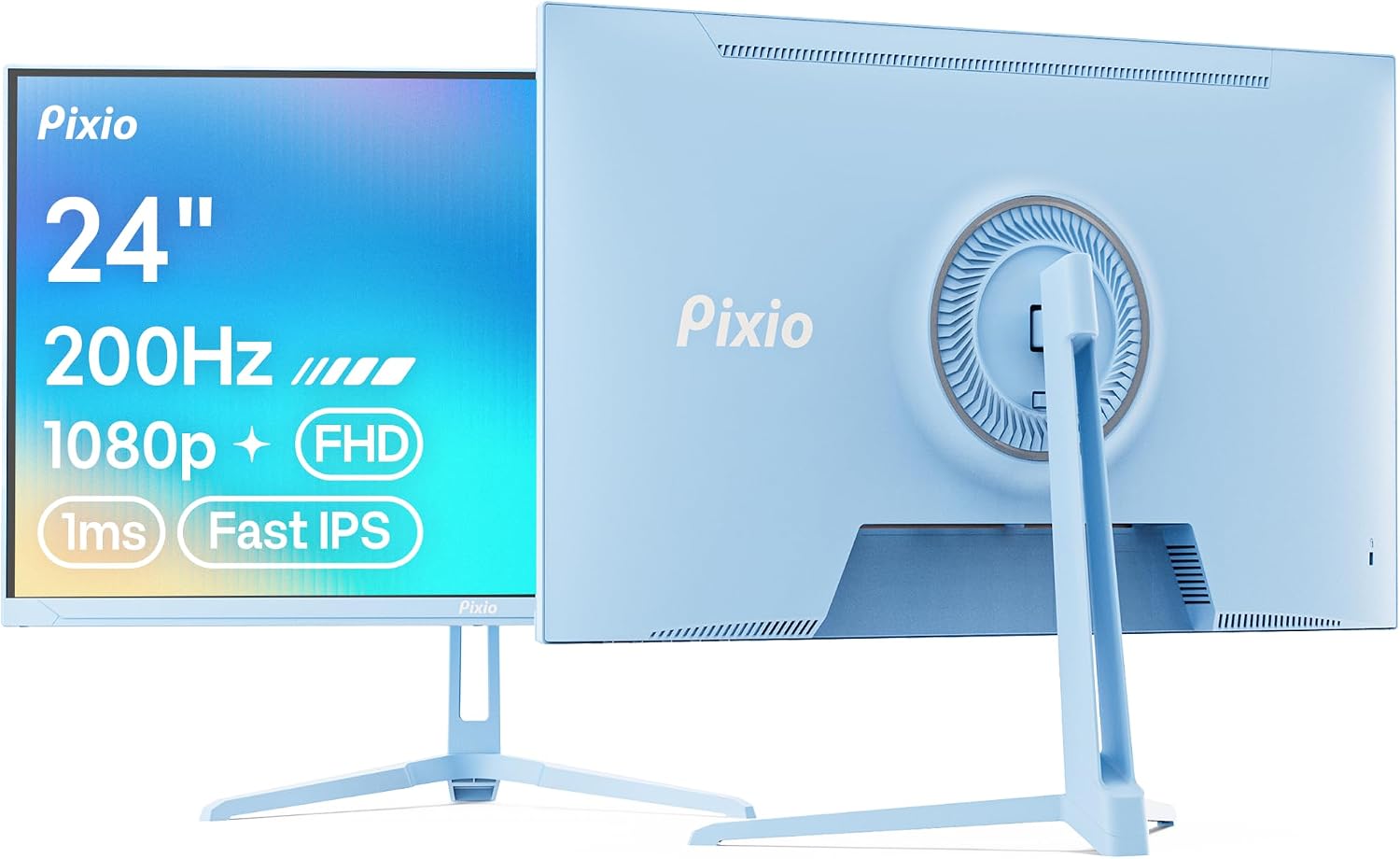
Pixio PX246 Wave Mint Green 24 inch 120Hz Refresh Rate FHD 1080p Resolution IPS Panel 4ms GTG Response Time Gaming Monitor with Adaptive Sync
Bottom line: The Pixio PX246 Wave Mint Green 24 inch 120Hz Refresh Rate FHD 1080p: 120Hz refresh rate, double a standard 60Hz office monitor; main trade-off: only one HDMI port, so two modern devices can't stay connected.
As an Amazon Associate, SpecPicks earns from qualifying purchases. Full disclosure →
Pros & Cons
Pros
- ✓ 120Hz refresh rate, double a standard 60Hz office monitor
- ✓ IPS panel with wide viewing angles and vivid color
- ✓ Adaptive Sync removes tearing when frame rates fluctuate
- ✓ VGA input at 1080p/60Hz works with older PCs and retro builds
Cons
- ✗ Only one HDMI port, so two modern devices can't stay connected
- ✗ No DisplayPort input listed in the product specs
- ✗ VGA input is limited to 60Hz, so 120Hz needs HDMI
- ✗ 120Hz is below the 144-240Hz that esports players often want
Manufacturer description
The Pixio PX246 Wave is a 24-inch gaming monitor for a first high-refresh setup, or for a desk where looks matter. Its Full HD 1080p IPS panel runs at 120Hz. That is double the 60Hz of a standard office display, so motion looks smoother in shooters, racing games and fast platformers. A 4ms gray-to-gray response time helps reduce ghosting during quick camera pans. Adaptive Sync matches the monitor's refresh rate to your GPU's frame rate. This removes screen tearing and stutter when your frame rate drops below 120 fps in demanding games. The IPS panel gives you wider viewing angles and more…
SpecPicks Verdict
SpecPicks scored Pixio PX246 Wave Mint Green 24 inch 120Hz Refresh Rate FHD 1080p… using a rating × review-volume × price-fit model applied to our editorial and benchmark analysis across the gaming monitors category. Pixio's gaming monitors lineup sits within the broader category mid-tier; price and specs are the deciding factors over brand loyalty here. Judge it on the specification table and the price rather than on sentiment: check the figures that decide your use case, then put it side-by-side with two or three close alternatives in the Compare tool before clicking through.
Common buyer scenarios for gaming monitors of this kind: matching it to an existing build, replacing a failing part, or upgrading from a previous-generation equivalent. Check the spec table below against your current setup — particularly socket / form-factor / power-rating fields — and confirm compatibility on the retailer's listing before purchase. Prices and stock are set by the retailer and may have moved since this page was last updated.
Frequently Asked Questions
What refresh rate and resolution does the Pixio PX246 Wave support?
It is a 24-inch Full HD 1920x1080 IPS monitor with a 120Hz refresh rate. You need the HDMI 2.0 port to get 120Hz. The VGA port is limited to 1080p at 60Hz.
Does the Pixio PX246 Wave have DisplayPort?
The product listing names only two inputs: one HDMI 2.0 port and one VGA port. No DisplayPort is listed, so plan to connect your PC or console over HDMI.
Does it support FreeSync or G-Sync?
The PX246 Wave supports Adaptive Sync, which matches the refresh rate to your GPU's frame rate to reduce tearing and stutter. The listing does not name FreeSync or G-Sync certification. Check your graphics card's documentation to confirm variable refresh rate works over HDMI.
Is the Pixio PX246 Wave good for competitive gaming?
It works well for casual and mid-level competitive play. The 120Hz refresh rate and 4ms GTG response time are a clear step up from a 60Hz monitor. Players who want 144Hz or higher, or 1ms response times, should look at faster panels.
Key Features
- 120Hz Refresh Rate for Smooth Gaming - Experience ultra-smooth visuals with a 120Hz refresh rate, ensuring fluid motion and reduced motion blur during fast-paced action.
- 4ms GTG Response Time - Enjoy quick and responsive gameplay with a 4ms gray-to-gray response time, minimizing ghosting and blurring for a crisp and clear image.
- Vibrant Full HD 1080p IPS Display - Immerse yourself in stunning Full HD 1080p resolution with an IPS panel, providing vivid colors, sharp details, and wide viewing angles for an enhanced visual experience.
- Adaptive Sync - Matches the refresh rate of the monitor to the frame rate of the GPU, eliminating screen tearing and stuttering for a smooth and seamless gaming experience.
- Supports HDMI and VGA - There is one HDMI 2.0 port that supports 1920x1080@120Hz and a VGA port that supports 1920x1080@60Hz. The PX246 Wave has compatibility for newer machines and older as well
- Sleek and Stylish Design- The 24-inch Pixio PX246 Wave combines performance and aesthetics with a slim profile and modern design, making it the perfect addition to any gaming setup or workspace.
Full Specifications
| Brand | Pixio |
|---|---|
| Color | Mint Green |
| Voltage | 12 Volts |
| Brightness | 300 Candela |
| Model Name | PX246WAVEMT |
| Resolution | FHD 1080p |
| Screen Size | 24 Inches |
| Aspect Ratio | 16:9 |
| Display Type | LED |
| Model Number | PX246WAVEMT |
| Refresh Rate | 120 Hz |
| Adaptive Sync | FreeSync |
| Response Time | 4 Milliseconds |
| Screen Finish | Matte |
| Viewing Angle | 178 Degrees |
| Contrast Ratio | 1000:1 |
| Has Color Screen | Yes |
| Native Resolution | 1920x1080 |
| Power Consumption | 28 Watts |
| Display Technology | IPS |
Ready to buy?
Pixio PX246 Wave Mint Green 24 inch 120Hz Refresh Rate FHD 1080p Resolution IPS Panel 4ms GTG Response Time Gaming Monitor with Adaptive Sync is listed on Amazon. Price, availability, shipping and returns are set by Amazon and its sellers — check the listing for current terms. SpecPicks earns a small commission on qualifying purchases — thank you for supporting independent review work.
Related Gaming Monitors



Pixio PX246 Wave Mint Green 24 inch 120Hz… head-to-head
Side-by-side specs, prices, and a pick for each matchup — no tab-switching.
More guides & deep dives from the SpecPicks archive
Browse all articles & guides →- Emulation Hardware in 2026: FPGA, Software, and Cart-Reader Ecosystems
- Best Budget Gaming PC Build 2026 — ~$1,000 ($800 on Sale)
- Best Retro Handhelds in 2026 — From $35 to $500
- How to Build a Windows 98 Retro PC in 2026
- The Complete Voodoo5 5500 AGP Driver Guide (2026 Edition)
- RTX 4070 Super vs RX 7800 XT — Which to Buy in 2026
- Best 1440p Gaming GPUs in 2026
More reviews from the SpecPicks archive
Browse all reviews →- Can a Raspberry Pi 4 8GB Run a Local LLM in 2026? Real tok/s and What Fits
- Best Coding LLM Stack for an RTX 3060 12GB and 32GB RAM (2026)
- AMD Ryzen 7 7700X3D Review: 7800X3D's OEM-Only Rival
- Best AMD Ryzen 5000 CPUs for AM4 in 2026
- Best Streaming Starter Kit for Creators in 2026
- Why NVIDIA's New AI Servers Use Hot-Tub Coolant
- How to Archive Your Old IDE and CompactFlash Retro PC Drives in 2026
- vLLM vs llama.cpp on a 12GB GPU: Which Serves Local LLMs Faster?
- Best Gaming SSD for PC Builds in 2026: 5 Picks Tested
- Gemma-4-Harmonia-31B Heretic: What the Uncensored Merge Adds Over Base Gemma 4
- Radxa Rock 5B+ Review (2026): The Enthusiast's RK3588 Board
- DeepSeek V3 VRAM Requirements: What 671B Really Needs
- Best 4K Monitor Under $400 for Console & PC Gaming 2026: SANSUI vs KOORUI vs ASUS TUF
- AMD's Ryzen 7 7700X3D Goes Newegg-Exclusive at $329
- Flux 3 Native-Audio Video: Can a 12GB GPU Run It?
- Best Racing Wheel Under $300: Logitech G29 vs HORI Force Feedback
- Sub-$300 4K Mini-LED Gaming Monitors Hit the Mainstream
- Homelab Month One: Raspberry Pi 4 or a Ryzen 5 Mini-PC?
- SATA/IDE to USB Adapters in 2026: FIDECO vs Unitek vs Vantec for Retro PC Data Recovery
- Is the Ryzen 7 5800X Still Worth It for 1440p Gaming in 2026?
- Authentic Retro PC Audio in 2026: Sound BlasterX G6 vs Vintage AWE64 and Audigy
- Best USB-C Capture and Streaming Gear for Console + PC Creators (2026)
- Retro Game Emulator Download 2026: Best Picks for AMD PCs
- Building a Local LLM Voice Assistant on Raspberry Pi 4 8GB: Whisper + Llama 3.2 1B Setup (2026)
Earliest SpecPicks reviews
Browse full archive →- Best GPU for Llama 3.1 8B (2026)
- Best GPU for Qwen 3 14B (2026)
- Best GPU for Qwen 3 32B (2026)
- Best GPU for Llama 3.1 70B (2026)
- Best GPU for DeepSeek-R1 32B (2026)
- Best GPU for Llama 3.1 405B (2026)
- How to run Llama 3.1 8B on NVIDIA GeForce RTX 5090
- How to run Qwen 3 14B on NVIDIA GeForce RTX 5090
- How to run Qwen 3 32B on NVIDIA GeForce RTX 5090
- How to run Llama 3.1 70B on NVIDIA GeForce RTX 5090
- How to run DeepSeek-R1 32B on NVIDIA GeForce RTX 5090
- How to run Llama 3.1 8B on NVIDIA GeForce RTX 4090