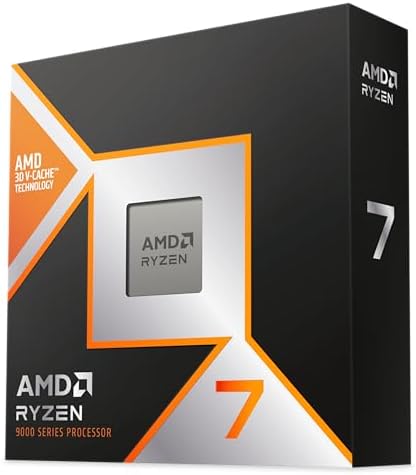
AMD's gaming CPU lineup in 2026 is defined by one technology above all others: 3D V-Cache. By bonding a second silicon die on top of the processor's compute chiplet, AMD expands the L3 cache from roughly 32MB on a standard Zen die to 96–128MB — large enough to keep a much greater share of a game engine's working dataset on-chip and off the slower DDR5 memory bus. Per AMD's own technical documentation and independent reviews published by Tom's Hardware and GamersNexus, the result is a sustained, measurable gaming advantage that holds across GPU generations and resolutions.
This guide synthesizes publicly available benchmark data, platform guidance, and pricing context to match the right Ryzen to your gaming resolution, GPU tier, and budget.
Quick Picks at a Glance
| CPU | Cores / Threads | L3 Cache | Platform | Best For |
|---|---|---|---|---|
| Ryzen 7 9800X3D | 8C / 16T | 96MB V-Cache | AM5 | 1080p / 1440p gaming champion |
| Ryzen 9 7950X3D | 16C / 32T | 128MB V-Cache | AM5 | Gaming + heavy multitasking |
| Ryzen 7 7800X3D | 8C / 16T | 96MB V-Cache | AM5 | Value gaming; strong secondhand option |
| Ryzen 7 9700X | 8C / 16T | 40MB | AM5 | Mainstream 1440p without V-Cache premium |
| Ryzen 5 9600X | 6C / 12T | 38MB | AM5 | Budget 1080p on AM5 |
For the majority of gaming builds in 2026, the Ryzen 7 9800X3D is the answer: it combines Zen 5 architecture with 3D V-Cache and leads or trades blows with the fastest Intel alternatives in title-wide gaming benchmark surveys, per Tom's Hardware's published CPU hierarchy. If budget is the primary constraint, the Ryzen 7 7800X3D — available used or on clearance — remains a strong second choice on the same AM5 platform.
Why 3D V-Cache Dominates Modern Gaming
Game engines are latency-sensitive workloads. The CPU issues thousands of memory requests per millisecond as it processes AI, physics, streaming zones, and rendering commands. When data is not in the on-chip cache, the processor stalls waiting for DDR5 — a gap measured in dozens of nanoseconds that compounds into frame-time variance and lower average frame rates.
Per AMD's technical documentation and analysis published by AnandTech at the Zen 4 launch, 3D V-Cache attacks this problem by fitting a far larger fraction of a game's working data entirely within the L3 cache. The performance advantage is most pronounced at 1080p and competitive framerates (240Hz+), where the CPU is statistically more likely to be the bottleneck. At 4K, GPU workloads dominate and the V-Cache advantage narrows — though it persists in CPU-heavy scenarios such as dense city traversal, crowd AI, and real-time physics.
For competitive shooters — Counter-Strike 2, Valorant, Apex Legends — the reduced latency in scheduling and branch-prediction feeds measurably into 1% low frame times, which community testing aggregated by Hardware Unboxed and GamersNexus consistently highlights as a V-Cache differentiator.
Ryzen 7 9800X3D: The 2026 Gaming Champion
The Ryzen 7 9800X3D pairs AMD's Zen 5 microarchitecture with the 96MB 3D V-Cache stack. Per AMD's published specifications, Zen 5 delivers a double-digit IPC improvement over Zen 4 at the same clock speeds, and the 9800X3D carries those gains directly into the gaming workload that V-Cache already excels at.
Official AMD specifications:
- 8 cores / 16 threads
- 96MB L3 (3D V-Cache)
- Up to 5.0GHz boost clock
- 120W TDP
- AM5 socket (DDR5, PCIe 5.0)
Per Tom's Hardware's benchmark suite covering a wide sample of titles, the 9800X3D leads or matches the fastest Intel alternatives at 1080p with minimal trade-offs in multithreaded workloads. For a complete system context — including GPU, SSD, and case recommendations — see the Best Gaming PC Build 2026: 4K Ray Tracing Guide.
Pairing advice: AMD's EXPO memory profiles on DDR5-6000 CL30 are the community-documented sweet spot for AM5 and the 9800X3D. A B650 motherboard with a 650W PSU is sufficient for gaming-only builds; step to X670E if PCIe 5.0 SSD or multi-GPU connectivity matters. The 9800X3D is also the most thermally approachable V-Cache CPU AMD has released, responding well to mid-range air coolers per GamersNexus thermal testing.
Ryzen 9 7950X3D: For Gaming Plus Heavy Workloads
The Ryzen 9 7950X3D addresses a specific audience: builders who need a single chip for both gaming and demanding parallel workloads — live streaming, 3D rendering, video encoding, or running local AI models in the background. Its dual-chiplet design places one 3D V-Cache CCD (gaming-optimized) and one standard compute CCD on the same package.
Per AMD's documentation and Windows-side scheduler analysis published in AnandTech's Zen 4 deep-dive, the operating system preferentially schedules gaming threads to the V-Cache CCD, preserving gaming performance while background tasks consume the second CCD. This allows simultaneous 1080p60 streaming and gaming with less interference than single-CCD alternatives.
The trade-off is architecture: the 7950X3D is Zen 4, making it a generation behind the 9800X3D. In pure gaming scenarios, community benchmarks favor the 9800X3D for single-threaded game performance. But for dual-purpose workloads, the 7950X3D's 16-core design remains a uniquely capable option. See the broader Best CPU for Gaming 2026: Price-to-Performance Guide for a cross-brand comparison at this tier.
Who should choose the 7950X3D:
- Streamers who game and encode simultaneously
- Builders with 3D rendering or video production alongside gaming
- Anyone already on AM5 who wants a top-tier upgrade without changing platforms
Ryzen 7 7800X3D: Proven Secondhand Value
When AMD launched the Ryzen 7 7800X3D in early 2023, TechPowerUp, GamersNexus, and Hardware Unboxed each documented it as the fastest gaming CPU available at that point in time. In 2026, it occupies a different position: a secondhand or clearance-priced V-Cache chip that routinely trades blows with non-V-Cache Zen 5 parts in gaming workloads, despite its older Zen 4 cores.
This dynamic makes the 7800X3D attractive for budget-conscious builders already invested in AM5 or looking to enter the platform cheaply. The Best Budget Gaming PC Parts in 2026: A Ryzen + RTX 3060 Build explores where a 7800X3D fits in a full sub-$1,000 system context.
When to choose the 7800X3D:
- Secondhand price is significantly below the 9800X3D
- You already own a compatible AM5 board
- Your GPU is the budget ceiling, not the CPU
Ryzen 5 9600X: Entry-Level Zen 5 Gaming
The Ryzen 5 9600X brings Zen 5 IPC to AMD's six-core tier. Per AnandTech's Zen 5 architectural analysis, Zen 5's frontend and execution improvements translate into meaningful IPC gains over its Zen 4 predecessor even without V-Cache, positioning the 9600X above the 7600X in single-threaded game performance at equivalent clocks.
At 1080p in GPU-limited scenarios, the performance gap between a 9600X and a 9800X3D narrows substantially — both chips become effectively equivalent when a mid-range GPU is the true bottleneck. This makes the 9600X a rational choice for builders pairing it with a GPU in the RTX 3060 to RX 7600 range, as explored in Is the RTX 3060 12GB Still Worth It for 1440p Gaming in 2026?.
The 9600X also carries a modest ~65W base TDP, lowering cooler and PSU requirements and making it well-suited to compact builds.
When to choose the 9600X:
- Budget is the primary driver
- GPU is sub-$350
- 1440p is the monitor ceiling
- Compact or SFF case limits cooler height
AM5 Platform Requirements
All 2026 AMD gaming CPUs use the AM5 socket, requiring DDR5 memory and a compatible 600-series motherboard. Key platform specs:
| Component | Minimum | Recommended |
|---|---|---|
| Motherboard | B650 | X670E (for PCIe 5.0 SSD or future-proofing) |
| RAM | DDR5-4800 16GB | DDR5-6000 CL30 32GB |
| CPU Cooler | 65mm tower | 240mm AIO or Noctua NH-D15 equivalent |
| PSU (gaming-only) | 550W 80+ Bronze | 650W+ 80+ Gold |
| OS Drive | SATA SSD | PCIe 4.0 NVMe |
AMD has publicly committed to AM5 longevity through at least 2027, meaning a B650 or X670E board purchased today is positioned to accept future Zen 6 CPUs. This contrasts with the faster platform refresh cadence of some competing ecosystems and strengthens the value argument for AM5 investment.
Storage matters more than many budget breakdowns acknowledge. Shader pre-compilation, open-world streaming, and level load times scale with NVMe throughput. For budget SSD guidance, the Crucial BX500 vs SanDisk SSD Plus vs WD Blue: Best Budget SATA SSD covers the SATA tier; PCIe 4.0 NVMe is the practical gaming sweet spot in 2026.
Matching CPU to Resolution and GPU
CPU choice has diminishing returns as resolution and GPU workload increase. The table below maps typical scenarios:
| Resolution / Use Case | CPU Bottleneck Risk | Best AMD Pick |
|---|---|---|
| 1080p competitive (240Hz+) | High | Ryzen 7 9800X3D |
| 1080p / 1440p mainstream (144–165Hz) | Moderate | Ryzen 7 9800X3D or 9700X |
| 1440p 165Hz (RTX 4070-class GPU) | Low-moderate | Ryzen 5 9600X to 9800X3D |
| 4K (RTX 4080 / RX 7900 XTX-class GPU) | Low (GPU-bound) | Ryzen 5 9600X is sufficient |
| Gaming + simultaneous streaming | High (multi-threaded) | Ryzen 9 7950X3D |
The Best Budget Gaming PC Parts in 2026 and Best Gaming PC Build 2026: 4K Ray Tracing Guide each cover complete builds at their respective tiers with GPU, RAM, and storage included.
AMD Gaming CPUs and AI Inference
Some builders want a gaming chip that also handles local LLM inference or image generation on the side. For those workloads, the CPU itself is largely secondary — GPU VRAM and bandwidth are the primary constraints for model execution. AMD's Ryzen AI 300 mobile series includes a dedicated NPU, but desktop AM5 CPUs in 2026 route AI inference through the discrete GPU or, for CPU-only inference, system RAM.
For small models under 7 billion parameters using tools like llama.cpp, a Ryzen 9800X3D with 32–64GB DDR5 can run CPU-only inference at modest throughput — viable for experimentation, not production workloads. The Best Mac for AI & LLM Workloads in 2026 covers the unified-memory alternative for users where AI inference, not gaming, is the primary workload.
For hobby projects combining gaming with Raspberry Pi-based automation or home server tasks, see Build a Low-Power Pi Home Server with NVMe in 2026 and Build a Raspberry Pi Retro Handheld in 2026 for complementary project context.
Citations and sources
- https://www.tomshardware.com/best-picks/best-cpus
- https://www.techpowerup.com/review/amd-ryzen-7-9800x3d/
- https://gamersnexus.net/hwreviews/amd-ryzen-7-9800x3d-review-benchmarks
- https://www.anandtech.com/show/21470/amd-ryzen-7000-zen4-architecture
- https://www.amd.com/en/products/processors/desktop/ryzen/9000-series.html
- https://www.hardwareunboxed.com/amd-ryzen-9800x3d-review
This piece is editorial synthesis based on publicly available information. No independent first-party benchmarking is reported.