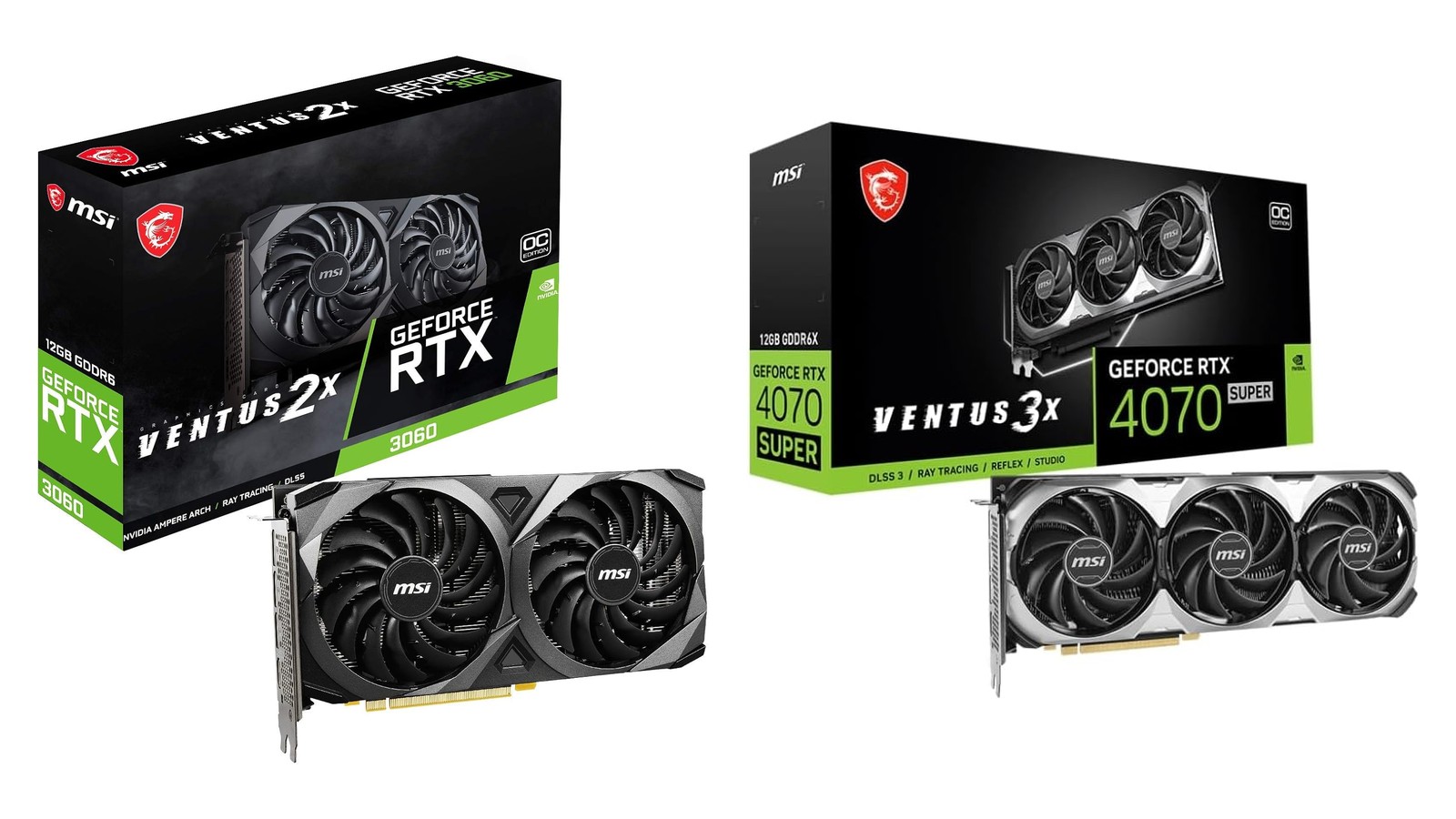
Same ceiling, different throttle
If you are shopping for a local-LLM card in the 12 GB tier as of September 2026, the two names that keep coming up are the MSI Gaming GeForce RTX 3060 12GB and the RTX 4070 Super. One is a 2021 Ampere card that still sells around $480 new. The other is a 2024 Ada card that launched at $599 per Wikipedia and currently sits around $630 for the ASUS Dual GeForce RTX 4070 Super EVO OC in the SpecPicks catalog snapshot.
The thing to understand before you compare benchmark tables is that VRAM capacity and memory bandwidth do two different jobs. Capacity is a gate: it decides whether a given model and quantization loads onto the GPU at all. Bandwidth is a throttle: once the model is loaded, every generated token has to stream the active weights out of VRAM, so the rate at which memory can be read sets the ceiling on tokens per second. These two cards share the gate and differ on the throttle.
That makes this an unusually clean comparison. There is no model the 4070 Super can run that the RTX 3060 12GB cannot, and no model that fits on one but spills on the other. Everything you gain from the extra money is speed — and, as the tables below show, the speed gain is much larger on prompt processing than on token generation.
This synthesis assumes one card, one user, and a GGUF runtime such as llama.cpp, Ollama or LM Studio. That is the configuration most readers build. If you plan to serve FP8 checkpoints through vLLM, skip to the FP8 note in the spec table, because that is the one place where Ada does something Ampere cannot.
Key takeaways
- Identical VRAM ceiling. Both cards carry 12 GB on a 192-bit bus. Qwen3 14B at Q4_K_M (9.00 GB file) fits on both; Q6_K (12.12 GB) fits on neither.
- 1.40x the bandwidth. 504 GB/s vs 360 GB/s per Wikipedia's GeForce 30 series and 40 series tables — and measured generation tracks it at 1.37-1.46x.
- About 2.5x the prefill. Hardware Corner measures 2,522 vs 973 tok/s prompt processing on Qwen3 14B at 4K context. Long RAG prompts and coding agents feel this most.
- More power, still modest. 220 W vs 170 W total graphics power, and 650 W vs 550 W recommended system power per NVIDIA's spec pages.
- The 16 GB alternative matters. The RTX 5060 Ti 16GB costs less than the 4070 Super, generates within about 10% of it, and holds 4 GB more model.
Step 0 — are you bottlenecked by speed or by VRAM?
Before choosing between these two cards, decide which wall you are actually hitting. The answer changes the recommendation completely.
You are VRAM-bound if the model you want to run does not fit at a quant you are happy with. Typical symptoms: Ollama silently offloads layers to the CPU and generation drops to single digits, or you are forced down to Q3 on a 14B model to leave room for context. If this is you, neither card is the answer. Both stop at 12 GB. Jump to the 16 GB section below.
You are speed-bound if your model already fits comfortably — say Llama 3.1 8B or Qwen3 14B at Q4_K_M — but responses feel slow, or long prompts take several seconds before the first token appears. This is the case where the 4070 Super earns its price, and specifically the second symptom (slow time-to-first-token) more than the first.
You are neither if you run 7-8B chat models at short context. At that size the 3060 already generates more than 50 tok/s in the benchmarks below, which is faster than you can read.
Spec-delta table
| Spec | RTX 3060 12GB | RTX 4070 Super | Delta | LLM impact |
|---|---|---|---|---|
| VRAM | 12 GB GDDR6 | 12 GB GDDR6X | Same capacity | Same model ceiling |
| Bus width | 192-bit | 192-bit | Same | — |
| Memory bandwidth | 360 GB/s | 504 GB/s | +40% | Sets token-generation speed |
| CUDA cores | 3,584 | 7,168 | 2.0x | Drives prompt processing |
| FP8 tensor math | No (Ampere, CC 8.6) | Yes (Ada, CC 8.9) | Ada only | Matters for vLLM FP8, not GGUF |
| Total graphics power | 170 W | 220 W | +50 W | Slightly larger PSU |
| Required system power | 550 W | 650 W | +100 W | — |
| Launch MSRP | $329 | $599 | +82% | — |
| Street price (Sept 2026) | ~$480 | ~$630 | ~+32% | Price may vary |
Sources: memory, bus, CUDA core and power figures from NVIDIA's RTX 3060 family page and RTX 4070 family page; bandwidth and launch MSRP from the Wikipedia GeForce 30 and 40 series tables. NVIDIA's own 3060 table lists both "12 GB / 8 GB" configurations — the 8 GB variant has a 128-bit bus and is a different card for LLM work, so check the listing says 12GB before you buy. The FP8 row comes from the vLLM FP8 documentation, which states FP8 computation "is supported on NVIDIA GPUs with compute capability >= 8.9 (Ada Lovelace, Hopper, Blackwell)" while Ampere gets weight-only FP8 via Marlin kernels.
Tokens per second on Llama 3.1 8B, Qwen3 14B and Gemma 3 12B
The cleanest public dataset for this pair is Hardware Corner, which publishes prompt-processing (pp) and token-generation (tg) tables for both cards on the same Qwen3 models at the same Q4_K quantization. Figures below are read from the tables on the RTX 3060 12GB page and the RTX 4070 Super page, not the summary cards.
| Model (Q4_K) | Context | RTX 3060 12GB pp / tg | RTX 4070 Super pp / tg | tg ratio | pp ratio |
|---|---|---|---|---|---|
| Qwen3 8B | 4K | 1,696.8 / 55.2 | 4,321.7 / 75.4 | 1.37x | 2.55x |
| Qwen3 8B | 16K | 1,119.2 / 42.0 | 2,525.8 / 56.2 | 1.34x | 2.26x |
| Qwen3 8B | 32K | 764.7 / 31.9 | 1,595.7 / 42.2 | 1.32x | 2.09x |
| Qwen3 14B | 4K | 972.6 / 31.2 | 2,522.2 / 45.5 | 1.46x | 2.59x |
| Qwen3 14B | 16K | 678.2 / 22.7 | 1,578.1 / 37.2 | 1.64x | 2.33x |
The generation ratio lands between 1.32x and 1.46x in every short-to-medium context row — right on top of the 1.40x bandwidth ratio. That is the textbook signature of a bandwidth-bound workload. The one outlier, 1.64x on 14B at 16K, is where the 3060's KV cache is squeezing its remaining headroom (see the context section below).
For Llama 3.1 8B at Q4_K_M, LocalScore's RTX 3060 page reports 1,483 pp / 51.3 tg with 882 ms time-to-first-token, and its RTX 4070 Super page reports 3,336 pp / 53.4 tg with 400 ms. The prefill gap matches Hardware Corner; the generation figure for the 4070 Super does not, and the same entry shows the 4070 Super below the 3060 on Qwen2.5 14B generation (24.9 vs 26.6 tok/s). That entry has only three models tested and runs against the bandwidth math, so treat it as one noisy community submission rather than evidence that the 4070 Super is slower.
For Gemma 3 12B, no public source measures both cards on the same build, so this synthesis does not quote a number. Expect the same pattern: its Q4_K_M GGUF is 7.30 GB per the bartowski Gemma 3 12B GGUF repo, smaller than Qwen3 14B, so both cards should generate somewhat faster than on 14B with the same ~1.4x ratio.
The llama.cpp project's own CUDA scoreboard has an RTX 3060 row (Llama 2 7B Q4_0: 2,407.67 pp512 / 76.92 tg128 with flash attention) but, as of this writing, no RTX 4070 Super row — only the 256-bit 4070 Ti Super, which is a different card.
Quantization matrix
File sizes are for Qwen3 14B GGUFs from the bartowski Qwen3-14B GGUF repo. "Fits" means the weights load fully on the GPU with at least a 4K context.
| Quant | File size | RTX 3060 12GB | RTX 4070 Super | RTX 5060 Ti 16GB | Quality |
|---|---|---|---|---|---|
| Q3_K_M | 7.32 GB | Fits, long context | Fits, long context | Fits | Noticeable loss |
| Q4_K_M | 9.00 GB | Fits, ~16K context | Fits, ~16K context | Fits, 32K | Common default |
| Q5_K_M | 10.51 GB | Fits, short context | Fits, short context | Fits | Small loss |
| Q6_K | 12.12 GB | No | No | Fits | Near-lossless |
| Q8_0 | 15.70 GB | No | No | Not with usable context | Near-lossless |
Two rows matter. Q4_K_M is the sweet spot on both 12 GB cards, and it is the quant every benchmark above uses. Q6_K is where a 16 GB card opens a door neither 12 GB card has. For Llama 3.1 8B the picture is easier — Q4_K_M is 4.92 GB and Q8_0 is 8.54 GB per the bartowski Llama 3.1 8B GGUF repo, so both cards run 8B at Q8_0 with room to spare.
Prefill vs generation: where Ada's extra compute helps
Generating a token is a memory-read problem: the GPU streams roughly the whole weight file for each token and does comparatively little math on it. Processing a prompt is the opposite: thousands of tokens are pushed through the weights in parallel, so the work is dominated by matrix multiplies and scales with tensor throughput. The 4070 Super has twice the CUDA cores and a newer tensor-core generation, and that is why its prefill lead (2.1-2.6x) is so much bigger than its generation lead (1.3-1.5x).
What that means in practice:
- Chat with short prompts. A 200-token question barely registers on either card. You feel generation speed, so the gap is ~1.4x.
- RAG over documents. Stuffing 8-16K tokens of retrieved context into every query is prefill-dominated. At 16K on Qwen3 14B, the 3060 processes 678 tok/s against the 4070 Super's 1,578 per Hardware Corner — a 16K prompt is roughly 24 seconds before the first token on the 3060 and about 10 on the 4070 Super.
- Coding agents. Tools such as Aider, Continue or OpenHands resend large chunks of repository context on every turn. This is the workload where the 4070 Super is most clearly worth the premium.
LocalScore's time-to-first-token figures tell the same story: 1.92 s on the 3060 vs 786 ms on the 4070 Super for Qwen2.5 14B.
How does context length change the picture at 16K and 32K?
The KV cache — the stored attention keys and values for every token in the context — lives in VRAM alongside the weights. Per the Qwen3-14B config, the model has 40 layers, 8 key-value heads and a head dimension of 128. At 16-bit precision that works out to 2 × 40 × 8 × 128 × 2 bytes = 160 KiB per token (this synthesis's arithmetic, from the published config):
| Context | KV cache (FP16) | Q4_K_M weights + cache | Fits in 12 GB? |
|---|---|---|---|
| 4K | ~0.63 GiB | ~9.0 GiB | Yes, comfortably |
| 16K | ~2.5 GiB | ~10.9 GiB | Yes, tight |
| 32K | ~5.0 GiB | ~13.4 GiB | No |
That is why Hardware Corner's tables have 14B rows at 16K but none at 32K for either 12 GB card, while the RTX 5060 Ti 16GB page does report 14B at 32K (621.0 pp / 25.9 tg). If you need 32K on a 12 GB card, llama.cpp lets you quantize the KV cache to 8-bit, which roughly halves the cache footprint, or you drop the weights to Q3_K_M. Both costs are identical on the two cards, because the ceiling is identical.
Is a 16 GB card like the RTX 5060 Ti a better buy than either?
For a lot of readers, yes. The GIGABYTE GeForce RTX 5060 Ti Gaming OC 16G sits around $440 in the catalog snapshot — cheaper than the 4070 Super — and adds 4 GB of VRAM. NVIDIA's RTX 5060 family page lists it at 16 GB GDDR7 on a 128-bit bus with 180 W total graphics power; Wikipedia's GeForce 50 series table gives 448 GB/s of bandwidth and a $429 launch price.
448 GB/s sits between the two 12 GB cards, and the measured numbers follow. On the RTX 5060 Ti 16GB page, Hardware Corner reports Qwen3 14B Q4_K at 1,743.0 pp / 41.1 tg at 4K and 942.6 / 32.9 at 16K. So on a model that fits in 12 GB, the 4070 Super still generates about 10% faster and processes prompts about 45% faster. But the 5060 Ti runs Qwen3 14B at Q6_K, and it runs 14B at 32K context without cache tricks — two things neither 12 GB card can do at any price.
The llama.cpp scoreboard backs this up on a smaller model: the 5060 Ti 16GB posts 4,195.53 pp512 / 93.46 tg128 on Llama 2 7B Q4_0 with flash attention, against the 3060's 2,407.67 / 76.92.
Perf-per-dollar and perf-per-watt
Using Qwen3 14B Q4_K at 4K from Hardware Corner, catalog prices from the September 2026 SpecPicks snapshot (price may vary), and total graphics power from NVIDIA:
| Card | Street price | tg tok/s | tg per $100 | pp per $100 | tg per 100 W |
|---|---|---|---|---|---|
| RTX 3060 12GB (MSI Gaming) | ~$480 | 31.2 | 6.5 | 203 | 18.4 |
| RTX 4070 Super (ASUS Dual EVO) | ~$632 | 45.5 | 7.2 | 399 | 20.7 |
| RTX 5060 Ti 16GB (GIGABYTE Gaming OC) | ~$440 | 41.1 | 9.3 | 396 | 22.8 |
A few things to note. The ZOTAC Gaming RTX 3060 Twin Edge OC 12GB lists near $500, so the 3060's value case depends on finding it near $480 or less. The MSI GeForce RTX 4070 Super 12G Ventus 3X OC was listed well above $1,000 in the same snapshot, which is a marketplace-seller price, not the card's real value — do not pay it when the ASUS Dual EVO is around $630. And at current street prices the 3060's per-dollar advantage has largely disappeared: it is still the cheapest way into 12 GB, but not the cheapest tok/s.
Can you game and run a model on the same card?
Yes, but not at the same time on a 12 GB card with a 14B model loaded. A modern game at 1440p can claim several gigabytes of VRAM on its own, and a Qwen3 14B Q4_K_M model plus a 4K cache already needs about 9 GiB. When both compete for the same 12 GB, the driver or the runtime pushes one of them into system memory and both slow down. The fix is identical on both cards: unload the model before launching the game (ollama stop <model> or set a short OLLAMA_KEEP_ALIVE), or run an 8B model while gaming. The 4070 Super has no advantage here because the ceiling is the same.
Common pitfalls on a 12 GB inference build
- Buying the 8 GB RTX 3060. It shares the name, but NVIDIA lists it with a 128-bit bus. It cannot hold Qwen3 14B at Q4_K_M and is materially slower. Check the listing title for "12GB".
- Assuming 4070 Super = bigger models. It does not. If the model you want spills on a 3060, it spills on a 4070 Super.
- Ignoring the power connector. ASUS's Dual RTX 4070 Super EVO spec sheet lists a 16-pin power connector and recommends a 750 W PSU (NVIDIA's own figure is 650 W). Older supplies need the included adapter.
- Reading one benchmark cell as gospel. The LocalScore 4070 Super entry shows it slower than the 3060 on 14B generation. Cross-check against a second source before drawing conclusions.
Verdict matrix
Get the RTX 3060 12GB if your models are 8-14B, your prompts are short, you mostly chat, and you want the lowest cost of entry into 12 GB. At 31 tok/s on Qwen3 14B, it is fast enough to read along with.
Get the RTX 4070 Super if you are already happy with 12 GB but your workflow is prompt-heavy — RAG, long documents, coding agents — or you want to serve FP8 checkpoints through vLLM. The 2.5x prefill advantage is the real reason to pay more.
Get a 16 GB card instead if you are VRAM-bound: you want Qwen3 14B at Q6_K, 32K context without KV-cache quantization, or headroom for the next model size up. The RTX 5060 Ti 16GB costs less than the 4070 Super and gives up only about 10% of its generation speed.
Recommended pick
For most readers comparing these two cards for local LLMs in 2026, the better purchase is actually the third option: the GIGABYTE RTX 5060 Ti Gaming OC 16G delivers roughly 90% of the 4070 Super's token generation for less money and removes the 12 GB ceiling. Between the two cards in the title, pick the ASUS Dual RTX 4070 Super EVO OC only if prompt processing is your bottleneck, and the MSI Gaming RTX 3060 12GB if you want the cheapest proven 12 GB card for 8-14B chat.
Live price comparison
Prices move weekly. The head-to-head page carries live Amazon pricing for both cards: RTX 3060 12GB vs RTX 4070 Super — live comparison. Prices quoted in this article are a SpecPicks catalog snapshot from 2026-09-24 and may vary.
Related guides
- Best 12GB GPU for Local LLMs in 2026
- RTX 3060 12GB vs RTX 4060 Ti 16GB for Gemma 3 12B
- Which LLMs Fit on an RTX 3060 12GB in 2026
- Best 16GB GPU for Local LLMs in 2026
- RTX 3060 12GB vs RTX 4070 for Qwen2.5 14B
- RTX 3060 12 GB benchmark data
- RTX 4070 Super benchmark data
Citations and sources
- Wikipedia — GeForce 30 series (RTX 3060 bandwidth, MSRP) — accessed 2026-09-24
- Wikipedia — GeForce 40 series (RTX 4070 Super bandwidth, MSRP) — accessed 2026-09-24
- NVIDIA — GeForce RTX 3060 family specifications — accessed 2026-09-24
- NVIDIA — GeForce RTX 4070 family specifications — accessed 2026-09-24
- NVIDIA — GeForce RTX 5060 family specifications — accessed 2026-09-24
- Hardware Corner — RTX 3060 12GB LLM benchmarks — accessed 2026-09-24
- Hardware Corner — RTX 4070 Super LLM benchmarks — accessed 2026-09-24
- Hardware Corner — RTX 5060 Ti 16GB LLM benchmarks — accessed 2026-09-24
- LocalScore — RTX 3060 results — accessed 2026-09-24
- LocalScore — RTX 4070 Super results — accessed 2026-09-24
- llama.cpp — CUDA performance scoreboard (discussion #15013) — accessed 2026-09-24
- llama.cpp — project repository — accessed 2026-09-24
- vLLM — FP8 quantization documentation — accessed 2026-09-24
- Hugging Face — Qwen3-14B config.json — accessed 2026-09-24
- Hugging Face — bartowski Qwen3-14B GGUF — accessed 2026-09-24
- Hugging Face — bartowski Llama 3.1 8B Instruct GGUF — accessed 2026-09-24
- Hugging Face — bartowski Gemma 3 12B GGUF — accessed 2026-09-24
- ASUS — Dual RTX 4070 Super EVO OC tech specs — accessed 2026-09-24
This piece is editorial synthesis based on publicly available information. No independent first-party benchmarking is reported.




