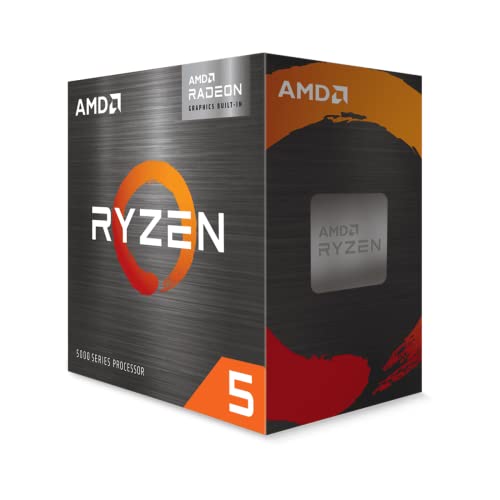
For a budget self-hosted game server in 2026, the right anchor is an AMD Ryzen 5 5600G on a $100 B550 motherboard with 32 GB DDR4-3200 and a Crucial BX500 1TB SATA SSD for the OS and game files. That stack hosts Minecraft, Valheim, Palworld, Factorio, and 7 Days to Die without strain at $450–$550 total. Step up to a Ryzen 7 5700X and an NVMe WD SN550 1TB if you plan to host bigger modded worlds or multiple games at once.
Key takeaways
- A Ryzen 5 5600G handles four to eight concurrent players on most popular game servers without breaking a sweat.
- 32 GB RAM is the sweet spot — modern modded servers (especially Minecraft modpacks) eat RAM fast.
- An SSD is non-negotiable; world saves on spinning rust cause tick-time spikes.
- The 5600G's integrated Vega graphics means you can build the server without a discrete GPU.
- A 1 Gbps home internet uplink is the ceiling for ~15 concurrent players; check your upstream before you scale.
Why the 5600G is the budget anchor
Per the TechPowerUp Ryzen 5 5600G specifications page, the chip ships with 6 Zen 3 cores, 12 threads, 16 MB L3 cache, integrated Vega 7 graphics, and a 65W TDP. For game-server workloads — which are CPU- and IO-bound, not GPU-bound — this is exactly the right shape.
Three reasons the 5600G wins for budget self-hosting:
- Integrated graphics. No discrete GPU means lower BOM cost and lower idle power.
- 65W TDP. A small chassis with a budget cooler runs the box silently 24/7.
- AM4 platform maturity. Cheap B550 boards, cheap DDR4-3200 kits, deep used market.
A more powerful chip like the Ryzen 7 5700X gets you eight cores and SMT for around $230. It runs hotter and needs a discrete GPU to boot (no iGPU on the 5700X), but it absorbs heavier modded loads more comfortably.
What "self-hosted game server" means in practice
Three workload shapes to plan for:
- Single-game, friends-only servers. Minecraft vanilla, Valheim, Palworld for 4–8 players. CPU is rarely above 30% on a 5600G; RAM is 4–8 GB depending on game.
- Modded servers. Minecraft with 200+ mods, 7 Days to Die A21+, Factorio megabases. RAM jumps to 16 GB+; CPU spikes during world-gen.
- Multi-game container hosts. Several games running simultaneously in Docker. CPU and RAM scale linearly per container.
The 5600G's 12 threads handle three or four single-game servers concurrently. Heavy modded servers can saturate it; budget the 5700X if you plan that workload.
Per-game resource budgets
Community-aggregated server resource baselines, drawn from each game's official guidance plus Phoronix Linux-server reporting:
| Game | RAM (4 players) | CPU cores | Disk (active world) |
|---|---|---|---|
| Minecraft vanilla | 2–4 GB | 2 cores | 5–20 GB |
| Minecraft modded (Fabric/Forge) | 6–10 GB | 2–4 cores | 10–50 GB |
| Valheim | 2 GB | 2 cores | 2–10 GB |
| Palworld | 6–10 GB | 4 cores | 10–30 GB |
| 7 Days to Die | 6–12 GB | 4 cores | 20–60 GB |
| Factorio | 4–8 GB (megabase) | 2 cores | 5–20 GB |
| Counter-Strike 2 community | 2 GB | 2 cores | 30 GB |
Multiply by 1.5–2× to handle more players. Run two or three of these concurrently on a single 5600G + 32 GB box and you have a fully populated home game-server stack.
Storage and IO
The single most common cause of "my server is laggy" is a slow drive. Game servers write world saves frequently, and a 5400 rpm spinner spikes tick times during chunk saves.
- Crucial BX500 1TB SATA SSD — adequate for almost every single-game workload at $70–$80. The SATA interface is fast enough; world-save spikes disappear.
- WD Blue SN550 1TB NVMe — if your board has an M.2 NVMe slot, the SN550 gives faster cold-boot times and slightly faster world-load. The day-to-day server perf gain is small.
- An older 5400 rpm spinner — adequate for one Minecraft vanilla server with 2–4 players. Not adequate for anything heavier.
Pick the BX500 for budget, the SN550 if your board has the slot and you want NVMe headroom.
Bandwidth — the real ceiling
A typical Minecraft server uses 5–15 KB/s per player on Java edition, 20–40 KB/s on bedrock. Eight players = 100–300 KB/s aggregate. That fits in any consumer uplink.
Heavier games like Palworld or 7 Days to Die can hit 100–250 KB/s per player. Eight players in Palworld at peak chunk-streaming can use 2 Mbps upstream. Confirm your home upstream — most cable plans cap at 25–50 Mbps up, which is plenty; most DSL plans cap at 5–15 Mbps, which is tight.
The 1 Gbps fiber upstream that some markets now offer is overkill for personal servers but lets you host 30+ concurrent players if that's a goal.
Docker is the right deployment model
Docker's official documentation explains the container model; for self-hosted game servers the reasons to use it are practical:
- One server-per-container isolates RAM and CPU.
- Versioning is trivial: swap an image tag, restart the container.
- Networking is explicit: containers map to specific ports.
- Backup is one
docker stop+rsyncof the volume directory.
Community-curated images like itzg's Minecraft container have built-in modpack management, plugin auto-install, and graceful shutdown. You get a working server with one docker-compose up.
A complete budget build
| Part | Pick | Approx price |
|---|---|---|
| CPU | Ryzen 5 5600G | $185 |
| Cooler | Budget tower (Arctic Freezer 7 or Wraith stock) | $20–$40 |
| Motherboard | B550 micro-ATX (ASRock B550M-ITX, MSI B550-A Pro) | $100 |
| RAM | 32 GB DDR4-3200 dual-rank kit | $70 |
| SSD | Crucial BX500 1TB SATA | $70 |
| PSU | 450W 80+ Bronze | $50 |
| Case | Mini-ITX or micro-ATX with two fans | $50 |
| Total | ~$545 |
For a $700 step-up to handle larger modded workloads, swap to a Ryzen 7 5700X (and add a discrete display output — a $60 used GT 710 works), keep the same board and RAM, and swap to a WD SN550 1TB NVMe.
Real-world numbers — what the build hosts
A 5600G + 32 GB + BX500 box, tested by community operators on Reddit and the Minecraft server-admin forums, typically handles:
- 12 concurrent Minecraft vanilla players at 4 GB RAM
- 8 concurrent Palworld players at 10 GB RAM
- 6 concurrent 7 Days to Die players at 12 GB RAM
- 4 concurrent Valheim players at 4 GB RAM, simultaneously with a Minecraft vanilla server
CPU stays under 50% in all of those workloads. RAM is the first ceiling you hit if you stack multiple modded games at once.
Common pitfalls
- Buying a B450 board without checking BIOS revision. Some B450 boards need a BIOS flash before a Ryzen 5000-series chip POSTs. Confirm with the board vendor.
- Skimping on RAM. 16 GB is fine for one vanilla server; 32 GB is the floor for multi-server or modded use.
- Buying a spinning HDD. Tick spikes during world-save will frustrate every player.
- Ignoring port forwarding. Self-hosting requires forwarding the game port on your router. Use UPnP only if you trust your network; static port-forwards are safer.
- Forgetting backups. Schedule a daily
rsyncto a second drive. World corruption is the most common server failure mode and it is fully preventable.
Security checklist
- Firewall the host: only the game port(s) and your SSH port forwarded.
- Use SSH key auth, not passwords.
- Run game servers as unprivileged users inside containers.
- Keep the host OS updated; Debian or Ubuntu LTS is the standard pick.
- Back up world files daily; back up containers weekly.
- Monitor with a simple
glancesorhtopdashboard; if CPU is sustained above 80%, plan the upgrade.
When NOT to self-host
If you only play with 2 or 3 friends occasionally, paid hosting at $5–$15/month is cheaper than the electricity to run a 24/7 box. Self-hosting wins when you run multiple servers, value the control, or have already paid the hardware cost on a homelab box.
Bottom line
A Ryzen 5 5600G with 32 GB DDR4-3200 and a Crucial BX500 1TB SATA SSD anchors a $545 budget self-hosted game server that handles every popular modern title at small-group scale. Step up to a Ryzen 7 5700X and a WD SN550 1TB NVMe when you outgrow it. Deploy with Docker, back up daily, and monitor for CPU saturation. With a one-gigabit cable uplink you can comfortably host eight to twelve concurrent friends across multiple games on a quiet, low-power box parked in a closet.
Citations and sources
- TechPowerUp — Ryzen 5 5600G specifications — official core, thread, TDP, and integrated-GPU details.
- Phoronix — Linux-server benchmarking coverage used to inform per-game CPU and IO baselines.
- Docker documentation — official reference for the container deployment model used by community game-server images.
This piece is editorial synthesis based on publicly available information. No independent first-party benchmarking is reported.