If you want plug-and-play with a curated library and zero setup, an official mini console like the Nintendo Super NES Classic Edition or the Sega Genesis Mini is the right buy. If you want breadth across many systems, expandable libraries, and are willing to assemble and configure, a Raspberry Pi 4 8GB running RetroPie is the better path. Both choices are legitimate; they answer different questions.
What you are really choosing between
The retro-console market in 2026 splits cleanly into two philosophies. On one side are the official mini reissues from Nintendo, Sega, Sony, SNK, and Commodore — polished single-purpose boxes shipped by the platform holder, preloaded with a curated library of first- and third-party classics, HDMI-out, and a controller in the box. Per Nintendo Life launch coverage from the mini-console era and the manufacturer product pages at Nintendo and Sega, these devices are aimed at people who want the games and the feel of the original hardware without any of the friction. Plug the HDMI cable in, plug the USB power in, pick a game, play.
On the other side is the DIY emulation route, best represented by the RetroPie project running on a Raspberry Pi 4 or Pi 5. RetroPie is a Debian-based image that wraps EmulationStation and a stack of platform emulators — RetroArch cores for NES, SNES, Genesis, Master System, PS1, N64, Game Boy, Game Boy Advance, Neo Geo, arcade, and many more — behind a single controller-driven front-end. Per the RetroPie documentation, the project is designed to be assembled from a Pi board, a microSD card, a power supply, HDMI cable, a case, and one or more controllers. It ships with no games. You supply the content, which you must legally own or be otherwise permitted to run.
That difference — curated turnkey box versus assemble-and-supply DIY — is the entire buying decision. Everything below is texture on top of it. This synthesis walks through what each option actually delivers in the box, where each one wins, the spec-delta table, controller feel, verdict matrix, and the paths to buy.
Key takeaways
- Official minis are gift-ready. Fixed lineup, authentic controllers, HDMI + USB power, no configuration. Per the Sega and Nintendo product pages, both the SNES Classic and Genesis Mini include everything needed to play out of the box.
- RetroPie covers many systems, not one. A single Pi 4 build handles NES through PS1 comfortably and much of N64/Dreamcast on the higher tier, per RetroPie documentation.
- Total cost tips depending on scope. A mini is cheaper as a single all-in purchase. A Pi build's cost grows with case, cooling, controller, and SD card, and can exceed a mini once fully kitted.
- Controllers are the biggest experience delta. The mini's included pads are faithful reproductions of the originals. A RetroPie can use any USB or Bluetooth pad — including a modern GameSir G7 SE — for a one-controller-fits-all setup.
- Neither ships with legal ROMs beyond what is preloaded on the minis. RetroPie users must source game content legally themselves.
What do the SNES Classic and Genesis Mini include out of the box?
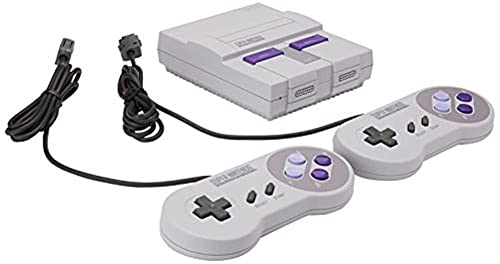
Both official minis follow the same recipe. The Nintendo Super NES Classic Edition includes the console itself, two wired controllers styled after the original SNES pads (with a slightly shortened cable relative to the classic hardware but still long enough for couch use), an HDMI cable, and a USB power cable. Per Nintendo's product page at Nintendo, it ships with 21 preloaded titles including Super Mario World, The Legend of Zelda: A Link to the Past, Super Metroid, Star Fox, and — as a first-time official release on hardware — Star Fox 2. No microSD slot, no game cartridge slot, no expandable storage designed for the end user.
The Sega Genesis Mini follows a similar template. It ships with two wired three-button controllers modeled on the original Genesis pads, an HDMI cable, and a USB power cable. Per the Sega product page, the console includes 42 preloaded titles, including Sonic the Hedgehog, Streets of Rage 2, Contra: Hard Corps, Shining Force, Gunstar Heroes, Castlevania: The New Generation, and Comix Zone. The interface is a menu that scrolls through the library with a couple of display filters (CRT, pixel-perfect, etc.), and the "menu" button on the controller returns you to the game picker.
The critical experience point about both minis: once the HDMI cable is in the TV and the USB cable is in a wall adapter or a TV's USB port, everything else is the game picker. There is no OS to update, no library to import, no folder structure to arrange, no controller pairing to negotiate. For a gift, for a nostalgia session, for a living-room setup where you do not want to think about maintenance, this is the entire appeal.
When does a Raspberry Pi RetroPie beat an official mini?
The RetroPie route beats an official mini when any of the following matter to you:
Breadth across many systems. A single Pi 4 build with RetroPie handles emulation for NES, SNES, Genesis, Master System, Game Gear, PC Engine / TurboGrafx-16, Neo Geo, arcade (via FBNeo / MAME cores), Game Boy, Game Boy Color, Game Boy Advance, Nintendo DS, PS1, and — on the Pi 4 with tuning — much of N64 and Dreamcast. Per RetroPie's docs, the supported list is longer than any single mini's library because each mini is a single-platform product by design.
Library expandability. A mini's game list is fixed. A RetroPie's library is whatever content you legally own and have loaded on the SD card, or an attached USB drive. If your retro habit is "everything I ever owned as a kid across four platforms", the mini approach requires four minis. The Pi approach requires one Pi.
Controller choice. RetroPie recognizes almost any USB or Bluetooth controller — an 8BitDo Pro 2, a modern GameSir G7 SE, a PlayStation DualSense, a wired Xbox pad, an original-style USB-remake pad from Retro-Bit. You can use one modern controller across every system, or use period-appropriate USB reproductions per platform.
Tinkering as the point. For a segment of the audience, assembling the box is the fun part. Choosing the case, adding a small heat sink and fan, installing the RetroPie image, flashing the SD card, configuring the controller, sorting the library — this is a weekend project people enjoy. Minis do not scratch that itch.
The Pi loses when the buyer wants none of that: no setup, no configuration, no responsibility for content licensing, no research. That is the buying line.
Spec delta at a glance
| Attribute | SNES Classic | Genesis Mini | Raspberry Pi 4 RetroPie |
|---|---|---|---|
| Preloaded game count | 21 (fixed) | 42 (fixed) | 0 (user-supplied) |
| Systems emulated | 1 (SNES) | 1 (Genesis / Mega Drive) | 20+ (NES-PS1, some N64/Dreamcast) |
| Expandability | None officially | None officially | High (SD card, USB) |
| Controllers included | 2 wired SNES-style | 2 wired 3-button | 0 (bring your own) |
| Video out | HDMI | HDMI | HDMI (dual micro-HDMI on Pi 4) |
| Power | USB (5V) | USB (5V) | USB-C (5V, 3A recommended) |
| Requires assembly | No | No | Yes (case, cooling, SD card, controllers) |
| Requires ROM sourcing | No | No | Yes (user's responsibility) |
| Typical street price (2026) | Sub-$100 used market | Sub-$100 used market | ~$75 board + ~$50-80 accessories |
| Save states | Per built-in interface | Per built-in interface | Per emulator (rich, per-slot) |
| CRT / scanline filter options | Basic filters | Basic filters | Deep, per-core (shader library) |
| Firmware updates | None expected | None expected | Ongoing (RetroPie image updates) |
Prices in the table are directional — verify at time of purchase. Both official minis are out of primary production and are trading on the secondary market; new-in-box units still appear regularly at national retailers but the range shifts week to week.
Which has the best controllers and feel?
The controllers are the single largest experience difference between the paths.
SNES Classic controllers are the reference SNES layout: four face buttons in the classic diamond, L and R shoulder buttons, D-pad, Start and Select. The plastic feel and button response match the 1990s originals closely, at the cost of a shortened cable. For SNES titles specifically, this is the controller you want, and it is unavailable in modern reproduction form for the mini's platform without buying third-party pads.
Genesis Mini controllers ship in the three-button configuration by default in the North American package (Sega has offered six-button variants at times regionally). For most of the included lineup, three-button is fine; a few fighters like Street Fighter II: Special Champion Edition benefit from a six-button. Third-party six-button pads for the Mini exist from Retro-Bit and 8BitDo; both are widely reviewed as competent replacements.
RetroPie controllers are the user's choice. Some popular options: 8BitDo SN30 Pro (SNES-authentic layout with modern conveniences), 8BitDo M30 (Genesis-authentic six-button, wireless), any USB Xbox pad (rock-solid Linux support), a PlayStation DualSense over USB, or a modern PC-first wired pad like the GameSir G7 SE that gives Hall-effect sticks and instant Windows-style recognition. The RetroPie project also supports arcade-stick USB devices for genre-appropriate feel on fighters and shmups.
If the buying priority is "authentic to one system", the official mini wins on controller. If the priority is "one modern controller across every system", RetroPie wins.
What to buy for each path
Official mini path — SNES focus. The core purchase is the Nintendo Super NES Classic Edition. No accessories are strictly required. Optional: a longer USB extension for the controller if the shortened stock cable is a problem for your seating distance.
Official mini path — Sega focus. The core purchase is the Sega Genesis Mini. Optional: a six-button third-party pad if the fighting-game titles are the ones you care about.
RetroPie path — the base build. Start with the Raspberry Pi 4 Computer Model B 8GB as the compute board (the 8GB tier is overkill for RetroPie itself but useful if you dual-purpose the Pi for other projects). Add a case with passive or active cooling, a quality 32-64GB microSD card (name-brand A2-rated), a USB-C power adapter capable of the Pi 4's 3A requirement, one or two controllers of your choice — a modern PC-style wired pad like the GameSir G7 SE is an easy first pick because it works cross-platform for both RetroPie and desktop PC gaming — and an HDMI cable (the Pi 4 uses micro-HDMI, so make sure the cable or adapter matches).
Both paths together. Many households end up with both — an official mini in the living room for one-platform nostalgia and a RetroPie in the office or bedroom for the wider library. The buys are not exclusive.
Verdict matrix — buy an official mini if…
- You want a gift-ready box with no assembly.
- You care most about one platform's classics (SNES for the SNES Classic, Genesis for the Genesis Mini) and are happy with the curated lineup.
- You do not want to think about ROM legality — the preloaded games are licensed and shipped by the platform holder.
- The intended user is a child, a non-technical family member, or someone who wants a plug-in-and-forget experience.
- You are giving it as a gift.
Verdict matrix — build a RetroPie if…
- You want breadth across many platforms, not depth on one.
- You already own or are willing to legally source game content.
- You enjoy the assembly and configuration as part of the fun.
- You want to reuse the Pi for other projects (media server, home automation, Pi-hole DNS) when it is not being a game console.
- You want deep per-core shader and filter options, save states, netplay, and the customization the open-source RetroArch stack allows.
- You want one modern controller across every emulated system, including a wired pad like the GameSir G7 SE.
Bottom line
Both routes are legitimate answers to different questions. The SNES Classic and Genesis Mini win for turnkey nostalgia on a single platform with authentic controllers, zero setup, and licensed content in the box. A Raspberry Pi 4 RetroPie build wins for breadth, expandability, controller flexibility, and the enjoyment of the assembly itself. Neither is objectively better; they are optimizing for different goals. The clarifying question for anyone on the fence is "am I willing to spend two hours configuring this, and am I willing to be responsible for legally sourcing the games?" If yes, go Pi. If no, go mini.
Common pitfalls
- Assuming the minis are still in primary production. Both are trading largely on the secondary market. Verify seller reputation before buying at unusually high prices.
- Under-powering the Pi 4. RetroPie needs the full-spec USB-C 5V/3A supply. Underpowered Pi builds throttle and misbehave in ways that look like emulator bugs.
- Skipping the case and cooling. Long emulation sessions push the Pi 4 CPU. A passive case is fine for NES/SNES/Genesis but N64 and Dreamcast cores benefit from active cooling.
- Ignoring ROM legality. RetroPie ships with zero games because sourcing is the user's responsibility. Playing dumps of games you do not own is a legal question in your jurisdiction, not the RetroPie project's problem to solve.
- Buying six-button Genesis pads unnecessarily. For most of the Mini's preloaded lineup, the included three-button pad is fine. Only add six-button if you specifically want to play fighters comfortably.
- Skipping HDMI cable quality. The Pi 4 uses micro-HDMI, and the cheapest cables and adapters in the market can be flaky enough to look like the console is broken. Spend on a name-brand cable or adapter here.
- Assuming a mini can be region-flexed. Both the SNES Classic and Genesis Mini shipped in regional lineups; a European PAL Mini and a North American NTSC Mini contain overlapping but not identical libraries. Verify the region of the unit you are buying if a specific title matters to you.
What the RetroPie setup weekend actually looks like
For readers who have never done it, here is the honest sequence of steps for a first-time RetroPie build. The point is not to teach the whole process — the RetroPie documentation does that — but to give an accurate picture of the time investment.
Day one — hardware and imaging. Unbox the Raspberry Pi 4 8GB, install the passive heatsink shims that came with the case, drop the board in, and connect USB-C power, HDMI, and Ethernet. Download the current RetroPie image from the project site, flash it to the microSD card with the Raspberry Pi Imager or balenaEtcher, and slot the card into the Pi. First boot brings up EmulationStation and prompts you to configure a controller — hold a face button on the pad you want to use, then walk through the button assignments as prompted. This part is about 30 minutes for a first-timer.
Day one — network and updates. Get the Pi on your Wi-Fi (or use Ethernet), then use the built-in RetroPie setup script to update the base packages and pull the latest RetroArch cores. On a home connection this is typically 20-45 minutes, mostly waiting for downloads.
Day two — content and scraper. Legally source your game content, load it onto the Pi via the network share the RetroPie image exposes, and run the built-in scraper to attach cover art and metadata to each title. The scraper is the difference between "a folder of file names" and "a polished game picker with box art"; it is worth the extra hour on setup day. Scraping a few hundred titles across four or five systems takes an hour or two of unattended runtime.
Day two — polish. Set your preferred shaders per system (a mild CRT shader on 8-bit and 16-bit systems, pixel-perfect on Game Boy Advance, etc.), configure save-state hotkeys, and — optionally — set up screen scraping for high-score tracking or netplay for online multiplayer on a handful of arcade titles.
Total realistic time investment for a fully polished first build: a weekend if you enjoy the process, half a weekend if you have done it before, more if you get into the deep end of shader tuning. This is not a "plug it in and play" experience by any honest measure — it is a project, which is the point for the audience that wants it.
Related guides
- Windows 98 Gaming PC with CompactFlash Storage Build for 2026
- Raspberry Pi 4 as an AirPlay Receiver in 2026
- Best Budget GPU for Local LLMs Under $300 in 2026
Citations and sources
- Nintendo — official product pages
- Sega — official product pages
- Nintendo Life — mini console reissue coverage
- RetroPie — project documentation and setup
This piece is editorial synthesis based on publicly available information. No independent first-party benchmarking is reported.
Disclosure: SpecPicks earns from qualifying purchases as an Amazon Associate; prices and availability may vary.