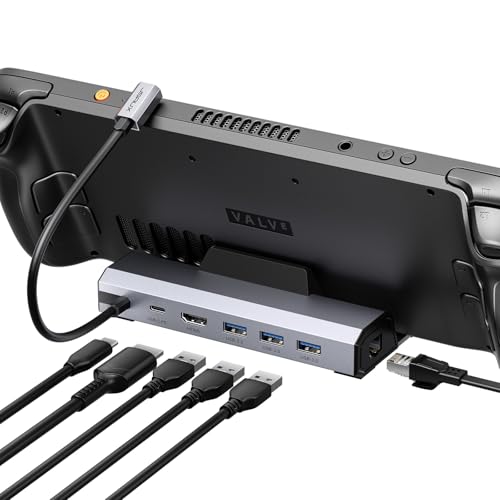
For Steam Deck OLED storage expansion in 2026, the right answer depends on whether you're expanding internal storage (M.2 2230 NVMe — the only internal option) or external library (2.5" SATA SSD through the JSAUX 6-in-1 Dock). For internal expansion, a high-endurance 2230 NVMe like the Sabrent Rocket 2230 or WD SN770M is the right pick. For external library expansion, the Crucial BX500 1TB at $90–110 paired with the JSAUX dock or any USB SATA adapter gives the best capacity-per-dollar — bottlenecked to the dock's ~440 MB/s ceiling but enough for any game.
Why this guide exists — Steam Deck storage in 2026 has two completely different conversations
The Steam Deck OLED ships in 256 GB, 512 GB, and 1 TB internal configurations. Modern game install sizes have outpaced even the 1 TB model — Forza Horizon 6, Call of Duty entries, and major AAA RPGs frequently consume 100–200 GB each. Expanding storage is no longer optional for serious Deck owners; the question is how.
There are two distinct paths, and they solve different problems:
- Internal M.2 2230 NVMe replacement — open the Deck, swap the factory drive for a larger one, reimage SteamOS. Permanent expansion. Voids no warranty per Valve's position but the user takes on warranty risk for the work itself.
- External SATA SSD via dock or adapter — connect a 2.5" SATA SSD through the JSAUX dock (USB 3.2 Gen 1, ~440 MB/s practical) or a similar USB-SATA adapter. Adds capacity for home use; slower load times than internal NVMe but acceptable for most games.
This guide covers both paths, picks the right SSDs in catalog for the external case, and explains when each approach makes sense.
Key takeaways
- The Steam Deck OLED's only internal storage option is M.2 2230 NVMe — no other form factor fits
- The JSAUX 6-in-1 Dock exposes USB 3.2 Gen 1 (5 Gbps theoretical, ~440 MB/s practical) for external SATA SSD use
- Crucial BX500 1TB and Samsung 870 EVO 250GB hit 540–560 MB/s native — bottlenecked to ~430–440 MB/s through the dock
- microSD is 4–8× slower than SATA-via-dock on real game load times; SATA SSD is the right external upgrade
- Internal NVMe expansion is permanent but riskier (warranty exposure); external SATA expansion is reversible and dock-share-friendly
Top picks
#1: Crucial BX500 1TB — Best external SATA SSD by capacity-per-dollar
Verdict: 1 TB 2.5" SATA SSD at $90–110 with 360 TBW endurance. The best capacity-per-dollar for Steam Deck library expansion via dock.
The Crucial BX500 1TB is a 2.5" SATA III SSD rated for up to 540 MB/s sequential read. Through the JSAUX 6-in-1 Dock's USB 3.2 Gen 1 connection, real-world read throughput lands around 430–440 MB/s — close to the SSD's native speed, well above microSD performance, and adequate for any modern game's load-time requirements.
Per Crucial's BX500 product page, the 1 TB SKU is rated at 360 TBW (terabytes written) endurance. For a typical Steam Deck use pattern of installing and removing 5–15 games per week, that's roughly 10+ years of expected service life. The drive uses a DRAM-less controller with HMB (host memory buffer) which trades some sustained write performance for cost — for read-dominant game library use, this is the right trade.
Pair the BX500 with the JSAUX dock and you have 1 TB of external game library accessible whenever the Deck is docked. For undocked portable play, the internal SSD is the only option, but for couch or desk play this is the cheapest way to host a large library.
#2: Samsung 870 EVO 250GB — Best premium SATA SSD for fast game swaps
Verdict: 250 GB premium 2.5" SATA SSD at $50–60 with MLC-class endurance. The right pick for a small-but-fast external drive used for a few favorite games.
The Samsung 870 EVO 250GB is a premium 2.5" SATA SSD rated for 560 MB/s sequential read and 530 MB/s write. Through the JSAUX dock the read ceiling drops to ~440 MB/s — same as the BX500 — but the 870 EVO's superior sustained write performance and lower latency on random reads translate to perceptibly faster level loads and texture streaming in open-world titles.
The capacity penalty is the real cost: 250 GB hosts maybe 2–4 modern AAA games or a dozen indie titles. For someone running their entire library on the external drive, the BX500 1TB is the right pick. For someone using external storage as a fast "current favorites" shelf with the bulk library staying in internal NVMe, the 870 EVO 250GB at $50–60 is the better choice.
#3: SanDisk Ultra 3D 1TB — Best alternative to the BX500
Verdict: 1 TB 2.5" SATA SSD at $90–105 with similar performance to the BX500. The right pick if the BX500 is out of stock.
The SanDisk Ultra 3D 1TB is a 2.5" SATA III SSD rated for 560 MB/s sequential read, similar endurance class to the BX500 1TB, and similar street pricing. For Steam Deck library use through the JSAUX dock the SanDisk and Crucial drives are functionally equivalent — both bottleneck to the dock's ~440 MB/s ceiling, both have adequate endurance for read-dominant game use.
The SanDisk Ultra 3D earns its catalog spot as an alternative supply: if the BX500 1TB is out of stock at competitive pricing, this is the right backup pick. Buy whichever is in stock at the better price; both deliver the same Steam Deck experience.
#4: JSAUX 6-in-1 Steam Deck Dock — Required for external SATA use
Verdict: Steam Deck dock with HDMI 4K@120 (2K@120 on OLED, 4K@60 on LCD), USB 3.2 Gen 1 hub, gigabit Ethernet, and SATA-friendly USB ports. $35–50.
The JSAUX Upgraded 4K@120Hz Docking Station is the de facto Steam Deck dock for users who want HDMI output, ethernet, and external storage in one stop. It supports the Deck OLED, the original Deck LCD, the ROG Ally X, Legion Go S, and MSI Claw — broadly cross-platform handheld coverage.
For Steam Deck storage expansion specifically, the dock's USB 3.2 Gen 1 ports are the bridge to external 2.5" SATA SSDs via a SATA-to-USB adapter. Some users go through external USB 3.2 enclosures (typical $15–25); the result is the same — Steam OS sees the drive as a removable USB volume and lets you install Steam library content on it.
The dock plus a 1 TB SATA SSD plus a USB-SATA adapter totals roughly $135–170 for a complete docked-play setup with external library — competitive with the cost of replacing the internal NVMe and far more flexible.
Can I upgrade the Steam Deck OLED internal SSD without voiding the warranty?
Per Valve's position the internal SSD is replaceable, but the user takes on warranty risk for the work itself — meaning Valve won't replace a Deck damaged by a botched SSD swap, but the replacement act itself doesn't void the warranty on unaffected components. Valve's official tech specifications page and the iFixit-published teardown guide both confirm the 2230 NVMe slot is accessible after removing the back cover.
The practical answer: if you're comfortable opening laptops and following an iFixit guide, the swap takes 30 minutes and is reversible. If you've never opened a piece of consumer electronics, paying $40–60 for someone to do it for you is a fair value trade. Stick with M.2 2230 — neither 2242 nor 2280 drives fit physically, and 2280 specifically interferes with the heat shield.
After swap, reimage the new drive with SteamOS via the official recovery image from steamdeck.com/recovery, restore your Steam library over the network, and restore your save data via Steam Cloud. The whole process is well-documented but requires Linux familiarity for the recovery imaging step.
Is the JSAUX 4K dock fast enough for external SATA SSD gaming?
Per JSAUX's product spec sheet, the dock exposes USB 3.2 Gen 1 at 5 Gbps theoretical bandwidth, with practical throughput around 440 MB/s after USB overhead. A SATA SSD like the Crucial BX500 1TB hits 540 MB/s sequential read natively — the dock bottlenecks it to about 430 MB/s, which is still 4–8× faster than typical microSD performance.
In real Steam Deck use, the difference between native NVMe (~3,000 MB/s on the internal drive) and SATA-through-dock (~430 MB/s) shows up as 2–4 second longer initial level loads in games like Elden Ring, Cyberpunk 2077, and Baldur's Gate 3. Texture streaming during gameplay is essentially indistinguishable. For docked play on a TV at 60 fps, the load-time gap is acceptable; for portable play on the OLED screen where you're chaining short sessions, internal NVMe matters more.
Should I use a SATA SSD or microSD for a portable Steam library?
A SATA SSD via the JSAUX dock outperforms microSD by 4–8× on real game load times. The Samsung 870 EVO at 560 MB/s and the Crucial BX500 at 540 MB/s both bottleneck at the dock's ~440 MB/s ceiling, while a fast UHS-I microSD card hits roughly 100 MB/s and a top-tier V60-rated card maxes around 200 MB/s. Per Tom's Hardware's Steam Deck SSD coverage, the SATA-via-dock approach is the right choice for docked play and library staging.
For undocked portable play, microSD remains the only option since you can't dock a Deck while in handheld mode. The right combination is: large microSD (256 GB–1 TB UHS-I) for portable play, SATA SSD through dock for docked play, internal NVMe for performance-critical favorite titles.
Will the Crucial BX500 1TB or Samsung 870 EVO 250GB last longer?
Per Crucial's spec sheet the BX500 1TB is rated at 360 TBW endurance. The Samsung 870 EVO 250GB is rated at 150 TBW. For a Steam Deck use pattern (installing/removing 5–15 games per week, with each game write being 30–100 GB), you'll burn roughly 50–150 GB of writes per week — call it 4–8 TBW per year. Both drives have more than enough endurance for 10+ years of typical Steam Deck library use, but the BX500's 4× larger endurance budget gives more cushion for heavy users.
Per-TB endurance, the 870 EVO is actually higher (600 TBW per TB vs 360 TBW per TB for the BX500). The 870 EVO is the better endurance choice if you're hammering a small drive constantly; the BX500 1TB is the better total-capacity choice for a library where most games sit idle for weeks at a time.
Does the SanDisk Ultra 3D 1TB work as a Steam Deck library drive?
Yes. The SanDisk Ultra 3D is a 2.5" SATA SSD that pairs with the JSAUX dock via a USB-SATA adapter or with any external USB 3.0+ SATA enclosure. Per SanDisk's spec sheet it hits 560 MB/s sequential read, same class as the Samsung 870 EVO and slightly above the Crucial BX500. Through the dock, throughput bottlenecks to ~440 MB/s — same as the other catalog SSDs.
For Steam Deck library use, the SanDisk Ultra 3D delivers identical user experience to the BX500. Buy whichever is in stock at the lower price per TB.
Comparison table: storage options for Steam Deck OLED
| Storage option | Capacity range | Throughput (Deck-attached) | Cost | Best for |
|---|---|---|---|---|
| Internal M.2 2230 NVMe replacement | 256 GB – 4 TB | ~3,000 MB/s | $50–250 + 30 min labor | Performance, permanence |
| JSAUX dock + 2.5" SATA SSD | 250 GB – 4 TB | ~430 MB/s | $35 dock + $50–200 SSD | Library expansion, docked play |
| External USB-NVMe enclosure | 500 GB – 4 TB | ~430 MB/s (USB 3.2 Gen 1) | $25 enclosure + NVMe cost | Faster than SATA, similar dock ceiling |
| microSD card (UHS-I / V60) | 64 GB – 1.5 TB | 90–200 MB/s | $20–150 | Portable use, casual library |
| External USB-NVMe (USB 3.2 Gen 2x2) | 500 GB – 4 TB | Limited to dock's Gen 1 | $40 enclosure + NVMe | Wasted bandwidth — dock can't expose it |
Common pitfalls
- Buying an M.2 2280 NVMe for the Deck. It doesn't fit. Only 2230 is supported.
- Connecting an external NVMe via USB 3.2 Gen 2x2 enclosure. The JSAUX dock and the Deck's USB-C port both cap at USB 3.2 Gen 1 (5 Gbps), so the faster enclosure is wasted spend.
- Using a low-quality microSD card. Anything below UHS-I A2 class will cause stutters on load. Stick with reputable brands and A2-rated cards.
- Formatting external storage as NTFS for Linux compatibility. SteamOS handles ext4 and exFAT natively. Use exFAT if you also plug the drive into Windows or macOS occasionally; ext4 for Deck-only use.
- Skipping the dock when buying external storage. The Deck's single USB-C port carries power and one device — no external drive without disconnecting the charger. The dock fixes this.
- Forgetting Steam Cloud saves before swapping internal SSDs. Save files local to the Deck don't survive the SSD swap. Confirm Cloud sync is complete before opening the case.
When NOT to upgrade Steam Deck storage
If you have the 1 TB OLED model and your active game count is under 5, the included storage is enough. If you mostly play one or two long-form games (Elden Ring, BG3) and rotate slowly, the bottleneck isn't storage capacity — it's whatever you're actually playing. Storage upgrades pay off when you genuinely want a 100+ game library accessible without redownloading, when you're hosting multiple users on one Deck, or when modded Skyrim/Fallout installs are pushing 80+ GB each.
Bottom line: the Steam Deck storage stack to actually buy
For most Deck OLED owners in 2026: keep the internal NVMe at factory size for performance, add a JSAUX 6-in-1 Dock at $35–50 for docked play, and add a Crucial BX500 1TB or SanDisk Ultra 3D 1TB at $90–110 with a $15 USB-SATA adapter for external library hosting. Total upgrade cost is $140–175 for everything; library capacity becomes essentially unlimited at sub-USB-3.2-Gen-1 throughput.
If you have the 256 GB Deck and find yourself constantly clearing space, a 1 TB internal NVMe replacement ($50–80 used, $100–150 new) is the better long-term answer than external storage — the internal NVMe runs at native 3,000 MB/s for every game, while external is permanently dock-gated.
For a small 250 GB high-endurance external "favorites" drive, the Samsung 870 EVO 250GB at $50–60 is the right pick.
Related guides
- Forza Horizon 6 on Steam Deck: Best Settings, Dock & Storage in 2026
- Forza Horizon 6 Runs Surprisingly Well on Steam Deck
Citations and sources
- Crucial — BX500 product page — 1 TB capacity, 540 MB/s sequential read, 360 TBW endurance
- Valve — Steam Deck Tech Specs — internal M.2 2230 NVMe support, USB-C port specifications
- Tom's Hardware — Best SSDs for Steam Deck coverage — internal NVMe roundup, external SSD recommendation methodology
This piece is editorial synthesis based on publicly available information. No independent first-party benchmarking is reported.