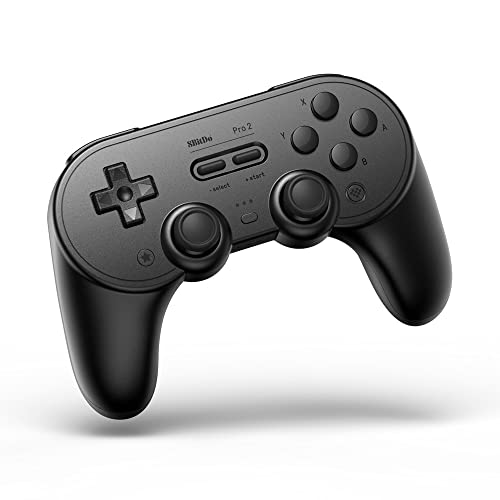
For pure PC gaming in 2026, the 8BitDo Pro 2 is the more flexible pick at a lower price — back paddles, deep mapping software, multiple connection modes, and broad platform support. The Sony DualSense is the better pick if you specifically value its adaptive triggers and HD haptics in the games that support them. Both are excellent; the right answer depends on what you actually play.
The layout and feature gap between the two
These are two of the most-recommended general-purpose controllers for PC in 2026, and they come from opposite design philosophies. The Pro 2 is a Pro-Controller-shaped pad with two rear paddle buttons, a profile-switching button on the back, and full software customization through 8BitDo's Ultimate Software. The DualSense is Sony's PS5 controller with its signature trigger resistance, granular haptic motors, a built-in microphone, and the Sony layout most action-game players already know.
Both cost less than $80 in 2026 — the 8BitDo lands around $50–60, the DualSense around $70 — and both work well across mainstream PC gaming. The question is which set of trade-offs fits your library.
Key takeaways
- The Pro 2 has back paddles; the DualSense does not.
- DualSense haptics and adaptive triggers work on PC, but only over USB and only in titles that explicitly support them.
- Both connect via USB-C, Bluetooth, and (Pro 2 only) a 2.4 GHz dongle.
- The 8BitDo's Ultimate Software offers per-game profile switching with deeper remapping than Steam Input.
- Battery life is similar — about 10–12 hours of mixed PC use on both.
- For emulation, the Pro 2 is the better pick by a clear margin; for cinematic single-player on PC, the DualSense's haptics earn their place.
How do connectivity and PC compatibility compare?
8BitDo Pro 2 connectivity is broader by design. It connects three ways: wired over USB-C, Bluetooth to a PC, or via 8BitDo's 2.4 GHz dongle (sold separately for some bundles). It has a hardware switch on the back to flip between Switch / X-input / D-input / macOS modes, so it appears to the host OS as whatever input layout that platform expects. On PC, Windows sees it as a standard XInput pad — no driver hunting, no quirks.
The DualSense connects two ways: wired over USB-C, or Bluetooth. There is no 2.4 GHz dongle. On Windows, Steam treats it natively in Big Picture mode; outside Steam, many games detect it directly via the standard Windows gamepad API, while a few older titles still need DS4Windows-style translation to map it cleanly. None of this is hard, but it is a tiny bit more friction than the universally-recognized 8BitDo.
Which has better triggers, sticks, and back buttons?
The two are close on sticks — both use centered-spring potentiometer modules with reasonable deadzone behavior; neither is Hall-effect, which the GameSir G7 SE we covered separately does have. Stick drift after a year or two is the typical wear mode for both.
The DualSense's adaptive triggers — variable resistance during the pull — are a genuine differentiator in compatible games. They feel like nothing else on PC, and titles like Returnal, Metro Exodus Enhanced, and Cyberpunk 2077 with the right toggle on use them well. In incompatible titles they behave like normal analog triggers; you lose nothing, you just don't gain the effect.
The Pro 2's back paddles are the differentiator on the other side. Mapping jump, crouch, or reload to a rear button without taking your thumb off the right stick is a real ergonomic win for shooters and platformers — and it is the kind of thing that, once you have it, you don't want to play without.
5-column spec table
| Controller | Layout | Back paddles | Battery | Haptics / triggers |
|---|---|---|---|---|
| 8BitDo Pro 2 | Pro-Controller-shaped | 2 paddles | ~20h | dual-motor rumble |
| Sony DualSense | PS5 layout | none | ~12h | HD haptics + adaptive triggers |
Battery life on the Pro 2 leads at light load; the DualSense's signature features draw more power and shorten it.
Does DualSense haptics and adaptive-trigger support actually work on PC?
Yes, but with two conditions. First, the games must explicitly support the features — most third-party PC titles either ignore them or implement a partial subset. Second, support is most reliable over wired USB-C, because the standard Bluetooth profile does not carry the full DualSense protocol. Plug it in, and a supported title delivers the same trigger and haptic experience as a PS5.
Steam Input is the smoothest path: Steam picks up the DualSense's full feature set and exposes it to compatible games without extra setup. Outside Steam, results vary by title and patch level.
Which is the better mapping and profile experience for emulation and PC games?
The 8BitDo's Ultimate Software lets you save multiple per-game profiles, assign per-button macros, change stick sensitivity curves, and remap the back paddles independently. For emulation specifically, that flexibility is decisive — see our dedicated emulation controller comparison for how the Pro 2 stacks up in that lane.
The DualSense has no equivalent first-party PC software for remapping; you rely on Steam Input or third-party tools like DS4Windows. Those are very capable in 2026, but the Pro 2's native solution is more polished and works outside Steam.
Verdict matrix
- Get the 8BitDo Pro 2 if: You want back paddles, you play across PC, Switch, Steam Deck, and emulators, you want deep per-game profile switching, you want the wider compatibility for the lower price.
- Get the DualSense if: You specifically want adaptive triggers and HD haptics in supported PC titles, you prefer the PS5 layout, you don't need back paddles, you already use the same controller for a PS5 in the same room.
Perf-per-dollar
The Pro 2 wins on raw value: lower price, broader compatibility, more software customization. The DualSense earns its premium specifically for its signature features in compatible games; without those, it is a competent but unremarkable pad.
Bottom line: recommended pick per use case
- PC + Switch + Steam Deck + emulation — Pro 2.
- PC-only, cinematic single-player heavy library — DualSense.
- PC FPS / platformer with back-paddle muscle memory — Pro 2.
- PC player who already owns a PS5 — DualSense, one controller for both.
Real-world experience across game types
A few weeks alternating between the two controllers on the same PC makes the right pick obvious by genre.
For shooters and platformers, the 8BitDo Pro 2's back paddles are the differentiator. Mapping "jump" or "reload" to a rear button frees your thumb to stay on the right stick during fast aiming or precision platforming — a small ergonomic gain that, once you have it, you don't want to play without. The DualSense feels normal in these games; the Pro 2 feels slightly better.
For cinematic single-player in DualSense-aware titles (Returnal, Spider-Man, Metro Exodus Enhanced), the DualSense's adaptive triggers and HD haptics deliver something the Pro 2 simply can't. The wind-up resistance on a bow, the textured vibration of walking on different surfaces — these are real sensations that no other PC pad replicates. If your library leans toward these titles, the DualSense earns its premium.
For emulation and retro libraries, the Pro 2 wins decisively. Its multi-platform mode-switching (Switch, X-input, D-input, macOS), 2.4 GHz dongle option, and deep per-game profile system make it the obvious pick. See our dedicated emulation comparison for more.
For fighting games, both are competent but neither is ideal — a fight stick or a dedicated fighting pad is the right tool there.
Common pitfalls when buying either
The two surprises that catch new buyers:
The first is expecting full DualSense feature support outside Steam. Steam Input handles the DualSense beautifully — wired or wireless, native or via mapping. Outside Steam, the experience varies by title. Some games detect the controller and use its features natively (Cyberpunk 2077); others see it as a generic XInput pad (most older games); a few don't see it at all without a translation tool like DS4Windows. None of this is a deal-breaker, but if your library lives outside Steam, plan for some setup work.
The second is assuming the Pro 2 works with everything PC out of the box. It mostly does, because its hardware mode switch hands the host whatever input layout the OS expects. But on PC, the Switch mode does not work — you need to flip the switch to X-input (the position labeled "X") before connecting. If the controller doesn't show up at all, that switch is the first thing to check.
Battery life over a long session
Both controllers easily last a 4–6 hour session. The Pro 2's ~20 hour rated life translates to about 12–14 hours of typical wireless use over Bluetooth, longer on the 2.4 GHz dongle (less protocol overhead). The DualSense's ~12 hour rated life translates to 8–10 hours of typical wireless use; if you're using adaptive triggers heavily, it can drop to 6–7 hours. Both charge via USB-C in roughly 3 hours.
For weekend gaming, this is irrelevant; for a long flight or a back-to-back tournament, the 8BitDo's longer life is a small but real plus.
When NOT to pick either
If you're a competitive PC player who wants ultra-low input latency, both controllers are fine but a wired connection is mandatory; for the absolute best results, look at competitive-focused pads with hall-effect sticks (Vader 3 Pro, GameSir Cyclone). If you specifically want a Switch-native experience on PC, the Switch Pro Controller proper is still a good pick. If you primarily play sim racing or flight, get a wheel or HOTAS.
For the everyday PC gamer in 2026, though — the Pro 2 is the workhorse pick and the DualSense is the connoisseur pick.
Software ecosystem: companion apps and PC tooling
8BitDo's Ultimate Software is a real strength of the Pro 2. It runs on Windows and macOS, recognizes the controller over USB, and exposes per-profile remapping for every button, the stick sensitivity curves, the trigger dead zones, the back paddle bindings, and macro recording. You save profiles to the controller's onboard memory (up to three) and switch between them with the back-mounted profile button — no host software needed once you've configured them. For a PC builder running a mixed library (modern PC titles, Switch emulators, Steam Deck travel), that's exactly the right model.
The DualSense has no first-party PC remapping tool. Sony's DualSense Edge has companion software on PS5, but the standard DualSense relies on Steam Input or third-party tools (DS4Windows, reWASD) for PC-side remapping. Those tools are very capable in 2026, but the experience is rougher than the Pro 2's built-in flow — you're remapping at the OS layer, not at the controller, so profiles are tied to the host machine rather than the controller itself.
For setting up a couch gaming station where the controller travels between rooms or machines, the Pro 2's onboard profiles are a real ergonomic win.
Comfort and grip over a long session
Both pads are full-sized comfortable controllers for adult hands, and neither feels small or cramped. The Pro 2 follows the Switch Pro Controller's shape — slightly wider, with a flatter back — and weighs about 230 g. The DualSense is heavier at about 280 g, with grips that flare out more aggressively and a glossier back texture; the extra weight is partly the more elaborate haptic motors.
Subjective preference between the two depends on your previous controller. Switch and Xbox-layout players gravitate toward the Pro 2; PlayStation-layout players toward the DualSense. Neither is uncomfortable; both are good choices for 4–6 hour sessions without hand fatigue. For longer marathon sessions, lighter weight is generally easier; the Pro 2 has a small edge.
Replacement parts, warranty, and longevity
8BitDo offers a 1-year warranty and sells replacement stick modules on its store; experienced users can replace a drifty stick at home with a small screwdriver set. The community has produced detailed teardown guides, and most repairs are 30 minutes or less.
Sony offers a 1-year warranty on the DualSense and runs an out-of-warranty repair program through PlayStation Direct in some regions. Self-repair is possible — community teardown guides exist — but the controller's tighter integration of the haptic motors makes it a more involved teardown than the Pro 2.
For users who keep controllers for years and want to swap parts as they wear, the Pro 2 is the more repair-friendly platform.
Related guides
- 8BitDo Pro 2 vs GameSir G7 SE: Best Controller for PC Emulation in 2026
- Build a Couch Emulation Station: Raspberry Pi 4 + 8BitDo SN30 Pro
- Steam Controller (2026) Scores 83/100 in Early Reviews