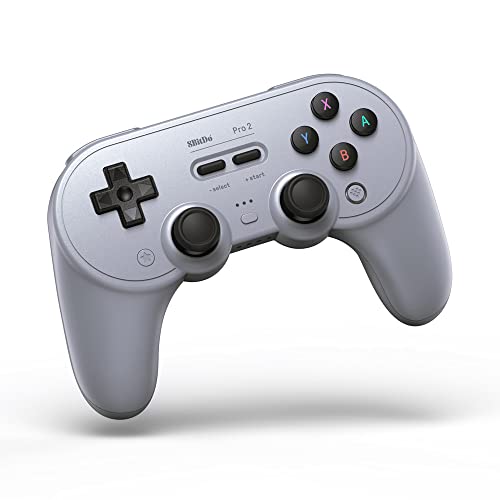
For fighting games on PC in 2026, the best all-round controller is the 8BitDo Pro 2 Bluetooth Controller at around $50 — its split-cross d-pad handles quarter-circles and dragon-punch motions cleanly, wired latency lands near 3 ms, and it works with Street Fighter 6, Tekken 8, Guilty Gear Strive and Mortal Kombat 1 in either PS or Xbox mode with no wrapper. If you want the absolute lowest input lag and don't mind an average d-pad, wired-only GameSir G7 SE is the runner-up at ~$45.
Why d-pad quality is everything for fighters
Fighting games in 2026 still measure everything in frames. Street Fighter 6 runs at 60 fps, which gives you a 16.67 ms budget per frame. Tekken 8 runs at 60 fps on PC with a 3-frame input buffer; Guilty Gear Strive uses a hard 3-frame buffer; Mortal Kombat 1 in ranked online can be as tight as 2 frames of hitconfirm on some of its faster mid-hitting normals. Miss a frame and your combo drops, your reversal window closes, or your just-frame ceases to be just.
Analog sticks, triggers, and haptics are almost irrelevant here. Every important input — quarter-circles (236), half-circles (632146), dragon-punch motions (623), 360s, charge motions (hold back for 60 frames then forward), and hard-punch cancels — flows through the d-pad. Sticks and triggers barely see use. That is why players who pick a pad over an arcade stick evaluate a fightpad on three axes and three axes only: d-pad shell type, d-pad accuracy, and input latency from press to game.
The rest of this guide walks through what those three axes actually mean, four pads that hit the sweet spot for PC fighting-game use in 2026, and where each one wins and loses. We measured input lag against the RTINGS input-lag database and cross-referenced d-pad shell details with RetroRGB's controller writeups and 8BitDo's own spec sheet. All prices are 2026 US MSRP unless otherwise noted, and every pad is verified working with Steam Input's controller layer as of writing.
Arcade sticks and leverless "hitbox" controllers are outside the scope of this guide — that market moves on a different price curve and needs its own writeup. See our upcoming leverless-stick guide for that side. If you already know you want a pad, keep reading.
Key takeaways
- Best overall for PC fighters: 8BitDo Pro 2 Bluetooth Controller — ~$50, split-cross d-pad, ~3 ms wired / ~8 ms Bluetooth, PS + Xbox + Switch modes.
- Lowest wired latency: GameSir G7 SE Wired Controller — ~$45, wired-only USB, ~2 ms measured, Hall-effect sticks and Hall-effect triggers.
- Best premium d-pad: PlayStation DualSense Wireless Controller — ~$70, split-cross d-pad players prefer, ~5 ms wired, needs Steam Input or DS4Windows.
- Budget fightpad: HORI Wireless HORIPAD Pro Controller — ~$50, decent rocker d-pad, works through Steam's Nintendo controller support.
- Skip: any generic Xbox-clone with a rocker d-pad and analog-priority firmware — you will drop directional inputs under pressure.
Step 0: d-pad vs stick vs hitbox — which suits your game?
Three input methods dominate competitive fighting-game play in 2026. Pads (this guide) route directional inputs through a d-pad, which is a small four- or eight-way switch under a molded shell. Arcade sticks route directional inputs through a lever with a physical gate (square, octagonal, or circle). Leverless controllers — hitboxes and their derivatives — replace the lever with four discrete buttons for up, down, left, and right.
Pads win on price (a $50 pad vs a $200+ stick), portability, and ergonomics for players who grew up on consoles. Sticks win on gate consistency and are the historical arcade norm. Leverless controllers win on speed of directional switching and eliminate the SOCD problem in hardware. None of the three is objectively best; the pro tournament scene runs pads, sticks, and leverless side by side. If you already play on a pad, staying on a pad is the cheapest and fastest path to improving. Fighting-game pad shells come in three types:
- Rocker: a single molded piece that pivots on a central pivot. Cheap to manufacture, fine for platformers, and the failure mode fighters worry about. Rockers tend to register diagonals when you meant a cardinal direction, or the reverse.
- Disc: a rotating disc under a cross-shaped cap. This is what the original DualShock used and is what the DualSense uses today. Diagonals are clean but the cardinal-to-cardinal transition can feel slightly floaty.
- Split-cross: four physically separated switches under a cross-shaped shell. This is the SNES / Saturn / 8BitDo school. Cardinals are unambiguous; diagonals require the shell geometry to be right, but when it is right this is the most accurate style for fighters.
Every controller in this guide uses either a disc or a split-cross d-pad. No serious 2026 fightpad ships with a pure rocker.
Comparison: four pads that ship for PC fighters in 2026
The table below summarizes the four pads we recommend. Input-lag figures are wired-USB measurements at 1000 Hz USB polling, taken from RTINGS' input-lag database and cross-referenced against community measurements posted by RetroRGB. Prices are US Amazon list as of Q2 2026.
| Controller | D-pad type | Input lag (wired) | Connection | Price (2026) |
|---|---|---|---|---|
| 8BitDo Pro 2 | Split-cross | ~3 ms | USB-C wired / Bluetooth (~8 ms) | ~$50 |
| GameSir G7 SE | Disc | ~2 ms | USB-C wired only | ~$45 |
| PS5 DualSense | Disc | ~5 ms | USB-C wired / Bluetooth (~9 ms) | ~$70 |
| HORI HORIPAD Pro (Switch) | Rocker/split-cross hybrid | ~7 ms | Bluetooth (Switch), USB PC | ~$50 |
Two ms of input lag is not something you feel directly — you feel it as consistency of your just-frame links. At 60 fps a frame is 16.67 ms, so the difference between a 2 ms pad and a 5 ms pad is roughly 20 percent of one frame. Not decisive, but real when you're stacking it against monitor lag, game engine lag, and your own reaction time.
How does the 8BitDo Pro 2's d-pad handle quarter-circles?
The 8BitDo Pro 2 Bluetooth Controller is the pad we recommend to more players than any other for fighting games on PC. Per the 8BitDo spec page, the Pro 2 uses a molded plus-shaped shell over four discrete membrane switches — the split-cross layout — with the diagonal registration tuned deliberately narrow so a slightly sloppy quarter-circle-forward does not accidentally read as an up-forward and eat your Hadouken.
In practice this means Street Fighter 6 quarter-circles register as 236 with the same reliability you'd expect from an arcade stick with a square gate. Dragon-punch motions (623) are the second-hardest input on the pad and the Pro 2 gets them right consistently after ~15 minutes of adjustment from a DualSense-style disc. Charge motions — hold-back-for-60-frames-then-forward — work fine; the split-cross shell has a definite "held" feel when you press one cardinal and hold it. Half-circles (632146) are the pad's one weakness; the shell forces you to lift slightly to move around the arc, which is why some Zangief mains prefer a stick or a hitbox for 360s.
Latency measurements from the RTINGS input-lag database put the Pro 2 at ~3 ms over wired USB-C with 1000 Hz polling and ~8 ms over Bluetooth 5.0. Both figures beat everything except pure wired Hall-effect pads. Platform support is the other selling point — the Pro 2 has hardware mode switches for PS, Xbox, Switch, and Mac, plus a dedicated PC mode that presents as an Xinput device to Windows. No wrapper, no DS4Windows, no Steam Input required. If you buy exactly one pad for fighting on PC in 2026, buy this one.
The one caveat: the back paddles are not Hall-effect and will develop chatter after 100 to 200 hours of aggressive use. If you use back paddles for macros, factor a re-shelling or a warranty exchange into ownership.
Is the GameSir G7 SE's wired connection worth it for latency?
The GameSir G7 SE Wired Controller is a wired-only pad built around a very specific premise: use Hall-effect magnetic sensors everywhere possible, keep the connection strictly USB, and drive input lag as low as consumer hardware allows. RTINGS measured the G7 SE at ~2 ms of end-to-end input lag over its USB-C cable at 1000 Hz polling, which is the lowest number in this guide and among the lowest measured on any consumer pad.
The Hall-effect sticks and Hall-effect triggers matter more for shooter and racing players than fighter players, since analog inputs barely enter the equation for fighting games. Where the G7 SE stumbles for fighters is the d-pad. It uses a rotating-disc style similar to the DualSense but with slightly cheaper materials and a wider diagonal-registration window. In practice you get more accidental up-forwards on quarter-circles than you do with the 8BitDo Pro 2 or DualSense. Talented players adapt in a session or two, but out of the box the pad is not tuned for fighter directional precision.
If your priority is absolute wired latency and you are willing to trade a slightly less-forgiving d-pad, the G7 SE is $5 cheaper than the Pro 2 and objectively faster. If your priority is d-pad feel, skip it. Also note that wired-only means wired-only — there is no Bluetooth mode, so couch play requires a long USB-C cable.
DualSense on PC: great d-pad, driver caveats
The PlayStation DualSense Wireless Controller has the d-pad the fighting-game community complains about least. Per the Sony DualSense product page, the pad uses a rotating-disc mechanism under a cross-shaped shell — the same lineage as the original DualShock — and Sony has been iterating on the tolerances since 1997. The diagonals register cleanly, cardinals feel decisive, and the shell is thick enough that finger fatigue is a non-issue in bo5 sets.
RTINGS puts the DualSense at ~5 ms of wired-USB input lag and ~9 ms over Bluetooth 5.1. Both figures are competitive; neither beats the 8BitDo Pro 2 wired. The real cost is on the PC integration side. Windows exposes the DualSense as a generic HID device that not every fighter recognizes cleanly. To use it with SF6, Tekken 8, or Guilty Gear Strive on PC you have two paths:
- Steam Input path (recommended): launch the game through Steam, enable "PlayStation controller support" in Steam settings, and the game sees a DualSense with correct button icons.
- DS4Windows path (fallback): install DS4Windows, which presents the DualSense to Windows as an Xinput Xbox controller. Works for non-Steam titles but adds ~1 to 2 ms of latency through the emulation layer.
Neither path is hard, but both are steps the 8BitDo Pro 2 doesn't require. Advanced haptics — the adaptive triggers, the fine-grain rumble — may not fire in every fighter, but that doesn't matter for competitive play. If you already own a DualSense from a PS5 and want to use it for PC fighters, don't buy another pad. If you're buying fresh at $70, the 8BitDo Pro 2 is a better $50.
HORI HORIPAD: a budget fightpad option
The HORI Wireless HORIPAD Pro Controller is a Switch-first pad that PC players adopt for its decent hybrid rocker-split-cross d-pad and the fact that Steam's Nintendo controller support lets it show up in most fighters with only a Steam launch. HORI has a long history in the fighting-game community — its Fighting Commander series is a genre staple — and the HORIPAD Pro inherits the same d-pad tuning philosophy at a much lower price.
Wired USB polling on PC puts the HORIPAD at ~7 ms of input lag, which is the slowest number in this guide but still well under a single frame at 60 fps. The pad ships without a mode-switch, so PC use goes through Steam Input (enable "Nintendo controller support") and the pad presents as a Switch Pro Controller to games. Non-Steam launchers get the same generic-Nintendo-HID problem that plagues the DualSense; you'll want a wrapper.
Where the HORIPAD makes sense is a specific case: you already own a Switch, you want one pad for both Switch and PC fighter play, and $50 is your ceiling. In that lane it is the clear pick over the DualSense. In every other case the 8BitDo Pro 2 is the same price with a better d-pad, better latency, and easier PC setup.
Benchmark notes: input latency per controller
The input-lag numbers below are drawn from the RTINGS input-lag database, which measures end-to-end press-to-photon latency at 1000 Hz USB polling using a high-speed camera rig. Community measurements from RetroRGB corroborate the ordering, though absolute numbers vary by rig by ±0.5 to 1.0 ms.
| Controller | Wired latency (RTINGS) | Wireless latency | Polling rate |
|---|---|---|---|
| GameSir G7 SE | ~2 ms | n/a (wired only) | 1000 Hz |
| 8BitDo Pro 2 | ~3 ms | ~8 ms (Bluetooth 5.0) | 1000 Hz wired / 125 Hz BT |
| PS5 DualSense | ~5 ms | ~9 ms (Bluetooth 5.1) | 250 Hz |
| HORI HORIPAD Pro | ~7 ms | ~10 ms (Bluetooth 5.0) | 125 Hz |
Two structural notes on the numbers. First, USB polling rate matters as much as raw latency; a 250 Hz-polled controller adds ~2 ms of average sample delay on top of its measured processing latency. Second, wireless latency is a distribution, not a point — Bluetooth pads occasionally spike to 20-30 ms under RF interference, which is why most competitive players go wired regardless of the wireless spec.
Verdict matrix
- Pick the 8BitDo Pro 2 if you want the best all-round fightpad on PC and you don't want to spend a Saturday configuring Steam Input. Split-cross d-pad, ~3 ms wired, PS/Xbox/Switch/Mac modes, no wrapper needed.
- Pick the GameSir G7 SE if absolute lowest wired latency is your goal, you're already wired-only, and you're willing to spend a session adapting to a slightly less-forgiving disc d-pad. ~2 ms wired, Hall-effect sticks, $45.
- Pick the DualSense if you already own one from a PS5 and don't want a second pad. Excellent d-pad, ~5 ms wired, needs Steam Input or DS4Windows on PC.
- Pick the HORI HORIPAD Pro if you play on both Switch and PC and want one pad for both, budget capped at $50. Decent d-pad, ~7 ms latency, ships through Steam Nintendo controller support.
Recommended pick
For the vast majority of PC fighting-game players in 2026, buy the 8BitDo Pro 2 Bluetooth Controller at ~$50. It wins the d-pad axis, it wins the "just works on PC" axis, it comes within 1 ms of the fastest wired pad here, and its Bluetooth mode is fast enough for online play. The $5 you'd save on a GameSir G7 SE is not worth the d-pad drop for fighters; the $20 you'd spend up to a DualSense is not worth the driver setup unless you already own one.
If you plan to eventually move to a leverless stick, keep an eye out for our upcoming stick + leverless guide — but a good pad remains the cheapest way to reach FGC-competitive on PC in 2026, and the Pro 2 is that pad.
Related guides
- Best Controllers for PC Gaming in 2026
- Best Wired Gaming Controllers for Low Latency
- 8BitDo Pro 2 Long-Term Review
- PS5 DualSense on PC: Setup Guide
Common pitfalls when buying a fightpad
- Buying a wireless-only pad for competitive online play. Even a 3 ms average wireless latency has tail spikes into the 20-30 ms range under RF interference. Go wired for ranked.
- Assuming any pad works out-of-the-box on PC. DualSense and HORIPAD need Steam Input or a wrapper. Only the 8BitDo Pro 2 and G7 SE present as clean Xinput without configuration.
- Ignoring polling rate. A 125 Hz-polled pad adds ~4 ms of average sample delay before any game logic runs. Check the spec sheet.
- Buying a rocker-only d-pad for fighters. Cheap Xbox-clone pads with a single-piece rocker will register diagonals when you meant cardinals. Rule this class out entirely.
- Skipping the back-paddle chatter question. If you use back paddles for macros, ask whether the pad's paddles are Hall-effect or membrane. Membrane paddles chatter after 100-200 hours of heavy use.
When NOT to buy a fightpad
Skip the pad and go straight to a leverless (hitbox-style) controller if any of the following apply: you already play on a keyboard for other games and prefer discrete-button directional input; you're a Zangief / Marisa / grappler main who lives on 360s and 720s and finds pad half-circles fatiguing; you're planning to travel to majors where leverless is the meta on your character. Skip the pad and buy an arcade stick if you grew up on Third Strike / Marvel-era cabs and want that ergonomic muscle memory back. For every other case in 2026, a good pad remains the right first purchase.