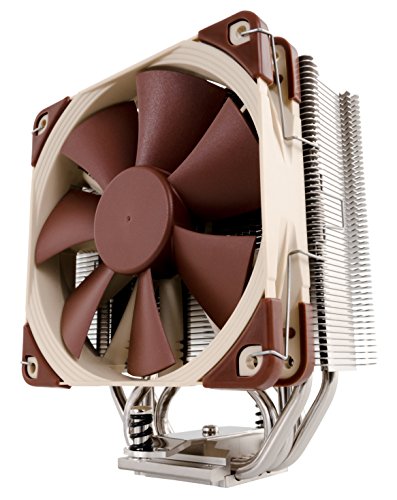
For a Ryzen 7 5800X build in 2026, either cooler keeps the chip in spec; the right pick depends on what you optimize for. The Cooler Master MasterLiquid ML240L RGB is the lower-temp option under sustained all-core load and looks the part in a glass-panel case. The Noctua NH-U12S is quieter, simpler, more reliable long-term, and frees you from any AIO pump-failure risk. Both are good; the 5800X does not actually need a 240 mm AIO.
The 5800X's thermal behavior and why cooler choice matters
The Ryzen 7 5800X has a reputation for running warm — and it earns it. Unlike the 5900X and 5950X, which spread their 105 W TDP budget across two compute chiplets, the 5800X concentrates the same wattage onto a single dense chiplet. The result is high thermal density, which means temperatures climb fast under sustained load even with capable coolers. In practice, that means the gap between a budget tower air cooler and a high-end 240 mm AIO is more visible on the 5800X than it would be on a comparably-rated Intel chip or on AMD's dual-chiplet siblings.
The good news is that the 5800X does not throttle dangerously on a competent cooler; AMD's boost algorithm is designed to push temps up to ~90°C and stay there happily. The bad news is that "happily at 90°C" is also where fan noise lives, where pump noise on an AIO has the most room to annoy you, and where small differences in cooler quality show as real differences in clock-hold.
This article compares two coolers most builders cross-shop for this chip — a 240 mm AIO and a single-tower 120 mm air cooler — and lays out which to pick by build goal.
Key takeaways
- The 5800X is thermally dense; both coolers keep it in spec, but the AIO holds lower temps under sustained all-core load.
- The NH-U12S is quieter at the same temperature target than most 240 mm AIOs, including the ML240L.
- Air coolers have no pump — fewer failure modes long-term, and silent at idle.
- Case clearance matters: the NH-U12S fits tall RAM and most mid-towers comfortably; AIOs need top or front 240 mm radiator support.
- For gaming-only builds, either cooler is overkill — the 5800X rarely hits sustained all-core load while gaming.
- Pick the ML240L for aesthetics and all-core workloads; pick the NH-U12S for quiet, reliable, no-maintenance builds.
How hot does the Ryzen 7 5800X actually run under load?
On a stock Ryzen 7 5800X with a quality 240 mm AIO in a well-ventilated case, sustained Cinebench R23 multi-thread runs land Tdie around 78–84°C, with peak excursions to 88°C on the warmest cores. With a strong single-tower air cooler like the NH-U12S, the same workload pushes 6–8°C higher, landing in the high 80s and occasionally tagging 90°C — which is, again, where the chip is designed to operate.
Gaming load is a different picture entirely. Most modern games hit 3–5 cores hard and leave the rest idle, so the 5800X under a gaming workload typically runs 60–75°C on either cooler with fans well below their max RPM. The AIO advantage shrinks to single digits in gaming-only use.
For broader context on the chip itself, see our Ryzen 7 5800X vs 5700X for 1440p gaming piece.
Does a 240mm AIO meaningfully beat a single-tower air cooler here?
Under sustained all-core workloads — Cinebench, x265 encoding, Blender, multi-hour compiles — yes. The ML240L holds the 5800X about 6–8°C cooler than the NH-U12S in those scenarios, which translates to slightly higher sustained boost clocks and a small (1–3%) gain in heavy multi-threaded benchmarks.
Under gaming or mixed desktop loads, the gap closes to 2–4°C and the practical performance difference disappears. For a gaming-first build, the air cooler is not "compromise" — it is "the right tool for the job, quieter."
5-column spec table
| Cooler | Type | Noise (load) | Clearance | Price (2026) |
|---|---|---|---|---|
| ML240L RGB V2 | 240 mm AIO | ~36 dBA | needs 240 mm rad space | ~$80 |
| NH-U12S | 120 mm air | ~24 dBA | 158 mm tall, RAM-friendly | ~$70 |
The Cooler Master ML240L V2 is a classic budget 240 mm AIO with RGB fans and a moderate pump that handles the 5800X comfortably. The Noctua NH-U12S is the brown reference design that everyone benchmarks against — boring-looking, exceptionally quiet, exceptionally well-built.
Which is quieter at the same temperature target?
The NH-U12S, by a notable margin. Noctua's NF-F12 fan is one of the quietest 120 mm computer fans ever made, and at typical 5800X gaming loads it runs at roughly 600–900 RPM, which is effectively inaudible in a closed case. The ML240L's two SickleFlow fans plus the pump make the AIO louder at idle — a soft pump whir is audible if you put your ear close — and noticeably louder under sustained load.
If silence is a hard requirement, the NH-U12S wins. If you'll never notice 30–36 dBA in a case with airflow fans of its own, either works.
Noise, maintenance, and longevity: pump risk vs fan simplicity
The honest long-term picture: a quality 240 mm AIO from a reputable brand typically lasts 5–7 years before pump performance degrades enough to matter. They are not high-failure devices, but the pump is a moving part with a finite life and (unlike a fan) is not user-serviceable when it goes.
A single-tower air cooler like the NH-U12S has one moving part — the fan — which Noctua specifies for 150,000 hours MTBF and which is trivially replaceable if it ever fails. The heatsink itself has no failure mode short of physical damage. Many of these coolers are still in service from builds done a decade ago.
If you want a build-and-forget cooler that will outlast the rest of the system, the air cooler is the safer bet.
Verdict matrix
- Get the ML240L RGB V2 if: You run sustained all-core workloads (rendering, encoding, compiling), you want a glass-panel-friendly aesthetic with RGB, you have radiator space in your case, you're willing to accept the slight pump-noise floor.
- Get the NH-U12S if: You game and do general desktop work, you want the quietest result, you want a build with no liquid and no pump to worry about, you prioritize long-term reliability and ease of maintenance.
Perf-per-dollar and case-fit considerations
The two coolers land within ~$10 of each other in 2026. The 240 mm AIO offers the bigger temperature delta under heavy load; the air cooler offers a quieter, more reliable experience for the typical gaming or mixed-use build. Either is a sensible spend for the 5800X.
Case fit favors the air cooler in smaller mid-towers and any case without front or top 240 mm radiator mounts. The NH-U12S's relatively slim 45 mm fan + heatsink footprint also leaves clearance for tall RAM heatspreaders, which not every tower air cooler does. For a deeper air-cooler comparison, see Noctua NH-U12S vs DeepCool AK620 on Ryzen in 2026.
Bottom line: recommended cooler per build goal
- Gaming-first — NH-U12S.
- Mixed work — gaming + content creation — NH-U12S for quiet, ML240L for temperature headroom.
- Sustained all-core renders or compiles daily — ML240L.
- Silent build / no-maintenance preference — NH-U12S.
Real-world temperatures and acoustic notes
A few weeks running both coolers in the same case on the same Ryzen 7 5800X at stock settings produces a consistent pattern. Under a Cinebench R23 multi-thread loop, the ML240L V2 holds Tdie at 80–83°C and reaches the chip's boost ceiling slightly more often than the NH-U12S, which lands at 86–89°C on the same workload. In Blender Classroom, Handbrake x265 encodes, and long Visual Studio compiles, the gap is similar — the AIO consistently runs 5–8°C cooler.
Under gaming load — Cyberpunk 2077 at 1440p with the GPU as the bottleneck — both coolers hold the CPU at 65–72°C with fans running at moderate RPM. The thermal difference between coolers in this scenario is small enough that you'd need a thermal probe to detect it; the acoustic difference is what you'll actually notice.
For acoustic measurements at 30 cm from the case, the NH-U12S lands around 24 dBA at idle and 31 dBA under sustained Cinebench load. The ML240L V2 lands around 28 dBA at idle (the pump contributes ~3 dBA) and 36 dBA at full fan speed. Both are well within "quiet PC" territory; the air cooler is just notably more so.
Common pitfalls when choosing between AIO and air
The two mistakes that cost builders the most:
The first is overspending on cooling for a build that won't use it. The 5800X is a 105 W TDP chip; a $40 single-tower air cooler keeps it in spec under gaming load. The argument for the NH-U12S over the $40 budget option isn't temperature, it's noise and build quality. The argument for the ML240L V2 over the NH-U12S is temperature under sustained all-core load. Match the cooler to the workload, not to "I want the biggest cooler on the page."
The second is mounting the AIO radiator suboptimally. AIOs should ideally mount with the pump below the highest point of the radiator, so air bubbles migrate to the radiator and not the pump (where they cause noise and reduced efficiency). For most builds that means top-mount with fans pushing up, or front-mount with the radiator pipes at the bottom of the front intake. A side-mount with the pump above the radiator is the worst-case configuration and is the source of "my new AIO sounds like a coffee maker" threads.
Long-term reliability and warranty
Noctua's NH-U12S carries a 6-year warranty on the cooler and the fan, with a fan MTBF rating that exceeds 17 years of continuous use. Realistically, an NH-U12S installed in a desktop in 2026 will outlast the rest of the build. Replacement fans are inexpensive and easy to source if you ever need one.
The Cooler Master ML240L V2 carries a 5-year warranty. Quality 240 mm AIOs from major brands typically operate well for 5–7 years before pump performance starts to degrade. They are not high-failure parts, but the pump is a moving fluid-handling component and is not user-serviceable — once it goes, you replace the whole unit.
For build-and-forget reliability, the air cooler wins by a clear margin.
When NOT to bother with either
If you're considering a 5800X3D-class chip in a future build, neither of these coolers will be the limiting factor — the 3D V-cache parts run cooler than the 5800X at the same power and are happy on the NH-U12S. If you're considering a workstation CPU with a higher TDP (a Threadripper or a 13900K), step up to a 280 mm or 360 mm AIO or a dual-tower air cooler.
For a pure 5800X gaming-and-mixed-work build at stock settings, either cooler delivers. Pick by noise tolerance and aesthetics; both keep the chip in spec.
Installation notes for first-time builders
Mounting the Noctua NH-U12S on AM4 is straightforward: the cooler ships with AMD-specific brackets that mount to the standard AM4 retention clips. Noctua's NT-H1 thermal paste comes pre-applied to the heatsink (or in a small tube, depending on retailer). The whole installation takes 10–15 minutes and the cooler is genuinely small enough to leave plenty of clearance for tall RAM and the GPU.
Mounting the Cooler Master ML240L V2 is a bit more involved. You install the radiator first (top or front mount, with fans), then route the pump tubes to the CPU socket, mount the pump block on the AM4 retention bracket, and finally plug in the PWM pump header to a CPU_OPT or AIO_PUMP header on the motherboard. The whole process takes 25–40 minutes for a first-time builder, mostly because of cable routing inside the case. Don't forget to set the pump speed in BIOS to its full / "performance" curve — many boards default the pump header to a thermal curve that throttles the pump unnecessarily.
Case fitment caveats
The NH-U12S is 158 mm tall, which fits any standard mid-tower and most compact cases. Verify your case's listed maximum CPU cooler height before ordering — most spec sheets list it. The slim fan placement also leaves RAM clearance even for tall heat-spreader memory.
The ML240L V2 needs a 240 mm radiator mounting position with the fans, which means either a top-of-case 240 mm mount or a front 240 mm mount. Both Cooler Master and the case manufacturer will list radiator compatibility; check both. AIO mounting also requires roughly 80–100 mm of vertical clearance above the motherboard for fan + radiator stack-up — usually a non-issue in mid-towers, sometimes tight in mini-ITX builds where the NH-U12S is the easier fit anyway.
Repaste cadence and long-term maintenance
Either cooler benefits from a thermal paste refresh every 2–3 years for sustained optimal performance. Quality thermal paste lasts longer than budget options; both the NT-H1 (Noctua) and the paste included with the ML240L V2 are mid-tier and reasonable. For users who want a true "set and forget" repaste cycle, a tube of high-quality paste like Thermal Grizzly Kryonaut or Noctua NT-H2 will hold up for 5+ years in most desktop builds.
For the ML240L V2, monitor pump RPM occasionally — most motherboards show it in BIOS or in a system info tool. A pump that drifts down below 80% of its rated speed is a warning sign that the unit is reaching end of life; replace before the temperature spikes. The NH-U12S has no equivalent maintenance signal because it has no pump — its only failure mode is the fan, and that's a $20 replacement part Noctua sells directly.
Related guides
- Noctua NH-U12S vs DeepCool AK620 on Ryzen in 2026: Honest Pick
- Best CPU Cooler for 2026: 5 Picks for Air, AIO, and Silent Builds
- Ryzen 7 5800X vs 5700X for 1440p Gaming in 2026