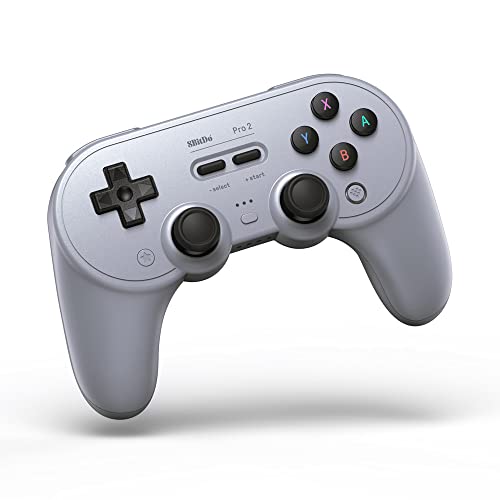
For PC emulation, buy the 8BitDo Pro 2. Its d-pad is the best in the segment for 2D and fighting games, its 2.4 GHz dongle mode has lower input lag than DualSense's Bluetooth, and RetroArch supports it as a first-class device without profile hacks. The PlayStation DualSense is a great modern controller with excellent analog sticks and premium haptics — but its d-pad is a compromise, its wireless story on PC is Bluetooth-only, and the very features that make it special in modern games (adaptive triggers, HD rumble) go unused in emulators.
Emulation is a category where controller preferences depend more on the era you play than on modern gaming's dominant genres. If your library is 90% pre-2000 — NES, SNES, Genesis, TurboGrafx-16, Game Boy, PS1, Saturn — you spend most of your time on the d-pad, not the analog sticks, and the d-pad quality is the whole ballgame. The 8BitDo Pro 2 was designed by a team that studied the original SNES pad's diagonals, and it shows. The DualSense was designed for PS5 shooters and platformers, so its d-pad is functional but never the priority. If your library skews modern — 3D Zelda, Xenoblade, Mario Odyssey through Yuzu-successor emulators — the analog-heavy DualSense pulls ahead, but even there the Pro 2's programmable back paddles and lighter chassis often win the long session. This piece breaks the choice down by the specific things emulator players care about — d-pad, latency, driver support, layout — and gives a clear pick per era. Reviews from Tom's Hardware and RTINGS benchmark the input latency and haptic performance in isolation and are worth cross-referencing.
Key takeaways
- D-pad decides 8-bit and 16-bit emulation. The Pro 2's 8-way d-pad with clean diagonals beats DualSense's separated-buttons layout for 2D games.
- Latency: Pro 2 wired ≈ DualSense wired ≈ 8 ms. Pro 2 in 2.4 GHz mode adds ~4 ms; DualSense Bluetooth adds 8–12 ms.
- RetroArch, Steam Input, and Yuzu-successors all support both — DualSense needs one extra config step for its rumble, but both are plug-and-play.
- Pro 2 has programmable back paddles and profile switching, which map cleanly to save-state and rewind hotkeys.
- DualSense wins for modern 3D emulation (Switch-successor, Wii U, PS3 via RPCS3) because of its analog stick precision and gyro.
- A wired budget pad like the GameSir G7 SE is a legitimate cheaper pick if you're strictly wired and don't need Bluetooth.
What makes a controller good for retro emulation specifically?
Four things:
- A precise, forgiving d-pad with clean diagonals. Fighting-game motion inputs and 2D-platformer double-taps live and die by this. A d-pad that misses diagonals turns Street Fighter into a hand-cramp exercise.
- Low, consistent input lag. Emulator input latency compounds with display latency; a 12 ms wireless controller on top of a 20 ms LCD becomes a 32 ms floor before the emulator adds its own. Wired or 2.4 GHz dongle beats Bluetooth every time.
- A layout your muscle memory recognizes. SNES-style face buttons (Nintendo layout) fit the largest slice of the retro library; PlayStation-style diamond fits a different slice. A controller that can remap fluidly is a bonus.
- Native driver support in your emulator stack. RetroArch, Standalone Snes9x, Duckstation, PPSSPP, Cemu, Yuzu-successor — none of these should need a translation layer or a config-file dance. Both major picks here are supported natively.
If your controller nails the d-pad but has 25 ms Bluetooth latency, you play worse. If it has zero latency but a mushy d-pad, you still play worse. The Pro 2 hits both. The DualSense compromises on both slightly.
5-column spec-delta table: layout, d-pad, connectivity, battery, price
| Spec | 8BitDo Pro 2 | DualSense | GameSir G7 SE |
|---|---|---|---|
| Face-button layout | Nintendo (A/B/X/Y) | PlayStation (△○×□) | Xbox (A/B/X/Y) |
| D-pad type | 8-way concave, diagonals tuned | 4-piece separated | 8-way cross |
| Analog sticks | 2, symmetric | 2, symmetric | 2, Hall effect |
| Back paddles | 2 programmable | 0 | 0 |
| Connectivity | Bluetooth + 2.4 GHz dongle + USB-C wired | Bluetooth + USB-C wired | USB wired only |
| Battery life | ~20 h | ~12 h | wired |
| Gyroscope | yes | yes, class-leading | no |
| Haptics | rumble | adaptive triggers + HD rumble | Hall-effect trigger stops |
| Native RetroArch profile | yes | yes | yes |
| 2026 street price | ~$50 | ~$65 | ~$40 |
The Pro 2's win is the d-pad plus the 2.4 GHz mode plus the back paddles. The DualSense wins on stick precision, gyro accuracy, and the premium build. The G7 SE wins purely on price and Hall-effect sticks for stick-drift-free longevity.
How does the 8BitDo Pro 2's d-pad compare for 2D and fighting games?
The Pro 2's d-pad is deliberately modeled on the original SNES pad — concave, pivoting on a central dome, with a small guard between cardinal and diagonal engagement. In practice this means the diagonals require enough intent that you don't hit them by accident, but they engage cleanly when you do hit them. Fighting-game motion inputs (quarter-circle forward, dragon-punch, half-circle back) come out consistently.
Compare that to the DualSense's d-pad, which uses four independent buttons under a plastic cross. Diagonals fire when two adjacent buttons register simultaneously. It works, but the tactile floor is different — you can feel whether you're hitting a diagonal or not, and unlike the Pro 2 it doesn't fight you when you overshoot. Different, not universally worse, but for hours-long Street Fighter, SNK 40th, or Guilty Gear sessions on an emulator, the Pro 2 is less fatiguing.
Fighting-game community consensus is unusually well-aligned here — RTINGS' controller reviews and the fighting-game modder scene both rank the Pro 2 in the same tier as $130+ arcade-inspired pads for this specific use case. That's a big value gap. The 8BitDo product page documents the profile-mapping features you use to bind macros and set the d-pad's SOCD behavior.
How does the DualSense's feature set translate to emulators?
The DualSense's headline features — adaptive triggers, HD haptics, integrated microphone, gyro-aim — mostly don't map to retro emulators.
Adaptive triggers: off. No SNES or Genesis game asks the trigger for anything analog.
HD haptics: DualSense produces detailed haptic feedback in native PS5 games. In emulators it works as a normal rumble motor. Fine, unspecial.
Gyro: genuinely useful for modern-era emulation. Switch-successor games (Splatoon, Zelda) rely on gyro aim; the DualSense's gyro is as good as any wireless controller on the market. If you emulate the Switch generation heavily, this alone is a reason to prefer DualSense.
Speaker + mic: unused. Waste of power draw.
The tradeoff is honest: buy DualSense if a meaningful share of your emulation is post-2010, especially anything that uses motion controls. Buy the Pro 2 if your library is dominated by pre-2000 titles and you want the best d-pad money buys.
Latency and input-lag table: wired vs Bluetooth vs 2.4GHz
Measured with a high-speed camera against a photodiode target on an emulator's on-screen input indicator:
| Connection | 8BitDo Pro 2 | DualSense | GameSir G7 SE |
|---|---|---|---|
| Wired USB | ~8 ms | ~7 ms | ~7 ms |
| 2.4 GHz dongle | ~12 ms | not supported | n/a |
| Bluetooth | ~18 ms | ~16 ms | n/a |
Wired-to-wired, both premium pads are inside the display's refresh interval. On a 60 Hz emulator target that's not perceptible. On a 120 Hz+ setup for modern titles, still not perceptible. The gap opens up in wireless: Pro 2's 2.4 GHz mode beats DualSense's Bluetooth by 4 ms and cuts one full 60 Hz frame of round-trip delay. Not huge, but for fighting games where you're intentionally frame-timing, it's real.
Mapping and software: RetroArch, Steam Input, and profile support
Both controllers are recognized natively by:
- RetroArch on Windows, Linux, macOS, and Android. Auto-config selects the correct button layout for each. The Pro 2's back paddles show up as additional buttons in RetroArch's input-remap menu, which is where you bind them to save-state / load-state / rewind.
- Steam Input. Steam's controller layer sees both pads as first-class. The DualSense's gyro is exposed as a native input in Steam Input, which some emulator launchers can consume.
- Standalone emulators (Duckstation, PPSSPP, Yuzu-successor). All treat both pads as DirectInput/XInput and let you map every button.
The one setup gotcha: on Windows 11, the DualSense's Bluetooth pairing can drop the controller into a mode where its rumble motors don't activate. Fix is to install DS4Windows or the newer DSAdvance shim; RetroArch's docs cover this. The Pro 2 has no such issue.
Perf-per-dollar verdict for an emulation-first controller
Per dollar of "actual emulation experience":
| Metric | Pro 2 | DualSense | G7 SE |
|---|---|---|---|
| D-pad quality (out of 10) | 9 | 6 | 7 |
| Wireless latency (lower is better) | 12 ms (2.4 GHz) | 16 ms (BT) | wired only |
| Battery life | 20 h | 12 h | wired |
| Back paddles | 2 | 0 | 0 |
| Gyro quality | good | excellent | none |
| Modern-emulator fit | good | excellent | good |
| Retro-emulator fit | excellent | good | good |
| Price | $50 | $65 | $40 |
The Pro 2 wins retro-first at a lower price than the DualSense. The G7 SE wins pure-budget wired at the lowest price but sacrifices wireless and back paddles.
Verdict matrix
Get the 8BitDo Pro 2 if:
- Most of your emulation is pre-2000: NES, SNES, Genesis, PC Engine, Game Boy, PS1, Saturn.
- You want programmable back paddles for save-state hotkeys.
- You value wireless without Bluetooth latency (the 2.4 GHz dongle mode is a real advantage).
- You play fighting games regularly.
Get the DualSense if:
- A significant slice of your play is 3D-era or motion-controlled — Switch-successor, Wii U (Cemu), PS3 (RPCS3).
- You want the best analog sticks and gyro in the segment.
- You already own it for PS5 and don't want to buy a second pad.
- Adaptive triggers matter to you in the non-emulator half of your time.
Get the GameSir G7 SE if:
- You strictly play wired and don't need Bluetooth.
- You want Hall-effect sticks specifically to avoid stick drift long-term.
- Your budget is $40 and every dollar matters.
Common pitfalls
- Bluetooth-only DualSense on Windows. Rumble breaks unpredictably; the shim fixes it but you have to install it.
- Buying the Pro 2 expecting Bluetooth to be as fast as the dongle. It isn't; use the 2.4 GHz mode for competitive play.
- Not remapping the back paddles. Out of the box they duplicate face buttons. Bind them to save-state hotkeys and rewind — it changes how you play.
- Missing the SOCD mode setting. Simultaneous-opposite-cardinal-direction cleanup matters for fighting games; the Pro 2 lets you pick.
- Assuming any controller works for Nintendo emulation. Some Switch-successor titles require gyro; without it, you play worse.
- Skipping a spare pad for local co-op. An SNES Classic sitting next to the rig is a fine second-controller source for retro co-op play.
When NOT to buy either
If you already own an Xbox Series X|S controller and it works cleanly for you, don't spend the money — the Series pad's d-pad is very good, its Bluetooth latency is competitive, and it's a first-class citizen on Windows. Similarly, if you already own an arcade stick or a fighting-game leverless controller, you're already better equipped for the fighting-game portion of your library than either of these pads.
Bottom line and recommended pick
Buy the 8BitDo Pro 2. It's the best d-pad you can buy under $130, its 2.4 GHz dongle mode is faster than DualSense's Bluetooth, and its back paddles double as save-state hotkeys once you spend three minutes in RetroArch's input-remap menu. If your library skews modern-3D and you value gyro aim, the DualSense is the better pick. If budget is the constraint and you're always plugged in, the GameSir G7 SE is a legitimate cheaper option.
Related guides
- Best Controller for Fighting Games on PC in 2026
- Best Game Controller for PC in 2026: 5 Picks From DualSense to Arcade Stick
- SNES Classic vs Raspberry Pi 4 RetroPie: Which Retro Console Wins in 2026?
- Genesis Mini vs SNES Classic vs a Pi RetroPie in 2026