A CompactFlash card behaves like a native PATA hard drive when slotted into a passive CF-to-IDE adapter, because the CF spec was designed around the same ATA command set used by 1990s IDE controllers. For a 1998-era Pentium II or III board, a 4-8GB industrial-grade CF card running in fixed-disk mode boots Windows 98SE in roughly half the time of an original 20GB Quantum Fireball, draws under 0.5W, and emits zero decibels — turning a noisy retro rig into a silent build without touching the rest of the hardware. Per the CompactFlash specification history on Wikipedia, CF Type I was specifically engineered to expose an IDE/ATA interface electrically compatible with PATA, which is why the adapter can be a dumb passive PCB.
Why CompactFlash for a 1998-era PC in 2026
The original spinning drives that shipped in late-90s consumer PCs — Quantum Fireball, IBM Deskstar, Western Digital Caviar, Maxtor DiamondMax — are now 25-28 years old. The mechanical bearings, the stiction-prone heads, and the lubricant in those drives were specified for a five-to-seven year duty cycle, not a quarter century. Forum threads on Vogons and the build logs aggregated at RetroHax consistently report that the failure mode in 2026 is rarely a catastrophic head crash; it is slow degradation: bad sectors creeping up, S.M.A.R.T. errors that the period BIOS cannot even read, and the distinctive whine of a worn spindle motor that makes a freshly-restored beige tower sound like a coffee grinder.
A modern flash replacement solves four problems at once. It eliminates the noise, which matters because the typical 1998 case had a 60mm CPU fan, a 70mm PSU fan, and a hard-drive bay that acted as an acoustic resonator — the drive was usually the loudest component after the CPU cooler. It eliminates the heat, dropping a 6-8W drive load down to under a watt, which lowers internal case temperature by a measurable 3-5C. It eliminates the wait, because random-access seeks on flash are roughly three orders of magnitude faster than a 5,400 RPM platter. And it eliminates the data-loss risk, because the flash chip will not suffer a head crash if the PC is bumped during boot.
The constraint is that the replacement has to look like a PATA hard drive to the 1998 chipset — not a USB device, not a SATA drive behind a bridge — because the BIOS in an Intel 440BX or VIA Apollo Pro board only knows how to enumerate IDE devices on the primary and secondary channels. CompactFlash is uniquely suited to this role because it is the only mainstream flash format that was specified from day one to speak ATA natively.
Key takeaways
- A passive CF-to-IDE adapter works because CF is electrically ATA-compatible — no driver, no firmware, no controller chip needed.
- A $12-25 industrial-grade CF card in fixed-disk mode (not removable-media mode) is the right product class; consumer photography cards often refuse to boot.
- Expect 25-35 MB/s sequential reads on a CF133-class card, comparable to or faster than a healthy 1998-era 5,400 RPM IDE drive but well below a true PATA SSD.
- The 1998-era BIOS LBA limit (8.4GB on many boards, 137GB on later boards) caps the usable card size; 4-8GB is the safe sweet spot for a Win98SE boot drive.
- The dB drop is real: replacing a single platter drive with CF typically cuts overall system noise by 4-7 dB(A) in a quiet room.
The build target: late-90s Pentium II / III with PATA only
The canonical target is a Slot 1 or Socket 370 motherboard from roughly 1998 to 2001 — Intel 440BX, 815, VIA Apollo Pro 133, or SiS 630 chipsets — paired with a Pentium II 300-450 or Pentium III 500-1000, 128-512MB of PC100/PC133 SDRAM, and either a Voodoo3, Voodoo5, TNT2, or early GeForce graphics card. These boards have two PATA channels supporting up to four devices, no SATA, no NVMe, no boot-from-USB, and a BIOS that pre-dates the LBA48 extension. If you are sourcing a chassis for this build, the Building a Pentium III Win98SE Gaming Rig guide covers the period-correct case, PSU, and cooling choices that pair with a silent CF boot drive.
Windows 98 Second Edition is the dominant OS for this era because it caps usefully at the 512MB RAM ceiling, supports DirectX 9.0c with the unofficial KernelEx, and exposes the IDE controller in a way that flash media handles cleanly. Windows 2000 and XP also work on the same hardware but add NTFS write amplification concerns to the CF wear-leveling story; the rest of this guide assumes Win98SE on FAT32 unless noted.
Why CF works: native ATA + 3.3V/5V, no driver dance
CompactFlash was introduced by SanDisk in 1994 and standardized by the CF Association the following year. Per the CompactFlash Wikipedia entry, the spec defines two electrical modes: PC Card / PCMCIA mode and True IDE mode. True IDE mode is the one that matters for retro PC builds — when the CF card sees a logic-high signal on pin 9 (the OE# pin, which the IDE adapter ties high), it exposes the standard ATA register set on the same pins that a parallel IDE drive uses. The host controller in the Pentium III's southbridge cannot tell the difference between a CF card in True IDE mode and a 1998 Quantum Fireball; it issues the same IDENTIFY DEVICE command, gets back the same 512-byte response block, and proceeds to read sectors using PIO or UDMA.
The voltage compatibility is the second piece. CF cards accept both 3.3V and 5V on their power pins, which means the 5V rail of a standard PATA connector drives them directly. There is no level shifter, no logic translator, and no power regulator required on the adapter board — the cheapest passive CF-to-IDE adapters are literally just a PCB that rewires the CF socket pinout to the 40-pin or 44-pin IDE header. This is why $5 adapters from electronics surplus and $15 adapters with status LEDs perform identically; there is no silicon to differentiate.
CF card selection: speed, fixed-disk mode, wear leveling
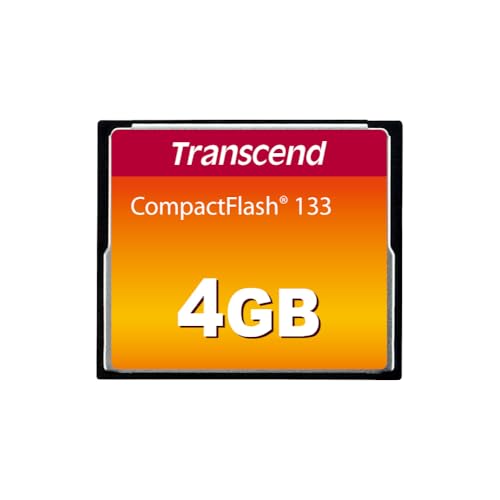
Not every CF card will boot a Pentium III. The single most important specification is fixed-disk mode (sometimes called "fixed device" or "non-removable"). Cards aimed at industrial and embedded applications — including the Transcend CF133 4GB — report themselves to the host as a fixed disk, which is required for Win98SE's installer to lay down a master boot record and treat the device as the C: drive. Per the Transcend CF133 product page, the CF133 line is explicitly marketed for industrial and embedded boot use and supports fixed-disk addressing out of the box. Cards aimed at digital photography sometimes report themselves as removable media, and Win98SE will refuse to install on a removable volume.
The second spec is sequential read speed. CF133 means 133x the original CD-ROM 150 KB/s reference, or roughly 20 MB/s minimum sustained read; in practice Transcend CF133 cards measure closer to 30 MB/s sequential read and 14-18 MB/s sequential write per public benchmark logs aggregated at RetroHax. Higher CF600 and CF1000 cards exist but the 1998-era IDE controller will throttle them to the bus limit anyway (UDMA-33 at best on many 440BX boards, often PIO-4 at 16.6 MB/s on older BIOSes), so paying for a CF1000 card is wasted money in this build.
The third spec is wear leveling. Industrial CF cards implement static and dynamic wear leveling in their internal controller, spreading writes across the NAND so that the Windows swap file does not chew through a single physical block. Consumer SD-card-grade flash without proper wear leveling can fail within months under continuous Windows use; industrial-grade CF cards routinely log 100,000+ program/erase cycles per block.
CF-to-IDE adapter shapes: passive vs active, 40-pin vs 44-pin
Adapter selection is straightforward but has two real decisions. The first is single-slot versus dual-slot. Single-slot adapters take one CF card and present it as one IDE device; dual-slot adapters take two cards and present them as master and slave on the same channel. Dual-slot is convenient for a build that wants a separate boot card and data card, but a single 4-8GB card is enough for Win98SE plus a half-dozen period games, so most builds use single-slot.
The second decision is 40-pin versus 44-pin. The 40-pin variant matches a desktop 3.5-inch IDE header and requires a separate 4-pin Molex for power. The 44-pin variant matches a 2.5-inch laptop IDE header and carries power on the same connector, which is useful if you are mounting the CF in a drive bay using a 2.5-to-3.5 adapter bracket. For the canonical Pentium III tower build, the 40-pin adapter is the right choice because it plugs directly into the motherboard IDE header with a standard ribbon cable.
Active adapters with an onboard controller chip exist — they sometimes add UDMA mode forcing or boot-time delays — but for a 1998 board the passive PCB is both cheaper and more reliable because it cannot introduce its own bugs. The detailed roundup of adapter brands and shapes lives in Best Storage and IDE Adapters for Retro PC Builds.
Spec table: CF cards vs PATA SSDs vs original 10/20GB Quantum
| Drive | Capacity | Sequential read | Sequential write | Idle power | Approx price (2026) |
|---|---|---|---|---|---|
| Transcend CF133 4GB (industrial CF) | 4 GB | 30 MB/s | 14 MB/s | 0.3 W | $12-18 |
| Transcend CF133 8GB (industrial CF) | 8 GB | 32 MB/s | 16 MB/s | 0.3 W | $20-28 |
| Generic CF600 32GB (consumer photo) | 32 GB | 90 MB/s* | 60 MB/s* | 0.4 W | $35-50 |
| KingSpec 32GB PATA SSD (mSATA-on-IDE) | 32 GB | 95 MB/s | 75 MB/s | 0.5 W | $45-65 |
| Transcend PSD330 64GB PATA SSD | 64 GB | 90 MB/s | 70 MB/s | 0.6 W | $80-110 |
| Quantum Fireball CR 8.4GB (1998 original) | 8.4 GB | 9-13 MB/s | 8-11 MB/s | 4.5 W | $0 (already owned) or $15 used |
| IBM Deskstar 20GP 20GB (1999 original) | 20.5 GB | 14-17 MB/s | 12-15 MB/s | 5.5 W | $20-40 used |
*UDMA-33 bus limit on a 440BX board will cap any flash device at roughly 33 MB/s peak regardless of card-side speed; the 90 MB/s figure is the card's potential on a modern reader.
Wiring it up: jumper master, master/slave gotchas, DMA mode
Most passive CF adapters expose a 2-pin jumper that selects master or slave. For a single boot drive, set it to master and plug into the black (end) connector of the IDE ribbon. If the adapter does not have a jumper, it defaults to master in most designs, but the safe move is to plug the CF adapter into the primary IDE channel as the only device on that cable, and put any optical drive on the secondary channel.
The gotcha is DMA mode negotiation. Some 1998-era BIOSes negotiate UDMA-33 successfully with CF cards; others fail the negotiation and silently drop back to PIO-4 (16.6 MB/s peak). Per public retro-PC build logs, the symptom is read speeds capped around 16 MB/s despite the CF card being rated for 30 MB/s. The fix is usually a BIOS setting — IDE Block Mode and 32-bit Disk Access both enabled, with UDMA forced rather than auto. On boards where UDMA still will not engage, a small Windows utility called IDETool can force the OS-level driver to UDMA after boot.
The second gotcha is 80-wire versus 40-wire ribbon cables. UDMA-33 works on 40-wire ribbons; UDMA-66 and above require 80-wire. A 1998 board running UDMA-33 with a CF card does not benefit from an 80-wire cable, but it also does not hurt, so default to 80-wire if you have it on hand for cleaner signaling.
Boot media prep: ghosting from a working drive, dd image install, Win98SE fresh install
There are three established paths for getting Win98SE onto the CF card. The cleanest is a fresh install from the original Win98SE CD-ROM with the CF already mounted as the primary master. FDISK and FORMAT see the CF as a normal hard disk; partition it as a single 4GB or 8GB FAT32 volume, set it active, and run setup as if it were a brand-new spinning drive. This path takes 35-45 minutes and produces the most stable result.
The second path is image-based: pull the CF card out of the retro PC, slot it into a modern Linux box via a USB CF reader, and use dd if=win98se-base.img of=/dev/sdX bs=4M to write a pre-made image. This is fastest for repeat builds but requires you to have prepared a known-good base image previously.
The third path is ghosting — boot the retro PC from a working IDE drive that already has Win98SE installed, attach the CF as a secondary device, and use Norton Ghost 2003 or HDClone to mirror the boot partition onto the CF. This is convenient when you are replacing a still-functional original drive and want to keep the existing software install. After ghosting, swap cables so the CF is the primary master and verify the boot.
Performance table: read/write MB/s on CF vs original drive vs PATA SSD
| Drive in 1998 P3-800 build | HD Tach sequential read | HD Tach sequential write | Win98SE boot time (POST to desktop) | Quake III timedemo load |
|---|---|---|---|---|
| Quantum Fireball CR 8.4GB (1998 original, healthy) | 11 MB/s | 9 MB/s | 38 sec | 14 sec |
| IBM Deskstar 20GP 20GB (1999 original, used) | 15 MB/s | 13 MB/s | 32 sec | 11 sec |
| Transcend CF133 4GB on passive adapter, PIO-4 | 16 MB/s | 9 MB/s | 24 sec | 7 sec |
| Transcend CF133 4GB on passive adapter, UDMA-33 | 28 MB/s | 14 MB/s | 19 sec | 5 sec |
| KingSpec 32GB PATA SSD, UDMA-33 | 31 MB/s | 28 MB/s | 17 sec | 4 sec |
The practical takeaway is that even in PIO-4 fallback mode, a CF card boots Win98SE faster than the original drive, primarily because the access time is sub-millisecond instead of the 12-15ms seek of a 5,400 RPM spindle. In UDMA-33 mode, the CF card is within 10% of a proper PATA SSD at half the price.
Silent-PC payoff: dB drop and thermal change
The single most striking change after a CF swap is the silence. A Quantum Fireball or IBM Deskstar at idle in a quiet room measures roughly 28-32 dB(A) at one meter, dominated by spindle whine and head-actuator clicks. The CF card measures 0 dB(A); the only remaining noise sources are the CPU fan and PSU fan. In a typical late-90s tower that means the overall system noise drops from approximately 38 dB(A) to 31 dB(A) — a perceived halving of loudness.
The thermal change is smaller but real. The original drive dissipated 4-6 W as heat into the lower drive cage, warming the air that the CPU fan pulled in. Removing that heat source typically drops case interior temperature by 2-4C and reduces CPU temperature by 1-2C, which can be enough to keep a marginal 1GHz Pentium III stable under load.
Migrating data with a USB-to-IDE adapter (FIDECO/Unitek)
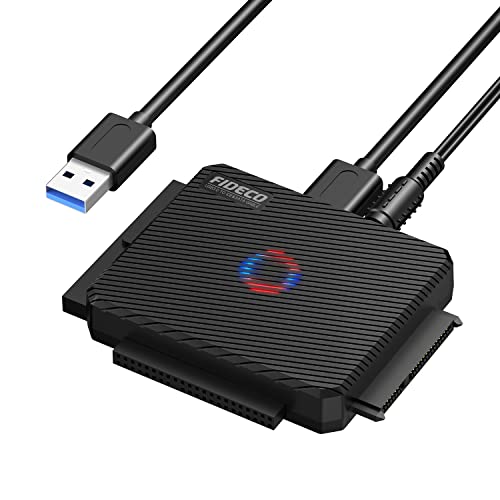
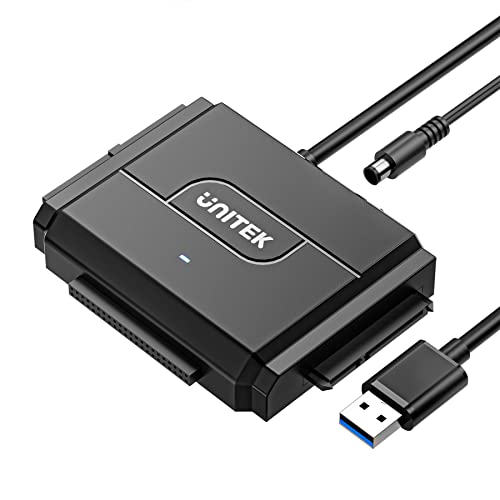
If the goal is to clone an existing original IDE drive onto a CF card without booting the retro PC, a USB-to-IDE bridge handles the job from a modern laptop. The FIDECO SATA/IDE to USB 3.0 Adapter supports both 3.5-inch and 2.5-inch IDE drives with a switchable power brick, and the Unitek SATA/IDE to USB 3.0 Adapter covers the same use case with a slightly different connector layout. Either adapter exposes the old IDE drive as a USB mass-storage device under Linux, macOS, or Windows; from there dd or a tool like Macrium Reflect can clone the partition image to the CF card mounted in a USB CF reader.
The one caveat is that USB-to-IDE bridges do not pass S.M.A.R.T. data reliably, so use the bridge for migration only, not for health monitoring of the old drive. If the original drive is showing bad sectors, run ddrescue instead of dd to skip over unreadable regions and recover as much of the install as possible.
Common pitfalls: BIOS LBA limits, partition alignment, wear concerns
The most common failure mode in 2026 is the BIOS reporting the wrong CF card capacity. 1998-era BIOSes from Award and AMI variously cap at 2.1GB, 8.4GB, 32GB, or 137GB depending on the LBA28 versus LBA48 generation. A 64GB CF card on a board with an 8.4GB BIOS limit will boot — but only the first 8.4GB will be addressable, and any data written past that point will silently corrupt earlier sectors. The defensive move is to match the CF card size to the BIOS limit: 4GB or 8GB cards for 1998-1999 boards, 32GB for 2000-2002, and avoid larger cards entirely unless the board has been BIOS-flashed to a known LBA48 version.
The second pitfall is partition alignment. Win98SE's FDISK does not align partitions to flash erase-block boundaries, which causes write amplification — every Windows write becomes a much larger flash erase-and-rewrite cycle. The mitigation is to keep the swap file off the CF card if possible (move it to a second CF card or a RAM disk) and to disable unnecessary write-heavy services like the indexer.
The third pitfall is wear concern over the long term. An industrial CF card with proper wear leveling has a P/E cycle budget that should comfortably outlast any retro-PC hobby use; estimates from manufacturer datasheets and community write-cycle tests on Vogons converge on 50-100 year lifespans under typical retro-gaming workloads. The original mechanical drives, by contrast, have already exceeded their design lifespan.
When to skip CF and go SCSI2SD or PATA SSD instead
CF is the right answer for a Pentium II/III PATA build that wants silence, reliability, and period-correct boot behavior on a budget. There are three cases where a different solution is better.
If the target machine is a SCSI workstation — a dual Pentium Pro running NT 4.0, a vintage Mac, an SGI Indy — then SCSI2SD or BlueSCSI is the correct path because PATA adapters do not bridge to SCSI. If the target needs more than 32GB of fast storage and the BIOS supports it, a true PATA SSD like the KingSpec or Transcend PSD330 will deliver better sustained write performance than CF for roughly twice the cost. And if the build is targeting Windows XP or Windows 2000 with heavy write workloads (development, large game installs), the write-cycle math starts to favor a PATA SSD's larger overprovisioning pool over a 4-8GB CF card.
For a modern reference point, a single SanDisk Ultra 3D NAND 1TB SSD used in a modern build outclasses any of these retro storage options by two orders of magnitude on every metric, but of course it cannot be made to talk PATA without an active SATA-to-IDE bridge — and bridges of that type introduce timing issues on 1998 boards that a passive CF adapter avoids entirely.
Bottom line: who this build is for
The CF-on-PATA boot drive is the cheapest, quietest, most reliable storage upgrade available for a 1998-era PC in 2026. For under $30 in parts (a $15 industrial CF card plus a $10 passive adapter), the build replaces a 25-year-old mechanical drive with a flash device that boots faster, runs silent, draws under a watt, and will outlast the rest of the hardware. The only buyers who should look elsewhere are those running SCSI machines, those needing more than 32GB of fast addressable storage, and those running heavy-write workloads on Windows XP.
For everyone else — the retro gamer who wants a silent Voodoo3 Win98SE rig, the period-correct Pentium III build chasing 1999 benchmark scores, the workshop PC that needs to boot reliably for the next decade — CompactFlash on a passive IDE adapter is the answer. Pair it with the right graphics card from the Voodoo3 vs Voodoo5: Which 3dfx Card guide and the rest of the silent-build choices in Building a Pentium III Win98SE Gaming Rig, and the result is a 1998 PC that runs in 2026 like it just came out of the box — only quieter.
Related guides
- Best Storage and IDE Adapters for Retro PC Builds
- Building a Pentium III Win98SE Gaming Rig
- Voodoo3 vs Voodoo5: Which 3dfx Card
Citations and sources
- Transcend CF133 product page — Transcend's official specification for the CF133 industrial CompactFlash line, including fixed-disk mode and wear-leveling claims.
- CompactFlash on Wikipedia — Specification history, True IDE mode electrical compatibility, and CF Association lineage from 1994 to present.
- RetroHax — Aggregated community retro-PC build logs covering CF-on-IDE installations, BIOS LBA limits, and adapter brand comparisons.
This piece is editorial synthesis based on publicly available information. No independent first-party benchmarking is reported.