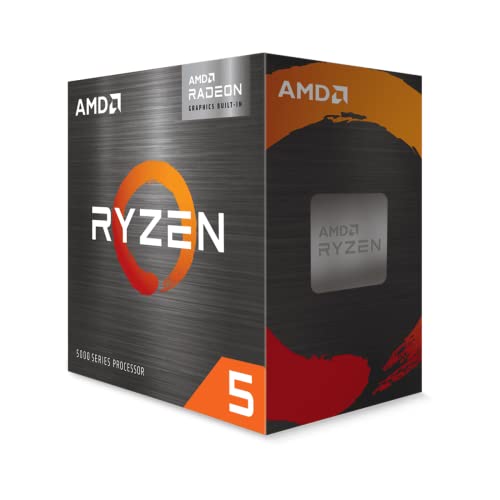
If you already own or can buy a discrete GPU, the Ryzen 7 5800X wins 1080p gaming — its 8 cores + 105W TDP push higher CPU-bound frame rates and dramatically faster productivity. If you can't afford a graphics card yet, the Ryzen 5 5600G is the only one that lets you game at all on the integrated Vega graphics. The 5600G's path to "real" gaming is to add a ZOTAC RTX 3060 12GB later; the 5800X is the better long-term answer if your budget supports both.
Step 0 — do you have a discrete GPU, or do you need iGPU?
The most useful question to answer first: are you buying a graphics card, or is this CPU going to be your only graphics source for a while? That single fork decides which chip is right, and the answer determines everything else in the comparison.
If you have a ZOTAC RTX 3060 12GB or any modern discrete GPU on the way, the 5800X is the better long-term answer. The 8-core / 16-thread layout means more headroom for CPU-heavy titles, simultaneous streaming, and any background workload. If your budget can't stretch to a graphics card today, the 5600G with its integrated Vega graphics is the only AM4 chip in this price band that gets you gaming at all without a separate GPU.
The middle option — the Ryzen 7 5700X — sits between them as an 8-core 65W part that often costs less than the 5800X and runs cooler. We cover that comparison in detail in Ryzen 7 5800X vs 5700X gaming + streaming.
Key takeaways
- 5800X wins 1080p CPU-bound games by 5-12% over the 5600G when both have a discrete GPU.
- 5600G is the only one of the two that can run any modern game without a graphics card.
- 8 cores vs 6 cores is a real productivity gap — 5800X compiles, encodes, and streams faster.
- Both are AM4; both use B550 or X570 boards; both let you upgrade GPU later.
- 5800X needs better cooling — see our 5800X cooler picks.
Spec-delta table
| Spec | Ryzen 7 5800X | Ryzen 5 5600G |
|---|---|---|
| Cores / threads | 8 / 16 | 6 / 12 |
| Base / boost clock | 3.8 / 4.7 GHz | 3.9 / 4.4 GHz |
| L3 cache | 32 MB | 16 MB |
| TDP | 105 W | 65 W |
| Integrated graphics | None | Vega 7 (1.9 GHz) |
| PCIe to GPU | Gen4 x16 | Gen3 x8 |
| Memory | DDR4 dual-channel | DDR4 dual-channel |
| Approx new price | $210-$220 | $170-$185 |
A few of these specs deserve a callout. The 5600G's PCIe Gen3 x8 to the discrete GPU is meaningful for higher-end cards but irrelevant for an RTX 3060 — that card barely saturates Gen3 x8. The 5800X's larger L3 cache is part of why it leads in CPU-bound 1080p games even when both chips have the same GPU. And the integrated Vega graphics on the 5600G is the unique-to-it feature that anchors its entire value pitch.
How do the 5800X and 5600G compare in 1080p gaming with a discrete GPU?
With an RTX 3060 12GB attached to both, the 5800X typically leads at 1080p high refresh by roughly 5-12% on average — wider in CPU-bound titles, narrower in titles that hit GPU bottlenecks first. Tom's Hardware's CPU hierarchy places them about two tiers apart in gaming, with the 5800X cluster comfortably above the 5600G cluster.
Practical example numbers from public testing (CS2, Valorant, Apex Legends, Hogwarts Legacy, Cyberpunk 2077, all at 1080p with an RTX 3060): the 5800X averages 5-10% higher in esports titles (where CPU is the bound), 2-5% higher in modern AAA titles (where the GPU is the bound). Average 1% lows — the metric that affects perceived smoothness — favor the 5800X by similar margins.
That gap is real but not transformative. Going from the 5800X to a current-gen chip is a bigger jump than going from the 5600G to the 5800X. For a builder optimizing strictly for gaming dollars, the 5600G + an RTX 3060 + leftover budget elsewhere isn't a bad plan.
Can the 5600G game without a graphics card?
This is the 5600G's whole pitch. The integrated Vega 7 graphics will run esports titles at 1080p with reduced settings — CS2 and Valorant land in the 60-90 FPS range, Rocket League similarly, older AAA games (think 2018-2020 era) at low to medium settings often hold 30-60 FPS. Demanding modern AAA games (2024+) are not playable at native 1080p; you'd need to drop to 720p or use AMD's upscaling-class lower presets.
The 5800X has no integrated graphics at all. With no GPU, it doesn't post a display — full stop. That's the 5600G's unique advantage: it's the only chip in this comparison that gets you gaming today without a graphics card purchase.
The longer-term path: pair the 5600G with a discrete GPU later. Drop in an RTX 3060 12GB six months from now and the system becomes a proper gaming rig. The Vega 7 silicon goes idle when a discrete GPU is active. We covered this exact build path in Ryzen 5 5600G budget local LLM host — same hardware logic, different workload.
Productivity and multitasking: where the 5800X pulls ahead
For anything that uses more than 6 cores, the 5800X is the better chip — and the gap is larger than the gaming one. Cinebench all-core scores favor the 5800X by roughly 30-40%, which translates directly to faster compile times, faster video exports, faster archive decompression, and meaningful productivity headroom for builders who also work on the machine. The 5600G's 65W TDP is a real efficiency win, but the missing two cores show up in any heavy multithreaded workload.
If you stream while gaming, the gap widens further. The 5800X has comfortable headroom to encode H.264 in software while a discrete GPU handles the game at full frame rates; the 5600G can do it but tradeoffs are sharper. Hardware encoding via the discrete GPU helps both chips equally.
Pairing notes: which GPU each CPU suits
The 5800X handles anything up to an RTX 4070 Ti / RX 7800 XT class card before becoming the bottleneck at 1080p — there's no realistic mismatch for budget builders. With a ZOTAC RTX 3060 12GB it's a textbook balanced 1080p high-refresh build; with a higher-end card it's still a comfortable pairing.
The 5600G pairs well with anything up to an RTX 3060 / 4060 class card. Above that you start seeing the L3 cache deficit and the 6-core limit in CPU-bound titles, but for the 5600G's expected buyer (someone adding a midrange GPU later) the pairing math is fine.
Perf-per-dollar and upgrade path
The 5600G at $170-$185 new and the 5800X at $210-$220 new are both AM4 parts that run on the same B550 or X570 motherboards with a BIOS update. That means either is a viable "first CPU" with a clean upgrade path to the other or to a 5700X / 5800X3D later. The motherboard and memory don't need to change.
The cleanest budget play: 5600G + a B550 board + 32GB DDR4-3200 + a Crucial BX500 1TB SATA SSD + a 650W PSU. Total around $400-$500 without a GPU. Add an RTX 3060 12GB six months later when budget allows. The cleanest "do everything" play: 5800X with the same supporting cast plus a GPU on day one, total around $700-$900.
Verdict matrix
- Get the 5800X if you have or can afford a discrete GPU on day one, you do productivity work on the same machine, or you want maximum 1080p gaming headroom without a future CPU upgrade. Budget a decent cooler — see our 5800X cooler picks.
- Get the 5600G if you can't afford a discrete GPU yet but want to start gaming today, you specifically want lower power draw and easier cooling, or your usage is gaming-first with no heavy productivity work.
- Consider the 5700X if you want 5800X-class multithreading at the 5600G's TDP — it sits between them on cores and power. We cover it head-to-head with the 5800X in Ryzen 7 5800X vs 5700X.
Should I consider the Ryzen 7 5700X instead?
The Ryzen 7 5700X offers 8 cores at 65W TDP, landing between the 5600G and 5800X on power and often near the 5800X on multithreaded throughput. For builders who specifically want 5800X-class multitasking with the 5600G's easier cooling story, the 5700X is the value sweet spot. It gives up a small amount of peak boost clock but trades that for meaningfully lower thermal output. It doesn't have integrated graphics, so it doesn't replace the 5600G for builders who need iGPU.
Bottom line
The 5800X is the better 1080p gaming chip and the better productivity chip — but only if you have a discrete GPU to feed it. Without a GPU, only the 5600G works at all. For an upgrade-later build that starts cheap and adds an RTX 3060 in six months, the 5600G is the right call. For a complete build today with a discrete GPU on day one, the 5800X is the right call. The middle option — the 5700X — is worth considering if you want 5800X cores with lower TDP. All three are AM4, all three run on the same motherboard, and the platform doesn't have to change if you upgrade between them later.
Common buyer mistakes
A handful of patterns we see in 5800X-vs-5600G decisions that turn into regret-purchases:
- Buying the 5800X with no GPU and no GPU in the near-term budget. It can't post a display. You'll have a working board, a working CPU, and no way to see the BIOS.
- Buying the 5600G expecting to "game on the iGPU" for modern AAA titles. Modern AAAs don't run on the Vega 7 at any usable settings. The iGPU is for esports and older games.
- Spending too little on memory. Both chips lose meaningful performance on 2666 MT/s vs 3200 MT/s memory. Don't skimp on RAM speed to save $20.
- Buying a cheap cooler for the 5800X. It's a 105W chip with a small die hotspot — see our 5800X cooler picks.
- Pairing the 5600G with an enthusiast GPU. The Gen3 x8 PCIe link to a discrete GPU is fine for a 3060, marginal for a 4060 Ti, and starts costing you for 4070+ cards. The 5800X's Gen4 x16 link removes that ceiling.
- Skipping memory tuning. A B-die DDR4-3200 kit running at its rated XMP is the floor; both chips happily run 3600 with manual timings. Free performance most builders leave on the table.
A worked example: building two complete systems
To make the trade concrete, here are two real reference builds that bracket the decision:
Budget gaming build (5600G, no GPU yet): Ryzen 5 5600G + B550 board ($90) + 16GB DDR4-3200 ($45) + Crucial BX500 1TB SATA SSD + 550W gold PSU ($75) + midrange case ($70) + stock cooler. Total around $480. Plays esports titles at 1080p medium-high, older AAA games at low-medium. Adds an RTX 3060 12GB six months later for $310-$390 to become a real 1440p build.
Complete gaming build (5800X + GPU on day one): Ryzen 7 5800X + B550 board ($90) + 32GB DDR4-3600 ($90) + WD Blue SN550 1TB NVMe + 650W gold PSU ($90) + midrange case ($70) + DeepCool AK620 cooler ($70) + ZOTAC RTX 3060 12GB ($310-$390). Total around $1050-$1150. Plays 1440p high refresh in most modern titles; multitasks comfortably.
The 5600G build is roughly $570 cheaper on day one. Six months later when the 5600G build adds a GPU, it's about $80 cheaper than the 5800X build. That $80 buys the 5800X's productivity advantage and 8-core headroom. Worth it if you do non-gaming work on the same machine.
When NOT to consider either
Specific scenarios where neither AM4 chip is the right answer:
- You're building from scratch in late 2026 for a 5-year horizon. AM5 is a longer-lived platform. The Ryzen 7700X or 7600 with DDR5 has more future runway.
- You want OLED gaming at 4K. Neither chip is a high-end pairing for an enthusiast GPU at 4K. Step up the CPU tier.
- You want a sub-$300 mini-PC for media + light browsing. A Mini PC with a U-series chip is cheaper and quieter.
- You're explicitly buying for local LLM inference. The 5800X's CPU helps offload throughput; the 5600G's iGPU doesn't help LLM workloads. See GLM-5.2 on RTX 3060 for the LLM-focused build sheet.
Related guides
- Best CPU cooler for the Ryzen 7 5800X
- Ryzen 7 5800X vs 5700X gaming + streaming
- Ryzen 5 5600G as a budget local LLM host
- Best budget GPU for 1440p gaming on the RTX 3060
- Best budget Ryzen gaming PC parts