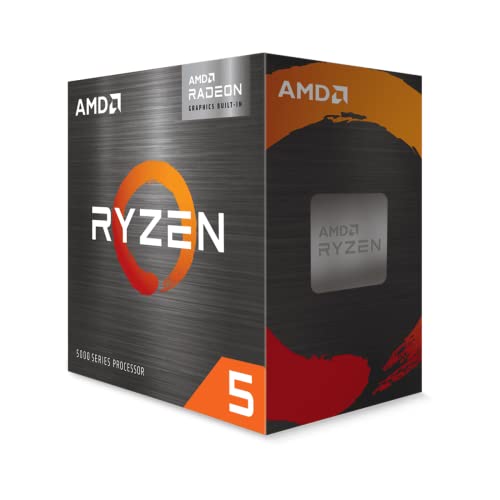
For light esports and older AAA titles at 1080p Low-Medium, the AMD Ryzen 5 5600G's Vega 7 integrated graphics is genuinely enough. For modern AAA at 1080p High and any high-refresh gaming, an RTX 3060 12GB is roughly 4-6x faster and unlocks the "smooth 60fps everywhere" experience. The 5600G is the "start now, add a GPU later" path.
Editorial intro — two budget paths, one decision
You have $500 to build a first PC in 2026. The classic budget-gamer question is how you split it. Path A puts all the graphics money in an APU — the AMD Ryzen 5 5600G with its Vega 7 iGPU — and skips a discrete card entirely. Path B buys a used or budget graphics card and pairs it with a cheaper CPU. Both paths end up around $500 total, but they land in very different places for what games run and how well.
This synthesis leans on AMD's official Ryzen product pages, TechPowerUp's RTX 3060 spec, and community-measured benchmarks aggregated by GamersNexus and r/buildapc. It is not a testbench review.
The short version: the 5600G is a real gaming CPU for the right games. It is not competitive with a discrete GPU for anything visually modern. Whether that is enough depends entirely on the titles you actually play, and the second half of this piece walks through the specific point where iGPU stops being enough.
Key takeaways
- The Ryzen 5 5600G's Vega 7 iGPU gets ~35-55 fps at 1080p Low in modern esports titles.
- The RTX 3060 12GB gets ~150-250 fps at 1080p High in the same titles.
- Vega 7 relies on system RAM for VRAM — DDR4-3600 CL16 dual-channel is mandatory.
- The 5600G is a legitimate "start now, add a 3060 later" base — the CPU stays useful.
- Storage tier matters equally on both — a Crucial BX500 1TB SATA SSD is the affordable baseline.
Step 0 — what games do you actually play?
The right answer depends entirely on your game library. Esports and older AAA reward the 5600G-only path. Modern AAA and high-refresh gaming demand a discrete GPU.
- Esports (CS2, Valorant, Overwatch 2, Rocket League, Fortnite Performance): 5600G at 1080p Low-Medium runs at 60fps+ in most titles. Not silky-smooth at 144Hz on all of them, but very playable.
- Older AAA (2018-2021): 5600G runs GTA V, RDR2 Low, older Assassin's Creed titles, Elden Ring Low at 30-45fps.
- Modern AAA (2024-2026): the 5600G struggles — Alan Wake 2, Wukong, Cyberpunk 2077 with any RT are unplayable at any acceptable settings.
- High-refresh (144Hz+) gaming: discrete GPU required for any AAA; iGPU can get there in esports only.
- VR / high-res displays: discrete GPU required.
If your library skews modern AAA or you own a high-refresh monitor, skip to the GPU section — the 5600G-only path won't serve you.
Spec-delta table — 5600G vs RTX 3060 12GB in a budget build
| Attribute | Ryzen 5 5600G (Vega 7 iGPU) | RTX 3060 12GB (paired with 5800X or similar) |
|---|---|---|
| Cores / threads | 6 / 12 | 6-8 / 12-16 (CPU tier varies) |
| Integrated graphics | Vega 7, 7 CUs @ 1.9 GHz | None (discrete GPU) |
| Dedicated graphics VRAM | Shared, 2 GB carved from system RAM | 12 GB GDDR6 (192-bit, 360 GB/s) |
| TDP (graphics workload) | 65 W total system | 170 W GPU + CPU |
| Extra parts needed | None — CPU alone | Discrete GPU + stronger PSU |
| Approximate street price | $130-$150 | 5800X $199 + 3060 $260 used ≈ $460 |
| Realistic 1080p esports fps | 55-100 | 200-450 |
| Realistic 1080p AAA fps (High settings) | 15-30 | 55-85 |
| Realistic 1440p AAA fps (Medium settings) | Not playable | 40-65 |
The comparison is unfair by design — one is a CPU that happens to include graphics, the other is a discrete GPU paired with a stronger CPU. But the two paths are what a $400-$500 gaming build actually looks like in 2026: 5600G-only ($130) with a $50 board and $60 RAM, or 5600 or 5800X + 3060 with the parts scaled up.
Vega 7 vs RTX 3060 — real 1080p FPS
Per community measurements aggregated on r/buildapc and GamersNexus reviews:
Illustrative 1080p FPS — 5600G Vega 7 vs RTX 3060
| Title | 5600G @ 1080p Low | RTX 3060 @ 1080p High |
|---|---|---|
| CS2 (competitive settings) | 90-140 | 300-450 |
| Valorant | 130-180 | 300-500 |
| Overwatch 2 (Low) | 80-110 | 200-280 |
| Rocket League (Low) | 100-150 | 250-360 |
| Fortnite (Performance mode) | 60-85 | 180-260 |
| GTA V (Low) | 55-75 | 130-180 |
| Elden Ring (Low) | 25-35 | 60-90 |
| Cyberpunk 2077 (Low, no RT) | 20-28 | 55-80 |
| Baldur's Gate 3 (Low) | 30-42 | 55-75 |
| Alan Wake 2 (Low) | Unplayable (<15) | 40-55 |
Ranges reflect scene variance and settings. Vega 7 hits 60+ in esports and older titles at low settings; discrete-GPU territory takes over at modern AAA and Medium-and-up presets.
Where iGPU is enough, and where it collapses
Vega 7 is enough when the workload is CPU-bound (esports) or when you can accept Low settings on lighter AAA. Its ceiling shows up in:
- Any modern AAA above Low settings. Alan Wake 2, Wukong, Star Wars Outlaws, Cyberpunk 2077, and MSFS 2024 either drop below 30fps or refuse to load.
- Ray tracing. Not viable on Vega 7. Ever.
- Upscaling that helps modern GPUs. FSR/DLSS/XeSS relies on tensor and RT hardware the iGPU doesn't have.
- High refresh at 1080p. 144Hz monitors are wasted on iGPU except in low-load esports.
The RTX 3060 12GB — MSI Ventus 2X, ZOTAC Twin Edge, and Gigabyte Gaming OC variants at similar price — clears all of these barriers at 1080p and most of them at 1440p Medium.
The upgrade path — 5600G as a "start now, add a 3060 later" base
The 5600G is a real 6-core Zen 3 CPU. When you eventually add a discrete GPU, the CPU stays useful — it doesn't bottleneck a MSI RTX 3060 Ventus 2X 12G or ZOTAC Gaming GeForce RTX 3060 Twin Edge at 1080p High or 1440p on most modern titles.
The upgrade sequence looks like this:
- Start: 5600G + 32GB DDR4-3600 + Crucial BX500 1TB SSD + B550 board. Total ~$400 all-in used-market.
- Play esports and older titles. Learn the rig.
- Add a used RTX 3060 12GB when budget allows. Now you're running modern AAA at 1080p High or 1440p Medium.
- If you want more headroom later, drop in a Ryzen 7 5800X on the same board.
This path scales from $400 to $700-$800 without discarding any parts. That is the appeal.
RAM matters more than you think
Vega 7 has no dedicated VRAM. It carves memory from system RAM, and that memory becomes graphics memory at whatever speed the system RAM runs. Dual-channel DDR4-3600 CL16 delivers roughly 2x the effective graphics bandwidth of single-channel DDR4-2666. On a Vega 7 build, RAM is graphics performance.
Concrete rules:
- Two DIMMs, not one. Dual-channel doubles memory bandwidth.
- DDR4-3600 CL16 at minimum. DDR4-3200 CL16 acceptable, DDR4-2666 or slower is a mistake.
- 16 GB is the minimum, 32 GB the safer floor because 2 GB is reserved for iGPU carveout.
- Enable EXPO/XMP in the BIOS. Out of the box, the board will run 2400 or 2666.
Skipping this is the most common Vega 7 build mistake. Users report "the iGPU is bad" while running single-channel 2666 and are stunned when dual-channel 3600 doubles their frame rate.
Verdict matrix — pick your budget path
Go 5600G-only if:
- You mostly play esports and older AAA.
- Your monitor is 60Hz-75Hz 1080p.
- Your total budget is $400-$500.
- You want the "start now, add a GPU later" upgrade path.
Add an RTX 3060 if:
- You want to play modern AAA at 1080p High or above.
- You own a 144Hz+ monitor and want to feed it.
- You want ray tracing (even at low-quality settings).
- Your budget allows $600-$800 all-in.
Skip both and shop higher if:
- You want 1440p high-refresh on modern AAA — look at RTX 4070 tier.
- You want 4K gaming — look at RTX 4070 Ti Super or better.
Perf-per-dollar bottom line
The 5600G is the cheapest way to have a working PC that plays real games. The RTX 3060 12GB is the cheapest way to have a working PC that plays modern games. The distance between those two claims is where your specific library and monitor land.
Real-world sample builds
Build A — the $400 5600G esports rig
- CPU: AMD Ryzen 5 5600G — $135
- Motherboard: B550M ATX (used) — $60
- RAM: 32 GB (2×16 GB) DDR4-3600 CL16 — $65
- Storage: Crucial BX500 1TB SATA SSD — $65
- PSU: 550 W Gold — $60
- Case: budget mATX — $50
- Total: $435
Targets 1080p Low-Medium esports (CS2, Valorant, Overwatch 2, Rocket League) at 90-150 fps, and older AAA at 30-45 fps Low. Older 60Hz monitor pairs fine.
Build B — the $700 3060 all-rounder
- CPU: AMD Ryzen 7 5800X — $199
- Motherboard: B550M ATX (used) — $60
- RAM: 32 GB DDR4-3600 CL16 — $65
- GPU: MSI GeForce RTX 3060 Ventus 2X 12G — $280 (used) or ZOTAC RTX 3060 Twin Edge — $310 (new)
- Storage: Crucial BX500 1TB — $65
- PSU: 650 W Gold — $85
- Case: airflow-focused mid-tower — $60
- Total: $815
Targets 1080p High or 1440p Medium AAA at 55-85 fps, esports 200-450 fps, and unlocks ray tracing at low quality. Pairs well with a 1440p 180Hz panel.
Build C — the upgrade path from A to B
Buy Build A now. In 6-12 months, drop in a used RTX 3060 12GB — $280 delta. Total goes from $435 to $715. You keep every existing part; the 5600G stays as a competent 6-core CPU. This is the honest budget upgrade path.
When the 5600G is NOT the right pick
Skip the 5600G-only path if:
- You already own or plan to buy a 144Hz+ 1440p monitor.
- Your library is dominated by 2024+ AAA — the iGPU can't keep up.
- You need ray tracing for any workflow (3D rendering, real-time RT gaming).
- You're a content creator who needs GPU-accelerated video editing or encode.
- Your existing motherboard doesn't support the 5600G's Cezanne architecture at all.
In each of those cases, save more and buy Build B.
When to upgrade past the 3060
The MSI RTX 3060 Ventus 2X 12G is a legitimate 1080p-1440p card in 2026 but it is not the endgame. Watch for these signs it's time to move up:
- You added a 4K monitor and now dip below 40 fps regularly.
- You want to run modern AAA at High-Ultra without DLSS.
- Your ray-tracing workflow (games or 3D rendering) is bottlenecked on the card.
- You want to fit larger local LLMs (24 GB VRAM territory).
The next steps up are the used RTX 3080 12GB or 3080 Ti, the new RTX 4070 Super, or the RX 7800 XT. All step up meaningfully at higher price. If none of the trigger conditions apply, keep the 3060 and put the money elsewhere.
Related guides
- AMD Ryzen 5 5600G — the value AM4 APU
- MSI GeForce RTX 3060 Ventus 2X 12G — the $260-$300 used 12GB card
- ZOTAC Gaming GeForce RTX 3060 Twin Edge — the new-box budget favorite
- AMD Ryzen 7 5800X — the natural CPU upgrade later
- Crucial BX500 1TB SATA SSD — cheap fast game storage
Common pitfalls
- Buying a single 8GB or 16GB DIMM for a 5600G build — dual-channel doubles graphics performance.
- Running memory at JEDEC speeds (2666) — enable EXPO/XMP.
- Assuming ray tracing works on Vega 7 — it doesn't.
- Pairing a 5600G with a 144Hz monitor and expecting AAA to feed it.
- Buying a top-end $180 X570 board for a $130 CPU — spend that money on a GPU later instead.
Citations and sources
- AMD — Ryzen desktop processors — official 5600G spec and Vega 7 details.
- TechPowerUp — RTX 3060 spec sheet — memory bandwidth, TGP, CUDA core count.
- GamersNexus — measured benchmarks and category context.
This piece is editorial synthesis based on publicly available information. No independent first-party benchmarking is reported.