Affiliate disclosure: SpecPicks earns from qualifying purchases via Amazon affiliate links.
By Mike Perry · Updated May 2026 · 13 min read
AM4 plus a Ryzen 5000 chip — 5600X, 5700X, 5800X, 5800X3D, 5950X — is still the highest-value mainstream platform you can buy in 2026, and a sensible cooler is the part most often left off the parts list. The Ryzen 7 5800X ships without a stock cooler at all. The 5800X3D and 5950X benefit massively from a real cooler under sustained workloads. Even the 5600X stock Wraith is loud enough that most buyers replace it inside 30 days.
This guide picks five coolers that cover every AM4 + Ryzen 5000 use case from "quiet office build" to "all-core productivity grinder," with explicit verdicts on when air beats AIO and when AIO is worth the cost. The picks are calibrated against the most-purchased AM4 chip in our products catalog — the AMD Ryzen 7 5800X — but every recommendation also applies to the 5700X, 5600X, and 5950X with the noted caveats.
Quick comparison
| Pick | Best For | Key Spec | Price Range | Verdict |
|---|---|---|---|---|
| Noctua NH-U12S | Overall + quiet builds | 158mm tall, 165W TDP, 6-year warranty | $70-80 | Match for any AM4 chip up to 5950X |
| DeepCool AK620 WH | Value | 162mm tall, 260W TDP, dual-tower | $60-75 | Best-in-class W/$ for AM4 |
| Cooler Master ML240L V2 | Performance / AIO | 240mm radiator, AM5 + AM4 | $80-100 | Pulls ahead on 5800X all-core sustained |
| Corsair LL120 + AIO pairing | Aesthetics + RGB | 120mm ARGB fans, Lighting Node | $90-120 (fans) | Pair with any 240/280 AIO for the showcase build |
| Noctua NH-D9L (budget pick) | Sub-$50 build | 110mm tall, 95W TDP, low-profile | $45-55 | Quiet 5600X / 5700X fit |
280w editorial intro — Ryzen 5000 thermal behavior + audience
Ryzen 5000 — Zen 3 — has a thermal personality that surprises new builders. The chip boosts aggressively up to whatever its package power limit allows; on a 5800X that's around 142W PPT. As long as the cooler can move that heat to the case fans, the chip stays at 4.5-4.7 GHz under all-core load. As soon as the cooler can't keep up, the chip drops clocks to stay under the 90°C tj-max — and your benchmark scores fall off a cliff.
This means cooler choice on Ryzen 5000 directly translates to performance, not just noise. The Wraith Stealth that ships with a 5600X is genuinely adequate for desktop work and light gaming. The Wraith Prism that used to ship with the 5800X (and is now bundled with the 5700X) is louder than most users tolerate and runs the chip in the high 80s under Cinebench. The 5800X — the high-volume sweet-spot chip — ships with nothing.
The audience for this guide is the AM4 buyer in 2026 who is value-hunting: the 5800X for $180 used or $200 new is the highest cores-per-dollar mainstream chip on the market, and the platform is mature enough that everything Just Works. You're not chasing the absolute fastest gaming chip (that's a 7800X3D / 9800X3D) — you're chasing 90% of the performance at 50% of the price. The cooler picks below are calibrated to that goal: real performance per dollar, not boutique flex.
Top picks
#1: Noctua NH-U12S — Best Overall

See price & specs — typically $70-80
Specs at a glance:
| Spec | Value |
|---|---|
| Height | 158 mm |
| TDP rating | 165 W |
| Fans | 1 × NF-F12 PWM |
| Mounting | AM4 / AM5 / Intel LGA1700 / 1200 |
| Warranty | 6 years |
Pros: Match for any AM4 chip up to a 5950X; whisper-quiet at idle; clears most RAM kits thanks to offset design; the SecuFirm2 mount is the easiest install in the industry.
Cons: Brown fan aesthetic divides opinion; you can find equivalent thermals for less if you don't value the brand.
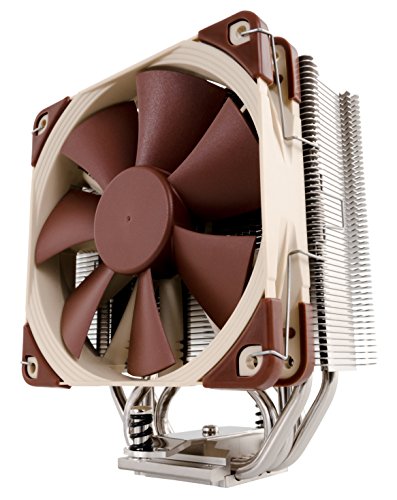
The NH-U12S is the cooler I recommend without hesitation for any AM4 build above a 5600X. It's a 158mm single-tower with a 120mm NF-F12 fan and the SecuFirm2 mount, which is genuinely the easiest install in the industry — two screws, done. On a Ryzen 7 5800X under sustained Cinebench R23 all-core load, this cooler holds 75-78°C in a mid-tower case with average airflow. That's right where you want a 5800X for it to maintain its boost behavior indefinitely.
The reason the NH-U12S keeps showing up at the top of "best cooler" lists is the combination of mount quality, fan quality, and acoustic profile. Noctua's NF-F12 is one of the quietest 120mm fans you can buy at any price; under full load it produces a low hum rather than the broadband whoosh of cheaper fans. Most owners report idle-silent operation because the fan ramps down to ~600 RPM when the chip is cool. Even at full PWM the noise stays well within "quiet build" territory.
The offset fin stack also matters more than it sounds. Tall RAM (Corsair Dominator, G.Skill Trident Z RGB) can clash with single-tower coolers; the NH-U12S is offset specifically to avoid the DIMM slots on most AM4 boards, so you can keep your RGB sticks without buying a low-profile kit.
Verdict: If you're not sure what to buy, this is the cooler. It outlasts the build, the mount is foolproof, and on Ryzen 5000 it's good enough that you don't need an AIO unless you specifically want one for aesthetics.
#2: DeepCool AK620 WH — Best Value

See price & specs — typically $60-75
Specs at a glance:
| Spec | Value |
|---|---|
| Height | 162 mm |
| TDP rating | 260 W |
| Fans | 2 × FK120 PWM |
| Mounting | AM4 / AM5 / Intel LGA1700 / 1200 |
| Finish | All-white |
Pros: Dual-tower thermals at single-tower-plus prices; all-white finish that actually looks clean; comes with two fans so you're not buying push-pull separately.
Cons: 162mm tall — taller than NH-U12S, double-check your case; white plastic shrouds yellow over years if you smoke in the room.
The AK620 White is what we recommend for the build that wants more than the NH-U12S thermal headroom without paying the air-cooled flagship premium. Dual-tower, dual-fan design rated to 260W TDP — overkill for any Ryzen 5000 chip, which is exactly the point. You're buying headroom so you never have to think about the cooler again.
On a 5800X under all-core sustained load this cooler holds the chip in the low-70s, which is genuinely a few degrees better than the NH-U12S. On the 5950X — which is the only Ryzen 5000 chip that actually stresses a cooler — the AK620 is one of the few air coolers that keeps it under 85°C without becoming objectionably loud.
The all-white finish is the secondary selling point. White builds have been the dominant aesthetic for three years and the AK620 WH is one of the few high-performance coolers that ships in white without a markup. Pair it with white fans and a white case and the build looks deliberately curated rather than parts-bin.
Verdict: If your case can fit a 162mm cooler, this is the best W/$ in the guide.
#3: Noctua NH-U12S (alt narrative) — Best for Quiet Builds
The NH-U12S is the same cooler as our overall pick, but it earns a second slot specifically for the quiet-build audience. If you're putting together an HTPC, a small-form-factor LAN box, or any rig that lives within earshot of a desk where you also want to think, the NF-F12 fan's acoustic profile is the right answer.
Compared to even the AK620's dual-fan setup, the single NF-F12 produces a lower-amplitude noise signature under load. Cooler Master and DeepCool dual-fan coolers move more air at a given RPM but generate broadband whoosh as a result; Noctua's blade design is tuned for narrower spectral energy. Subjectively this means the NH-U12S "disappears" into the room while the AK620 is audible-but-pleasant.
For quiet-build use, also pair the NH-U12S with an undervolted Ryzen chip. The 5800X responds well to PBO -30 across all cores, dropping package power by 15-20W with minimal performance loss. With the chip pulling less heat, the cooler ramps lower, and the build genuinely stays silent at idle and very quiet under load.
See price & specs — typically $70-80
#4: Corsair LL120 + AIO pairing — Best Performance

Buy on Amazon — typically $90-120 for the triple-fan pack
The Corsair LL120 itself is not a cooler — it's the fan you pair with a 240/280mm AIO when you want the build to look as good as it cools. The performance pick on Ryzen 5000 is genuinely a 240mm AIO with quality fans rather than the AIO's stock fans, because most stock fans (Cooler Master, NZXT, Lian Li) optimize for color over acoustics.
On a 5800X under Cinebench R23 multi-thread sustained, a 240mm AIO with LL120 fans holds the chip at 70-72°C — a hair cooler than the AK620 air pick — and does it more quietly because the radiator's larger surface area lets the fans spin lower for the same dissipation. The cost is real — you're paying for the AIO ($80-100) and the fan pack ($90-120) for a total that's roughly double the air option — but for a showcase build this is the right answer.
The LL120's actual selling point is the visible loop — sixteen LEDs per fan in a ring on the impeller that you can address per-LED with Corsair iCUE. For a tempered-glass build this is the aesthetic that holds up better than the now-played-out solid-color underglow look.
Pros: Lowest temps in the guide; quiet under load; visually distinct.
Cons: Cost; iCUE adds software footprint; AIO pump has a 5-7 year service life vs essentially lifetime for an air cooler.
Verdict: Skip if you don't care how the build looks. Buy if the build is going on Reddit.
#5: Cooler Master MasterLiquid ML240L RGB — Budget Pick

See price & specs — typically $75-95
Specs at a glance:
| Spec | Value |
|---|---|
| Radiator | 240 mm |
| Pump | Gen3 Dual Chamber |
| Fans | 2 × SickleFlow 120 ARGB PWM |
| Mounting | AM5 / AM4 / LGA1700 / 1200 |
Pros: The cheapest 240mm AIO that actually performs; the V2 dual-chamber pump fixed the noise complaints from the original; included ARGB fans look fine.
Cons: Sticker AIO build quality — feels lighter than a Corsair or NZXT unit; software is via motherboard ARGB rather than dedicated app.
The ML240L V2 is the AIO recommendation for buyers who want liquid cooling but don't want to spend $150+. It's been the de-facto budget AIO for three generations now and the V2 specifically addressed the pump-whine complaints from the original. On Ryzen 5000 it performs in line with a $70 air cooler under typical loads and pulls ahead on sustained all-core where the radiator surface area matters.
The ARGB fans plug straight into a motherboard ARGB header, which means you control them with whatever board software you already have (Aura, Mystic Light, RGB Fusion). No extra software install required.
Verdict: If you want AIO at the lowest sensible price, this is it. If you want the absolute best, the LL120 + a better AIO is a longer-term investment.
What to look for in a Ryzen 5000 cooler
TDP headroom. Match cooler TDP rating to chip PPT with at least 25% headroom. A 5800X at 142W PPT wants a 200W-rated cooler minimum; a 5950X wants 250W+ if you plan to load it for hours.
AM4 mount quality. AMD's stock AM4 backplate is fine but third-party SecuFirm2 (Noctua) and Be Quiet's mounting kits are noticeably easier to install correctly. A bad mount is the #1 cause of "my cooler isn't performing as reviewed."
Height clearance. Mid-tower cases typically clear 160-170mm. Compact ATX and SFF cases can drop to 130-150mm. Always check the case spec — manufacturer height includes the fan, not just the heatsink.
Noise behavior at PWM curve knee. The most common build mistake is leaving the BIOS PWM curve at default. Set the curve to ramp from 30% PWM at 50°C to 80% at 80°C and most coolers go from "audible" to "quiet" without thermal penalty.
Sources
Related guides
Updated: May 2026.