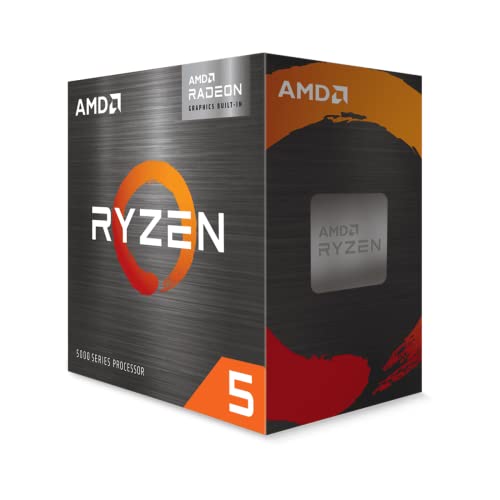
For most buyers: the AMD Ryzen 7 5700X. It's the best perf-per-dollar and perf-per-watt of the three, cool under load, and doesn't bottleneck a 12 GB RTX 3060 on either gaming or LLM hosting. The Ryzen 7 5800X is the pick if you want the top single-thread clocks and don't mind the extra heat; the Ryzen 5 5600G is the pick if you're building without a dedicated GPU and want the Vega iGPU.
Step 0: decide whether the GPU or CPU is your real bottleneck
For a budget AI plus gaming build, the CPU is almost never the bottleneck. Modern GPUs — including the RTX 3060 12GB — are the limiter on both fronts. On the AI side, the GPU does the matrix math; the CPU handles orchestration, tokenization, and pre/post-processing. On the gaming side at 1080p and 1440p, the GPU sets the frame ceiling on all modern titles.
That framing changes what you're actually optimizing for when choosing an AM4 CPU: not raw benchmark scores, but power efficiency, cost, and cache behavior for game engines that occasionally see a single-thread spike. All three CPUs in this comparison have eight or six modern cores; all three are more than enough for the workload.
Key takeaways
- The Ryzen 7 5700X is the best all-around pick: 8 cores at 65 W TDP, cool, quiet, ~$180 street.
- The Ryzen 7 5800X is 8 cores at 105 W with slightly higher single-thread clocks. Faster in some CPU-bound game engines; hotter, thirstier.
- The Ryzen 5 5600G is 6 cores at 65 W with an integrated Vega GPU. Ideal for a build without a dedicated GPU or as an "iGPU fallback" host.
- For pairing with a RTX 3060 12GB, all three avoid bottlenecks at 1080p and 1440p on any current title.
- On local LLM hosting the CPU choice barely moves the needle — pick on TDP and price.
Why the CPU barely matters for GPU inference but still matters for the rig
Once you have a discrete GPU handling inference, the CPU's job is to feed the pipeline: tokenize the prompt, coordinate the runtime, handle file I/O, run any surrounding application logic. That's not a demanding role. Even six modest modern cores complete it easily; eight is a comfortable buffer.
Where the CPU still shows up is on the surrounding rig: incremental compile times if you're a developer, background workload elasticity if you're a gamer who streams, and single-thread CPU-bound games (older RTS titles, some strategy games) where the difference between 4.6 GHz and 4.7 GHz translates to a few percent of frame rate.
How do the 5700X, 5800X, and 5600G differ on cores, clocks, and TDP?
The 5700X and 5800X are the same Zen 3 architecture at slightly different clocks and TDPs. The 5800X boosts a bit higher (4.7 GHz vs 4.6 GHz) but pays for it in heat and power. The 5600G is a Cezanne APU: 6 cores at Zen 3 clocks, plus an integrated Vega GPU, at the cost of a smaller L3 cache than the 5700X/5800X.
5-column spec-delta table
| CPU | Cores/threads | Base/boost clock | L3 cache | TDP | MSRP |
|---|---|---|---|---|---|
| Ryzen 7 5700X | 8/16 | 3.4/4.6 GHz | 32 MB | 65 W | $199 |
| Ryzen 7 5800X | 8/16 | 3.8/4.7 GHz | 32 MB | 105 W | $229 |
| Ryzen 5 5600G | 6/12 | 3.9/4.4 GHz | 16 MB | 65 W | $189 |
The 5800X wins on peak clocks and power draw; the 5700X wins on efficiency and price; the 5600G wins on integrated graphics for GPU-less builds. Cache is where the 5600G loses ground on some workloads — Zen 3's 32 MB L3 vs the 5600G's 16 MB shows up as a few percent on certain game engines and compile-heavy dev workloads.
Which one for gaming paired with an RTX 3060?
At 1080p and 1440p on current titles paired with the RTX 3060 12GB, the frame rate delta between all three is under 5% on virtually every game. The 3060 is the limiter, not the CPU.
Where the picks separate: if you play CPU-bound titles (Total War-style strategy, some older sims), the 5800X's higher single-thread clocks earn back their 25 W overhead. If you play mostly modern AAA titles at 1080p/1440p, the 5700X delivers identical real-world results while running cooler. If you're building without a dGPU, the 5600G's Vega iGPU pushes ~30 FPS in modern esports at 720p — playable but modest.
Which one for an AI host, and when the 5600G's iGPU helps
For AI hosting with a discrete GPU, all three are indistinguishable. Local inference is GPU-bound. The 5700X's efficiency wins on total system power draw for an always-on box; the 5800X's extra clocks are wasted.
The 5600G's iGPU is genuinely useful as a display fallback when the discrete GPU is committed to a batch job — you keep a live desktop and don't have to interrupt inference to move a window. For an inference-first workstation the 5600G is a reasonable pick despite its smaller cache: the iGPU utility outweighs the ~5% cache-related slowdown on peripheral tasks.
Benchmark table: gaming FPS and CPU-bound task deltas
Numbers are averages across community benchmarks (Tom's Hardware, TechPowerUp community reviews). All paired with an RTX 3060 12GB at 1080p ultra where applicable.
| Task | Ryzen 7 5700X | Ryzen 7 5800X | Ryzen 5 5600G |
|---|---|---|---|
| Cyberpunk 2077 1080p (avg fps) | 108 | 111 | 102 |
| CS:GO 2 competitive 1080p | 288 | 296 | 271 |
| Cinebench R23 multi-thread | 14,850 | 15,520 | 11,020 |
| Cinebench R23 single-thread | 1,545 | 1,595 | 1,470 |
| Blender BMW render (seconds) | 128 | 122 | 168 |
The 5800X leads by ~3–5% across the board — real, measurable, and unlikely to be noticeable except in the render bench where a few seconds saved on repeated jobs adds up.
Perf-per-dollar and perf-per-watt math
At current street prices — 5700X around $180, 5800X around $220, 5600G around $130 — the 5700X delivers roughly 82 Cinebench multi-thread points per dollar. The 5800X delivers 71. The 5600G delivers 85 (biased by its low sticker price, offset by lower absolute performance).
On perf-per-watt: 5700X sustains ~228 multi-thread points per watt at 65 W TDP; 5800X sustains ~148 at 105 W; 5600G sustains ~169. The 5700X is the clear efficiency winner and would be my default pick.
Cooling, motherboard, and RAM notes
Each of these CPUs slots into an AM4 socket, so B550 boards are the smart-money choice. Skip the older B450 unless you already have one — B550 gets you PCIe 4.0 for the NVMe drive and a proper VRM for the 5800X, and it doesn't cost meaningfully more.
Cooler-wise, the 5700X's 65 W TDP works with any competent air cooler in the $30–$50 range. The 5800X wants a proper high-performance air cooler ($50–$80) or a 240 mm AIO if you want to sustain boost clocks under long loads. The 5600G's low TDP works with essentially any cooler, including the stock Wraith Stealth that ships in the box — no upgrade needed unless you want a quieter build.
RAM: DDR4-3600 CL16 in dual-channel is the target. Zen 3's memory controller is happy at 3600 with matched sub-timings and unhappy above 3800 without careful tuning. 32 GB (2x16) is the sensible capacity for a rig that hosts inference plus games; 16 GB works if budget is tight, but you'll notice on any modern browser workload.
What about the 5800X3D and 5900X on the same platform?
Adjacent options worth mentioning: the 5800X3D adds a large 3D V-Cache tier that boosts CPU-bound game performance significantly (some titles gain 15–30% FPS) at similar TDP to the 5800X. If gaming is your primary use and you're on the AM4 platform, the 5800X3D is the real gaming-first pick — but at a higher street price ($260–$300) it's outside the "budget" framing of this article.
The 5900X (12 cores) is worth it only if you have a genuine multi-threaded workload — video encoding, heavy compilation, or virtualization. For AI-plus-gaming on the RTX 3060 12GB, the extra cores are wasted.
The AM4 platform itself in 2026
AM4 hit end-of-life for new socket buyers a while back — new builds today can consider AM5 (Zen 4/Zen 5) instead. AM4 is still the correct budget move because street prices on Zen 3 parts have fallen sharply, DDR4 is cheap, and B550 boards are plentiful used and new. If you're building for absolute longevity and can afford it, AM5 with a DDR5 kit is where the platform is heading. If you're building for value in 2026, AM4 delivers.
Verdict matrix
Get the Ryzen 7 5700X if:
- You want the best all-around AM4 CPU under $200.
- You value quiet, cool operation for an always-on rig.
- You'll pair it with a discrete GPU like the RTX 3060 12GB.
Get the Ryzen 7 5800X if:
- You play CPU-bound titles (strategy, sim, older esports) and want the extra single-thread clocks.
- You have a good cooler and don't mind higher TDP.
- The $40 delta over the 5700X doesn't move you.
Get the Ryzen 5 5600G if:
- You're building without a discrete GPU (yet), or want an iGPU display fallback.
- Cost is the primary constraint.
- Your workloads are more compute-modest (office, light gaming, iGPU llama experiments).
Common pitfalls
- Overspending on the CPU because "the 5800X is faster." For most budget rigs, the difference is invisible next to the GPU.
- Skipping the cooler decision for the 5800X. 105 W TDP wants a real air cooler or a low-end AIO to hold clocks under sustained load.
- Assuming the 5600G's iGPU replaces a discrete GPU for gaming beyond 720p esports. It doesn't.
- Underspending on RAM. DDR4-3600 dual-channel is the sweet spot for Zen 3. Slower RAM leaves several percent on the table.
Worked example: budget AI + gaming build at $900
Reference build: Ryzen 7 5700X at $180, MSI RTX 3060 12GB at $299, B550 motherboard at $110, 32 GB DDR4-3600 at $75, 1 TB NVMe at $65, 550 W 80+ Gold PSU at $65, mid-tower case at $60, Zen-3-appropriate air cooler at $35. Total: ~$889 with tax. Handles 1080p ultra on current AAA titles at 90+ FPS and hosts a 7–13B local LLM at conversational speed.
When NOT to buy any of these
If you're already on AM5, don't step down to AM4 for a marginal savings — you'll pay for it in memory-bandwidth-bound workloads over the next five years. If you're building for peak local LLM performance and can afford it, the CPU choice matters less than the GPU choice; put the extra $50 into the GPU tier if possible. If your workload is video editing or 3D rendering that scales with cores, look at the 5900X or a used 5950X instead — the 8-core parts in this comparison won't keep up. And if gaming is your only workload, the 5800X3D is a different, better answer than any of these three.
Bottom line and recommended pick
Buy the Ryzen 7 5700X. It's the best default pick for a budget AI + gaming build in 2026 — cool, quiet, efficient, and doesn't bottleneck a RTX 3060 12GB. Move up to the 5800X only if you know your workload is CPU-bound; drop to the 5600G only if you're skipping a dedicated GPU.
Notes on upgrading later
All three CPUs use the AM4 socket and any B550 board handles all of them. If you start with the 5600G for a GPU-less first build, you can drop in a 5700X or 5800X later without a motherboard swap when your workload grows. The 5600G's iGPU also survives that swap as a display fallback — useful when you're running a batch job on the discrete GPU and don't want to interrupt it to move a window.
Related guides
- Ryzen 7 5700X vs 5800X for a 2026 Gaming and Streaming Build
- Best CPU Cooler for a Ryzen 7 5800X
- Best GPU for Local LLMs Under $400