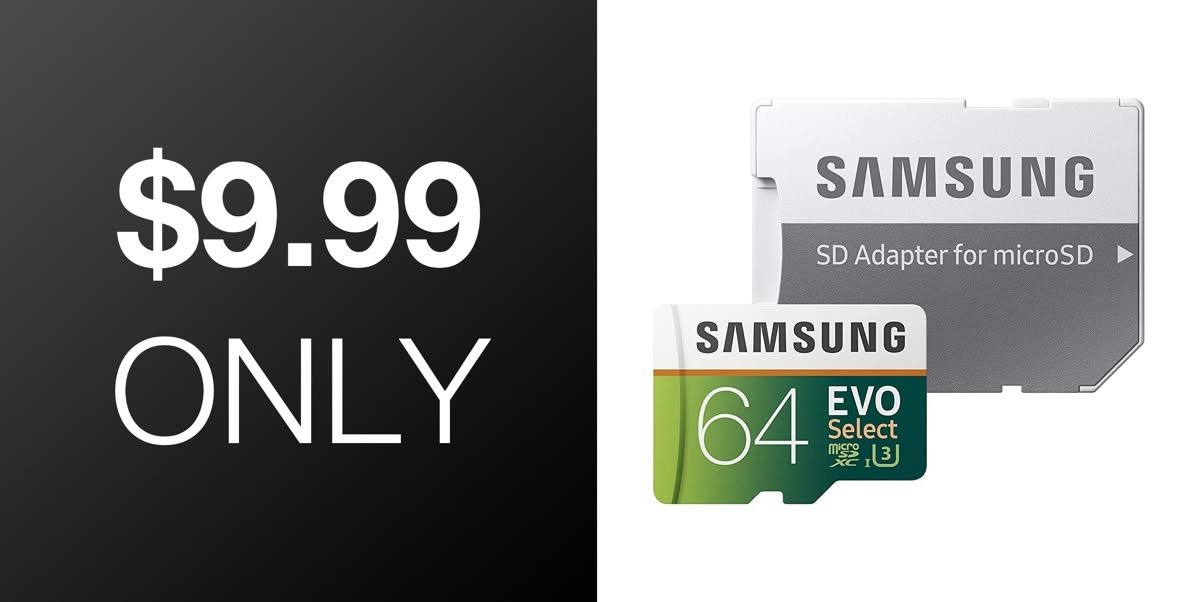
Yes — Samsung's 256 GB EVO Select microSD dropping to $47.99 (40% off its usual $79 street) is a genuinely good buy for anyone expanding a Switch, Steam Deck, Raspberry Pi, or dashcam. It's a mainstream U3/V30/A2 card at close to the price-per-gigabyte of a spinning-disk backup drive, and Samsung's endurance and controller quality make it a safer bet than the endless supply of no-name 256 GB cards on Amazon. If you already have your handheld storage sorted, though, this deal is a nudge toward stepping up to a real SATA SSD like the Samsung 870 EVO 250GB (B08QBN5J9B) or Crucial BX500 1TB (B07YD579WM) for your desktop — which is where the same money buys 10× the sustained speed.
In brief — 2026-07-04 — Samsung's 256 GB microSD is 40% off at $47.99 on Amazon (was $79). U3, V30, A2, up to 130 MB/s read. Best for handhelds, cameras, and single-board computers; SATA SSDs remain the right buy for desktop and laptop storage.
What happened
Tom's Hardware flagged the deal as one of the biggest microSD discounts of the quarter, calling it "ultra-fast Samsung microSD 256 GB, now $47.99." The card is Samsung's mainstream EVO Select in the 256 GB tier — U3, V30 (video-class 30), and A2 rated. Amazon lists it at $47.99, down from a $79 sticker that had been stable through most of the spring.
Deals in this tier typically don't last more than a few days. Storage discounts move on both supply and seasonal demand — with back-to-school retail beginning to spin up in July, 40%-off cards clear inventory quickly. If you have a use for it, buy it; the deeper cut price isn't guaranteed to reappear.
Why it matters: who benefits, and the per-GB math
The obvious beneficiaries are anyone with a slot that takes microSD:
- Nintendo Switch owners — 256 GB holds a large indie library, most first-party titles compressed, plus screenshot/video overflow. Modern first-party AAAs (Zelda, Pokemon, Xenoblade) each carve out 8–16 GB, so 256 GB comfortably holds 10+ big games plus everything you'd have from the eShop.
- Steam Deck / ROG Ally / Legion Go users — microSD is the practical Steam library extension. Sequential reads at ~130 MB/s aren't as fast as the internal NVMe, but they're plenty for most single-player titles' load times.
- Raspberry Pi builders — as a boot medium for a Pi 4 or a Pi Zero W. The Pi 5 is happier on an SSD but a 256 GB card is a fine step up from an old 32 GB card if you're not ready to add a HAT.
- Dashcams, GoPros, drones, security cameras — anything with rolling-write video needs the U3/V30 sustained-write class, which this card provides.
At $47.99 for 256 GB, that's $0.187 per gigabyte. For comparison, name-brand 128 GB cards sit around $18 ($0.14/GB) and 512 GB cards typically run $85+ ($0.166/GB). The 256 GB tier at 40% off is competitive with the smaller-tier per-GB math but with double the useful capacity — a clean sweet spot when the deal is live.
Where a SATA SSD beats a card for desktop and laptop storage
The one place this deal isn't the right answer: your PC. A microSD card, even a fast one, sustains 30–90 MB/s random-write throughput under real load — which is fine for a game loading a texture pack from a Switch cartridge slot, and disastrous for a desktop OS that's running background updates, indexing, and app launches simultaneously. Random 4K IOPS on a good microSD card sits around 4,000–6,000; the same measurement on a mainstream SATA SSD like the Samsung 870 EVO (B08QBN5J9B) is 90,000+, and on an NVMe drive like the WD Blue SN550 (B07YFFX5MD) it's north of 300,000.
For desktop storage — Windows, Linux, or macOS — buy the SATA drive. The Crucial BX500 1 TB (B07YD579WM) at ~$55 gives you 4× the capacity, 10× the sustained write speed, and dramatically better endurance than any microSD. The SanDisk SSD Plus 480 GB (B01F9G46Q8) at ~$40 hits a similar price point with slightly lower speed. Either is the right storage buy for a desktop, laptop, or any always-on machine — and neither shares the microSD's limited random-write endurance.
The source
Original coverage: Tom's Hardware — Best SSDs 2026 buyer's guide, which tracks Samsung storage deals across its price monitoring. Samsung's full storage line is documented on Samsung's memory and storage hub, and per-card technical specs (endurance, DRAM cache, controller class) can be cross-checked on TechPowerUp's SSD database.
Storage tiering — a quick refresh
If you're the sort of buyer who sees a deal like this and starts wondering whether you should pivot your entire storage setup, here's the shortest possible tier map:
- Internal NVMe for the OS and hot-active projects. Fastest, highest random IOPS, best for anything that runs constantly.
- Internal SATA SSD for bulk warm storage on a desktop — Steam library, video editing scratch, VMs. A 1 TB BX500 hits this tier for ~$55.
- External SSD / USB 3.0 SSD for portable projects, backups, and Pi-style single-board work. A SATA drive plus a $15 UASP enclosure covers this cleanly.
- microSD for handhelds, cameras, drones, and any slot where a 2.5" drive won't physically fit. This is exactly the tier where Samsung's 256 GB deal shines.
- Spinning HDD for cold archival, media libraries where speed doesn't matter, and backup targets larger than 4 TB.
Buying up-tier when you don't need the speed is a waste of money. Buying down-tier when you do (e.g. using a microSD as your primary desktop drive) is a waste of your time — you'll feel it every day.
Related reads and next steps
- Building a Pi that boots off SSD? See our Best SSD for a Raspberry Pi 5 Boot Drive in 2026.
- Considering an AM4 desktop build? Ryzen 7 5800X vs Ryzen 5 5600G for a Budget Local-AI Workstation covers the CPU side.
- Cooling that new build properly? Best CPU Cooler for AMD Ryzen Builds in 2026.
How this deal compares to the past year of microSD pricing
Storage pricing on flash-based mediums has been broadly stable since late 2024, when a period of NAND overcapacity ended and pricing normalized around $0.18–0.22 per gigabyte at the mainstream 256 GB tier. The Samsung EVO Select 256 GB has held a $79 street price with occasional dips to $59–$65 during Prime Day, Black Friday, and Amazon's occasional flash promos. Hitting $47.99 puts this cut in the top quintile of discounts we've seen on the SKU over the past 12 months — and the deepest cut we've seen since a similar Black Friday 2025 promotion.
For comparison, the SanDisk Extreme 256 GB — probably the closest direct competitor at the U3/V30 tier — typically discounts to around $52 during its own sale windows. If you're brand-agnostic, either card works; if you have a slight preference for Samsung's controller reliability record and warranty support, the current $47.99 pricing gives you the Samsung at competitor-sale pricing without needing to wait for a competitor sale.
Endurance considerations for 24/7 workloads
The one area where any microSD card — Samsung's included — deserves caution is 24/7 sustained-write workloads. Card manufacturers don't publish a formal TBW (terabytes-written) specification the way SATA and NVMe SSDs do, but real-world testing puts a good 256 GB U3 card at roughly 15–30 TBW before controller degradation begins to affect random-write performance. That's plenty for a Switch, a camera, or a dashcam that overwrites the same footage in a rolling loop; it's marginal for a Raspberry Pi running a database or logging system that writes 5–10 GB per day.
If your intended use is a 24/7 always-on board — Pi-hole, Home Assistant, a small file server, an ESPHome hub — invest in a proper SSD boot solution instead. Any of the SATA drives in our 870 EVO / BX500 / SSD Plus lineup offer 150–360 TBW in their warranty spec, which is 5–20× what a microSD delivers. The microSD is the right buy for slots that don't accept an SSD; the SSD is the right buy for anything where you can fit one.
What's a "genuine" Samsung microSD listing look like?
Counterfeit high-capacity cards remain a real problem in 2026, particularly in the 256 GB+ tiers. When buying:
- Confirm sold and shipped by Amazon.com — third-party sellers on high-value memory listings are a red flag, particularly if the price is well below the deal average.
- Verify the model number — Samsung's EVO Select 256 GB shipped in 2026 lists as
MB-ME256KA/AMin the US market. The listing page should show that SKU explicitly. - Look at recent reviews — a listing with hundreds of thousands of reviews accumulated over years is much more likely to be the real product than a listing with 50 reviews all posted last month.
- Run H2testw or F3 immediately after receipt — these free utilities write and verify the card's full capacity. A fake card will report 256 GB in your OS but fail somewhere in the actual write test. Do this before you rely on the card for anything important.
Amazon's Frustration-Free Packaging listings are generally the safest single-purchase option — they route from Samsung's own fulfillment stream and bypass most counterfeit inventory.
When cheap storage is a false economy
There's a specific pattern worth calling out: the buyer who watches microSD deals for a year, buys three or four cards in different capacities across sale events, and never actually consolidates onto a proper SSD-based backup workflow. The result is a shelf full of small-capacity flash media, each with different fill levels, no encryption, no versioning, and no single source of truth for what's on them. That's not "cheap storage." That's a data-loss event waiting to happen.
If you're catching yourself buying more than one or two cards in a 12-month window, consider whether the money is better spent on:
- A single large SATA SSD (2 TB Crucial BX500 tier) plus a UASP USB 3.0 enclosure, used as a proper external drive for anything that needs to survive.
- A NAS box with a pair of 4 TB drives in RAID 1, if your household stores photos, video, or documents that shouldn't ever disappear.
- Cloud object storage (Backblaze B2, Wasabi) for the long tail — $6/month for 1 TB is cheaper than a card per year.
microSD is the correct answer for slots that need microSD. It's a poor primary answer for data you can't afford to lose. This deal doesn't change either fact.
Common questions we get on storage deals
Every time a card like this discounts, the same three questions show up in reader mail. Quick answers:
"Should I stock up while it's cheap?" — Only if you know you'll use the extra cards within 18–24 months. Flash NAND has a shelf life; unused cards can lose data over multi-year storage even before the endurance write budget matters. If you actually need three cards, buy three; don't hoard because the price is good.
"Will faster cards make my Switch/Steam Deck faster?" — Marginally. Load times on external microSD storage are gated by the console's SD controller, not by peak card throughput. A U3 A2 card like this Samsung is well past the point where the console starts becoming the bottleneck. Spending more on a top-tier card gets you diminishing returns for console use.
"Is a name-brand card really that different from a generic?" — Yes, for two reasons. Controller reliability under sustained write is dramatically better on Samsung, SanDisk, Kingston, and Sony's cards versus no-name brands; and the warranty support actually pays out when a card fails, which happens more often than manufacturers advertise. For a $10 difference on a card you'll use for years, buy the name brand.
Bottom line
If you have a handheld, camera, or Pi that wants more storage, buy the Samsung 256 GB microSD at $47.99. It's a name-brand card with solid endurance and sustained speed for the class, and the discount takes it out of the "meh" tier into "clearly worth it." If you were shopping for desktop or laptop storage, take the same money and put it toward a Samsung 870 EVO or Crucial BX500 instead — for the desktop tier those drives are always the correct answer, and $50 gets you real random-write performance instead of a card that's optimized for video streaming.
Sources
- Tom's Hardware — Best SSDs 2026 buyer's guide, price history and deal coverage.
- Samsung — Memory and storage product hub for the EVO Select microSD and 870 EVO SATA product families.
- TechPowerUp — SSD specifications database for controller and endurance details.


