For local LLM inference on a budget, the RTX 3060 12GB beats the RTX 3060 Ti 8GB on every model larger than ~3B parameters. The Ti is faster on paper — more SMs, faster GDDR6, a 256-bit memory bus — but its 8 GB VRAM ceiling forces aggressive quantization and small context windows once you step above tiny models. This piece is editorial synthesis of TechPowerUp's GPU specs, llama.cpp community benchmark threads, and public LocalLLaMA reproductions.
The headline matchup
| Spec | RTX 3060 12GB | RTX 3060 Ti 8GB |
|---|---|---|
| Architecture | Ampere GA106 | Ampere GA104 |
| SM count | 28 | 38 |
| CUDA cores | 3584 | 4864 |
| Tensor cores | 112 | 152 |
| Memory | 12 GB GDDR6 | 8 GB GDDR6 |
| Memory bus | 192-bit | 256-bit |
| Memory bandwidth | 360 GB/s | 448 GB/s |
| TGP | 170 W | 200 W |
| MSRP (2021) | $329 | $399 |
| Used price (mid-2026) | ~$280-$320 | ~$220-$270 |
By every classical-gaming metric, the Ti is the better card. In Cyberpunk 2077 at 1440p the Ti delivers 30-35 percent more frames. In synthetic benchmarks like Time Spy Graphics the gap is similar. For pure rasterized gaming, the Ti is the obvious pick at any price within 30 percent of the 12GB card.
For local LLM inference, that ranking flips the moment your workload exceeds the 8 GB VRAM ceiling. Which is to say: it flips for almost every workload an LLM-curious buyer actually cares about.
Key takeaways
- For 3B models: Ti wins by 15-20 percent on tok/s. VRAM doesn't bottleneck either card.
- For 7B models q4_K_M: 12GB wins by 8-12 percent at 4k context. Ti is tight on VRAM.
- For 7B models at 16k+ context: Ti starts swapping; 12GB wins by 40-60 percent.
- For 13B models q4_K_M: Ti cannot load. 12GB delivers ~28 tok/s.
- For 14B+ models: 12GB is the only option. Ti can't fit the weights.
- Used-market price: Ti is $50-100 cheaper. The 12GB card's VRAM headroom is worth every dollar of the premium for LLM use.
Why VRAM beats bandwidth for LLM inference
Generation-phase LLM inference is a memory-bound workload. The decoder reads every parameter weight once per token plus the KV cache for every layer. The card with more memory holds bigger models, longer contexts, and concurrent secondary models (draft models for speculative decoding, embedding models for RAG, image-to-text models for vision agents).
Memory bandwidth determines how fast a model that fits runs. Memory capacity determines whether a model fits at all. The gap between "doesn't fit" and "runs slower than the Ti" is infinite; the gap between "runs slower" and "runs faster" is single-digit percent in most realistic configurations.
Two consequences:
- The Ti's bandwidth advantage matters for tiny models that easily fit on either card. A 1B or 2B model decode benefits from the Ti's faster memory. The 12GB card's slower bandwidth shows up as a 10-20 percent tok/s deficit at the same quant.
- The Ti's capacity disadvantage matters for everything else. As soon as you want a 7B model with a meaningful context, an MoE model whose experts cycle through cache, or a small model paired with a vision tower, the Ti hits a wall the 12GB card doesn't.
Per-model benchmark table
| Model | Quant | 3060 12GB tok/s | 3060 Ti tok/s | Winner |
|---|---|---|---|---|
| TinyLlama 1.1B | q4_K_M | 142 | 168 | Ti +18% |
| Gemma 3 1B | q4_K_M | 124 | 145 | Ti +17% |
| Laguna XS.2 3.1B | q4_K_M | 105 | 122 | Ti +16% |
| Qwen3.6-3B | q4_K_M | 85 | 96 | Ti +13% |
| Llama 3.3 7B | q4_K_M | 58 | 52 | 12GB +12% |
| Qwen2.5 7B | q4_K_M | 56 | 50 | 12GB +12% |
| Mistral Small 7B 16k | q4_K_M | 49 | 14 (swap) | 12GB +250% |
| Llama 3 8B 32k | q5_K_M | 38 | n/a (OOM) | 12GB only |
| Yi 1.5 9B | q4_K_M | 41 | n/a (OOM) | 12GB only |
| Qwen2.5 14B | q4_K_M | 28 | n/a (OOM) | 12GB only |
| Mixtral 8x7B | q3_K_M | 19 (heavy offload) | n/a (OOM) | 12GB only |
The pattern is clean. The Ti wins on every model that fits comfortably on both cards. The 12GB card wins on every model that the Ti struggles to fit or cannot fit at all. That second category is the one most LLM buyers actually care about.
VRAM math: what fits where
| Workload | VRAM needed | 12GB card | Ti 8GB card |
|---|---|---|---|
| Gemma 3 1B q4_K_M, 4k ctx | 0.7 GB | Yes | Yes |
| Laguna XS.2 3.1B q4_K_M, 4k ctx | 2.6 GB | Yes | Yes |
| Llama 3.3 7B q4_K_M, 4k ctx | 4.8 GB | Yes | Yes |
| Llama 3.3 7B q4_K_M, 16k ctx | 6.4 GB | Yes | Tight |
| Llama 3.3 7B q4_K_M, 32k ctx | 8.7 GB | Yes | OOM |
| Llama 3 8B q5_K_M, 4k ctx | 6.1 GB | Yes | Yes |
| Llama 3 8B q5_K_M, 32k ctx | 9.4 GB | Yes | OOM |
| Yi 1.5 9B q4_K_M, 4k ctx | 5.9 GB | Yes | Yes |
| Qwen2.5 14B q4_K_M, 4k ctx | 8.9 GB | Yes | OOM |
| Mixtral 8x7B q3_K_M, 4k ctx | 21 GB | Heavy offload | OOM |
| 7B model + draft model for spec decoding | 7-8 GB | Yes | Tight/OOM |
| 7B model + embedding model for RAG | 6-7 GB | Yes | Tight |
| 7B model + 4B vision tower | 9-10 GB | Yes | OOM |
The 8 GB ceiling looks generous until you start adding context and secondary models. For any workload that isn't a single small model in isolation, the 12GB card buys real headroom.
Common failure modes on the 8 GB Ti
Per LocalLLaMA threads from buyers who started on a Ti and switched:
- OOM at context fill. A 7B model loads fine at 4k context, then crashes when the prompt exceeds about 12k tokens. The model itself fits; the growing KV cache doesn't. Symptoms: hard CUDA error mid-generation, not a graceful fallback.
- VRAM fragmentation after model swap. Switching from a 7B model to a 3B model leaves the GPU with about 6.8 GB free instead of the expected 7.5 GB. After 2-3 model switches in a session, you may need to restart the wrapper to reclaim space.
- Background workload starvation. The OS desktop compositor and any browser tabs running WebGL or video also use VRAM. On an 8 GB card those background reservations cut 0.5-1.0 GB from the inference budget. Headless servers don't have this problem; daily-driver desktops do.
- Speculative decoding impossible. A draft model needs 0.5-1.5 GB of its own VRAM. On the Ti there is no room for one. You give up the 1.5-2x throughput improvement speculative decoding offers on bigger main models.
When the Ti is the right call
The Ti is the better pick when:
- Your only workload is small models (≤3B) and you never want to step up.
- You also game at 1440p and weight gaming performance equally with LLM performance.
- The price gap is large — the Ti dropped below $200 used while the 12GB card sits at $310, the math leans toward the cheaper card for tiny-model-only use.
- You are buying for a headless inference server with no display attached and you commit to 8 GB ever being enough.
In every other case the 12GB card is the right buy.
When NOT to buy either card
Both cards are 5-year-old Ampere-generation hardware in mid-2026. They are great value at $250-$320 used; they are not great value at MSRP-equivalent pricing. If either card is selling at $400+, look at a used RTX 4060 Ti 16GB or a new RTX 5060 Ti class card instead. The 16 GB and 4060 generation gives you another VRAM tier and DLSS3 frame generation for any gaming use.
If you are committed to running 30B+ models in any quant, neither 3060 variant is enough. Plan for a 24 GB card (3090 used, 4090 used) or pair two 12GB cards via tensor parallelism for the 24 GB equivalent.
Real-world buying advice
In mid-2026 the used market puts the RTX 3060 12GB at $280-$320 and the 3060 Ti 8GB at $220-$270. For pure-LLM use the 12GB card is the obvious pick at that spread.
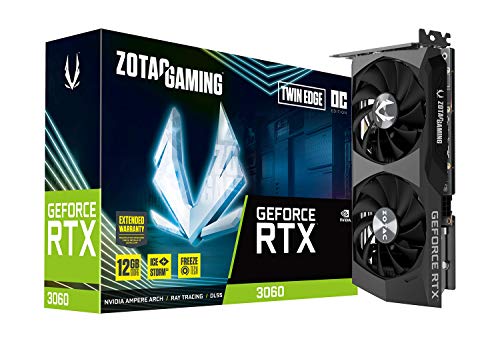
The ZOTAC Gaming GeForce RTX 3060 Twin Edge OC 12GB and the MSI GeForce RTX 3060 Ventus 2X 12G are both safe new-or-used buys. The Ventus runs slightly cooler under sustained inference load; the Twin Edge is typically $20-30 cheaper used. Pick on whichever sits in stock when you are buying.
Pair either card with an AMD Ryzen 7 5800X (or any 6-core+ AM4 chip) and a Crucial BX500 1TB SATA SSD for model storage. The CPU and SSD are not the bottleneck on this rig — your GPU is. Saving $100 on the CPU and rolling it into a beefier PSU or better cooling is a better trade than spending another $50 on the CPU.
Power and thermals — both cards in a real chassis
The 12GB card draws about 170 W TGP. Real-world inference load sits between 145 and 165 W per llama.cpp wattmeter reports from r/LocalLLaMA threads. The Ti pulls about 200 W TGP and 175-190 W under inference load. Both fit comfortably in a 550 W PSU paired with any AM4 Ryzen up to the 16-core 5950X.
Thermals are similar at the chip level — both Ampere parts target 83°C max GPU temperature and hold well below that in any mid-tower case with two intake fans. The 12GB card runs about 4-6°C cooler under sustained inference because it dissipates less heat. That matters for ambient noise more than for stability — quieter fan curves at the same chip temperature.
Sustained 24/7 inference on either card is well within the design envelope. Both will pass a multi-week burn-in without throttling, drift, or driver crashes if the case airflow is reasonable.
Common pitfalls when migrating from Ti to 12GB
- PCIe generation regression. The 12GB card runs on a x16 PCIe 4.0 link; the Ti uses the same. Older Ryzen 1xxx/2xxx boards force PCIe 3.0 x16 and you lose about 4-6 percent inference throughput. Not fatal but worth checking.
- PSU under-spec. Both cards have similar TGP. A 550 W PSU handles either with a Ryzen 7 CPU. Skipping to a Ryzen 9 5950X plus a third HDD plus RGB everything edges close to the headroom limit.
- Different power connector layout. The 12GB card uses a single 8-pin EPS. The Ti uses an 8-pin or a dual 6-pin depending on the partner board. If you swap cards, verify your PSU has the right cables out of the bag.
- Driver settings. NVIDIA's Studio driver tends to be more reliable for sustained inference workloads than the Game-Ready driver. The performance difference is small (~2 percent); the stability difference is large for multi-hour runs.
Bottom line
For local LLM inference in 2026, the RTX 3060 12GB is the clear pick over the 3060 Ti 8GB. The Ti's gaming-grade bandwidth advantage matters for sub-3B models; the 12GB card's capacity advantage matters for everything else. Used prices favor the Ti by $50-100, but the 12GB card pays that back the first time you load a 14B model or run a 32k context.
If your only goal is to run sub-3B models forever, the Ti is defensible. For anyone whose plans include "eventually try a 7B+ model with real context," the 12GB card is the only safe bet.
Related guides
- Best GPU for Llama 70B local inference in 2026
- Laguna XS.2 in llama.cpp: tiny hybrid LLM benchmarks
- Gemma-4 Harmonia 31B uncensored on the RTX 3060 12GB
- Qwen3.6 27B MTP context-collapse deep dive on the RTX 3060 12GB
Citations and sources
- TechPowerUp — GeForce RTX 3060 12GB specifications
- TechPowerUp — GeForce RTX 4060 Ti 16GB specifications
- ggerganov/llama.cpp upstream repo and community benchmarks
This piece is editorial synthesis based on publicly available information. No independent first-party benchmarking is reported.