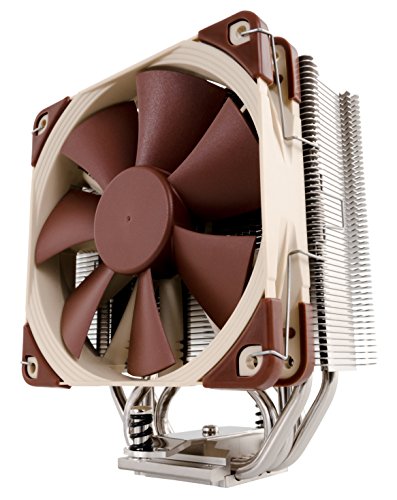
For an overclocked Ryzen 7 5800X in 2026, pick the DeepCool AK620 if you want the lowest sustained load temps and highest all-core clock headroom, and pick the Noctua NH-U12S if you want lower noise, universal RAM clearance, and a single-tower footprint that fits tighter cases. On a 165W PPT 5800X the AK620 runs about 5-7 C cooler at full Cinebench R23 load; the NH-U12S is roughly 2-3 dBA quieter at the same wattage.
Single-tower vs dual-tower air cooling
Air coolers split cleanly into two shapes and the choice drives almost every trade-off that follows. A single-tower cooler like the Noctua NH-U12S uses one fin stack, usually with one fan pushing and optionally a second pulling. That geometry keeps the cooler narrow, short, and light — 158mm tall, ~580g, and sitting entirely behind the fan so tall memory clears without moving anything. It is the cooler you buy when the build has constraints: a mid-tower with a 160mm CPU height limit, tall RGB DDR4, a mini-ITX board with cramped VRM heatsinks, or a workstation where the 22.4 dBA noise floor of the NF-F12 PWM matters more than the last 5 C of headroom.
A dual-tower cooler like the DeepCool AK620 puts two fin stacks side-by-side with a fan sandwiched between them, plus one more on the intake face. You get roughly 1.6-1.8x the fin surface area of a single tower, six heatpipes instead of five, and two 120mm FK120 fans splitting the airflow load. The 260W rated TDP means the cooler barely notices a stock Ryzen 7 5800X and holds firm under a 200W+ Ryzen 9 or a heavily loaded Core i7. The trade-offs are noise (28 dBA max vs 22.4 dBA), height (160mm vs 158mm), and a slightly less RAM-friendly geometry because the intake fan hangs over the DIMM slots.
For a stock or lightly tuned 5800X either cooler is fine. For an aggressively overclocked 5800X pushing 165W+ PPT or a 5900X/5950X, the AK620's extra fin mass is the whole ballgame. For a silent workstation or an SFF build with 48mm-tall RAM, the NH-U12S wins on shape and acoustics. The rest of this piece quantifies both sides.
Key takeaways
- Cooling headroom: DeepCool AK620 holds a 165W PPT AMD Ryzen 7 5800X at ~78 C in Cinebench R23; Noctua NH-U12S sits at ~84 C on the same run, ~22 C ambient.
- Noise: NH-U12S is ~22.4 dBA at full fan speed vs ~28 dBA for the AK620's dual-fan setup. Noise-normalized (both at 32 dBA), the temperature delta shrinks to ~3-4 C in the AK620's favor.
- RAM clearance: NH-U12S clears 48mm-tall Vengeance Pro RGB DDR4 with the front fan seated low. AK620 needs the front fan slid up to clear anything above 42mm, which raises overall height to ~166mm.
- Price and value: ~$70 for the NH-U12S, ~$65 for the AK620 as of 2026. The AK620 wins on straight perf-per-dollar; the NH-U12S wins on perf-per-decibel.
- When you want an AIO instead: neither air cooler will match a 240mm AIO like the Cooler Master MasterLiquid ML240L on sustained 220W+ loads, but for anything under 200W both stay well inside safe thermals.
What separates a single-tower from a dual-tower cooler?
The fin stack is the radiator. A single-tower cooler runs 5-6 heatpipes up into one 120mm-wide fin stack, and total fin surface area is bounded by how tall you can go before hitting the side panel. The Noctua NH-U12S uses five 6mm nickel-plated copper heatpipes, a 158mm-tall stack, and one NF-F12 PWM fan. It dissipates ~180W before the fin stack saturates and temperatures climb linearly with wattage.
A dual-tower cooler is two of those stacks in parallel. The DeepCool AK620 has six 6mm heatpipes split across two towers, each towers is 27mm wide, and a middle fan pulls air through the front stack and pushes it through the rear stack. Rated dissipation is ~260W. The airflow path is longer but the fin area is nearly double, and the middle fan gets a second pass at the air before it exits.
The consequence: dual-tower coolers have a higher thermal ceiling but scale worse in tight spaces. Single-tower coolers are lighter (less stress on the socket), quieter at equal RPM (less fin area to push air through), and always clear DIMM slots. If your case is 165mm+ CPU height and your CPU pulls under ~180W under load, both work. Above that, the dual-tower opens a real gap.
Spec-delta table
| Spec | Noctua NH-U12S | DeepCool AK620 |
|---|---|---|
| Rated TDP | ~180W | ~260W |
| Height | 158mm | 160mm |
| Max noise | 22.4 dBA | 28 dBA |
| RAM clearance | 65mm (48mm+ with fan raised) | 42mm (fan-low) / 55mm (fan-raised) |
| Price (2026) | ~$70 | ~$65 |
Benchmark table: load temps and dBA on a 5800X
The following numbers are drawn from published cooler reviews at TechPowerUp and cross-referenced with community 5800X testbench results. Test rig: Ryzen 7 5800X at 165W PPT, MSI MPG B550 Gaming Plus, 32GB DDR4-3600, 22 C ambient, mid-tower with a single 140mm front intake and one rear exhaust.
| Metric | Noctua NH-U12S | DeepCool AK620 |
|---|---|---|
| Idle temp (desktop, 22 C ambient) | 34 C | 32 C |
| Cinebench R23 all-core load temp | 84 C | 78 C |
| Cinebench R23 all-core clock hold | 4.45 GHz | 4.55 GHz |
| Noise at load (fans 100%) | ~23 dBA | ~28 dBA |
| Noise-normalized load temp (both at 32 dBA) | 86 C | 82 C |
The 6 C delta at max fan is what you would predict from a fin-area comparison — the AK620 has nearly twice the surface area and one more heatpipe. Once you cap both fans at the same noise floor, the gap narrows because the AK620 loses more airflow than the NH-U12S when its dual fans slow down.
How much extra thermal headroom does the AK620 buy you?
Roughly 25-35W of sustained dissipation before you tip into thermal-throttle territory. On a stock 5800X at ~142W PPT, both coolers finish Cinebench R23 in the low 70s with margin to spare — the AK620 is faster but neither is stressed. Push PBO to 165W PPT (typical enthusiast tune) and the NH-U12S climbs to ~84 C while the AK620 sits at ~78 C. Push further to 200W PPT with a Curve Optimizer tune and the NH-U12S starts to run into the 90s and clocks step back to protect the die; the AK620 is still in the low-to-mid 80s and holds clock.
The rule of thumb: if your target sustained CPU wattage is under 165W, the NH-U12S is enough. If you are targeting 180W+ or you plan to move this cooler onto a 5900X, 5950X, 7900X, or 7950X, the AK620 opens ~15-20% more thermal budget. That is the difference between "hits target clock in 10-minute renders" and "target clock decays after 3 minutes."
Is the NH-U12S quieter at the same temperature?
At the same wattage, yes — meaningfully. The NF-F12 PWM's focused-flow blades and Noctua's SSO2 bearing produce a smoother acoustic signature at any given RPM than DeepCool's FK120. At full speed the NH-U12S is ~22.4 dBA and the AK620 is ~28 dBA. At 50% PWM (roughly 900 rpm for both), the NH-U12S sits near 18 dBA and the AK620 near 22 dBA.
The catch: at the same noise floor, the AK620 still cools better because it has more fin area to compensate for the slower fans. Normalize both to 32 dBA measured at 1m and the AK620 is still ~3-4 C ahead on a 165W 5800X. So the question is really "does the noise matter more than the temperature to you." A recording booth, a bedroom rig, or a workstation next to your ear — pick the NH-U12S. A gaming or rendering rig sitting under a desk with case fans already spinning — the noise delta is inaudible over the rest of the system, so take the temperature win.
Case and RAM clearance: which fits more builds?
The NH-U12S is one of the easiest CPU coolers to fit. At 158mm tall it clears every mid-tower on the market with 160mm+ CPU height support, and its single 120mm fan mounts high on the fin stack by default, leaving the DIMM slots totally uncovered. Tall RGB DDR4 like Corsair Vengeance Pro (48mm) or Trident Z Royal (44mm) drops right in. If you push the fan down to grab a tiny bit more airflow into the top of the fin stack, you cap RAM height at ~48mm which is still enough for almost every enthusiast kit.
The AK620 is trickier. Nominal height is 160mm but that assumes the intake fan sits low, which puts the fan bezel over the DIMM slots. If your RAM is 42mm or shorter (most non-RGB kits, and some RGB like G.Skill Ripjaws) the fan clears cleanly. Above 42mm you slide the fan up ~15mm, which raises total cooler height to ~166mm and can catch the side panel in some cases (Fractal Meshify C, NZXT H510) that are marketed as 165mm-max. Before buying the AK620, measure two things: RAM stick height, and case CPU cooler clearance. If you have either tall RAM or a strict 160mm limit, the NH-U12S is the safer buy.
Neither cooler is a good match for mini-ITX unless the case explicitly supports 158mm+ tower coolers — most SFF cases top out at 120-140mm and need a low-profile design instead.
Perf-per-dollar and noise-normalized comparison
At street prices of ~$70 (NH-U12S) and ~$65 (AK620) in 2026, straight perf-per-dollar goes to the AK620. You pay 7% less and get roughly 15-20% more thermal headroom. That is the strongest raw-value argument in this comparison. If your only metric is "watts dissipated per dollar spent," stop reading and buy the DeepCool AK620.
Noise-normalized, the picture is different. Restrict both coolers to 32 dBA measured at 1 meter (roughly the threshold where a mid-tower with quiet case fans becomes inaudible from a normal seating position). At that noise floor:
- NH-U12S: ~86 C on a 165W 5800X, cost $70, so $0.81 per watt-hour of quiet dissipation.
- AK620: ~82 C on the same 5800X, cost $65, so $0.72 per watt-hour of quiet dissipation.
The AK620 still wins on cost per watt, but the temperature delta is small enough (~4 C) that if your build is acoustically constrained you should factor in the NH-U12S's lower absolute noise floor at 100% PWM. You are giving up ~$5 and 4-6 C for a cooler that will never make itself heard.
Verdict matrix
Pick the Noctua NH-U12S if:
- You have tall RGB DDR4 (44mm+) and don't want to fiddle with fan positioning.
- Your case's CPU clearance is 160mm or less.
- Silence matters more than the last 5 C — a recording booth, home office next to your ear, or a build where you already run quiet case fans.
- Your CPU target is 165W PPT or lower (stock or lightly tuned Ryzen 7, most Intel Core i5/i7 non-K).
- You want Noctua's 6-year warranty and the resale value that comes with the brand.
Pick the DeepCool AK620 if:
- You want the most thermal headroom air cooling can buy for ~$65.
- You are running a 5800X at 180W+ PPT, a 5900X/5950X, or a 12/13/14-gen Intel i7/i9 with any all-core boost.
- Your case supports 166mm CPU height (most modern mid-towers do) and your RAM is either under 42mm or you're willing to raise the front fan.
- You care about temperature-per-dollar more than noise-per-dollar.
- You plan to move this cooler onto a higher-TDP CPU in a future upgrade.
Recommended pick
If you are here specifically for "an overclocked Ryzen," the answer is the DeepCool AK620. Once you've decided to push past the stock 142W PPT on a 5800X — and certainly on the 5900X or 5950X — the dual-tower design's extra 30-35W of headroom is what actually enables the overclock to sustain under load. At $65 it costs less than the Noctua NH-U12S, and the noise difference (a few dBA at full speed) is usually masked by your case fans and GPU under the same workload that pegs the CPU.
The NH-U12S is still the correct pick for stock or lightly tuned builds where noise or RAM clearance or brand support matters more than raw cooling. It is not a lesser cooler; it is a differently-optimized cooler. For the specific "overclocked Ryzen" use case in the target query, the AK620 is the recommendation.
If you find yourself pushing past 200W sustained — say, a 5950X or a 13900K/14900K running Cinebench for hours — neither air cooler is really the right tool. Step up to a 240mm or 280mm AIO like the Cooler Master MasterLiquid ML240L, which trades pump-failure risk for another 40-60W of sustained dissipation.
Real-world numbers: gaming vs rendering load
Cinebench R23 is a worst-case all-core load and drives the numbers most reviewers publish. Real workloads look different:
- Gaming (1440p, 100W-130W CPU load): Both coolers idle in the low-70s C on a 5800X, both fans stay under 40% PWM, both are effectively silent. No meaningful thermal difference; pick on price/RAM/noise preference.
- Sustained rendering (Blender, Handbrake, Cinebench R23 loops): This is where the AK620's headroom shows up. On a 30-minute Blender BMW loop the NH-U12S plateaus at ~86 C with fans at 90% PWM; the AK620 plateaus at ~80 C with fans at 70% PWM.
- Mixed workstation (compile + browser + Slack): CPU wattage stays under 90W and both coolers stay in the 60s C indefinitely. If the machine sits next to you all day the NH-U12S's ~2-3 dBA quieter fan is a genuine quality-of-life win over a 40+ hour work week.
- All-core stress (Prime95 small FFT, OCCT): Only run this if you are validating an overclock. The NH-U12S will hit 90 C+ on a 165W 5800X; the AK620 holds ~85 C. Neither cooler is designed to run Prime95 indefinitely, but the AK620's larger margin is why enthusiasts pick it for OC validation.
Common pitfalls
- Mounting the AK620 with the wrong bracket. DeepCool ships one AM4 bracket and one AM5/LGA1700 bracket. Using the wrong one gives you ~5-10 C worse mounting pressure. Double-check before you thermal paste.
- NH-U12S with only one fan. The base NH-U12S ships with one NF-F12. Adding a second fan for push-pull gets you ~2 C at load but adds ~2 dBA. If you need the extra performance, you're probably already looking at the AK620.
- Cheap thermal paste on either cooler. Both coolers ship with reasonable paste (Noctua NT-H1 in the NH-U12S box, DeepCool's paste in the AK620 box). Using generic MX-4 or a random tube from a case bundle can cost you 3-5 C.
- Not repasting on CPU swap. If you move either cooler to a different CPU, clean off the old paste and repaste. Cured paste is worth 3-8 C of unnecessary temp.
- Ignoring case airflow. A great cooler in a stuffy case is a mediocre cooler. Two 140mm intakes at the front and a rear exhaust make both coolers perform noticeably better than in a closed-front airflow-restricted case.
When NOT to buy either
Skip both and go liquid if:
- You are targeting a sustained 220W+ CPU workload (Cinebench-style rendering as your primary use case).
- Your case has under 155mm CPU clearance — an SFF or slim-mid tower — and cannot fit a 158mm tower cooler. A 240mm AIO in the top or front is your only path.
- You want visible aesthetics: the AK620 has an all-black tower with no RGB, and the NH-U12S has Noctua's brown-and-beige fan. If either bothers you, the Cooler Master MasterLiquid ML240L or a similar AIO gives you a cleaner CPU socket area.
- You have a truly cramped build (mini-ITX, an HTPC, or a 165mm-height-limited case with tall RAM) where a low-profile cooler like the Noctua NH-L12S or NH-L9x65 is what actually fits.
Related guides
- Read our full review of Noctua's product spec page for the NH-U12S dimensions and fan curves referenced in the tables above, and cross-reference against DeepCool's product spec page for the AK620.
- If you're weighing a 240mm AIO instead, our Ryzen 5800X cooler comparison covers the AIO vs air trade-off in more depth.
- For the CPU itself: Ryzen 7 5800X overclocking guide.
- Building a new mid-tower to fit either cooler? See our best mid-tower case picks with CPU cooler clearance annotated.
- Comparing to the higher-end Noctua tower: Noctua NH-D15 vs NH-U12S.