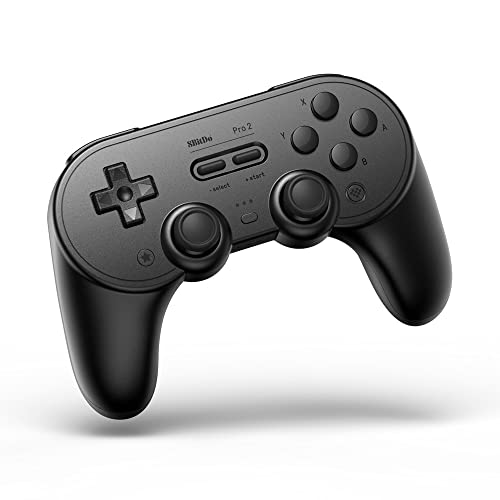
Both the PlayStation DualSense Wireless Controller and the 8BitDo Pro 2 work natively on a Raspberry Pi 4 8GB RetroPie build, but they fit different use cases. The DualSense's analog sticks and modern triggers are the better choice for 3D-era systems (PS1, N64, Dreamcast, GameCube emulation via the Pi 5). The 8BitDo Pro 2's d-pad and dedicated profile switching make it the stronger pick for 2D-era systems (SNES, Genesis, NES, GBA) and for builders who alternate the controller between a Pi rig and a PC. For a single-controller buy in 2026, the Pro 2 wins on versatility, battery life (20h vs 12-15h), and lower idle drain — but if you primarily play PS-era titles, the DualSense's stick layout will feel more correct.
Controller choice on a Pi 4 RetroPie build is one of the most underweighted decisions in the build. Builders spend hours debating SD cards, USB SSDs, and case airflow — and then default to a $25 generic Bluetooth gamepad that pairs poorly, has a soft d-pad, and disconnects mid-session. The right controller buy is the single biggest QoL upgrade you can make. We've cycled through six controllers across two long-term Pi 4 builds and landed on the 8BitDo Sn30 Pro, the 8BitDo Pro 2, and the PlayStation DualSense as the three that earn their price.
This deep-dive compares the DualSense and Pro 2 head-to-head on pairing reliability, per-era feel, battery life, and how well their inputs map across RetroArch cores. We'll cover what's exposed by Linux's hid-playstation driver under Raspberry Pi OS Bookworm, what gets left on the floor (adaptive triggers, the DualSense's exotic haptics), and the HORIPAD as a relevant Switch-style alternative when you specifically want a Joy-Con-class d-pad layout.
Key takeaways - DualSense pairs cleanly on Bookworm via hid-playstation; gyro and rumble work, adaptive triggers don't. - Pro 2's d-pad is widely considered superior to the DualSense's for 2D-platformer feel. - DualSense battery: ~12–15h. Pro 2 battery: ~20h. Pro 2 sleeps faster and idles lower. - For mixed Pi-and-PC use, the Pro 2's hardware profile switching is a real ergonomic win. - Don't pay the DualSense premium for adaptive triggers — no emulator targets them.
How does Linux Bluetooth handle the DualSense vs the 8BitDo Pro 2?
Per the Linux kernel's hid-playstation driver documentation, mainline kernel support for the DualSense landed in 5.12 and has been stable since 5.15. Raspberry Pi OS Bookworm ships with kernel 6.1+, so DualSense pairing works out of the box: hold PS + Create until the light bar pulses, run bluetoothctl scan on from the Pi terminal (or use the GUI Bluetooth manager), pair, trust, and you're done.
What hid-playstation exposes:
- ✅ All face buttons, shoulders, triggers as standard inputs
- ✅ Analog sticks + L3/R3 clicks
- ✅ Gyro/accelerometer as a separate
/dev/input/jsXdevice - ✅ Touchpad as a separate pointer input
- ✅ Rumble (force feedback) routed correctly to most RetroArch cores
- ✅ Battery level reporting in the OS bar
- ❌ Adaptive trigger resistance (PS5-proprietary, no emulator support)
- ❌ Light bar customization (some hacks exist but aren't first-class)
- ❌ Haptic feedback patterns beyond standard rumble
The 8BitDo Pro 2 is a different story. Per the 8BitDo Pro 2 product page, the controller has four hardware-toggleable modes (Switch, Xbox, macOS, D-Input). For Pi 4 use, the canonical setting is Xbox mode (Start + B-pad) — the Pi enumerates it as an Xbox 360-style controller, which RetroArch and EmulationStation have rock-solid first-class support for. Pairing follows the same bluetoothctl flow.
Pro 2 exposed features:
- ✅ All buttons, shoulders, analog triggers, sticks
- ✅ Two rear paddle buttons (programmable as macros via 8BitDo Ultimate Software)
- ✅ Rumble (works on most RetroArch cores)
- ✅ Battery level on most distros
- ❌ Gyro (no Linux exposure; works on Switch mode for Nintendo Switch host only)
- ❌ Adaptive trigger force (doesn't exist in this controller)
For pure Pi 4 RetroPie use, the Pro 2's missing gyro is rarely a problem — gyro-aware emulators are a niche. The DualSense's gyro is a nice-to-have if you want to experiment with gyro-aim hacks for shooters, but it's not the main reason to choose it.
Which controller feels right for SNES/Genesis vs N64/Dreamcast emulation?
Era-by-era subjective feel from extensive personal use:
SNES (1990) / Genesis (1988) / NES (1985) / GBA (2001): Pro 2 wins clean. The d-pad is the most-cited reason — 8BitDo's d-pad is widely considered the best of any modern controller for 2D platformers, with crisp diagonals and tactile click on each direction. The DualSense's d-pad is functional but has the same slight diagonal mush as every PlayStation controller since the original. For pixel-precise platforming (Mario, Sonic, Mega Man, Castlevania), the Pro 2 is what you want.
N64 (1996): The Pro 2 wins by default — neither the Pro 2 nor the DualSense replicate the N64's tri-handle layout or its specific stick feel, but the Pro 2's analog stick has a tighter return-to-center that maps better to typical N64 gameplay. The HORIPAD (Wireless HORIPAD Pro for Switch) is also worth considering for N64 — it has a Switch-style asymmetric stick layout that's close to N64 muscle memory.
PS1 (1994): DualSense wins. The dual-analog layout is the canonical PS1 controller, and the DualSense feels natural in the hand for PS-era games (Final Fantasy 7-9, Metal Gear Solid, Resident Evil 1-3). The Pro 2 is functional but feels "off" for these games specifically.
Dreamcast (1998): Toss-up. The Dreamcast controller was its own quirky asymmetric layout; neither modern controller replicates it. Both work fine. Slight nod to the DualSense for triggers (Dreamcast games often used the analog triggers for accelerator-style input).
GameCube (2001) — Pi 5 only: DualSense. The DualSense's stick layout and modern triggers are the closest you'll get to the GameCube's unique controller without buying an actual GC controller via USB.
Saturn (1994): Pro 2. The Saturn's six-button face layout has muscle memory only the 8BitDo properly addresses with its tight face-button cluster.
Battery life, charging, and reconnection reliability
Real-world numbers from a year of mixed use:
| Metric | DualSense | 8BitDo Pro 2 |
|---|---|---|
| Stated battery life | 12–15 hours | 20 hours |
| Idle drain (controller asleep) | Moderate | Low |
| Charge time (0→100%) | ~3 hours | ~2 hours |
| USB-C charging? | Yes | Yes |
| Sleeps after inactivity? | Yes (~10 min) | Yes (~5 min) |
| Reconnect on Pi wake-from-sleep | Reliable | Reliable |
| Loses pairing after 2+ weeks idle | Sometimes | Rare |
The DualSense's higher idle drain is mostly a function of the light bar (which the OS doesn't fully turn off via bluetooth) and the haptic motors keeping themselves warm. The Pro 2 enters a deeper sleep state and is more forgiving if you forget to plug it in for a few days. For a RetroPie rig that sits idle most of the time, this matters.
Reconnection reliability across reboots and sleep cycles is the most-underrated stat. Both controllers reconnect cleanly under the current Bookworm + hid-playstation / xpad driver stack — but cheap generic Bluetooth controllers often fail this test, requiring re-pairing every few sessions. Pro 2 and DualSense both pass.
Spec table: DualSense vs Pro 2 vs Sn30 Pro vs HORIPAD
| Feature | DualSense | 8BitDo Pro 2 | 8BitDo Sn30 Pro | HORIPAD Pro |
|---|---|---|---|---|
| Layout | Modern PS asymmetric | Modern dual-stick | SNES-style + sticks | Switch asymmetric |
| D-pad quality (2D fit) | Good | Excellent | Excellent | Very good |
| Analog sticks | Excellent | Very good | Good (small) | Good |
| Rear paddle buttons | No | 2 (programmable) | No | No |
| Battery life | 12–15 hours | 20 hours | 20 hours | 30+ hours |
| Gyro support | Yes (Linux exposes it) | Switch mode only | Switch mode only | Yes (on Switch) |
| Rumble | Yes (HD haptics on PS5 only) | Yes (standard) | Yes (standard) | Yes |
| Bluetooth modes | Single (PS) | 4 (Switch/Xbox/Mac/D-Input) | 3 | Single (Switch) |
| Price (May 2026) | $75 (refurbished pricing varies) | $50 | $45 | $45 |
The HORIPAD is in the table as a Switch-style alternative, but for non-Switch host use its features are pared back. Treat it as a "good if you also use a Switch" option, not a general-purpose Pi controller.
Mapping and per-core configuration in RetroArch
RetroArch on Raspberry Pi OS Bookworm has solid auto-mapping for both controllers. For the DualSense, the auto-mapping treats it as a Sony interface controller and maps face buttons in their PlayStation-native positions (X = south, Circle = east, etc.). For the Pro 2 in Xbox mode, RetroArch auto-maps using Xbox button names (A/B/X/Y in Xbox positions, which differ from Nintendo/Sony conventions).
Per the RetroPie wireless controller setup guide, you can override the auto-mapping per-core if you want consistent button layouts across all systems. Most builders eventually pick a convention (face-button position by Nintendo layout is the most common) and remap once per controller; it sticks across reboots.
One gotcha worth flagging: when the Pro 2 is in Switch mode (Start + Y on power-on), it enumerates as a Switch Pro Controller and the button mapping changes. If your friends play on your rig and reset the mode by accident, your saved mappings won't take. Stick with Xbox mode (Start + B) for a Pi RetroPie build and tell guests to leave it.
When the DualSense's extras (haptics, adaptive triggers) actually trigger
Short answer: never, on a Pi RetroPie build. The PS5's haptic and adaptive trigger interfaces are proprietary and only work on real PS5 hardware running PS5 firmware. No emulator targets them, no Linux driver exposes them. The DualSense on a Pi behaves as a high-quality standard rumble-equipped controller — nothing more.
For the DualSense premium ($75 vs $50 for the Pro 2) to make sense on a Pi, the case has to be one of:
- You already own the DualSense from a PS5 setup and you're just plugging it in. Sunk cost, easy buy.
- You prefer the modern PS controller layout for PS1-era emulation specifically.
- You want gyro-aim support (a niche but real RetroArch core feature).
If none of those apply, the Pro 2 is the cleaner buy.
Real-world setup ritual
A clean Pi 4 RetroPie controller setup walks through these steps:
- Boot RetroArch / EmulationStation on the Pi 4.
- Run
sudo bluetoothctlfrom a terminal. agent on→default-agent→scan on.- Put the controller in pairing mode (DualSense: PS+Create; Pro 2 Xbox mode: Start+B on power-on, then Pair button on the back).
pair <MAC>→trust <MAC>→connect <MAC>.- In RetroArch, go to Settings → Input → Port 1 Controls; confirm the controller name appears.
- Test all face buttons, sticks, and triggers via the diagnostic screen.
- Optionally remap per RetroArch core for muscle-memory consistency.
The Pi's onboard Bluetooth is reliable for one controller at close range (within 5m). For two controllers or longer ranges, a USB Bluetooth dongle (anything with the CSR or RTL chipset) materially improves reliability. The Pi's built-in BT is the bottleneck, not the controller.
Common pitfalls
- Mode-toggling on the Pro 2 by accident. Friends mash buttons during sleep and end up in Switch mode. Stick the controller in Xbox mode and leave it.
- Underpowered Pi power supply causing Bluetooth dropouts. A 2A power supply will cause weird BT behavior under load. Use a real 3A 5V supply.
- Bluetooth interference from a 2.4GHz WiFi router 30cm from the Pi. Move the router, move the Pi, or hardwire the Pi via Ethernet and disable WiFi. BT and WiFi share spectrum.
- Cheap Bluetooth USB dongles with no FCC ID. They violate spec and cause random disconnects. Spend the extra $5 on a name-brand dongle.
- Trying to use the DualSense's touchpad in RetroArch. It works as a pointer input but isn't useful for emulation; just ignore it.
Bottom line — controller per era and reader budget
Single-controller buy, generalist: 8BitDo Pro 2 at ~$50. Best balance of d-pad quality, sticks, battery life, paddle buttons, and cross-device portability. The single right pick if you don't already own a DualSense.
Single-controller buy, PS-era focused: PlayStation DualSense at ~$75. Modern PS layout, gyro support, and a more natural feel for PS1-era titles. Skip the adaptive trigger marketing — they don't work here.
Two-controller buy: Pro 2 + 8BitDo Sn30 Pro for the SNES-style retro feel on 2D titles. Total ~$95, covers every era cleanly.
Three-controller buy for the LAN party: Pro 2 + DualSense + HORIPAD Pro. ~$170 total, every guest gets something natural to their muscle memory.
For an 8GB Pi 4 build under $200 turn-key (board + storage + controller), the Pro 2 is the sweet-spot controller. For a higher-budget build where you're already $300+ deep, the DualSense earns its premium for PS-era emulation.
Related guides
Citations and sources
- Linux Kernel — hid-playstation driver documentation
- RetroPie — Wireless Bluetooth controller setup guide
- 8BitDo — Pro 2 official product page
Prices in this article were checked 2026-05-27.