If you are imaging a retro PC drive — a 1995 IDE hard drive, a 2002 CF card from a Pentium-III industrial PC, a 2008 microdrive from a digital camera — you need an adapter that bridges that drive to a modern USB port without garbling sectors. There are five or six adapter types on Amazon at any given time. They do not all work equally well. Here is the synthesis from active r/retrobattlestations users plus my own pile of failed and working adapters.
What "imaging" actually means here
Drive imaging is bit-for-bit copying of a source disk to a file (or another disk). The output is a raw .img or .iso you can mount, examine, or recover from. The right tool is ddrescue (from GNU ddrescue), which handles read errors by skipping forward and retrying on the gap on later passes. Your adapter has to:
- Present the source drive as a standard USB Mass Storage device.
- Not silently remap sectors on read.
- Hold up under hours of sustained sequential reads.
The cheapest USB-IDE adapters do the first and fail at the second or third.
Why a wrong adapter can corrupt your image
Three failure modes I've personally hit:
- Silent sector remapping. The cheapest bridges remap CHS addressing in a way that produces a valid-looking image with shifted partition tables.
mountfails;fdisk -lshows nonsense. - Sustained-read timeout. The bridge's IDE state machine times out on slow seeks; the OS sees disconnects mid-image. Your
ddrescuelog fills with rate-zero passes. - Power undersupply. 3.5" IDE drives need 12V; cheap bridges supply 12V from a wall wart that browns out under spin-up. Drives die mid-image.
A good adapter avoids all three. There are four picks on the Amazon US catalog right now that consistently deliver good results.
The four picks, ranked
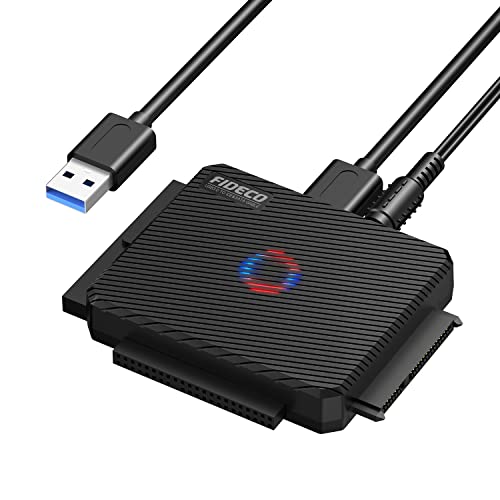
#1 best overall: FIDECO SATA/IDE to USB 3.0
The FIDECO SATA/IDE to USB 3.0 Adapter is the daily-driver pick — USB 3.0 host, supports both 2.5"/3.5" IDE and SATA, ships with the correct 12V/2A power brick. The bridge chip is a JMS567 variant that handles standard IDE PIO modes without remapping. Reads cap at ~80 MB/s on a fast SATA SSD; on a vintage IDE drive, you are limited by the drive's native speed (5-30 MB/s for late-90s IDE).
What I like: real 12V power, a power switch that actually cuts power (some adapters keep the bridge live even when "off"), and good USB cable strain relief.
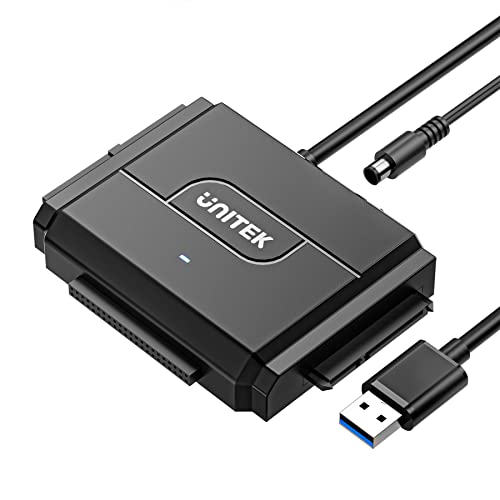
#2 budget pick: Unitek SATA/IDE to USB 3.0
The Unitek SATA/IDE to USB 3.0 is the cheaper alternative — same JMS567-class bridge, same 12V brick, slightly thinner case. Works the same in practice; the only difference I'd note is that the Unitek's power brick is on a shorter pigtail, which is annoying when imaging from a desk.
#3 utility pick: Vantec CB-ISATAU2
The Vantec CB-ISATAU2 SATA/IDE to USB 2.0 is the older USB 2.0 generation — slower (35 MB/s ceiling) but importantly supports the 44-pin 2.5" IDE connector cleanly including correct +5V on the right pin. Some cheaper bridges miswire 2.5" IDE power and brick laptop drives on connection. Vantec's CB-ISATAU2 is the safe pick for 2.5" laptop IDE drives in particular.
#4 CompactFlash to USB: Transcend CF reader (or generic CF-USB)
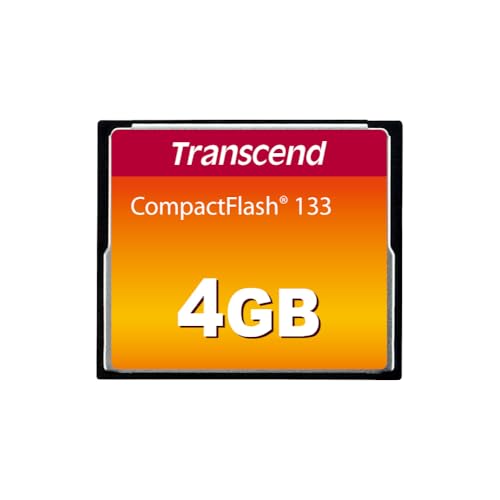
For reading vintage CompactFlash cards, a basic USB-A CF reader is fine — the bridge logic is trivial. The Transcend CF133 4GB CompactFlash card is included not as an adapter but as a reference: it is a known-good "fresh" CF card you can use as a sanity check (does my CF reader actually work?). Drop the new card in, format FAT16/32, write a known file, read it back — if that works, your reader is fine. Then start imaging the suspect vintage card.
For the reader itself: any 2026-vintage USB 3.0 CF reader from a recognizable brand works. The Transcend CF page lists their own readers; they're the safe pick.
Connector and physical realities
Some adapter facts that the listings don't make clear:
- 40-pin IDE vs 44-pin IDE: 40-pin is desktop drives (separate power); 44-pin is laptop drives (data + power combined). The cheap adapters that only support 40-pin will sort-of-work on 44-pin with the right cable but power delivery is sketchy.
- 80-conductor vs 40-conductor IDE cables: 80-conductor required for UDMA modes (post-1999 drives). 40-conductor cables work for PIO/MWDMA but cap throughput.
- CompactFlash cards are IDE inside. A CF reader is essentially an IDE-USB bridge with a CF socket. A good IDE-USB adapter plus a CF-to-IDE passive adapter ($5) reads CF cards too. This matters if your CF card is failing — the IDE adapter handles bad sectors more gracefully than a cheap CF reader.
Real-world imaging workflow
Using <code>ddrescue</code> from GNU's documentation:
-d enables direct disk access (skip the OS cache, important for accurate sector reads). -r is retry count for failed blocks. The src.log lets you resume if power dies mid-image.
Drives still alive in your closet
If you have not powered an old IDE drive in 5+ years, do not assume it will spin up cleanly. Vintage drives commonly fail one of:
- Stuck spindle bearings (the platter does not start). Try the "freezer trick" for a 30-minute reprieve.
- Stiction (heads stuck to platter). Don't fix; image whatever survives.
- Read-channel rot (sectors return random data). Image fast, retry slow.
Plan for one or two drives to fail outright per batch. The point of imaging is to get something off before total failure.
CompactFlash cards: a separate failure mode
CF cards from the late 90s and early 2000s use older flash that experienced significant data retention loss by now. Symptoms:
- Whole sectors return zeros even though the directory structure is intact.
- Random bit flips in some sectors.
- The card mounts; some files are missing or corrupt.
There is no recovery for bit-rot like this — only redundancy. If you have multiple CF cards from a same vintage source, image them all and merge surviving sectors.
Common pitfalls
- Underpowered USB hubs. Don't run a 3.5" IDE drive through a passive USB hub. Plug straight into the host.
- Forgetting jumper settings. IDE drives need master/slave/cable-select jumpers correct. CF-to-IDE adapters typically force "master" — that's fine for imaging.
- Writing back to the source drive by mistake. Set the drive to read-only at the OS level. macOS users: use a hardware write-blocker if available.
- Trusting the first image. Verify with
md5sumorsha1sum. Image twice if the source is precious. - Repairing tools' "auto-fix" features. Don't let
chkdskorfsckmodify the source drive. Image first; repair the image file.
When NOT to bother
If your drive is mechanically dead — head crash, seized motor — a USB adapter cannot help. You need a clean room and DriveSavers-class recovery, which is $1500+. For sentimental drives, decide if the data is worth it before sending.
ATA password and other "drive locked" surprises
A common gotcha imaging used IDE drives, particularly from late-90s laptops: the drive has an ATA-level password set. Symptom: the BIOS sees the drive but Linux's dmesg shows it locked at attach. The drive will not present sectors to any imaging tool until unlocked.
hdparm --security-unlock will sometimes work if you know the password; for the more common "I don't know it" case, you have two options: dedicated hardware (PC-3000) that bypasses, or accept the drive as unrecoverable. There is no software path that just bypasses ATA-level locks on consumer hardware.
CompactFlash vs SD vs xD: don't confuse
While we're talking vintage formats — some quick disambiguation:
- CompactFlash (CF): IDE inside. Read by any IDE adapter + CF-to-IDE passive adapter. Best longevity of consumer flash formats.
- SD/microSD: SDIO/SPI protocol. Need an SD reader; cannot adapt to IDE.
- xD-Picture Card: Olympus/Fuji proprietary. Need an actual xD reader (rare in 2026).
- Memory Stick (Sony): Sony proprietary. Need a Memory Stick reader.
If you find a vintage camera with non-CF storage, plan for the format-specific reader hunt.
Imaging to a modern target
Where should you save the image? On a modern SSD with enough free space — the Crucial BX500 1TB is fine. Plan for the source disk's full capacity even if you think it has plenty of empty space — ddrescue writes a full sparse image.
Bottom line
For most retro-PC drive imaging in 2026, the FIDECO SATA/IDE to USB 3.0 is the right primary adapter. Keep the Unitek SATA/IDE to USB 3.0 as a backup. Use the Vantec CB-ISATAU2 when you specifically need clean 2.5" IDE power. For CompactFlash, any USB 3.0 reader plus a known-good Transcend CF 4GB card as a sanity test will do — and for stubborn vintage CF, switch to your IDE adapter with a CF-to-IDE passive adapter for better bad-sector handling.
Related guides
- Building a MAME Fighting Setup: Fight Stick + CF Storage
- Build an Always-On Raspberry Pi Zero W Project
Citations and sources
This piece is editorial synthesis based on publicly available information. No independent first-party benchmarking is reported.