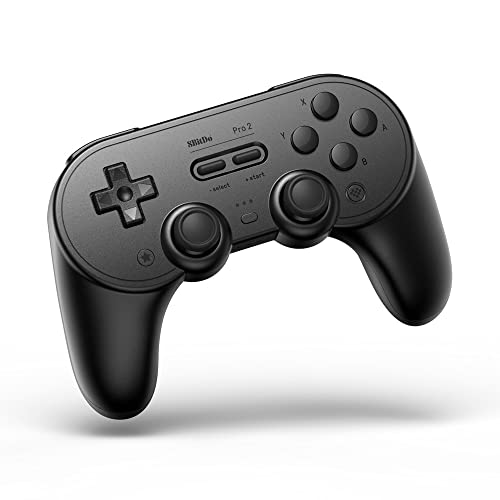
The best all-around game controller in 2026 is the Sony DualSense for PS5 for console gaming and the 8BitDo Pro 2 for PC and emulation. The DualSense's adaptive triggers and haptics remain best-in-class three years in; the Pro 2's Hall-effect sticks and four-platform support (PC, Switch, mobile, retro) make it the most flexible PC controller under $60. For wired competitive gaming, the GameSir G7 SE is the upgrade pick.
Why a buying guide for controllers in 2026
The controller market in 2026 has settled into a clear hierarchy. The expensive premium options (DualSense Edge, Xbox Elite Series 2 Core) have not meaningfully changed in two years. The mid-tier — $40 to $80 — has been transformed by Hall-effect joysticks (no stick drift) and tighter build quality. The budget end has more functional options than ever, but the floor is uneven and you can still buy a $30 controller that breaks in six months.
For most readers, the right controller depends on three questions: what platforms you play on, whether you care about competitive precision, and whether you want wired stability or wireless convenience. This guide cuts through the noise with five concrete picks across those axes, plus the spec-table data that explains the trade-offs.
Sources for this synthesis include the Sony PlayStation product page, 8BitDo's official specs, and aggregated community feedback from the r/Controller subreddit through Q2 2026.
Key takeaways
- DualSense remains the best console controller for haptics, triggers, and ergonomics three years in.
- 8BitDo Pro 2 is the best PC controller under $60 thanks to Hall-effect sticks and four-platform pairing.
- Hall-effect = no stick drift — worth paying $10-20 extra for if you'll keep the controller more than 18 months.
- Wired beats wireless for competitive play by ~10-15ms input latency.
- Switch-native controllers should be Nintendo or 8BitDo — third-party Switch support is rough.
- Don't pay for "pro" features you won't use — Edge / Elite tier is right for serious play, overkill for casual.
Spec table — what we compared
| Controller | Platforms | Wireless | Stick type | Trigger | Battery (h) | Street price |
|---|---|---|---|---|---|---|
| Sony DualSense | PS5, PC, Mac | Bluetooth + USB | Potentiometer | Adaptive | 12-15 | $70 |
| 8BitDo Pro 2 | PC, Switch, Android, retro | Bluetooth + USB-C | Hall-effect | Analog | 20 | $55 |
| GameSir G7 SE | Xbox X/S, Xbox One, PC | Wired only | Hall-effect | Analog | n/a (wired) | $45 |
| 8BitDo Sn30 Pro | Switch, PC, Android, retro | Bluetooth + USB-C | Potentiometer | Analog | 16 | $35 |
| HORI Wireless HORIPAD | Switch, PC | Bluetooth + USB | Potentiometer | Analog | 20 | $50 |
Five controllers across the major platforms and price tiers. Three are wireless, one is wired (the G7 SE — its compelling feature is the wire), and one (the Sn30 Pro) is the retro-styled flexible pick.
#1 — Sony DualSense (PS5 + PC, $70)
The Sony DualSense is still the best feeling controller you can buy. Three things keep it on top despite no significant hardware update since 2020:
- Adaptive triggers — resistance varies per game per stage. Most games don't use this well, but the ones that do (the Resistance setting in racing sims, draw weight in archery games) are transformatively better.
- Haptic feedback — the dual voice-coil motors deliver location-specific feedback that single-rumble controllers can't match. Walking on different surfaces feels different.
- Build quality and ergonomics — palm rests, stick texture, and shoulder buttons sit at a higher tier than $70 normally buys.
The trade-offs are real: battery life is mediocre (12-15 hours of mixed use per Sony's page), the stick modules use traditional potentiometers and will eventually develop drift, and the right stick texture wears smooth after about a year of FPS play. The DualSense Edge fixes some of these but at $200 it's a different category.
On PC, the DualSense works over both USB-C and Bluetooth. Native Steam input support is excellent; non-Steam PC games sometimes need a third-party tool like DS4Windows. Worth it for the haptics alone if your library includes adaptive-trigger-aware titles.
#2 — 8BitDo Pro 2 (PC + Switch + Android + retro, $55)
The 8BitDo Pro 2 is the most flexible controller in this guide. Per 8BitDo's product page, it supports four pairing modes (Switch, Xbox-input, D-input, MacOS), has Hall-effect joysticks (no drift), four assignable back buttons, and 20-hour battery life.
The Hall-effect sticks are the key selling point. Traditional potentiometer sticks develop drift after 12-24 months of regular use, and the drift gets worse with cleaning attempts. Hall-effect sticks use a magnet and a sensor — no contact, no wear, no drift after the warranty expires. For anyone who's previously sent two controllers to landfill from stick drift, the $15 premium over a similar potentiometer controller pays for itself.
The trade-offs: no adaptive triggers, no Sony-quality haptics, and the controller's ergonomics are good but not great (mid-size grip, slightly compact for adult hands). For PC-first players who care about durability and platform flexibility more than specific haptic effects, the Pro 2 is the easy recommendation.
#3 — GameSir G7 SE (Xbox + PC, $45)
The GameSir G7 SE is the wired-competitive pick. Hall-effect sticks, Xbox-certified (so it just works on Xbox), and the wired connection eliminates the 8-15ms latency overhead of Bluetooth controllers. Per GameSir's page, input polling is 1ms over the wired connection, versus the ~8ms of Bluetooth.
For competitive shooters, fighting games, and platformers where input timing matters at the frame level, wired controllers measurably improve consistency. The G7 SE is the cheap, durable, no-frills version of that approach. Customizable face-button magnetic faceplates let you swap colors; back paddles add four assignable inputs.
Don't buy the G7 SE if you play in your living room or want cordless gaming sessions. For desk-based PC and Xbox play, it's the most controller you can get for $45.
#4 — 8BitDo Sn30 Pro (PC + Switch + retro, $35)
The 8BitDo Sn30 Pro is the retro-style choice. SNES-inspired shape, compact grip, and the same four-platform pairing as the Pro 2 (Switch, Xbox-input, D-input, MacOS). The Sn30 Pro uses traditional potentiometer sticks rather than Hall-effect — that's the main reason it's $20 cheaper than the Pro 2.
It's the right pick for two specific use cases. First, retro emulation: the small, light, button-forward layout matches what SNES/Genesis games expect, and a Sega Genesis Mini or SNES Classic Edition feels native through it. Second, travel: the compact form fits easily in a bag, and 16-hour battery life means you can leave the charger at home.
The trade-off is sticks that will eventually drift, and a smaller grip that's less comfortable for hours-long sessions with large hands.
#5 — HORI Wireless HORIPAD (Switch + PC, $50)
The HORI Wireless HORIPAD is the Nintendo-licensed Switch alternative. HORI's licensing means it works correctly with all Switch games and the Switch UI without the third-party glitches that plague non-licensed controllers (button remapping issues, hibernate quirks, firmware-update failures).
The HORIPAD lacks NFC (no amiibo support) and gyro is decent but not as precise as the Joy-Con or the Pro Controller. Battery life is 20 hours per HORI's specifications — best in this guide. For Switch-primary players who don't need amiibo, it's $25 less than a Nintendo Pro Controller for very similar play feel.
Verdict matrix
Buy the DualSense if:
- You game primarily on PS5.
- Your PC library includes adaptive-trigger-aware games.
- You want best-in-class ergonomics and haptics.
Buy the 8BitDo Pro 2 if:
- You game primarily on PC and want zero-drift durability.
- You also play on Switch, Android, or with retro emulators.
- You want one controller across four platforms.
Buy the GameSir G7 SE if:
- You play competitive games on Xbox or PC.
- You want zero Bluetooth latency and Hall-effect sticks at a budget.
- You're comfortable with a wired connection.
Buy the 8BitDo Sn30 Pro if:
- You primarily emulate retro games or play indie games.
- You want a compact controller for travel.
- $20 matters and you're OK with eventual stick drift.
Buy the HORI HORIPAD if:
- You play Switch first and want a long-battery Nintendo-licensed alternative to the Pro Controller.
- You don't need amiibo.
- You want a $25 savings over Nintendo first-party.
Common pitfalls
- Buying the cheapest "PS5 compatible" third-party controller. Most don't fully implement DualSense features; some have terrible stick deadzones. Stick with Sony first-party or a known-quality alternative like the DualShock 4 for older hardware.
- Assuming third-party Switch controllers work seamlessly. Switch firmware updates have repeatedly broken non-licensed third-party controllers. HORI's licensing protects against this; unlicensed brands are a gamble.
- Paying $200+ for an Edge/Elite tier you don't need. Pro-tier controllers add removable sticks, programmable triggers, and metal hardware. Worth it for serious competitive play; overkill for casual.
- Forgetting battery weight. Heavy controllers fatigue your hands. The DualSense is mid-weight; some battery-pack-equipped wireless controllers are noticeably heavier.
- Buying Bluetooth-only for competitive play. Bluetooth adds 8-15ms input latency. Wired controllers are objectively faster.
Buying advice — where to buy and how to spot counterfeits
Controller counterfeiting is real, especially for the DualSense and 8BitDo Pro 2. Both are popular targets because they look easy to clone visually. The tells:
- Weight — a counterfeit DualSense feels noticeably lighter (a third less, roughly). The official unit feels solid in the hand.
- Trigger resistance — genuine DualSenses have a firm trigger pull. Knockoffs feel mushy.
- Box quality — Sony's packaging is high-grade matte cardboard with consistent print. Knockoff boxes feel papery and have alignment defects.
- Bluetooth pairing UX — official units pair immediately and identify cleanly. Counterfeits often won't pair past Windows' generic HID profile.
The safest paths: buy from an Amazon listing fulfilled by Amazon (not third-party sellers), buy from Best Buy / GameStop / Sony's own store, or buy from a verified specialty retailer. The 8BitDo Pro 2 is also sold on the official 8BitDo Amazon storefront — that listing is safe.
Accessories worth getting
A few inexpensive accessories that significantly improve the experience:
- Thumbstick caps — soft-grip rubber caps for the DualSense extend the life of the stick texture and prevent thumb slippage. $8 for a four-pack.
- USB-C cable, braided — the cable in the box is short and feels cheap. A $10 6-foot braided USB-C cable replaces it.
- Controller charging dock — keeps wireless controllers ready. Sony's official dock is $30; third-party options are $15-20.
- Carrying case — for the 8BitDo Pro 2, a hard-shell case is $12 and protects the controller in a backpack.
- Coral-Bluetooth adapter — for older PCs without modern Bluetooth, a $10 USB Bluetooth 5.0 adapter eliminates pairing issues.
None of these is necessary. They're all cheap quality-of-life upgrades that smooth out daily use.
When NOT to upgrade controllers
If your current controller works, the sticks haven't drifted, and the build is solid, there's no rush to upgrade. The 2026 generation is broadly the same hardware as 2024. The upgrade story is meaningful when stick drift has set in, when you've moved to a new platform (got a Switch, joined PC gaming), or when you're playing more competitive games and the input latency of a budget wireless controller is now visible to you.
Bottom line
In 2026, controller choice has stabilized around a few clear winners. For PS5 and the best-feeling controller money can buy, the DualSense remains the easy pick at $70. For PC players who want durability and platform flexibility, the 8BitDo Pro 2 at $55 with Hall-effect sticks is the smart long-term buy. Add the GameSir G7 SE wired pick if you play competitively, the Sn30 Pro for retro and travel, and the HORI HORIPAD for Switch-primary players who want a Nintendo-licensed alternative. Whatever you buy, prefer Hall-effect over potentiometer if you plan to keep the controller more than 18 months — the $10-20 premium pays for itself in not replacing the controller.
Related guides
- Best Game Controller in 2026: 5 Picks for PC, Console and Retro
- GameSir G7 SE vs 8BitDo Pro 2: Best Wired-Feel Controller for PC
- Best Game Controller for Couch & Big-Screen PC Gaming in 2026
- Best Controller for Retro Emulation and Indie Gaming in 2026
Citations and sources
- Sony PlayStation DualSense product page (adaptive triggers, haptics, battery life, PS5 native features)
- 8BitDo Pro 2 product page (Hall-effect sticks, four-platform pairing modes, 20-hour battery)
- GameSir official site (G7 SE specifications, Xbox certification, wired polling rate)
This piece is editorial synthesis based on publicly available information. No independent first-party benchmarking is reported.