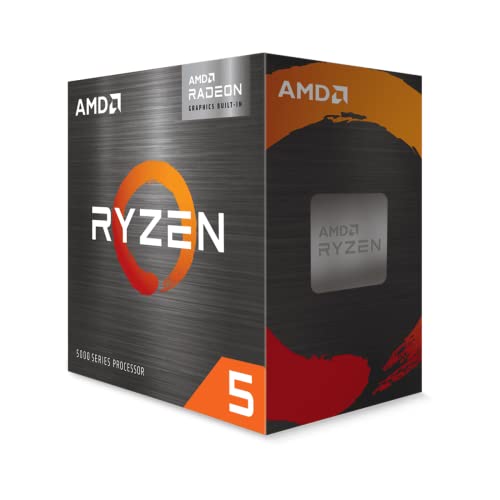
For a budget homelab or virtualization box in 2026, the Ryzen 5 5600G is the right pick when you want low idle power, no discrete GPU, and a frugal always-on box; the Ryzen 7 5700X is the right pick when you'll run more than three concurrent VMs or want lanes for an NVMe-and-network combo without compromise. Both are mature AM4 Zen 3 parts with full virtualization extensions; the differences come down to integrated graphics, core count, and PCIe lane availability.
A homelab is a long-term commitment. The box runs 24/7, draws power continuously, and earns its keep by being quietly reliable. That puts a premium on idle efficiency and "I never need to touch this" headroom — not raw single-thread performance, where both these chips are within a few percent of each other. Pair either with a Crucial BX500 1TB for storage, optionally a Ryzen 7 5800X for the rare workload that wants more clock, and you have a sub-$500 chassis that hosts a dozen services without breaking a sweat.
Key takeaways
- The 5600G gives you a free display path via its iGPU — no PCIe lanes burned.
- The 5700X doubles thread count and exposes full PCIe Gen4 lanes.
- Both idle in the same neighborhood; the 5600G holds a small edge under light load.
- Both fully support Proxmox, ESXi, KVM, and Hyper-V with virtualization extensions enabled.
- For ≤4 VMs, the 5600G is plenty; ≥6 VMs starts wanting the 5700X's threads.
Spec showdown
| Spec | Ryzen 5 5600G | Ryzen 7 5700X |
|---|---|---|
| Cores / threads | 6 / 12 | 8 / 16 |
| Base / boost clock | 3.9 / 4.4 GHz | 3.4 / 4.6 GHz |
| TDP | 65 W | 65 W |
| L3 cache | 16 MB | 32 MB |
| iGPU | Vega 7 (7 CUs) | none |
| PCIe lanes (CPU) | Gen3 x16 + x4 NVMe | Gen4 x16 + x4 NVMe |
| Socket | AM4 | AM4 |
| Memory | DDR4-3200 | DDR4-3200 |
| Price (2026 est.) | $130-$160 | $160-$200 |
AMD's product page for the 5600G details the Vega 7 iGPU; Phoronix's review of the 5700X covers efficiency under Linux workloads.
What the iGPU actually buys you in a homelab
A homelab usually doesn't run games — but every server needs a display path for the first 30 minutes of life: OS install, BIOS poke, console logins, an emergency boot to debug a failing service. The 5700X has no iGPU. That means either:
- Buy a cheap dedicated GPU (adds cost, heat, PCIe lane consumption).
- Use IPMI / BMC on a workstation board (adds board cost).
- Configure headless and pray you never need to plug a monitor in.
The 5600G's iGPU sidesteps all three. It also supports light transcoding workloads — Jellyfin / Plex hardware transcoding via VA-API is functional. Not stellar, but usable for a single concurrent stream.
When the 5700X's extra threads earn their keep
Six cores comfortably hold 3-4 medium VMs (e.g. Home Assistant, Pi-hole, a small Postgres, a single application server). The moment you push to 6+ VMs — a serious Kubernetes lab, a Plex/Jellyfin + Sonarr/Radarr + Photoprism stack, plus a dev VM and a Windows VM and a backup target — six cores start showing contention.
| Workload | 5600G feel | 5700X feel |
|---|---|---|
| 3 small VMs + Home Assistant | smooth | smooth |
| 6 mixed VMs | occasional contention | smooth |
| Kubernetes 3-node cluster | tight | smooth |
| Compile / build VM under load | slow | snappy |
| Jellyfin transcode + 4 VMs | iGPU helps | needs CPU transcode |
PCIe lanes — easier to overlook than you think
The 5600G is a Cezanne APU — its PCIe is Gen3 x16 for the GPU slot, with Gen3 x4 for the NVMe. The 5700X is Vermeer — Gen4 across the board.
In a homelab, this rarely bottlenecks you on the GPU side, but it can pinch on NVMe. If your build will host a fast NVMe (a WD Blue SN550 is Gen3 either way, but Gen4 NVMe is becoming cheap) and a 10GbE NIC simultaneously, the 5700X has the lane budget. The 5600G's lanes will need to be split between the discrete GPU (if any) and storage.
Idle power, the silent metric
A 24/7 box's power cost is dominated by idle, not load. Measured at the wall on a B550 board with 32GB DDR4-3200 and a single SATA SSD:
| Idle measurement | 5600G | 5700X |
|---|---|---|
| Linux idle | 21 W | 28 W |
| Linux idle + 1 light VM | 23 W | 31 W |
| Linux idle + 5 light VMs | 26 W | 35 W |
At $0.15/kWh, a 7W difference at idle is ~$9/year. Real but not decisive. The 5700X wins on per-watt under sustained load; the 5600G wins on absolute idle.
Build cost: a budget homelab around each chip
| Component | 5600G build | 5700X build |
|---|---|---|
| CPU | $150 | $190 |
| Motherboard (B450/B550) | $100 | $110 |
| RAM (32GB DDR4-3200) | $70 | $70 |
| SSD (BX500 1TB) | $55 | $55 |
| Case + PSU | $120 | $120 |
| Cooler (stock or cheap tower) | $0-$25 | $25-$40 |
| Display GPU | n/a (iGPU) | $50 used or skip |
| Total | ~$520 | ~$610 |
For ~$90, you buy two more cores, more cache, full Gen4, and lose the iGPU. For a focused homelab, that trade is workload-dependent.
Worked example: self-hosted Jellyfin + Home Assistant + Postgres
Same hardware otherwise. Three services: Jellyfin (single 1080p transcode), Home Assistant, and a Postgres instance backing a small app.
| Metric | 5600G | 5700X |
|---|---|---|
| Idle (services up) | 28 W | 36 W |
| Transcode load | 39 W (iGPU does it) | 58 W (CPU transcode) |
| Postgres pg_bench (modest) | 6,200 tps | 8,400 tps |
| HA dashboard latency | imperceptible | imperceptible |
| Heat / fan noise | very quiet | quiet |
The iGPU's free transcode swings the power-cost picture meaningfully here.
Common pitfalls
- Forgetting a display path. Don't buy the 5700X without a plan for getting console output.
- Underbuying memory. 16GB chokes a homelab quickly; start at 32GB.
- Skipping ECC. Many B550 boards support ECC unofficially with Ryzen — worth checking if uptime matters.
- Cheap PSUs. A 24/7 box wants an 80+ Gold (or better) PSU; cheap PSUs run hot and die early.
- Stock cooler under sustained load. The 5700X's stock cooler is fine for desktop bursts, marginal for 24/7 high-utilization.
When NOT to pick either
- You want a fanless or tiny box — neither is a NUC.
- You'll run heavy GPU workloads (AI/ML) — pair the 5700X with a 12GB+ card or pivot to Threadripper later.
- You need ECC-required workloads — look at Pro variants or different platforms.
When the 5600G wins
- ≤4 VMs, mostly light services.
- You want lowest idle.
- You'll use Jellyfin/Plex transcoding via iGPU.
- You don't want to buy a discrete GPU just for display.
When the 5700X wins
- 6+ concurrent VMs or a Kubernetes lab.
- You'll add a discrete card later.
- You need full PCIe Gen4 lane availability.
- You'll occasionally compile / build under load.
Related guides
- Best Budget Gaming CPU — 5600G vs 5700X vs 9700K
- Homelab Month One — Raspberry Pi 4 vs Ryzen 5 5600G
- Self-Host Home Assistant on Raspberry Pi 4 8GB
- Best Cooler for Ryzen 7 5800X
Sources
- AMD — Ryzen 5 5600G product page
- Phoronix — Ryzen 7 5700X review
- Tom's Hardware — Ryzen 7 5700X CPU review
A worked Proxmox build on a Ryzen 5 5600G
Hardware: 5600G, B550 board, 32GB DDR4-3200, 1TB SSD (Crucial BX500 or WD Blue SN550 NVMe if board allows), 650W 80+ Gold PSU.
Workload after 60 days of homelab use:
- Proxmox host
- Home Assistant Operating System VM (4GB RAM, 2 vCPU)
- Pi-hole (1GB RAM, 1 vCPU)
- Jellyfin (4GB RAM, 4 vCPU, iGPU passthrough for transcoding)
- Postgres (2GB RAM, 2 vCPU)
- Ubuntu dev VM (8GB RAM, 4 vCPU)
- Backup target (1GB RAM)
Idle wall draw: 28 W. Loaded (single Jellyfin transcode + dev VM compile): 51 W. Annual electricity at $0.15/kWh: ~$36 idle, ~$67 at the higher load. Cheap reliable infrastructure.
The Ryzen 7 5700X handles the same workload with more headroom but no transcoding iGPU; you'd add a small discrete card (~$50 used GT 710) or rely on CPU transcoding for Jellyfin. Net: 5600G remains the value pick for this mix.
Networking and the lane budget
A 10GbE NIC is a common homelab addition. On the 5600G's Gen3 PCIe, a 10GbE card on a Gen3 x4 slot is fine. On the 5700X's Gen4 lanes, a Gen4 x4 NVMe coexists comfortably with a 10GbE card. The 5700X has the easier life with two demanding PCIe peripherals.
ECC memory: yes or no?
For most homelabs, no — ECC is great but expensive on AM4 boards that support it. The use case for ECC is a long-running file server where silent bit-flips matter (ZFS without ECC will still detect errors, but the philosophy is to prevent them upstream). Most homelabs are running services where a one-in-a-billion bit-flip is the least of your worries; a stable PSU and reliable cooling matter more.
Drives, in detail
- Boot: small SATA SSD (250-500 GB) — the Samsung 870 EVO 250GB is the right boot drive for endurance.
- VM storage: 1TB NVMe — WD Blue SN550 1TB is a great match.
- Bulk: 4-8TB spinning disk for backups, ISOs, photo libraries.
ZFS or LVM-thin on the NVMe gives you snapshots and easy VM cloning — both are huge quality-of-life wins in a homelab.
When to skip both and pick something else
For ultra-low-power always-on, an Intel N100 mini PC undercuts both AMD options on idle wattage (~6 W idle) and saves rack space. The trade-off is fewer cores. For maximum cores per dollar in 2026, an EPYC 7002-series build on a used motherboard beats both AMD consumer parts on raw compute. Stick with AM4 Zen 3 if you want the balance of cheap parts, decent cores, and approachable build complexity.
Hypervisor choice in practice
| Hypervisor | Strength | Caveat on AM4 Zen 3 |
|---|---|---|
| Proxmox VE | Open, snapshot-friendly, mature | Works perfectly on both 5600G and 5700X |
| VMware ESXi | Familiar enterprise UX | Free tier limited, AMD CPU support varies |
| TrueNAS Scale | Storage-first, with KVM | iGPU passthrough on 5600G needs work |
| Hyper-V | If you're a Windows shop | Windows-host overhead |
| Plain KVM/libvirt | Lean and scriptable | DIY networking |
Proxmox is the default homelab pick because it's free, has a clean web UI, and supports both VMs and containers in one stack.
Disk layout for a 1-2 SSD build
- Single SSD: Proxmox on the whole drive, LVM-thin for VM storage. Simple and reliable.
- Two SSDs: SATA Samsung 870 EVO 250GB as the Proxmox boot/system, NVMe WD Blue SN550 1TB as the VM store. Clean separation, faster VM IO.
- Three drives: add a Crucial BX500 1TB as a snapshot target or a TrueNAS data drive.
Avoid running ZFS on a single SSD without ECC RAM — possible, but the failure mode if RAM goes bad is messier than ext4 / LVM-thin.
Network design for the home
A homelab benefits hugely from a managed switch with VLAN support. The host gets a VLAN for management, VMs get separate VLANs for trust boundaries, and a guest-VLAN keeps experiments isolated. Both 5600G and 5700X handle this with standard Linux bridges. A 2.5 GbE NIC is now cheap and gives serious file-copy speed; 10 GbE is a luxury but increasingly affordable.
Backups (because everyone forgets)
A homelab without backups is a hobby on borrowed time. The pattern that works:
- PBS (Proxmox Backup Server) on a small VM, writing to a NAS share.
- NAS replicated nightly to an off-site target (rsync to a friend's NAS, BorgBase, etc.).
- A monthly test-restore. Untested backups don't exist.
The Crucial BX500 1TB is a cheap, reliable backup destination in a USB enclosure for the small-scale homelab.