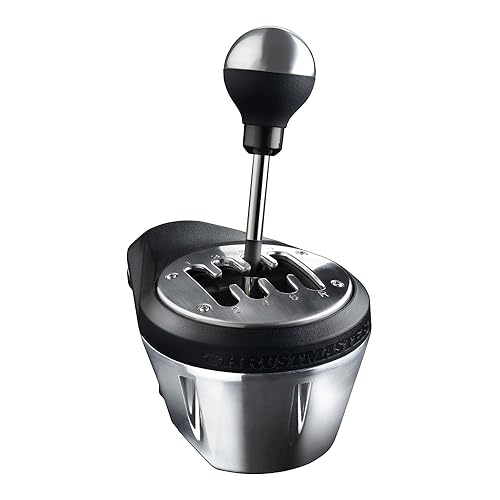
For a beginner getting into sim racing in 2026, the right starter setup is the Logitech G920 Driving Force for the wheel, the Thrustmaster TH8A for an H-pattern shifter once you outgrow the G920's six-speed stalk, and a sturdy desk clamp or a basic wheel stand. That combo costs roughly $400-$550, runs on PC and Xbox, and delivers force feedback strong enough to teach you how a car actually loses grip. The HORI Racing Wheel Overdrive sits below the G920 as a budget no-FFB starter; a DualSense controller covers the PS5 side or as a casual fallback.
The number-one mistake beginners make is buying too much wheel for their first month. A direct-drive wheel is glorious; it is also a $1,000+ commitment that mostly teaches you what your old desk can't survive. Start with a Logitech G920 (or its PlayStation sibling G29), learn the cars, then upgrade. Sim racing is one of the few hobbies where the cheap starter is also the right one.
Key takeaways
- Force feedback is the single most important feature; the G920 delivers it cheaply.
- An H-pattern shifter only matters for specific sims — add it once you know.
- A wobbly desk ruins strong feedback; a real wheel stand or a heavy desk is non-negotiable.
- PC vs console — match the wheel's certification before buying.
- A direct-drive wheel is the upgrade after a year, not the start.
What 'force feedback' is, in one paragraph
Force feedback (FFB) is the motors in a wheel pushing back against your hands as the simulation calculates tire load, suspension force, curb impacts, and lockup. It is the single most informative channel in sim racing — your eyes tell you where the car is, the wheel tells you what it is doing. A wheel without FFB still steers, but it can't teach you to drive — you'll over-rotate, miss apexes, and never feel the moment grip starts to slip.
The picks
Best starter — Logitech G920
The Logitech G920 has been the default starter sim wheel for the better part of a decade because it gets the fundamentals right: real FFB with two motors, 900° lock-to-lock rotation, paddle shifters, a clutch pedal, and a sturdy desk clamp. The mechanism is gear-driven — slightly notchier and louder than belt or direct-drive — but it transmits enough force to feel curb impacts and grip changes clearly. The G920 is the Xbox-and-PC variant; the G29 covers PlayStation. Both work identically on PC.
Pedals are a three-pedal set with a progressive brake. The brake is the noticeable weak point — most upgraders swap pedals first. For the first months, it is fine.
Step-up shifter — Thrustmaster TH8A
The Thrustmaster TH8A is the H-pattern shifter that the sim-racing community converged on years ago because it survives years of slamming. It has a magnetic position sensor (no wear), a real H-gate, an optional sequential mode, and a clamp / rig mount. It's overkill for most beginners — the G920's six-speed stalk works for the games most beginners play first. Get the TH8A once you find yourself reaching for an H-pattern in rally titles, classic cars, or trucks.
Budget no-FFB — HORI Racing Wheel Overdrive
The HORI Racing Wheel Overdrive is the get-into-the-hobby-cheap pick. No force feedback, no clutch pedal, but a real wheel and pedals at a price point well below the G920. It is officially Xbox-licensed and works on PC. The right use case: you want to try sim racing before committing, or the budget for FFB is months away.
The risk: many people who start without FFB drop the hobby because the cars never feel "right." If at all possible, save for the G920.
PS5 fallback — DualSense
If you're a PS5 player who isn't ready for a wheel, the DualSense has adaptive triggers that simulate brake-pedal weight, which is the closest a pad gets to wheel feel. Many games (Gran Turismo 7, F1) make excellent use of this. It is not a wheel; it is a smart placeholder until one fits the budget.
Spec comparison
| Device | FFB | Rotation | Pedals | Shifter | Platforms |
|---|---|---|---|---|---|
| G920 | gear-driven | 900° | 3 (progressive brake) | included paddles | Xbox / PC |
| TH8A | n/a | n/a | n/a | H + sequential | PC / Xbox / PS |
| HORI Overdrive | none | ~270° | 2 | included paddles | Xbox / PC |
| DualSense | adaptive triggers | n/a | n/a | n/a | PS5 / PC |
Mounting: the silent multiplier
A real wheel pushes back. If your desk flexes, the feedback that should arrive at your hands gets absorbed by the desk first. Two options that work:
- Sturdy desk + good clamp. A solid hardwood desk that doesn't move when you push hard. The G920's clamp is good; the threaded screw-in mounts even better if your desk allows.
- Dedicated wheel stand or rig. Steel-tube stand or a cockpit rig. The improvement in feedback fidelity is dramatic; the cost is a couple of hundred more dollars and floor space.
A flimsy desk with a strong wheel produces lousy feel and risks structural damage to the desk over time.
Real-world impressions on PC
Setup: G920 clamped to a 30 mm hardwood desk, TH8A on a side mount, Logitech G HUB at default profile.
| Sim | Feel on G920 | Notes |
|---|---|---|
| Assetto Corsa | excellent | mods unlock full FFB scaling |
| iRacing | excellent | tweak in-game FFB to driver-specific |
| F1 24 | very good | strong understeer cue |
| Gran Turismo 7 (PS5 needed) | n/a for G920 | use G29 |
| EA WRC | very good | rally needs the TH8A in H-mode |
| Forza Motorsport (recent) | good | calibration via in-game |
Common pitfalls
- Buying a direct-drive wheel as a first wheel. The leap is too big; you'll under-use it.
- Skipping the shifter "just because." If you don't play H-pattern sims, don't buy the TH8A. Most beginners don't need it yet.
- Cheap pedals on a great wheel. Pedal upgrades change your laps more than wheel upgrades after a point.
- No FFB. A non-FFB wheel teaches little; budget for one if at all possible.
- Calibration neglect. Each sim wants slightly different FFB scaling. Skipping calibration leaves money on the table.
When NOT to buy a wheel yet
- You play 1-2 races a month — the DualSense or an Xbox pad does fine.
- You don't have a stable desk or floor space.
- You're not sure sim racing will stick — the HORI Overdrive is a small commitment trial.
When the G920 + TH8A is the right call
- You'll race weekly for at least a year.
- You can mount the wheel solidly.
- You play sims with detailed manual-transmission modeling.
- You want a setup that lasts before any direct-drive upgrade.
Related guides
- Best Controller for Steam Deck PC — 8BitDo / GameSir / DualSense
- Best Controller for Fighting Games on PC
- Best Plug-and-Play Retro Gaming Consoles 2026
- Best Budget Gaming CPU — 5600G vs 5700X vs 9700K
Sources
- Logitech — Driving Force Racing Wheel
- Tom's Hardware — best racing wheels
- Thrustmaster — TH8A product page
What changes when you upgrade pedals
Most beginners outgrow the G920's included brake before the wheel. The brake is a rubber-cone progressive design — fine for casual driving, frustrating for trail-braking. A load-cell pedal upgrade ($200-$300 used) transforms threshold braking on iRacing, Assetto Corsa, and EA WRC. Most racers report bigger lap-time gains from pedals than from any wheel upgrade short of direct-drive.
H-pattern shifting, in detail
The Thrustmaster TH8A is the H-pattern most veterans converged on because it lasts. It uses a magnetic position sensor — no wear, no drift — and a real spring-loaded gate that feels mechanical. Sequential mode is a one-screw rotation away. Sims that reward the H-pattern include EA WRC, BeamNG.drive, American Truck Simulator, all the Assetto Corsa classic-car content, and most rally content. Sims that don't really need it: F1, modern GT racing, casual arcade.
A budget-conscious upgrade ladder
- Year 1: G920 + desk clamp + DIY mount stiffening. Total spend: ~$300.
- Year 2: add a load-cell brake pedal (used). Total: +$200.
- Year 3: TH8A for H-pattern sims. Total: +$200.
- Year 4: dedicated rig (DIY 80/20 or budget Next-Level). Total: +$200-$400.
- Year 5: direct-drive wheel base (used 5Nm-class). Total: +$500-$800.
At each step the gear lasts longer than at the previous step, which is the right way to spend in this hobby — slow, deliberate upgrades that survive the next four upgrades.
Don't ignore the chair
A wobbly office chair undoes every benefit of a strong wheel. Even a basic gaming chair clamped or staked to the floor is a meaningful upgrade. Direct-drive wheels demand a chair that won't slide backward when force is applied; a budget cockpit-style rig with a real seat is the better solution.
Real-world calibration tips
- In G HUB: set rotation to 540° for arcade, 720° for modern GT, 900° for classic / rally.
- In-sim FFB scaling: start at 80% strength, raise until the wheel clips on heavy curbs, back off 5%.
- Pedal calibration: set brake travel to 80% of full press — full-press is rarely useful and tires the calf.
- Force-feedback effects: enable canned effects (curb rumble, ABS pulse) only if your sim doesn't fake them natively.
When the DualSense is enough
For a PS5 player who races casually — a weekend of Gran Turismo 7, the odd F1 session — the DualSense controller with adaptive triggers is genuinely capable. The triggers simulate brake-pedal weight; the haptics communicate surface texture. It's not a wheel, but it's the best controller-based driving experience available, and a $70 commitment instead of $400.
A 30-day plan to learn to drive a sim
- Days 1-3. Set up the G920, mount it solidly, install Assetto Corsa and a free-to-try iRacing trial.
- Days 4-10. Drive one car on one track for 30-minute sessions. Don't switch. Look for the points where the FFB tells you you've reached the grip limit.
- Days 11-17. Introduce a second car (different drivetrain). The wheel teaches you what changes when weight transfers differently.
- Days 18-24. Introduce a third track. Use shorter sessions; focus on memorizing braking points by feel.
- Days 25-30. Try a multi-class race weekend. Pace under traffic is the test.
By the end of the month, you've learned more about car control than two years of pad-based driving teaches.
Sim-by-sim sweet spot
| Sim | Wheel needed? | Why |
|---|---|---|
| Gran Turismo 7 | rec | Adaptive triggers help, wheel is better |
| F1 24 | yes | Tire grip cues come through FFB |
| Assetto Corsa Competizione | yes | The whole point of the sim |
| iRacing | yes | Subscription cost only justified with a wheel |
| EA WRC | yes (with H-pattern preferred) | TH8A shines here |
| Forza Motorsport (recent) | optional | Pad is fine; wheel is enjoyable |
| BeamNG.drive | yes (H-pattern recommended) | Driveability ladder |
Stick with the starter for a year
A common pattern: a beginner buys the G920, drives for a month, hits a perceived wall, and assumes a more expensive wheel is the answer. It rarely is. The wall is almost always technique — and learning takes a year, not a month. Direct-drive wheels are real upgrades for racers who can lap consistently within a tenth of their best across many sessions. Below that level, the G920 is teaching you what you need to learn.
Maintenance habits
- Wipe the rim down monthly; leather absorbs oil.
- Tighten the desk clamp after every long session.
- Lubricate pedal pivots once a year.
- Update Logitech G HUB sparingly; new versions occasionally break older sim profiles.