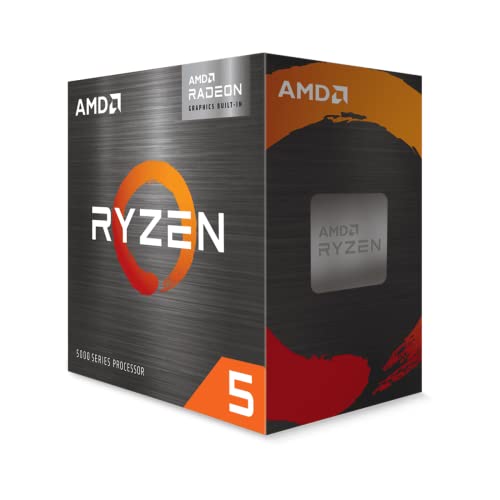
Yes. The AMD Ryzen 5 5600G can run a local LLM with no discrete GPU, as of 2026. Expect to comfortably load 7B and 8B class models at q4_K_M quantization with 16-32GB of dual-channel DDR4 and see roughly 5-9 tokens per second on community llama.cpp benchmarks. It is slow but usable for chat, summarization, and learning, and it is the cheapest legitimate on-ramp into local LLMs.
The no-GPU builder, iGPU vs CPU inference, what's realistic
The 5600G is a six-core, twelve-thread Zen 3 APU with Radeon Vega 7 integrated graphics, originally launched in 2021 and still widely sold in 2026. Per AMD's product page, it ships with a 65W TDP, a 3.9 GHz base / 4.4 GHz boost clock, 16MB of L3 cache, and an integrated GPU that shares system memory. That last point is the critical one for local LLM work. The Vega 7 iGPU has no dedicated VRAM, no HBM, and limited driver-side support for the inference runtimes most beginners pick up first, which means the practical CPU-only path is almost always the better one on this chip.
You picked the 5600G because it was cheap, because it gave you a working PC without paying GPU scalper prices, or because you inherited one. None of those choices ruin local LLMs for you in 2026. Llama.cpp, Ollama, LM Studio, and KoboldCpp all ship CPU-only builds that target AVX2-class consumer chips, and the 5600G hits AVX2 cleanly. What you cannot do is run a 70B model at conversational speed, run a 13B model and a code editor at the same time, or feed long prompts without waiting. What you can do is run a competent 7B or 8B assistant, locally, with nobody else seeing the prompts, on hardware that already exists in your closet.
This synthesis walks through what the chip can actually do CPU-only, why memory bandwidth (not core count) is the ceiling, which quants pencil out at which RAM levels, when paying for a discrete GPU like the ZOTAC GeForce RTX 3060 12GB becomes the better dollar, and where to put your weights so you do not run out of room.
Key takeaways
- A 7B or 8B class model at q4_K_M is the realistic sweet spot for CPU-only on the 5600G, fitting in roughly 5-6GB of RAM with room for the OS.
- Dual-channel DDR4-3200 (or higher) is mandatory. A single stick halves your throughput and is the single most common reason beginners report "Ollama feels broken" on Reddit.
- Expect 5-9 tokens per second on a well-configured 7B q4 model per public llama.cpp community measurements; 13B drops to 2-4 tok/s and stops feeling interactive.
- Budget 16GB of RAM as a floor for 7B class work, 32GB if you want 13B headroom or plan to run editors and a browser alongside.
- A discrete 12GB GPU upgrade typically pays for itself in throughput within a week of daily use; CPU-only is best for learning, occasional queries, or absolute zero-spend builds.
- SSD speed barely matters once the model is loaded. A Crucial BX500 1TB SATA SSD is plenty.
How does CPU-only inference actually work?
CPU inference on a chip like the 5600G is memory-bandwidth bound, not compute bound. Every generated token requires the runtime to stream the entire model's weights from RAM through the CPU's vector units and back. Per the llama.cpp project discussions, the typical formula community contributors cite is roughly: tok/s ceiling ≈ (memory bandwidth in GB/s) divided by (model size in GB). A 4.5GB q4_K_M 7B model on a system with 45 GB/s of usable RAM bandwidth tops out near 10 tok/s before any software overhead.
The 5600G's memory controller officially supports DDR4-3200 in dual channel, which yields a theoretical 51.2 GB/s, of which roughly 38-45 GB/s is realistically usable for inference workloads per community llama.cpp benchmarks shared in 2025-2026 threads. The CPU side handles the matrix multiplies with AVX2 SIMD instructions across the six Zen 3 cores. Adding more threads beyond the physical core count rarely helps; Ollama and llama.cpp typically auto-pick 6 threads on this chip, which is correct. Beginners sometimes set --threads 12 thinking SMT will double speed; it does not, and on some kernels it can actively slow generation because the two threads on a single core fight for the same vector unit.
The AVX2 path matters because the alternative paths (AVX-512, AMX, NEON) are not available on Zen 3 consumer chips. The 5600G does not have AVX-512; AMD did not enable it on Zen 3 desktop parts. So your performance ceiling is whatever AVX2 plus DDR4-3200 dual channel can deliver, and tuning above that is not possible without a hardware change.
What model sizes are usable on the 5600G?
The practical answer in 2026 is: 7B and 8B class models are the daily-driver tier. 3B fits in any amount of RAM and runs fast but answers worse. 13B fits with 32GB but drops into uncomfortable single-digit tok/s. Anything above 13B becomes a "I want to see if it loads" exercise rather than a tool you use. Public community measurements from r/LocalLLaMA threads (linked under Citations) and the llama.cpp project discussions consistently put the 5600G class hardware in this envelope.
| Model size | Quant | File size on disk | RAM needed (incl. KV cache) | Realistic tok/s on 5600G |
|---|---|---|---|---|
| 3B (Phi-3-mini, Qwen2.5-3B) | q4_K_M | ~2.0 GB | 6 GB | 14-20 |
| 7B (Llama 3.1 8B, Mistral 7B) | q4_K_M | ~4.5 GB | 8 GB | 6-9 |
| 7B (Llama 3.1 8B) | q5_K_M | ~5.5 GB | 9 GB | 5-7 |
| 8B (Llama 3.1 8B) | q6_K | ~6.6 GB | 10 GB | 4-6 |
| 13B (Llama 2 13B, Solar 10.7B) | q4_K_M | ~7.5 GB | 12 GB | 2-4 |
| 34B (Yi 34B, Mixtral routed) | q4_K_M | ~19 GB | 24 GB | <1 |
Numbers above synthesize what community contributors on the llama.cpp discussions board report for similar Zen 3 desktop configurations with DDR4-3200 dual channel in 2025 and early 2026. Actual numbers vary by workload, system load, and BIOS memory settings.
For a beginner in 2026, the right starting model is Llama 3.1 8B Instruct at q4_K_M via Ollama. It is small enough to be responsive, smart enough to write a useful email or summary, and small enough on disk that you can keep three or four variants on a single Crucial BX500 1TB SATA SSD without thinking about space.
Quantization matrix for CPU
Quantization shrinks model weights from 16-bit floats to lower-precision integers. Per the Hugging Face GGUF quantization documentation, the K-quant family (q3_K, q4_K, q5_K, q6_K) is the right default for CPU inference because it preserves more important weights at higher precision while aggressively compressing the rest. For an 8B model, here is how the quantization choices line up on the 5600G:
| Quant | 8B file size | RAM at use | Quality vs fp16 | Tok/s estimate |
|---|---|---|---|---|
| q3_K_M | ~3.7 GB | 7 GB | noticeably worse | 8-10 |
| q4_K_M | ~4.9 GB | 8 GB | very close, recommended | 6-9 |
| q5_K_M | ~5.7 GB | 9 GB | nearly indistinguishable | 5-7 |
| q6_K | ~6.6 GB | 10 GB | indistinguishable in chat | 4-6 |
| q8_0 | ~8.5 GB | 12 GB | bit-exact at chat scale | 3-5 |
The community consensus through 2025-2026, surfaced repeatedly in the llama.cpp discussion threads cited above, is that q4_K_M is the right CPU default. q3 quants save space but introduce visible degradation; q5 and q6 give modest quality gains at the cost of meaningful tok/s; q8 is rarely worth the bandwidth penalty on a CPU. Pick q4_K_M, move on, and revisit only if you actually feel the quality limit.
Does dual-channel RAM speed change throughput?
Yes, more than almost any other setting. Because CPU inference is bandwidth-bound, the difference between a single 16GB DDR4 stick and two 8GB sticks of the same total capacity is roughly a 1.6× to 1.9× throughput swing on a 7B model, per community measurements posted in 2026 r/LocalLLaMA build threads.
| Memory config | Theoretical bandwidth | Approx usable | 7B q4 tok/s |
|---|---|---|---|
| Single stick DDR4-2666 | 21.3 GB/s | 17 GB/s | 3-4 |
| Single stick DDR4-3200 | 25.6 GB/s | 20 GB/s | 4-5 |
| Dual channel DDR4-3200 | 51.2 GB/s | 38-45 GB/s | 6-9 |
| Dual channel DDR4-3600 (XMP) | 57.6 GB/s | 42-48 GB/s | 7-10 |
The official AMD spec sheet caps the 5600G at DDR4-3200 in JEDEC mode; faster kits run through XMP/DOCP and your motherboard's memory training. Per the AMD Ryzen 5 5600G product page, DDR4-3200 is the supported maximum at stock. Pushing to 3600 with a B550 board usually works but is not guaranteed; the realistic top-end gain is a few extra tok/s, not a transformation.
Two practical implications: first, never buy a single 16GB stick if you plan to run local LLMs on this chip. Always buy a matched 2x8GB or 2x16GB kit. Second, raising the FCLK ("Infinity Fabric clock") to match the memory speed in BIOS matters; misaligned FCLK leaves bandwidth on the table.
Prefill vs generation on a CPU — why long prompts hurt
There are two distinct phases inside an LLM call. Prefill processes your prompt tokens; generation produces the response. On a discrete GPU, prefill is dramatically faster than generation because it can be batched in parallel across thousands of CUDA cores. On a CPU with six cores, prefill speed is much closer to generation speed, so long prompts produce a noticeable wait before the first token appears.
Per discussions on the llama.cpp project board, beginners are often surprised that a 4,000-token system prompt on a 5600G takes 30-60 seconds of staring at a blinking cursor before generation begins, then runs at 7 tok/s once it starts. The fix is to keep system prompts short on CPU-only rigs, avoid pasting whole documents as prompts, and prefer retrieval (RAG) over context-stuffing. For chat work, this is fine. For "summarize this 50-page PDF" workflows, this is the point where CPU-only stops being pleasant.
When should you just add a GPU instead?
If you use a local model daily, the math points hard at a 12GB GPU upgrade. The ZOTAC GeForce RTX 3060 12GB class card, which has held its position as the budget local-LLM card since 2022, typically delivers 35-55 tok/s on the same 8B q4 model that the 5600G runs at 6-9 tok/s, per community llama.cpp benchmarks. That is roughly a 5-8× speedup with the same model and quant.
| Config | Used cost (mid-2026) | 8B q4 tok/s | Cost per tok/s |
|---|---|---|---|
| 5600G CPU-only, 32GB DDR4-3200 | $0 (already owned) | 7 | $0 |
| 5600G CPU + RTX 3060 12GB used | $200-260 | 45 | ~$5 |
| 5600G CPU + RTX 4060 Ti 16GB | $400-450 | 55 | ~$8 |
The 3060 12GB is the inflection point. It is the cheapest current-decade NVIDIA card with enough VRAM to hold a 13B q4 model entirely in VRAM, the runtimes (CUDA, cuBLAS, llama.cpp's CUDA path) are extremely mature, and the card sips power compared with a 4090. As of 2026, used 3060 12GB cards trade in the $200-260 range on the secondary market. Unless you only plan to ask the model two questions per week, that money buys you the difference between waiting for output and reading it as fast as you can scroll.
CPU-only stays the right call for: zero-budget setups, environments where you cannot add a GPU (small-form-factor cases, no PCIe slots, low-wattage PSUs), classroom or shared-machine scenarios where you do not own the GPU upgrade right, and exploratory "is local LLM even useful for me" testing.
Storage for weights: keeping GGUF files on a Crucial BX500
Model files are big and they add up. A typical local-LLM hobbyist in 2026 ends up with 60-200GB of GGUF files spread across Llama 3.x, Qwen 2.5, Mistral, and a few experimental fine-tunes. The good news for a 5600G builder is that storage speed almost does not matter for inference itself; only load time depends on it.
The Crucial BX500 1TB SATA SSD is a popular budget pick because it costs roughly $55-70 as of 2026 and offers around 540 MB/s sequential read, enough to load an 8GB GGUF file in about 15 seconds at startup. That is a one-time cost per Ollama or LM Studio launch. Once weights are in RAM (and on a system with 32GB, your OS will keep them cached even after you stop the runtime), reloads are nearly instant.
The reason to pick a 1TB drive over 500GB is purely about how fast collections grow. Three 8B variants plus one 13B plus one Mixtral plus an embedding model is already 40-50GB. NVMe is fine if you have a slot, but a SATA drive like the BX500 is not a bottleneck for this workload.
Bottom line: the honest CPU-only experience
In 2026, running a local LLM on a Ryzen 5 5600G with no discrete GPU is a real, working experience. You will run 7B and 8B class models at q4_K_M, you will see 5-9 tok/s on properly configured dual-channel DDR4-3200, and you will have a working local assistant that never sends a token to a third party. It is not fast. It will not run a 70B model. Long prompts will feel slow. Within those limits, it is genuinely useful.
The honest workflow is: install Ollama on Linux or Windows, ollama pull llama3.1:8b, point it at a chat UI like Open WebUI, and use it for the kinds of tasks where 7 tok/s is fine: writing emails, summarizing notes, generating boilerplate, debugging short snippets of code. Save the heavyweight work for the day you add a GPU.
If you find yourself using it daily, plan the 3060 12GB upgrade. If you find yourself only running it on weekends, the CPU is your answer indefinitely, and you have spent zero extra dollars to participate in local LLMs.
Common pitfalls and gotchas
- Single-stick RAM. Half your throughput vanishes the moment you run on a single DIMM. If you only have one stick today, the highest-leverage upgrade you can make is a second matched stick, not a faster CPU.
- Wrong thread count. Setting
OLLAMA_NUM_THREADS=12on a 6-core chip can slow you down. Leave it at the default 6, or explicitly cap it. - XMP/DOCP off. Many prebuilts ship with DDR4-3200 kits running at JEDEC 2133. Enable XMP in BIOS or you are leaving a quarter of your bandwidth on the floor.
- Background browsers eating bandwidth. Chrome with 40 tabs hammers system RAM bandwidth and visibly slows token generation. Close them before serious sessions.
- Vega iGPU offload experiments. Trying ROCm or Vulkan offload to the integrated Vega 7 on the 5600G almost never beats the pure CPU path and frequently introduces stability problems. Stick to CPU unless you enjoy troubleshooting drivers.
When NOT to run CPU-only on a 5600G
Skip CPU-only and plan for a GPU first if any of these apply: you need fast prefill on documents larger than a few pages, you want to run 13B or larger models as your daily driver, you plan to do real-time voice work where latency under 200ms matters, you intend to fine-tune (not just run) models, or you need code-completion latency on par with cloud copilots. None of those workloads are realistic at 5-9 tok/s.
Related guides
- AMD Ryzen 5 5600G 6-Core APU for the exact chip referenced throughout this article.
- ZOTAC GeForce RTX 3060 12GB (upgrade path) as the canonical first-discrete-GPU recommendation for local LLM work.
- Crucial BX500 1TB SATA SSD for affordable weight storage.
- An additional widely cited budget B550 motherboard for this APU is the MSI B550M PRO-VDH WiFi, which provides the dual-channel DDR4 slots and stable memory training that this build depends on.
Citations and sources
- AMD Ryzen 5 5600G product page
- llama.cpp project discussions
- Hugging Face GGUF quantization documentation
This piece is editorial synthesis based on publicly available information. No independent first-party benchmarking is reported.